Matthew 5:3 – Blessed are the Poor in Spirit

The Beatitudes of Christ (Matthew 5:1-12) are not a knee-jerk, random collection of pithy phrases from Jesus on what constitutes approval from God.  They intentionally build upon each other.  If the Sermon is the cornerstone of Christ’s teaching, and the Beatitudes are the cornerstone of the Sermon, then poverty of spirit is the cornerstone of the Beatitudes.  This Beatitude is foundational to the Christian life. So, what does it mean to be “poor in spirit”? 

“Poor” comes from the word “beggar.” And why does any beggar beg? Because they are in need. Beggars are desperate and destitute, knowing they need help just to survive another day. A beggar begs because he cannot rely on reciprocity; he has absolutely nothing to give in return.

Jesus was saying to the crowd following him, that true followers have a realization of their spiritual bankruptcy and have no shame in begging God to act on their behalf. The truth is that we are all spiritually destitute before God and stand in stark need of divine resources to help us. 

In reality, we have nothing of worth to give or offer to God. And we can gain nothing apart from God. Therefore, we must realize who we are and take the position of humility, not pride, and look to God.

To understand our poverty of spirit is to see that we are stripped of all self-righteousness, and absolutely need God. Knowing and understanding our spiritual bankruptcy is to see sin for what it really is. So, how do you know when you are poor in spirit?

  • The spiritual beggar makes no deals with God because they have nothing to bargain with. There is no ground from which to leverage anything.
  • The spiritual beggar doesn’t complain because they realize they don’t deserve anything. Instead, there is praise to God for such incredible grace in providing their needs.
  • Spiritual beggars are always begging, that is, praying all the time. Beggars don’t pray because it is an effective strategy to further their agenda. They pray because, if they don’t, they won’t make it!
  • Spiritual beggars take Christ on his terms, not theirs. The beggar will do anything Jesus says because he knows his situation is desperate. He has an inner attitude of total dependence upon God. Without humility before God, the spiritual beggar discerns he is hopeless. There is no room for the pride that tries to posture and position to get what I want, because the spiritual beggar knows he has none of this.
  • Spiritual beggars realize the more you learn, the more you don’t know – that you are dependent on a holy God and Holy Scripture, and not your own ideas, thoughts, convictions, and opinions. So, you willingly take the posture of listening instead of always talking.
  • The spiritual beggar knows no enemies. The late Henri Nouwen said, “Poverty is the inner disposition that allows us to take away our defenses and convert our enemies into friends. We can only perceive the stranger as an enemy as long as we have something to defend.” Those who are poor in spirit are not anxiously clinging to their stuff, their money, or their good name. They have nothing of their own; it all belongs to God for divine purposes.

Only the poor in spirit will enter the kingdom of heaven. The way is narrow and only a few are willing to truly humble themselves before God and take the posture of a beggar. If we think we are above this, then we have gone the broad way of destruction that many will find.

Humility knows that God is God, and I am not. Therefore, we orient our lives around this reality. Just as we need to respect the law of gravity and submit to its presence and reality, so it is most necessary and important to accept God’s rule and reign in this world and submit to its constant force. This is simply the way of wisdom.

We do not presume to come to you, O merciful Lord, trusting in our own righteousness, but in your abundant and great mercies. We are not worthy so much as to gather up the crumbs under your table; but you are the same Lord whose character is always to have mercy. Grant us, therefore, gracious Lord, to be intimately close to your dear Son Jesus Christ, and to identify with him in his death so that our sinful bodies may be made clean by his body, and our souls washed through his most precious blood. May we forever dwell in Christ, and he in us.  Amen.

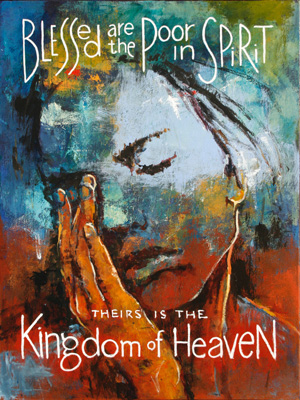
*Above painting by Hyatt Moore

Luke 6:43-45 – Your Words Reflect Your Heart

A good tree cannot produce bad fruit, and a bad tree cannot produce good fruit. You can tell what a tree is like by the fruit it produces. You cannot pick figs or grapes from thornbushes. Good people do good things because of the good in their hearts. Bad people do bad things because of the evil in their hearts. Your words show what is in your heart. (Contemporary English Version)

I always find public confessions on TV to be something rather disingenuous. Typically, celebrity apologies only take shape when one has been caught saying something and are called on the carpet. Then, when the apology comes, it is predictably odd and incongruent, in which the person says something to the tune of, “I’m sorry if I hurt anybody by what I said. Saying that really wasn’t me. I’m not really like that.”

Well, apparently you are like that because it came out of your mouth. Jesus said that out of the overflow of the heart the mouth speaks. The words we say out loud betray what is truly inside us.

To illustrate that point, Jesus used the metaphor of a tree. If the roots, the trunk, and the branches are good and healthy, then you can be sure the tree will produce good healthy fruit. However, if the tree is diseased, or infested with insects and rotting from the inside out, then no one can expect anything other than bad fruit, not fit to consume.

If the fruit is bad, the tree is bad. If the words are hateful, sarcastic, passive-aggressive, manipulative, conniving, racist, hurtful, ignorant, mean, unjust, foolish, and either subtly or overtly abusive, then the person has a dark heart and is need of redemption, not excuses.

Conversely, if the words are affirming, encouraging, loving, compassionate, gentle, caring, direct, helpful, peaceful, kind, giving hope and life, then there is a good heart behind it.

Yes, bad hearts can parrot good words. However, those words are not genuine but mere rote recitations to achieve some sort of personal agenda. And, of course, good people will occasionally say dumb or hurtful words. In such times, let it be a reminder that we all have some shadowy places within our hearts – and that we must depend on God’s grace to enlighten those dark spaces.

It is best to observe patterns rather than focus on isolated events where either good or bad words were said. A consistent pattern of invalidating another’s experiences or feelings; intimidating or threatening others; dismissing or discounting someone’s input; or being unnecessarily blunt are all major red flags pointing to a severe heart issue.

Evil does exist in the world. And if we are not vigilant to it’s insidious role in the crafting of words, wickedness can easily smack us upside the head when we aren’t looking.

The heart cannot be concealed forever. Eventually, the virtuous person will be shown as such by their stream of speech which pours forth from the heart, as if it were living water for others to drink and enjoy. Their words reflect their good character.

The wicked person, however, cannot keep the bad words down. Those vile words sit in the soul, poisoning and making the person ill. Then, all of a sudden, the evil words come up and out with a great vomitous heave and spew impurity and unholiness all over the innocent. Their words betray their foolish and poor character.

Every tree that does not bear good fruit will be cut down and thrown into the fire. The wicked heart will not be able to speak ill of others with impunity forever. They will be called to account for their abusive words, whether overtly violent, or subtly undermining.

The righteous heart, however, shall experience divine pleasure and reward, as if the careful construction of helpful and building up words win first-prize at the great heavenly fair.

The good person loves and does not hate. They are so far from harming anyone that they even pray and wish well for their enemies. They pray for blessings on those who curse them. There is an honest striving to speak good words to everyone, regardless of who they are.

The upright heart thinks the best of everyone and holds nothing over someone else’s head. Such a good heart condemns no one, leaving all judgment to God alone. It is patient with the most exasperating of people, praying they might come to their senses and become spiritually healthy.

The righteous are able to use their speech to admonish their neighbor with care and affection. They freely forgive, happily give, liberally encourage, and use their tongue to speak words of life. Indeed, their speech is wise, humble, full of grace, and above all, loving.

If there is a problem with words, it will not do to simply change the speech. That’s because it is a heart issue. And the heart must be willing to change and be transformed by sheer mercy. Fortunately, God is the expert on renovating dilapidated hearts and performing effective heart transplants.

Jesus is the gracious carpenter. God is the divine surgeon. The Holy Spirit is the energetic power source. They are ready for the work. Will you let them in?

Almighty God, to you all hearts are open, all desires known, and from you no secrets are hid: Cleanse the thoughts of our hearts by the inspiration of your Holy Spirit so that we may perfectly love you, and worthily magnify your holy Name; through Christ our Lord. Amen.

The Beatitudes of Jesus: An Introduction

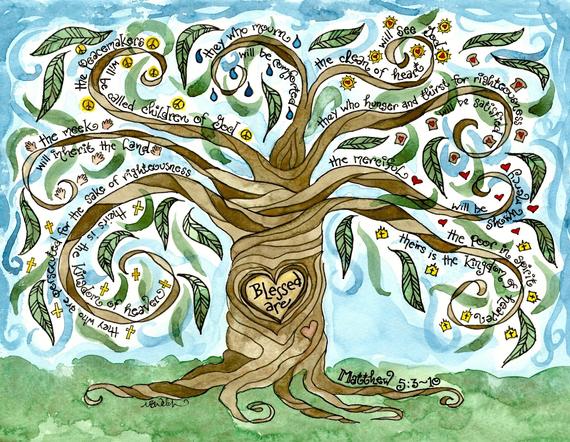
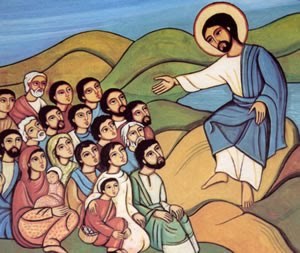
Now when Jesus saw the crowds, he went up on a mountainside and sat down. His disciples came to him, and he began to teach them. He said:

“Blessed are the poor in spirit,
    for theirs is the kingdom of heaven.
Blessed are those who mourn,
    for they will be comforted.
Blessed are the meek,
    for they will inherit the earth.
Blessed are those who hunger and thirst for righteousness,
    for they will be filled.
Blessed are the merciful,
    for they will be shown mercy.
Blessed are the pure in heart,
    for they will see God.
Blessed are the peacemakers,
    for they will be called children of God.
Blessed are those who are persecuted because of righteousness,
    for theirs is the kingdom of heaven.

“Blessed are you when people insult you, persecute you and falsely say all kinds of evil against you because of me. Rejoice and be glad, because great is your reward in heaven, for in the same way they persecuted the prophets who were before you. (Matthew 5:1-12, NIV)

The human brain is hard-wired, in such a way, that it works its best when healthy rhythms of giving and receiving occur. God created us to thrive and flourish when we pay attention to particular ways of being with one another as people.

Jesus used the term “blessed” not in a financial sense, as if having lots of money is what it means to experience blessing. The word “blessed” means to have God’s stamp of approval, his favor, with the emotional and spiritual response of joy or happiness. 

Real and lasting joy comes from a right relationship with God, defined according to what Jesus says – different from the false righteousness of the religious establishment which is based on outward appearance rather than inner attitudes. We need to know how to relate to our God, instead of simply conforming to an outward form of Christianity that everybody is doing.

Our entire selves are blessed when we engage in consistent rhythms of practicing humility before the Lord; sitting with grief; putting ourselves in another’s shoes; seeking right relationships with both God and others; pursuing mercy, purity, and peace-making in all our affairs; and allowing persecution to form us in ways the good times cannot.

Jesus preached the Beatitudes to clarify what it means to be approved by God. He wanted to gain true disciples who follow God for the right reasons. The crowd was following Jesus physically, but not necessarily spiritually. They all followed for different reasons: for healing, curiosity, or a genuine desire to be a disciple. So, Jesus sat them down to communicate what a true follower and disciple is.

Imagine we are part of the crowd originally hearing Christ’s Sermon on the Mount (Matthew 5-7).  The world in which the people lived, and the religious system which they took for granted, was highly restrictive. 

In order to approach God, enter the kingdom, and be a good citizen, one had to be Jewish, male, a faithful Law-keeper, physically whole, healthy, and able; and, if not wealthy, able to make a good living. 

Yes, this reality meant that Gentiles, women, those who struggled to keep the Law, the diseased and disabled, and the poor had no shot whatsoever in the kingdom of God. To be blessed and have God’s stamp of approval on your life meant you were a healthy and wealthy Jewish man who practiced a legalistic form of righteousness. 

Not a single one of us here would have any shot at the kingdom of God. Yet, we have heard something about this guy, Jesus. There seems to be something very compelling about him. We go seek him out, sit down on a mountainside and hear him say the most refreshing and scandalous words we have ever heard…

God approves of the spiritually bankrupt who realize they’ve got no leverage to make any deals. They shall be given the riches of God’s grace.

God approves of those who grieve over personal sin and lament the presence of sin in the world. They are the ones who will experience God’s forgiveness and comfort.

God approves of the powerless and those who use their authority to champion others. They will inherit God’s power and take up authority to command dark forces and put them in their place.

God approves of those who have a voracious appetite for right relationships and doing everything for the right reasons. Their growling spiritual stomachs will be stuffed with God’s righteousness.

God approves of those who liberally extend grace to others, being always considerate of everyone’s needs, showing neither prejudice nor favoritism. They shall receive God’s grace at the end of the age when Christ comes to judge the living and the dead.

God approves of the spiritually clean who have bathed in the waters of divine mercy. They will see Jesus face to face.

God approves of those who facilitate and negotiate peace. Because that is precisely what God’s children do.

God approves of those who are persecuted for living by these counter-cultural Beatitudes. They have an inheritance that will never perish, spoil, or fade.

Grant us, Lord God, a vision of our world as your love would make it: a world where the weak are protected, and none go hungry or poor; a world where the benefits of abundant life are shared, and everyone can enjoy them; a world where different races and cultures live in tolerance and mutual respect; a world where peace is built with justice, and justice is guided by love. And give us the inspiration and courage to build it, through Jesus Christ our Lord. Amen.

Psalm 92:1-4, 12-15 – Just Like a Cedar of Lebanon

It is good to give thanks to the Lord,
    to sing praises to your name, O Most High;
to declare your steadfast love in the morning,
    and your faithfulness by night,
to the music of the lute and the harp,
    to the melody of the lyre.
For you, O Lord, have made me glad by your work;
    at the works of your hands I sing for joy….

The righteous flourish like the palm tree,
    and grow like a cedar in Lebanon.
They are planted in the house of the Lord;
    they flourish in the courts of our God.
In old age they still produce fruit;
    they are always green and full of sap,
showing that the Lord is upright;
    he is my rock, and there is no unrighteousness in him.
(New Revised Standard Version)

The Lebanon Cedar tree is the national symbol of the nation of Lebanon, displayed on their national flag. Throughout history, this massive tree has served as a positive image of strength, stability, and uprightness.

Although the tree grows to about eighty feet, what is most impressive about the Lebanon Cedar is it’s large canopy, with branches stretching out to fifty feet. Thus, we have an apt metaphor for the spiritual life.

Whenever we engage in consistent rhythms of giving thanks for God’s steadfast love in the morning and expressing gratitude for the Lord’s great faithfulness at night, we not only grow up in our faith – stretching vertically toward God – we also grow horizontally, reaching out and being a canopy of righteousness for those who need safety, security, and sameness.

Human flourishing occurs deliberately, not by happenstance. It takes intentional work in attending to the development of the soul, the needs of the body, educating the mind, and feeling deeply about things so that the whole person thrives and enjoys life.

Yes, the body grows old and we all must die. Yet, although we might physically waste away, our inner selves can continue growing strong and spreading a wide canopy of righteousness that branches out with grace.

Unfortunately, the great forests of cedars in Lebanon have dwindled over the centuries to 13% of what they once were, due to over-harvesting its wood for shipbuilding, furniture making, and other uses. Even old King Solomon used Lebanon Cedars as the timber for the original Temple to God. Today, the oldest trees still surviving are 3,000 years old – which makes them truly biblical trees.

Indeed, in old age they are still producing cones and sap. The cedars are a testament to strength, resilience, and staying power. And that is exactly what the Lord wants to produce in us – a massive testimony of faith and patience, rooted in the soil of God’s grace, slowly but surely growing for the benefit of others.

This growth is a direct result of God’s activity. The Lord nourishes and sustains humanity, providing the right conditions of righteous soil, living water from heaven, and the warm sun of grace and mercy. We are then able to stretch both tall and wide, becoming an earthly manifestation of God’s goodness.

The Lord doesn’t keep us down but extends abundant grace so that we can extend to others that which has been extended to us. And if we keep maintaining this divine/human rhythm of grace, there is an ongoing and seemingly endless process of growth, even across three millennia.

The Lebanon Cedar is one of the most hardy trees on the planet. It’s thick trunk, expansive branches, resistance to worms and insects, and fragrance make it an apt emblem for the spiritual life. The righteous person is like this majestic unwavering tree, standing as a testimony to longevity, strength, beauty, and usefulness in the world.

I pray that out of his glorious riches he may strengthen you with power through his Spirit in your inner being, so that Christ may dwell in your hearts through faith. And I pray that you, being rooted and established in love, may have power, together with all the Lord’s holy people, to grasp how wide and long and high and deep is the love of Christ, and to know this love that surpasses knowledge—that you may be filled to the measure of all the fullness of God.

Now to him who is able to do immeasurably more than all we ask or imagine, according to his power that is at work within us, to him be glory in the church and in Christ Jesus throughout all generations, for ever and ever! Amen. (Ephesians 3:16-21, NIV)