Filled with Divine Fullness (Colossians 2:6-15)

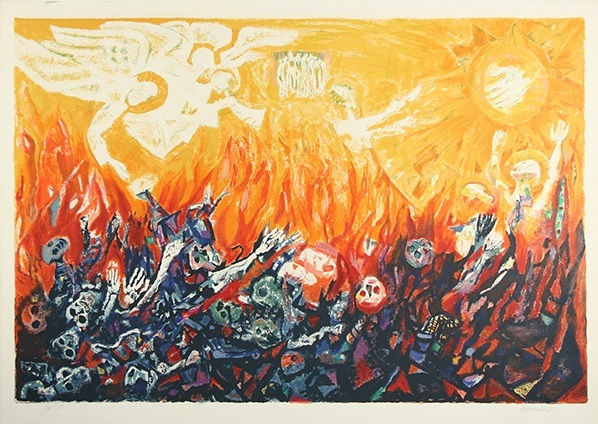
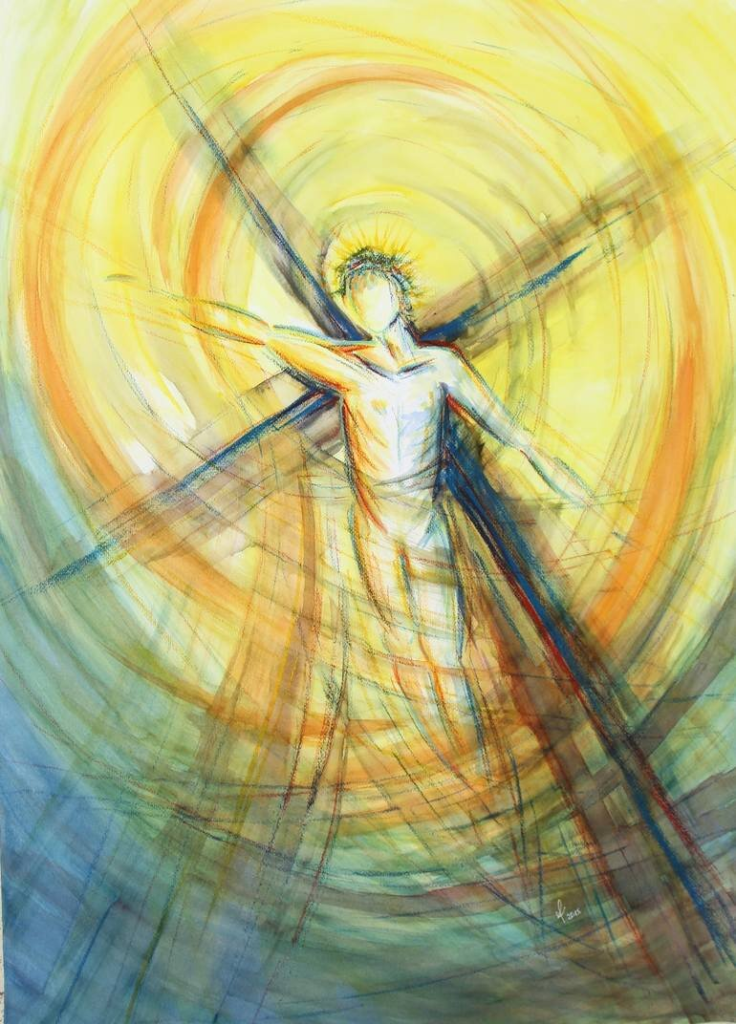
Resurrection, by Oliver Pfaff

As you therefore have received Christ Jesus the Lord, continue to walk in him, rooted and built up in him and established in the faith, just as you were taught, abounding in thanksgiving.

Watch out that no one takes you captive through philosophy and empty deceit, according to human tradition, according to the elemental principles of the world, and not according to Christ. 

For in him the whole fullness of deity dwells bodily, and you have come to fullness in him, who is the head of every ruler and authority. In him also you were circumcised with a spiritual circumcision, by the removal of the body of the flesh in the circumcision of Christ; when you were buried with him in baptism, you were also raised with him through faith in the power of God, who raised him from the dead. 

And when you were dead in trespasses and the uncircumcision of your flesh, God made you alive together with him, when he forgave us all our trespasses, erasing the record that stood against us with its legal demands. He set this aside, nailing it to the cross. He disarmed the rulers and authorities and made a public example of them, triumphing over them in it. (New Revised Standard Version)

On the television gameshow “Let’s Make a Deal,” selected members of the studio audience are offered something of value, and then given a choice of whether to keep it or exchange it for a different item.

The game’s drama is that the other item is hidden from the person until that choice is made. The participant does not know if the alternative item is of equal or greater value; or an item purposely chosen to be of little or no value.

The “deal” with Christianity is that Christians already have something of significant value. But they often lose it by going after something they aren’t even sure they actually want, or not.

Followers of Jesus have been given a valuable gift. And the Apostle Paul’s exhortation to the Church at Colossae was to go ahead and keep going with the prize you already possess.

Believers in Jesus have received him. Therefore, the believer is not to trade the words and ways of Jesus, and the redemption secured in Christ, for something else.

Having been redeemed by the Cross of Christ, believers are deeply rooted in Jesus. They are on a firm foundation of faith. Christians possess a faith full of hope and love.

So then, believers are encouraged by the Apostle Paul to take everything they have been taught, and everything they have received, and run with it.

It doesn’t matter what is behind another door, or what is on the other side of the curtain; grab ahold of what you possess in Jesus Christ. Stop considering a better way to live, and start living the life that’s been given to you.

Allow gratitude and thanksgiving to arise within you, and to come forth out of you. Quit looking how much greener the grass is on the other side of the fence. That pasture isn’t really greener; and there is not really a better way.

Many people have become disillusioned with institutional religion. They’ve had it with church. So, some of them end up throwing out the baby with the bath water, entertaining all sorts of ideas and approaches other than the grace-filled Christianity they once received.

Unfortunately, there are plenty of spiritual charlatans who seek to bedazzle people with fine sounding words. But it’s all nothing but a bunch of pseudo-intellectual philosophical babble.

Yet, because the messenger appears confident and makes grand pronouncements, they let themselves be captured, and go with it. And there are others who become enamored with endless theological talk, that has neither any real effect on one’s daily life, nor eternal life.

The Apostle was warning the Colossian believers about getting lost in the myriad traditions and superstitions that have an absence of Christ in the middle of them.

The way of Jesus has Christ directly and purposefully at the core of one’s life. Anything less is to make a deal and see what is behind another door.

The way of Jesus has very little to do with a particular theological tradition about the end times, or a certain literal interpretive stance, or a liturgical or non-liturgical approach to the Christian life.

Everything of God is right, just, and good. And according to Christianity, it comes through the person and work of Jesus, through Christ’s words and ways as expressed in the New Testament Gospels.

It seems to me that the Apostle Paul would be aghast today at how many supposed Christian believers worship him and his epistles! Instead of giving their full adoration to Christ.

The last word doesn’t come from Paul, but from Jesus. Keep in mind that Paul worshiped Christ, and did not point people to himself as the be-all-end-all of any philosophical approach.
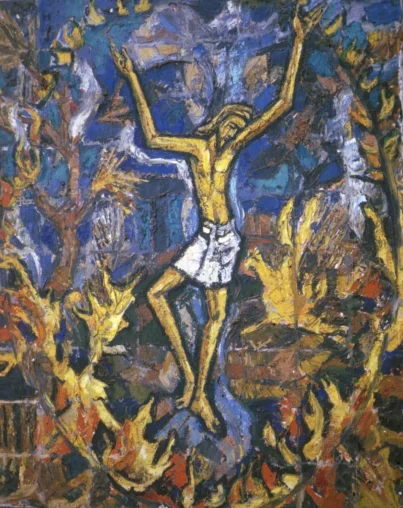
Jesus the Dancer, by Jyoti Sahi

Everything the Christian needs is within the fullness of Jesus Christ.

All things are empty without Christ, including the vast universe. The power and authority of Christ extends over all things and all people everywhere. Paul was insistent on this in all of the churches he established.

Thus, Christians must enter into the fullness of their Lord Jesus.

You can spend a lifetime, even an eternity after death, trying to figure out how God works, but you will never get to the end of it. God’s arm has that long of a reach. The fullness of Jesus is that big and filling. The strength of the Spirit is that powerful.

The heart and center of Christianity has nothing to do with circumcision, modes of baptism, keeping long lists of laws, or maintaining multiple spiritual practices. Because the Christian is already in, and already united with Christ.

This is why Paul prayed for believers to explore and realize what they already have in Christ, so that, with the eyes of their heart enlightened, they may perceive what is the hope to which God has called them, the riches of God’s glorious inheritance among the saints, and the immeasurable greatness of divine power for those who believe. (Ephesians 1:18-19)

The Christian has been spiritually raised from the dead, just as Christ was physically raised from death to life. And believers will also be physically raised, as Jesus was, if they have the spiritual eyes to see it.

Think of all those times in the past when you were stuck, and living a dead-end existence. Remember how God made you alive in Christ. All of your guilt and shame forgiven. All the stuff that kept you down and out, all that kept you from God, was nailed to the Cross of Christ.

The malevolent forces of this world have been stripped of their power, and can be seen as the sham they actually are.

It will not be nearly as valuable nor practical – not even close.

Being grounded in the person and work of Christ is where it’s at, my friend.

Watch out that nobody comes along and tries to sway you from Jesus. Don’t make any deals. You and I have Jesus. He is all we need.

Lord Jesus, you are worthy of our adoration, affection, and allegiance. Because of you, we don’t have to guess what God is like; there is no need to create our own image of God. Everything we need to know about God is revealed in and through you. Along with the Father and the Spirit, you have always existed in perfect relationship and unimaginable wonder.

Blessed Holy Trinity, the God whom I serve, may your divine dance of Father, Son, and Spirit pulsate within me, and flow out of me in a trust that you are enough. Then I will know that I, too, am enough as I avoid the false philosophies and promises of this world.

Almighty God, you fill the center of my being, so that I can let You be You, and so, be content and at peace, despite the alternative voices that chatter constantly around me. May your will be done, today and every day, to the glory of Jesus Christ my Lord. Amen.

All Saints Day (John 11:32-44)

The Forerunners of Christ with Saints and Martyrs, by Fra Angelico, 15th century

When Mary came where Jesus was and saw him, she knelt at his feet and said to him, “Lord, if you had been here, my brother would not have died.” When Jesus saw her weeping and the Jews who came with her also weeping, he was greatly disturbed in spirit and deeply moved. He said, “Where have you laid him?” They said to him, “Lord, come and see.” Jesus began to weep. So the Jews said, “See how he loved him!” But some of them said, “Could not he who opened the eyes of the blind man have kept this man from dying?”

Then Jesus, again greatly disturbed, came to the tomb. It was a cave, and a stone was lying against it. Jesus said, “Take away the stone.” Martha, the sister of the dead man, said to him, “Lord, already there is a stench because he has been dead four days.” Jesus said to her, “Did I not tell you that if you believed you would see the glory of God?” So they took away the stone.

And Jesus looked upward and said, “Father, I thank you for having heard me. I knew that you always hear me, but I have said this for the sake of the crowd standing here, so that they may believe that you sent me.” When he had said this, he cried with a loud voice, “Lazarus, come out!” The dead man came out, his hands and feet bound with strips of cloth and his face wrapped in a cloth. Jesus said to them, “Unbind him, and let him go.” (New Revised Standard Version)

Every year on the Christian Calendar, the Church commemorates the saints who have gone before us. This day provides an opportunity to acknowledge the spiritual reality that contemporary believers stand on the shoulders of those who lived and died before us. Those saints of yester year deserve our recognition.

Since many believers know little about Christian history, it is good to take the time and reflect on the contributions of our spiritual ancestors. Our own personal spiritual growth isn’t just something we did on our own; we owe a lot to the saints who preceded us, and made it possible for us to know Christ.

In our Gospel lesson for today, Mary’s brother Lazarus had died. She was distraught and mourned her loss. Jesus reminded Mary that physical death is not the end; it is a temporary move to a higher plan of existence, until we all share in the final resurrection of the dead together as believers.

Although dead, the saints we recognize and remember can still speak to us, making significant contributions to our lives. All sorts of books, including Holy Scripture, have timeless reminders of how to live in this world. And, for some Christian traditions, the saints of long ago still maintain a real interaction with us in the present.

Times may change, yet the basic nature of people does not. The saints of the past have incredible wisdom for us, if we will but listen.

The Raising of Lazarus, by John Reilly (1928-2010)

In this way, Lazarus serves as an example of one who has a unique, powerful, and compelling testimony. He speaks, not only actually in his post-resurrection awakening by Jesus, but also virtually in speaking to us through the text and from his historical and heavenly place.

The presence and testimony of Lazarus was incredibly real enough for the religious leaders to begin plotting Christ’s demise; and even planning to kill Lazarus, because of his powerful testimony.

There is a place for grief and tears, and a place for joy and celebration. It seems that too much of our present time is given to the lament which comes from loss. The death and then resurrection of Lazarus by Jesus is a foretaste of Christ’s return.

We, along with all of the saints of bygone eras, will share together in a great resurrection at the end of time.

The author of Hebrews understood this, and spoke about the saints’ anticipation. Even though their lives were often characterized by adversity and suffering, they were able to exercise patience and perseverance, knowing there is something better ahead, along with us:

Some faced jeers and flogging, and even chains and imprisonment. They were put to death by stoning; they were sawed in two; they were killed by the sword. They went about in sheepskins and goatskins, destitute, persecuted and mistreated—the world was not worthy of them. They wandered in deserts and mountains, living in caves and in holes in the ground.

These were all commended for their faith, yet none of them received what had been promised, since God had planned something better for us so that only together with us would they be made perfect. (Hebrews 11:36-40, NIV)

Death is our enemy. Each one of us will succumb to it. Even Lazarus, although dead and then raised to life, ended up dying again. Yet he, along with us, shall be raised immortal.

Until that glorious time, we need to keep going and enduring in this life. We are mortals, subject to all that mortality means for us. Death is that ever-present specter that continually lingers in the background of everyone’s life. The reality of death can upend us, either through the bereavement of loved ones, or through anxious thoughts of our own impending death.

Although Christ has won the war against our old enemy, the fight, however, is not yet over. We need to keep up a future orientation, as Jesus did, and as the faithful saints of the past did.

The risen Lord shall not only cry with us, but shall wipe away every tear, and make it so that we will never be put to shame.

This makes the Christian recognition of All Saints Day not only a remembrance of the past, but also a way of viewing the future. Let us, then, join with all the saints in looking forward to the day of Christ, and letting that perspective shape how we live today.

Beloved God, you deal with us kindly and in steadfast love. You lift up those bent over with heavy burdens, and sustain the weak and oppressed. Release us from our present anxious fears, so that we who hold fast to your commandments, may honor you with faith and patience for all that you have done for us, and will do for us; through Jesus Christ our Lord, in the power of the Holy Spirit. Amen.

From Darkness and Death to Light and Life (Acts 20:1-16)

St. Paul Restoring Eutychus to Life, by Taddeo Zuccaro (1529-1566)

When the uproar had ended, Paul sent for the disciples and, after encouraging them, said goodbye and set out for Macedonia. He traveled through that area, speaking many words of encouragement to the people, and finally arrived in Greece, where he stayed three months.

Because some Jews had plotted against him just as he was about to sail for Syria, he decided to go back through Macedonia. He was accompanied by Sopater son of Pyrrhus from Berea, Aristarchus and Secundus from Thessalonica, Gaius from Derbe, Timothy also, and Tychicus and Trophimus from the province of Asia. These men went on ahead and waited for us at Troas. But we sailed from Philippi after the Festival of Unleavened Bread, and five days later joined the others at Troas, where we stayed seven days.

On the first day of the week we came together to break bread. Paul spoke to the people and, because he intended to leave the next day, kept on talking until midnight. There were many lamps in the upstairs room where we were meeting. Seated in a window was a young man named Eutychus, who was sinking into a deep sleep as Paul talked on and on. When he was sound asleep, he fell to the ground from the third story and was picked up dead. 

Paul went down, threw himself on the young man and put his arms around him. “Don’t be alarmed,” he said. “He’s alive!” Then he went upstairs again and broke bread and ate. After talking until daylight, he left. The people took the young man home alive and were greatly comforted.

We went on ahead to the ship and sailed for Assos, where we were going to take Paul aboard. He had made this arrangement because he was going there on foot. When he met us at Assos, we took him aboard and went on to Mitylene. The next day we set sail from there and arrived off Chios. The day after that we crossed over to Samos, and on the following day arrived at Miletus. Paul had decided to sail past Ephesus to avoid spending time in the province of Asia, for he was in a hurry to reach Jerusalem, if possible, by the day of Pentecost. (New International Version)

Paul Raises Eutychus to Life, by Gerard Hoet, 1728

The Apostle Paul was fresh off a riot in the city of Ephesus. Reading through the book of Acts in the New Testament, this almost seems like another day in the office for Paul. Everywhere he went, Paul created a stir – not on purpose – but just for being himself. Much like the Lord Jesus he served, Paul was a guy people either loved or hated.

We pick up Paul’s journey as he was heading to Macedonia. There were several companions who accompanied him, as was usual. The Apostle rarely, if ever, traveled alone; he was always in an entourage and mentoring others in the ways of Christian ministry.

This journey was different than the others. Paul knew what was coming for him. He was beginning a farewell tour, knowing that he would end up back in Judea – which may mean death for him.

One of the reasons there was such a commotion everywhere Paul went was because the Jews continually opposed him. But Paul was not deterred; he was determined to persevere, and especially to encourage the churches he had formed.

While in Troas, Paul met with the believers on a Sunday. Since this was a final message to those gathered, Paul did the longwinded preacher thing by talking until midnight. Apparently, all the young people were sitting in the back (some things never change) and one of them, Eutychus, fell asleep in the window where he was seated, and fell out of the window to the ground.

By the time Paul got to Eutychus, he was pronounced dead. But the Apostle wasn’t having it. He scooped up the young man into his arms and declared that life is still in him. Like the Lord Jesus before him, Paul restored the presumably dead person back to life.

This is the power of resurrection, specifically the spiritual power of Christ’s resurrection: Death doesn’t have the last word.

Paul was speaking at night, which is why there were many lamps lit in the place. Despite the light, Eutychus closed his eyes and succumbed to shutting out the light. He quite literally fell into darkness, and into the place of death.

Yet, it doesn’t take much light to dispel the darkness. A small candle is enough to luminate a way forward. Paul had more than a candle available to him; he had enough to literally light up Eutychus.

And then everybody went back upstairs and Paul did what any preacher worth their salt would do next: He kept preaching.

I’m sure Paul’s everlasting long sermon after that dramatic event with Eutychus centered on the message to “stay awake!” And indeed, that’s exactly what believers in Jesus are to do.

Then Jesus returned to his disciples and found them sleeping. “Simon,” he said to Peter, “are you asleep? Couldn’t you keep watch for one hour? Watch and pray so that you will not fall into temptation. The spirit is willing, but the flesh is weak.” (Mark 14:37-38, NIV)

Paul wanted to sail past the port of Ephesus in order to get to Jerusalem quicker. When he was previously in the city, and established a church of new believers out of their old paganism, he said to them:

For you were once darkness, but now you are light in the Lord. Live as children of light (for the fruit of the light consists in all goodness, righteousness and truth) and find out what pleases the Lord. (Ephesians 5:8-10, NIV)

The Apostle Paul was an intense guy. And that’s a good thing, when it’s channeled in ways of encouraging others, supporting them spiritually, and even raising someone from death.

Fortunately, the intensity of his light can still be seen these two millennia later.

O God, who for our redemption gave your only-begotten Son to the death of the cross, and by his glorious resurrection delivered us from the power of our enemy: Grant us so to die daily to sin, that we may evermore live with him in the joy of his resurrection; through Jesus Christ your Son our Lord, who lives and reigns with you and the Holy Spirit, one God, now and forever. Amen.

Speak To the Dry Bones (Ezekiel 37:1-14)

Valley of the Dried Bones, by Abraham Rattner (1895–1978)

The power of the Lord came over me. The Lord brought me out by his Spirit and put me down in the middle of a valley. The valley was filled with bones. He led me all around them. I saw that there were very many bones at the bottom of the valley, and they were very dry.

Then he asked me, “Son of man, can these bones live?”

I answered, “Only you know, Almighty Lord.”

Then he said to me, “Prophesy to these bones. Tell them, ‘Dry bones, listen to the Lord’s word. This is what the Almighty Lord says to these bones: I will cause breath to enter you, and you will live. I will put ligaments on you, place muscles on you, and cover you with skin. I will put breath in you, and you will live. Then you will know that I am the Lord.’ ”

So I prophesied as I was commanded. While I was prophesying, suddenly there was a rattling noise, and the bones came together, one bone attaching itself to another. As I looked, I saw that ligaments were on them, muscles were on them, and skin covered them. Yet, there was no breath in them.

Then the Lord said to me, “Prophesy to the breath! Prophesy, son of man. Tell the breath, ‘This is what the Almighty Lord says: Come from the four winds, Breath, and breathe on these people who were killed so that they will live.’ ”

So I prophesied as he commanded me, and the breath entered them. Then they came to life and stood on their feet. There were enough of them to form a very large army.

The Lord also said to me, “Son of man, all the people of Israel are like these bones. The people say, ‘Our bones are dry, and our hope has vanished. We are completely destroyed.’ So prophesy. Tell them, ‘This is what the Almighty Lord says: My people, I will open your graves and take you out of them. I will bring you to Israel. Then, my people, you will know that I am the Lord, because I will open your graves and bring you out of your graves. I will put my Spirit in you, and you will live. I will place you in your own land. Then you will know that I, the Lord, have spoken, and I have done it, declares the Lord.’ ” (God’s Word Translation)

Dry. It might be good for humor or a martini. Dry, however, doesn’t feel good when it’s a time of spiritual dryness.

Perhaps you are dry. It seems the entire world is dry. Wars, conflict, death, violence, uncertainty, unrest, and upset people everywhere is evidence that there is dryness across the earth. Many institutions, organizations, companies, and faith communities have become so withered and dry, that they have folded and died.

The hard circumstances of our world, stress in our families, and challenging personal lives may easily create anxiety, and, so, parch our souls and leave our spirits bone dry. There is, however, a God who can breathe new life into us and move us from old-worn ruts in our thinking, feeling, and behaving, to renewed ways of being in the world. 

The prophet Ezekiel’s vision is a promise and a hope of resurrection, revival, and new life. Regardless of who we are and the situations in front of us, we are all displaced people – cast out of Eden and in need of restoration. 

We, along with the ancient Israelites, are in exile and long to return to our true home with God. Along with St. Augustine we declare that our “hearts are forever restless until they find their rest in God.”

Maybe you are presently experiencing the dry bones of hopelessness and despondency. Perhaps you are in a dark night of the soul where all of life seems like one huge rut. It could be you are wondering if God is really listening, or is even there at all, because of the dry bones surrounding you.

In my work as a hospital chaplain I often encounter patients who are, ironically, bone dry from too much drinking. Their alcoholism is like a massive desert littered with thousands of dry bones. Attempting to reanimate themselves while dulling the pain of incredibly hard dry circumstances, they drink liter after liter of “spirits” to replace the dead spirit inside them. Some become so dry and dead inside their immaterial selves, that they seek to end their material lives through suicide.

But it need not be this way. We might believe we will be able to live life and pursue God better without danger or hardship – that somehow difficulty is not to be part of life. The dry bones exist, however, as an opportunity for God to give life. That’s why Alexander Solzhenitsyn’s reaction to his exile in a Soviet labor camp in Siberia was to bless it, because it was there he said:

“I discovered that the meaning of earthly existence lies not, as we have grown used to thinking, in prospering, but in the development of the soul.”

Alexander Solzhenitsyn

God not only gives life; God restores life. And this is an important truth to know and remember in the inevitable dry times of our lives. God is not only a helper; the Lord reanimates us from spiritual rigor mortis to lively resurrection through breathing on us. And this is done for a reason. Jesus came to his disciples after his resurrection and said:

God resuscitates us for a purpose, so that we might be a blessing to the world. Faith is not only a possession to keep, but a gift to give. We glorify God in loving one another and loving the world as Jesus did.  God could have resurrected the bones without Ezekiel. Instead, the Lord used Ezekiel and had him participate in the revival by speaking to the bones. 

Such a challenge to speak to the dry bones can seem overwhelming to us. What do you do when your life is upended, even shattered – when such a profound change comes to you that it is impossible for your life to be as it was? 

The questions and commands of God seemed totally absurd to Ezekiel, speaking to dead dry bones. Yet methinks we ought to operate more in the realm of the absurd than in the realm of the safe routine.

Perhaps we ought to expect our faith to be exercised and look for God to breathe new life into the dead and decaying. To believe that something, someone, or even myself can change is to have internalized this amazing story of dry bones living again. 

Our self-imposed graves cannot hold us because God is among us.

We need a genuine heaven-sent, Spirit-breathed, glorious reanimation in which God sends reviving grace and raises the dead. 

Lord of Resurrection, please be attentive to our prayers; and make what is impossible possible:

For those without hope – feeling dried up and cut off from you – open their graves and bring them back to the land of the living.

For those spiritually oppressed – held captive by sin – release them from their chains and let them go! For those who weep – lost and lifeless in a tomb of fear and shame – give them the peace of your presence, and show them what your love can do.

For those complacent – withering on the vine, and living a dull dry existence without any spiritual vigor – awaken them, O Lord! Breathe into them new life!

Pour out your Spirit, gracious God, and awaken all kinds of people to a revival of obedience, love, and courage.

May your people be so full of your Spirit that life comes rolling off our tongues and the strength of life empowers our hands for service. Amen.