Implementing Reform (2 Kings 23:1-14)

Then the king [Josiah] called together all the elders of Judah and Jerusalem. He went up to the temple of the Lord with the people of Judah, the inhabitants of Jerusalem, the priests and the prophets—all the people from the least to the greatest. He read in their hearing all the words of the Book of the Covenant, which had been found in the temple of the Lord. 

The king stood by the pillar and renewed the covenant in the presence of the Lord—to follow the Lord and keep his commands, statutes and decrees with all his heart and all his soul, thus confirming the words of the covenant written in this book. Then all the people pledged themselves to the covenant.

The king ordered Hilkiah the high priest, the priests next in rank and the doorkeepers to remove from the temple of the Lord all the articles made for Baal and Asherah and all the starry hosts. He burned them outside Jerusalem in the fields of the Kidron Valley and took the ashes to Bethel. He did away with the idolatrous priests appointed by the kings of Judah to burn incense on the high places of the towns of Judah and on those around Jerusalem—those who burned incense to Baal, to the sun and moon, to the constellations and to all the starry hosts. 

He took the Asherah pole from the temple of the Lord to the Kidron Valley outside Jerusalem and burned it there. He ground it to powder and scattered the dust over the graves of the common people. He also tore down the quarters of the male shrine prostitutes that were in the temple of the Lord, the quarters where women did weaving for Asherah.

Josiah brought all the priests from the towns of Judah and desecrated the high places, from Geba to Beersheba, where the priests had burned incense. He broke down the gateway at the entrance of the Gate of Joshua, the city governor, which was on the left of the city gate. Although the priests of the high places did not serve at the altar of the Lord in Jerusalem, they ate unleavened bread with their fellow priests.

He desecrated Topheth, which was in the Valley of Ben Hinnom, so no one could use it to sacrifice their son or daughter in the fire to Molek. He removed from the entrance to the temple of the Lord the horses that the kings of Judah had dedicated to the sun. They were in the court near the room of an official named Nathan-Melek. Josiah then burned the chariots dedicated to the sun.

He pulled down the altars the kings of Judah had erected on the roof near the upper room of Ahaz, and the altars Manasseh had built in the two courts of the temple of the Lord. He removed them from there, smashed them to pieces and threw the rubble into the Kidron Valley. 

The king also desecrated the high places that were east of Jerusalem on the south of the Hill of Corruption—the ones Solomon king of Israel had built for Ashtoreth the vile goddess of the Sidonians, for Chemosh the vile god of Moab, and for Molek the detestable god of the people of Ammon. Josiah smashed the sacred stones and cut down the Asherah poles and covered the sites with human bones. (New International Version)

An engraving of King Josiah tearing down the idols, by Philip Galle (1537-1612)

The actions and reforms of King Josiah were bold, pervasive, and challenging.

The Book of Law was found in the Temple. Incredibly, over time, it had been lost. No one had read the words from that large scroll for a very long time. Yet, when Josiah decided to repair the dilapidated Temple, the Torah scroll was found.

Having heard the Torah’s words read to him, Josiah was cut to the heart. He quickly realized that he and the people had strayed far from the laws and commands of their God. So, Josiah was determined to do something about it.

The king decided to reinstate the provisions of the Torah. He assembled people from all levels of Jewish leadership and made a formal covenant to reinstitute the laws found in the scroll.

Over the centuries, other Jewish kings had introduced foreign deities, and built altars to those gods, even within the house of the Lord. There were sacrificial worship practices happening in Judea, from an array of nations with gods at odds with Yahweh, the one true God of Israel.

King Josiah’s purpose was to completely restore the worship of Yahweh, centered in Jerusalem. This meant that all the other gods and their worship practices had to be eliminated. They were defiling the worship of Yahweh.

Beginning in Jerusalem, and going throughout the entire land, Josiah enacted his reforms by removing the altars of foreign gods, high places of worship, and the priests who officiated at them.

Josiah’s reforms had their foundation in a clear set of values. The king knew exactly what he wanted the nation of Judah to be like, which warranted a thorough riddance of everything that was an obstacle to the values espoused in the Torah scroll.

Since Josiah had an objective standard, he was able to aggressively change anything which did not align with those values of worship and practice. And a lot of things had to go in order for the scriptural standard to be enacted and remain.

Most of us are never going to be in a position as Josiah. Yet, we can still bring about the sort of values change that is needed. Change always begins with us personally.

There may be a lot of things in your life, presently, which are obstacles to what you really want. We tend to accumulate a lot of extraneous things in our lives that are not adding to what is most important to us. This is why we often feel so loaded down with all sorts of busyness and activity.

Josiah’s reforms were a national large-scale pruning, so that the true worship of Yahweh could happen. A good place to begin for many of us is to do a regular pruning of our lives, so that we can keep ourselves free of the stuff that doesn’t really matter.

We must rid ourselves of guilt and shame, of the sin which weighs down the soul.

Let us throw off everything that hinders and the sin that so easily entangles. And let us run with perseverance the race marked out for us. (Hebrews 12:1b, NIV)

We need to carefully prune our religious activities, so that we can spiritually grow and mature.

“I am the true vine, and my Father is the gardener. He cuts off every branch in me that bears no fruit, while every branch that does bear fruit he prunes so that it will be even more fruitful… Remain in me, as I also remain in you. No branch can bear fruit by itself; it must remain in the vine. Neither can you bear fruit unless you remain in me.” (John 15:1-4, NIV)

It is good to identify and toss out plans that don’t achieve what we really need and want in life; and are not in sync with what God wants to do in our lives.

In him we were also chosen, having been predestined according to the plan of him who works out everything in conformity with the purpose of his will. (Ephesians 1:11, NIV)

Like a good gardener, it is imperative we keep the garden of our soul free of weeds, insects, and critters that would either choke out or eat away at what is most important in life.

Blessed God, I will try this day to live a simple, sincere and serene life, repelling promptly every thought of discontent, anxiety, discouragement, impurity, and selfishness; cultivating cheerfulness, encouragement, love, and the habit of holy silence; exercising restraint in purchasing, generosity in giving, carefulness in conversation, diligence in work, faithfulness in every task, and faith in all things.

And as I cannot in my own strength do this, nor even with a hope of success attempt it, I look to you, O Lord God my Father, in Jesus my Savior, through the enablement of the Holy Spirit. Amen.

I Concede (Job 42:1-6, 10-17)

By Bible Art

Then Job answered the Lord:

“I know that you can do all things
    and that no purpose of yours can be thwarted.
‘Who is this that hides counsel without knowledge?’
Therefore I have uttered what I did not understand,
    things too wonderful for me that I did not know.
‘Hear, and I will speak;
    I will question you, and you declare to me.’
I had heard of you by the hearing of the ear,
    but now my eye sees you;
therefore I despise myself
    and repent in dust and ashes.”

…And the Lord restored the fortunes of Job when he had prayed for his friends, and the Lord gave Job twice as much as he had before. 

Then all his brothers and sisters came to him, and all who had known him before, and they ate bread with him in his house; they showed him sympathy and comforted him for all the evil that the Lord had brought upon him; and each of them gave him a piece of money and a gold ring. 

The Lord blessed the latter days of Job more than his beginning, and he had fourteen thousand sheep, six thousand camels, a thousand yoke of oxen, and a thousand donkeys. He also had seven sons and three daughters. He named the first Jemimah, the second Keziah, and the third Keren-happuch. In all the land there were no women so beautiful as Job’s daughters, and their father gave them an inheritance along with their brothers. 

After this Job lived one hundred and forty years and saw his children and his children’s children, four generations. And Job died, old and full of days. (New Revised Standard Version)

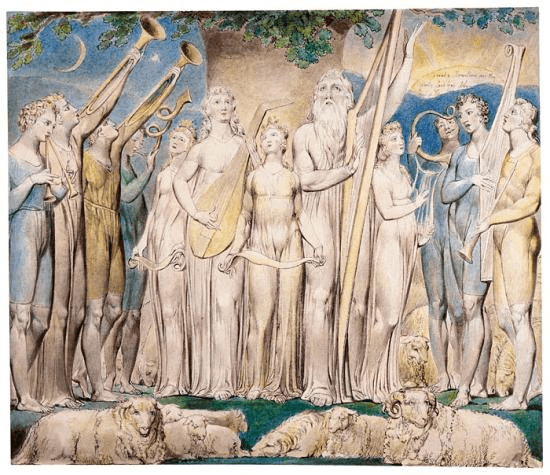
Job is restored, by William Blake (1757-1827)

Job was in awful suffering. He contended with God about it. Job’s friends contended with Job. In the end, God never gave a humanly suitable answer to the problem of suffering. Namely, because we cannot understand the answer, even if it is provided.

Indeed, the gap between God and humanity is quite pronounced. God is the Creator. We are creatures. Yet, God did vindicate Job.

That’s right God affirmed Job – and not Job’s companions. Even though Job did what many a believer in God today believes is wrong, perhaps even sacrilegious or sinful.

Job argued, confronted, grappled with, and even opposed God for the terrible troubles he faced in losing his family, his wealth, and his health. He fully engaged God.

Job’s friends, however, did no such thing. Instead, they argued, confronted, grappled with, and even opposed their friend Job. They fully avoided God.

In the end, Job conceded that he himself knows nothing. Yet, there is still the hint of complaint within him. This is good. Job did not stop engaging God. He remained faithful and devoted.

Let us never believe that faithfulness and devotion to God involves putting up a false front and nice polite piety. Prayer, in truth, is a hard wrestling with God, a struggling and working through all the difficulties of this unfair life.

God is not the least offended by our full, real, and raw engagement of him. But God is offended by avoiding such engagement altogether.

All of us, in reality, speak mostly in ignorance. We talk about things we don’t really understand. The only thing we can be 100% truthful about, however, is ourselves – about how we are really doing, feeling, experiencing, believing, struggling with, etc.

I myself am the true expert on me – and you, the expert on you. And this truth I can bring to God anytime, anywhere. The Book of Job affirms to me that this is the sort of devotion and sacrifice which the Lord is pleased with.

Job gained some knowledge and understanding through personally encountering God. The Lord God almighty, Creator of heaven and earth, actually spoke to Job in a direct revelation of the Divine presence.

This is an affirmation of Job’s integrity. But the godless, disintegrated, and fragmented person cannot see God or expect a personal audience with God.

Through all that Job had been through, he held to his integrity, and held onto God, both at the same time. In the end, he still did not understand why he had to go through such horrible suffering.

English translations of the Hebrew text don’t do it justice. There is always something lost in translation of any language to another. And it seems what is lost here is that Job was perhaps still protesting at the end. Yet, it comes across in English as Job despising and abhorring himself, as if he had done something very wrong.

“I despise myself,” misses the mark. Without getting into some deep grammatical Hebrew waters, I wonder if the phrase might better be rendered, “I protest.” What is meant to be conveyed is that Job still acknowledges what he originally held onto. Namely, that he has done nothing wrong, did not deserve what he went through, yet has never rejected God, nor lost faith in God.

Job did not need to repent of some secret sin, as his friends supposed. Job repenting does not mean because of sin; Job’s repentance was a change of position from mourner and complainer, to accepting the situation as it is, without answers.

So, this brings us back to the beginning of the book. God is God. There are celestial forces and operations in play we know nothing about. Humans are not God. Humans are never going to get most of what is happening in this world. And humans will inevitably experience hard and bad things – and not know why.

No answers given. No change of situation (yet). But Job changed. He changed his mind about how to live with what he was experiencing. He relinquished his complaint, and decided to keep living, even though he did not get answers.

Honestly, this response of Job is more consistent with my own experience of awful suffering, and more faithful to the text of Scripture. Much like Jacob wrestling with the angel, Job had to finally concede and relent, and continue on his life journey, come what may.

Following Job’s intercession for his friends, God restored Job to wealth and family. A significant piece of this restoration was Job’s wider community of friends and family who gathered around him, giving Job the consolation and comfort that the three “friends” in the book did not provide.

The community cared for Job, not through nice theological phrases, but with genuine fellowship. They shared together around the table, the community giving both a meal and contributing monetary gifts for Job’s needs.

The Book of Job ends, perhaps with as many, or more, questions than when it started. Answers, however, are not the point.

Rather, Job’s incredible and awful experience of suffering and redemption becomes an invitation for you and me to have a more expansive view of what a relationship with the living God truly looks like.

May God bless you with discomfort
At easy answers, half-truths, and superficial relationships,
So that you may live deep within your heart.

May God bless you with anger
At injustice, oppression and exploitation of people,
So that you may work for justice, freedom and peace.

May God bless you with tears
To shed for those who suffer pain, rejection, hunger, and war,
So that you may reach out your hand to comfort them
And turn their pain into joy.

And may God bless you with enough foolishness
To believe that you can make a difference in the world,
So that you can do what others claim cannot be done
To bring justice and kindness to all our children and the poor. Amen.

Renewal (Mark 6:30-34, 53-56)

Great Crowds Followed Jesus as He Preached the Good News, by Elizabeth Wang (1942-2016)

The apostles gathered around Jesus and told him all that they had done and taught. He said to them, “Come away to a deserted place all by yourselves and rest a while.” For many were coming and going, and they had no leisure even to eat. And they went away in the boat to a deserted place by themselves. 

Now many saw them going and recognized them, and they hurried there on foot from all the towns and arrived ahead of them. As he went ashore, he saw a great crowd, and he had compassion for them, because they were like sheep without a shepherd, and he began to teach them many things….

When they had crossed over, they came to land at Gennesaret and moored the boat. When they got out of the boat, people at once recognized him and rushed about that whole region and began to bring the sick on mats to wherever they heard he was. 

And wherever he went, into villages or cities or farms, they laid the sick in the marketplaces and begged him that they might touch even the fringe of his cloak, and all who touched it were healed. (New Revised Standard Version)

Recuperation

Christ’s disciples had just returned from their first ministry trip without Jesus. He had sent them in pairs to take authority over unclean spirits, with specific instructions on how to handle themselves. (Mark 6:6-13)

Now they had come together after a successful experience. Jesus immediately recognized that the disciples needed rest in a private retreat so that they could recover and debrief on their mission.

Jesus knew a thing or two about what we now call “self-care.” Christ understood the necessity for awareness of one’s physical, mental, emotional, and spiritual state – and to take appropriate steps in caring for oneself in order to maintain a vigorous life and ministry. He often punctuated his life with solitary times away with his heavenly Father. (e.g. Mark 1:35)

So, the disciples followed Jesus to a deserted place where they could be alone. Besides, it had become ever more risky to be out in the open. The religious authorities were looking for ways to snuff out this popular upstart of a movement with Jesus as rabbi.

Redirection

Things don’t always go as planned, even for the Son of God. Interruptions are part of working with people. Yet, Jesus never saw those disruptions as a bad thing. It seems that perhaps he even understood them as part of the plan from his heavenly Father. However Christ thought of them, he was unfazed by them.

With an expanding ministry came a larger and more expansive crowd following Jesus. Like a group of ancient paparazzi, there were people dedicated to tracking down Jesus and watching for him; they were absolutely intent on seeing him.

Whereas a lot of people might be annoyed with this behavior (especially us introverts!) Jesus truly saw them, viewing the crowds as “sheep without a shepherd.” In other words, Christ understood the people’s vulnerability, and he had compassion on them.

Refocus

Christ felt genuine care and concern for the people from the pit of his gut. Jesus knew their very real spiritual predicament, an age-old one that God was familiar with:

I, the Lord God, say you shepherds of Israel are doomed! You take care of yourselves while ignoring my sheep. You drink their milk and use their wool to make your clothes. Then you butcher the best ones for food. But you don’t take care of the flock! You have never protected the weak ones or healed the sick ones or bandaged those that get hurt. You let them wander off and never look for those that get lost. You are cruel and mean to my sheep. They strayed in every direction, and because there was no shepherd to watch them, they were attacked and eaten by wild animals. (Ezekiel 34:2-5, CEV)

Jesus, in the spirit Moses, took up the concern for people:

Moses spoke to the Lord: “Let the Lord, the God of all living things, appoint someone over the community who will go out before them and return before them, someone who will lead them out and bring them back, so that the Lord’s community won’t be like sheep without their shepherd.” (Numbers 27:15-17, CEB)

Because the Lord Jesus is the Good Shepherd and takes up the responsibility of caring for the flock, there were sheep (the crowds of people) continually either present around him or pursuing him (hence, the need for continual times of rest and recuperation).

All of this resulted in the impossibility of Jesus strolling into a town, village, or city under the radar.

Restoration

Not only did everyone want to see Jesus, but the people also desired to touch him, or at least the tassels of his garment – anything toget close and experience healing.

What’s so amazing about this account is that every single person who Jesus saw or touched experienced healing – without exception. It wasn’t that a few people, or even some of them, walked away changed. All of them did.

Indeed, Jesus is the divine shepherd, who will gather his sheep from the places where they have been scattered.

Christ went into towns and villages to the public places where the people were. That meant Jesus spent a good deal of time in the marketplaces. Since these were gathering areas where people bought and sold and interacted with each other, there you would also find the weakest, sickest, and most vulnerable people.

The needy were looking for help. And Jesus did for them, well beyond what any of them expected.

The Lord Jesus was also doing more than we might expect, as well. By conducting ministry in the economic center of a town, he was introducing a different (and subversive) economy from the kingdom of God.

Those with goods, resources, and money do not occupy the commercial spaces in God’s kingdom realm. Instead, the ones with the least, inhabit the spaces and places of honor. Indeed, many who are first will be last, and the last will be first. (Mark 10:31)

Christ’s earthly ministry restored people’s bodies, minds, emotions, and spirits – thus bringing a thriving economy into God’s kingdom. All of his work resulted in renewal of people’s lives, and a renewed way of living in this world.

“Healer of Our Every Ill” by Marty Haugen, 1987

Refrain:
Healer of our every ill,
light of each tomorrow,
give us peace beyond our fear,
and hope beyond our sorrow.

You who know our fears and sadness,
grace us with your peace and gladness;
Spirit of all comfort, fill our hearts. [Refrain]

In the pain and joy beholding
how your grace is still unfolding,
give us all your vision, God of love. [Refrain]

Give us strength to love each other,
every sister, every brother;
Spirit of all kindness, be our guide. [Refrain]

You who know each thought and feeling,
teach us all your way of healing;
Spirit of compassion, fill each heart. [Refrain]

Amen.

There Is Hope (Psalm 89:20-37)

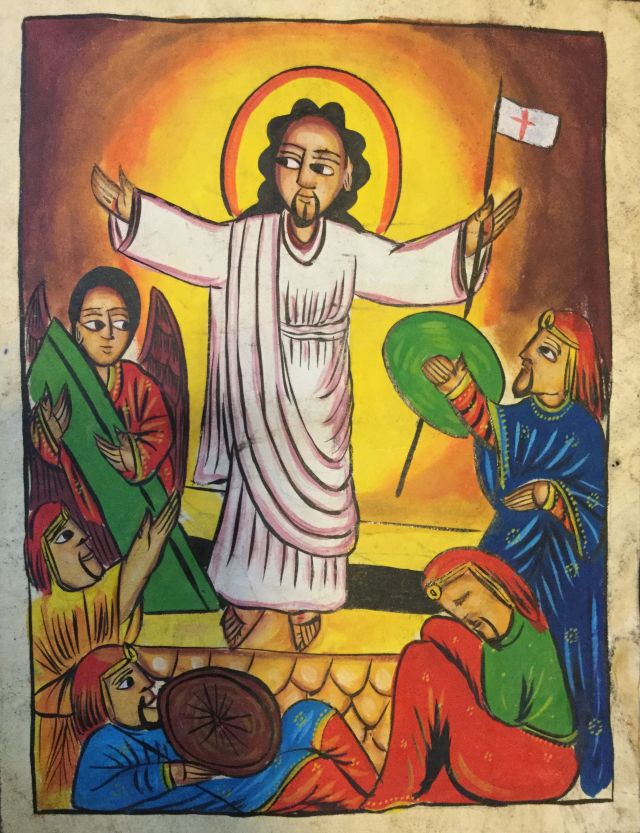
Ethiopian Orthodox depiction of Jesus

“I have found my servant David;
    with my holy oil I have anointed him;
my hand shall always remain with him;
    my arm also shall strengthen him.
The enemy shall not outwit him;
    the wicked shall not humble him.
I will crush his foes before him
    and strike down those who hate him.
My faithfulness and steadfast love shall be with him,
    and in my name his horn shall be exalted.
I will set his hand on the sea
    and his right hand on the rivers.
He shall cry to me, ‘You are my Father,
    my God, and the Rock of my salvation!’
I will make him the firstborn,
    the highest of the kings of the earth.
Forever I will keep my steadfast love for him,
    and my covenant with him will stand firm.
I will establish his line forever
    and his throne as long as the heavens endure.
If his children forsake my law
    and do not walk according to my ordinances,
if they violate my statutes
    and do not keep my commandments,
then I will punish their transgression with the rod
    and their iniquity with scourges,
but I will not remove from him my steadfast love
    or be false to my faithfulness.
I will not violate my covenant
    or alter the word that went forth from my lips.
Once and for all I have sworn by my holiness;
    I will not lie to David.
His line shall continue forever,
    and his throne endure before me like the sun.
It shall be established forever like the moon,
    an enduring witness in the skies.” (New Revised Standard Version)

Back when today’s psalm was originally crafted, there was a lot of stress for the Jews in Jerusalem. The city was in ruins, the land without their king, and the people were experiencing divine judgment from their God.

Into this situation, the psalmist brought some light from darkness; and hope for the survivors, that blessings lay in the future. The psalm is a song of prayer, speaking of the Lord’s faithfulness and steadfast love because of the promises made to the people’s ancient ancestor, King David.

The covenant between God and the people, made so many centuries ago, will never be broken. Why? Because fidelity to that covenant doesn’t depend on the people, but on the faithfulness of God and God’s timeless moral law.

The Lord God, the Almighty, did not forsake nor forget the people. The Lord’s mercies are new every morning; and God’s faithful love is forever.

Renewal and restoration are very real possibilities, despite the dire circumstances, and the people’s spiritual infidelity. Once again in history, one worthy of the throne of David will sit to judge the people with equity and grace.

The Son of David will be the custodian of God’s covenant promises. Evil shall be defeated. Authority to forgive sins, and to grant eternal life, will be established on earth. Indeed, the Lord’s enduring words and ways will be accomplished on this earth, as they are always done in God’s heaven.

The divine covenant will find its ultimate fulfillment in One whose throne is established for all eternity. The anointed one, the God-Man, will carry the burden of government on his shoulders; his rule and authority shall extend over the whole earth. (Isaiah 9:7)

Acting with the power of God, this Ruler is the visible image of the invisible God – the Mighty God, Eternal Father, Prince of Peace. For the Christian, these qualifications and descriptions are all met in the person of Jesus the Christ.

In a thoroughly and unabashed Christo-centric reading of the psalm, Jesus is the ultimate Messiah and High Priest who offered himself as the faultless, acceptable, eternal, and final sacrifice on behalf of the whole world. (Isaiah 53)

Therefore, since we are justified by faith, we have peace with God through our Lord Jesus Christ, through whom we have obtained access to this grace in which we stand, and we boast in our hope of sharing the glory of God. (Romans 5:1-2, NRSV)

Through Jesus, the New Testament perspective is that the old Mosaic Covenant became obsolete, and the New Covenant – promised by the prophets Jeremiah and Ezekiel – took its place. (Jeremiah 31:31-34; Ezekiel 36:25-27; Hebrews 8:13)

Although this High Priest died, he also was raised to life, and ascended to heaven – where he continues to intercede for God’s people.

He holds his priesthood permanently because he continues forever. Consequently, he is able for all time to save those who approach God through him, since he always lives to make intercession for them. (Hebrews 7:24-25, NRSV)

Before David was anointed king, Saul and his enemies hunted him and tried to kill him. Yet, through all of those twists and turns of harrowing circumstances, David trusted in the Lord and patiently waited for God to ensconce him as king. In time, that is precisely what happened. And David became the greatest king Israel ever had.

In much the same way, that fox King Herod tried to kill Jesus. Then later, Herod’s son, along with the religious establishment, sought to kill Jesus, as well. Behind the murderous intent, and every intent of doing away with the innocent, are the dark evil forces of this world.

The Accuser, Satan, the devil, tried to tempt the Christ and subvert the will of God, thus making the New Covenant something that would never happen. But Jesus was obedient to the Father – obedient even to death. (Philippians 2:8)

Christ Jesus offered himself willingly. His death may have been orchestrated by the existence of evil on this earth, yet it was God who allowed it all to occur, so that evil’s murderous tool, death, would become impotent.

The power of sin, death, and hell has been broken; but it will take awhile before the kingdom of God is established in all its grace and glory, and David’s fallen Tabernacle restored.

No matter how difficult, chaotic, and frustrating our current earthly situation may be, God will still establish the king; the good work begun and effected shall ultimately be thoroughly fulfilled. Jesus is coming again.

Until then, the good news is proclaimed that the kingdom of God is near. There is grace and forgiveness in the name of Jesus. Peace is no longer a pipe dream. Hope is real.

O Lord, when evil darkens our world, give us light. When despair numbs our souls, give us hope. When we stumble and fall, lift us up. When doubts assail us, give us faith. When nothing seems sure, give us trust. When ideals fade, give us vision. When we lose our way, be our guide, so that we may find serenity in Your presence, and purpose in doing Your will. Amen.