A Plan That Backfired (1 Samuel 4:1-22)

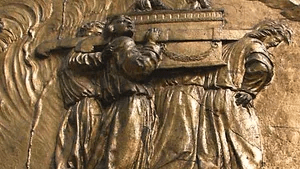
Transporting the Ark of the Covenant, Cathedral of Sainte-Marie, Auch, France

Now the Israelites went out to fight against the Philistines. The Israelites camped at Ebenezer, and the Philistines at Aphek. The Philistines deployed their forces to meet Israel, and as the battle spread, Israel was defeated by the Philistines, who killed about four thousand of them on the battlefield. When the soldiers returned to camp, the elders of Israel asked, “Why did the Lord bring defeat on us today before the Philistines? Let us bring the ark of the Lord’s covenant from Shiloh, so that he may go with us and save us from the hand of our enemies.”

So the people sent men to Shiloh, and they brought back the ark of the covenant of the Lord Almighty, who is enthroned between the cherubim. And Eli’s two sons, Hophni and Phinehas, were there with the ark of the covenant of God.

When the ark of the Lord’s covenant came into the camp, all Israel raised such a great shout that the ground shook. Hearing the uproar, the Philistines asked, “What’s all this shouting in the Hebrew camp?”

When they learned that the ark of the Lord had come into the camp, the Philistines were afraid. “A god has come into the camp,” they said. “Oh no! Nothing like this has happened before. We’re doomed! Who will deliver us from the hand of these mighty gods? They are the gods who struck the Egyptians with all kinds of plagues in the wilderness. Be strong, Philistines! Be men, or you will be subject to the Hebrews, as they have been to you. Be men, and fight!”

So the Philistines fought, and the Israelites were defeated and every man fled to his tent. The slaughter was very great; Israel lost thirty thousand foot soldiers. The ark of God was captured, and Eli’s two sons, Hophni and Phinehas, died.

That same day a Benjamite ran from the battle line and went to Shiloh with his clothes torn and dust on his head. When he arrived, there was Eli sitting on his chair by the side of the road, watching, because his heart feared for the ark of God. When the man entered the town and told what had happened, the whole town sent up a cry.

Eli heard the outcry and asked, “What is the meaning of this uproar?”

The man hurried over to Eli,who was ninety-eight years old and whose eyes had failed so that he could not see. He told Eli, “I have just come from the battle line; I fled from it this very day.”

Eli asked, “What happened, my son?”

The man who brought the news replied, “Israel fled before the Philistines, and the army has suffered heavy losses. Also your two sons, Hophni and Phinehas, are dead, and the ark of God has been captured.”

When he mentioned the ark of God, Eli fell backward off his chair by the side of the gate. His neck was broken and he died, for he was an old man, and he was heavy. He had led Israel forty years.

His daughter-in-law, the wife of Phinehas, was pregnant and near the time of delivery. When she heard the news that the ark of God had been captured and that her father-in-law and her husband were dead, she went into labor and gave birth, but was overcome by her labor pains. As she was dying, the women attending her said, “Don’t despair; you have given birth to a son.” But she did not respond or pay any attention.

She named the boy Ichabod, saying, “The Glory has departed from Israel”—because of the capture of the ark of God and the deaths of her father-in-law and her husband. She said, “The Glory has departed from Israel, for the ark of God has been captured.” (New International Version)

It was a really bad day. Yet, it wasn’t a day disconnected from other days. This particular day had been coming for quite some time.

The Philistines and the Israelites were continually going at each other. They had been enemies for a long time. But the Philistines were only the surface problem. The real issue had been building ever since Eli and his sons Hophni and Phineas were the priests in Israel.

They were tasked with the sacred responsibility of caring for the Tabernacle – the tent which housed the Ark of the Covenant – and attending to the people’s worship and sacrifices. But they had been terribly irresponsible in their work. As biblical readers, we are meant to feel the building tension of inevitable divine intervention of judgment against the injustice that was happening.

In one of the many military battles which took place against the Philistines, the Israelites suffered loss. So, someone had the bright idea of perhaps getting God involved. No one perceived, however, the involvement the Lord was planning. God was ready to deal with the wickedness in Israel.

The Ark of the Covenant was brought from Shiloh to the front lines. This, of course, meant that the persons who handled sacred objects, Hophni and Phineas, would have to be the ones who bring it. We sense as readers that in spite of the Ark’s symbolism of God’s presence with the Israelites, this move isn’t going to end well for Israel.

The story is leading us to an important point: Faithfulness to the invisible God is much more important and powerful than a visible sacred object. The Ark of the Covenant is a symbol of what is right and just; it is not a supernatural talisman to ward off a bad and stressful situation.

Many in Israel were faithful to the Lord. Israel’s leaders, however, were not. In an age old story that has kept repeating itself up to the present time, the people keep supporting a bad government which does not serve the common good of all persons; it only serves itself.

What is interesting here is that God neither fights against the Philistines, nor the Israelites. The Lord simply didn’t show up. God was absent and did not help Israel. The divine intervention turned out to be no intervention at all.

The entire Ark of the Covenant plan completely backfired. The Philistines, understanding the brevity of the situation, were emboldened to fight like never before – thus bringing devastation on the battlefield to Israel. The narrator takes note to let us know the impact this has on the old priest Eli, his two sons, and the rest of that family.

Superstition will get us nowhere – especially when we are looking for solutions to problems we created for ourselves by ignoring righteousness and justice. The hard work of doing what is right cannot be substituted with magic.

There is big difference between believing in God and becoming superstitious and wanting easy solutions to complex problems. God is not, cannot, and will not be contained in a box – even if it’s the Ark of the Covenant.

Eternal God, in whose perfect kingdom no sword is drawn but the sword of righteousness, no strength known but the strength of love: So mightily spread abroad your Spirit, that all people may be gathered under the banner of the Prince of Peace, as children of one Father; to whom be dominion and glory, now and forever. Amen.

Life (Genesis 1:20-2:4a)

The Creation of Heaven and Earth, by Unknown artist, c.18th century

God said, “Let the waters swarm with living things, and let birds fly above the earth up in the dome of the sky.” God created the great sea animals and all the tiny living things that swarm in the waters, each according to its kind, and all the winged birds, each according to its kind. God saw how good it was. Then God blessed them: “Be fertile and multiply and fill the waters in the seas, and let the birds multiply on the earth.”

There was evening and there was morning: the fifth day.

God said, “Let the earth produce every kind of living thing: livestock, crawling things, and wildlife.” And that’s what happened. God made every kind of wildlife, every kind of livestock, and every kind of creature that crawls on the ground. God saw how good it was. Then God said, “Let us make humanity in our image to resemble us so that they may take charge of the fish of the sea, the birds in the sky, the livestock, all the earth, and all the crawling things on earth.”

God created humanity in God’s own image,
        in the divine image God created them,
            male and female God created them.

God blessed them and said to them, “Be fertile and multiply; fill the earth and master it. Take charge of the fish of the sea, the birds in the sky, and everything crawling on the ground.” Then God said, “I now give to you all the plants on the earth that yield seeds and all the trees whose fruit produces its seeds within it. These will be your food. To all wildlife, to all the birds in the sky, and to everything crawling on the ground—to everything that breathes—I give all the green grasses for food.” And that’s what happened. God saw everything he had made; it was supremely good.

There was evening and there was morning: the sixth day.

The heavens and the earth and all who live in them were completed. On the sixth day God completed all the work that he had done, and on the seventh day God rested from all the work that he had done. God blessed the seventh day and made it holy, because on it God rested from all the work of creation. This is the account of the heavens and the earth when they were created. (Common English Bible)

God Created Man in His Image – Male and Female, by Jill Steenhuis

In this Christian season of Eastertide, believers remember and celebrate new life in Jesus Christ. In today’s Old Testament lesson, the lectionary reminds us of original life – when God created the heavens and the earth.

The Beginning of Life

This was the beginning, before there were any words like sin, disobedience, guilt, and shame. This was the time when the original people, Adam and Eve, knew nothing about trying to chase after unconditional love. They had no concept of estrangement or heartache. Everything was fresh and alive and shiny. Disappointment, hurt, and sadness were unknown to them. Everywhere, the earth was teeming with abundant life.

God made it all; and all that was created was very good, supremely reflecting the goodness of the Creator. Life existed everywhere. The predictable and consistent rhythms of the universe were in place. Day and night, work and rest, creation and care, were all woven into the fabric of the world’s sights and seasons. The possibilities for growth were incredible. Life was indeed good.

“New” was simply part of all there was. Without any want or need, every day was an adventure of discovering all the newness which existed.

The Complicated Life

We all, however, know that it did not remain this way. People are now all too familiar with the myriad ways of injustice, and with the film of sin that covers the entire world like a noxious pollutant. And it is this situation, of course, which created the need for a “new” life, because the present life had become a moldy old leftover in the refrigerator of a life that doesn’t keep anything cold nor fresh.

People were created as good human beings. Even though sin has profoundly touched everything in creation, goodness is still within us as God’s image-bearers. The later introduction of human sin into the world in no way whatsoever removes the inherent stamp of the divine image upon us.

Humanity is the only creature who bears this likeness to God. We are related to the animal world, having been created on the same day, and sharing the same blessings of life. Yet, people are distinctive, set above all other creatures.

The Responsible Life

This is why people are given dominion over all other creatures. This is not a claim to privilege; it is, however, very much a claim to responsibility. People have been tasked with being faithful stewards of creation, entrusted with caring for other creatures and the created order.

And humanity was created as both male and female, together expressing the will and character of God in creation as they tend to it and care for it. Together with God, we are relational beings, and not just a race of individuals inhabiting the same earth.

God is a social being, existing as a community within the Godhead. Therefore, to exist as an image-bearer of God means that people are social creatures who need community – with both God and other people.

After God did all the work of creating the world with all its plants and animals and birds and fishes and people, God “rested.” This is why the seventh day is set aside as sacred; its different than the other days, sort of like how people are similar but different from the other creation.

God is clearly separated from the work and the creation itself, that is, God is transcendent and above all things as the Creator. The world is good, but the world is not divine. In the same way, by observing a day of rest, humanity recognizes and affirms and remembers that the work they have done is not divine.

Our human works, good as they may be, are not a thing to be worshiped or equated with God. Therefore, the Sabbath both celebrates the creation and the created order of things, as well as separates us from the idol worship of our hands.

To live into our inherent image of God means that we will work hard and tend to the gardens that are around us. Yet, at the same time, we will understand that in doing our responsible tasks, people are to live in community and love one another, without idolizing any other part of creation or what we creatively build with our own two hands. That is for God alone, who is distinct from all that God has created.

God our Father, you created the world and sent your own Son to live among us, made of the same stuff, breathing the same air, marveling at sunrise and sunset just as we do. Help us to participate in the life around and within us as your life, as you living in us and we living in you and in each other.

God of love and life, restore us to your peace, renew us through your power and teach us to love all that you have created and to care for the earth as your gift and our home. Amen.

Learn by Example (1 Corinthians 10:6-13)

Now these things occurred as examples to keep us from setting our hearts on evil things as they did. Do not be idolaters, as some of them were; as it is written: “The people sat down to eat and drink and got up to indulge in revelry.” We should not commit sexual immorality, as some of them did—and in one day 23,000 of them died. We should not test Christ, as some of them did—and were killed by snakes. And do not grumble, as some of them did—and were killed by the destroying angel.

These things happened to them as examples and were written down as warnings for us, on whom the culmination of the ages has come. So, if you think you are standing firm, be careful that you don’t fall! No temptation has overtaken you except what is common to mankind. And God is faithful; he will not let you be tempted beyond what you can bear. But when you are tempted, he will also provide a way out so that you can endure it. (New International Version)

To learn by example is a whole lot better than having to learn something the hard way. One of the lessons of Holy Scripture is that it contains many stories of what not to do, and the consequences of disobedience and experiencing hard things because of anger and stubbornness.

The ancient Israelites in the desert were a group of people who ended up having to learn most things the hard way – simply because they were too stubborn and independent to listen to Moses and obey God’s commands.

Dealing with upset and recalcitrant people is a drag. But there is such a simple solution to it that you might not even believe it. If you learn to practice the one simple solution to dealing with angry, stubborn, and insecure people, your time will open much wider; your own emotions will calm down a great deal; and, you may find the kind of peace and settled conviction that you long for.

You know the type. We have all dealt with them. That chronically upset relative or in-law who demands your time and attention; the insecure co-worker who is constantly chirping about something he does not like in the company; or, the cranky neighbor who only talks to you when something infringes on his person or property.  These scenarios, and many more, you and I either have or will face.

Perhaps the religiously and perpetually upset person or group is the worst – because they hide their fears, anxieties, and insecurities behind a façade of piety and performance.

Let angry people endure the backlash of their own anger; if you try to make it better, you’ll only make it worse. (Proverbs 19:19, MSG)

I once was in a wedding in which a bridesmaid was constantly upset about something all throughout the rehearsal and into the wedding day. It got so bad that, just as we were about to walk down the aisle, she became agitated about something she did not like, and angrily stormed away. 

What would you do in such a situation? What did I do? I did absolutely nothing. I ignored her, told the rest of the wedding party to not follow her, and went about the ceremony. When she saw no one was going to rescue her, she was in line at the last minute to participate. 

If there is a person in your life, or you are in a group, who has frequent emotional meltdowns about most anything, learn the example of Holy Scripture, and hear this wisdom principle that can change your life: 

Angry, stubborn, and insecure people get upset because it works – they get their way. Someone will come to their rescue and fix their anger. But if you will practice the simple solution of letting them just be upset and stew in their own juices without coming to their aid to make it all better, they will eventually stop sucking your time and energy into their angry upset vortex.

The disobedient and upset person is typically one with some sort of entitlement mentality. The bridesmaid didn’t like the way things were being done, and she felt “entitled” to have things go her way. She wasn’t used to accepting “no” like most other people have to do. She believed everyone else ought to adjust for her behavior.

The important point to note here is that it is not your job to fix their emotions; it isn’t your responsibility to smooth everything out so that everyone feels just fine and are calmed down. Instead, it is my job and your job to practice self-control and be responsible for our own emotional well-being. 

If you keep trying to calm an angry person and assuage their emotions to an even keel, you will have to do it again, and again, and again…. Until they figure out their anger doesn’t work, it just does not pay to be upset.

This means that, deep within your soul, you must move from the fear of negative emotions in others to positive possibilities in the right direction. Not everyone is going to like you, no matter how hard you try.

“Follow my example, as I follow the example of Christ.”

The Apostle Paul (1 Corinthians 11:1, NIV)

Please understand that this does not mean we avoid helping others. It just means we don’t enable their bad behavior by solving their problems for them. We can walk beside them, encourage them, and teach them, but all without doing it for them.

Whenever we think we can handle things on our own, without anyone else’s input through consultation and collaboration, then we are setting up ourselves to have to learn the hard way. So, how will you choose to learn?

O God, by your Spirit, fashion our lives according to the example of your Son, and grant that we may show the power of your love to all among whom we live; through Jesus Christ our Lord. Amen.

Speak the Good Word (2 Timothy 4:1-5)

St. Paul the Apostle, Unknown artist

I’m giving you this commission in the presence of God and of Christ Jesus, who is coming to judge the living and the dead, and by his appearance and his kingdom. Preach the word. Be ready to do it whether it is convenient or inconvenient. Correct, confront, and encourage with patience and instruction. 

There will come a time when people will not tolerate sound teaching. They will collect teachers who say what they want to hear because they are self-centered. They will turn their back on the truth and turn to myths. But you must keep control of yourself in all circumstances. Endure suffering, do the work of a preacher of the good news, and carry out your service fully. (Common English Bible)

This letter from the Apostle Paul to Pastor Timothy was the last writing he ever crafted. Soon after sending this, according to historical tradition, Paul was martyred for his faith in the city of Rome, having been imprisoned there for two years. The letter contains some final words the Apostle wanted his young protégé to know that were important to him.

Paul left Timothy with a sacred charge to proclaim the gracious message of God – no matter the time nor circumstance – with all the divine patience and spiritual exhortation that the Lord gives.

A Word of Christ

The simple commission of Paul was to preach the word, proclaim the message, spread the good news. Paul called on Timothy to speak the word that God has spoken – the word passed on to him, first through his devout mother, then from his mentor, and finally from all the apostles. It’s a unified message of sound teaching concerning the person and work of Jesus Christ – God-breathed and committed to all God’s people who respond to the message in faith.

The responsibility is to not only hear the message, obey it, and guard it’s truth; the charge is to speak, to lift one’s voice and proclaim the message with confidence and without fear – because it is always open season on the proclamation of the gospel.

I don’t know what sort of picture this evokes for you to “preach the word.” Maybe you envision a preacher behind a pulpit in a church; or a guy with a bullhorn on a street corner; or an obnoxious coworker who takes any opportunity to puke the gospel onto another person; or some other picture which may be foreign to you.

Paul preaches in Athens, Unknown artist, 19th century

Please let me assure you that the Apostle Paul was not talking about any of those sorts of scenarios. The image is one of letting out something which is already inside of you, burning to come out and be heard.

It is to be so full of the life of Christ, that the words which come out of you are filled with that very life – a message of grace, redemption, hope, forgiveness, and love. And communicated in a way that also reflects the person of Jesus – an affect, gestures, posture, and tone of voice that resonates with another and is winsome, not annoying.

A Relevant Word

The person who proclaims the message of Christ does so in order to convince, encourage, rebuke, inform, and love. The messenger tells what another needs to hear, and not necessarily what they want to hear. This is a word that speaks to anyone in any situation within any sort of context or culture.

To speak with relevance in no way waters down the message of Christ. Rather, it means that the speaker takes great pains to talk in such a way as to help another in their own circumstance. Utilizing the mind and emotions, as well as the spirit, the preacher presents ideas, ethics, and feelings in order to announce good news.

And we are to always be patient with others. One must never resort to pressurized sales tactics to force another into the kingdom of God. The Word of God is a gracious message that provides life; and is not a big thick Bible that is used to smack somebody upside the head with condemnation.

Our responsibility is to be faithful in handling the message and proclaiming it with mercy. It is the Holy Spirit’s job to woo people to Jesus and purify them.

Don’t throw all over somebody a bucket of judgment, as if you are acting for God. Impatience, impertinence, impoliteness, and being impetuous, all belong to the devil’s imps, and have nothing to do with announcing good news of great joy for all the people.

An Uncompromising Word

Timothy lived in a society that was difficult in proclaiming the message of Jesus Christ. He lived in a city that had a grand temple to the goddess Artemis. He walked around seeing unethical practices and dubious living. Any of us would likely understand if Timothy shrunk back from having a bold proclamation of Christianity.

Paul speaking in the synagogue, a 12th century Byzantine mosaic

But the Apostle Paul was calling Timothy to preach good news without shrinking or shirking the message. One might be tempted to simply tell others what they’d like to hear and not stir the pot and cause any sort of conflict. Not everyone wants to hear the truth. For everyone who genuinely responds to a truthful and merciful message, there are four more persons who want none of it. They want what they want, and if someone says different, they’ll make their life hell.

These are the conspiracy theorists who would rather entertain spicy nuggets of opinion and speculation, than listen to evidence-based research and professionally peer reviewed material. They ground their ideas according to subjective taste and forsake objective documentation and witness.

Paul did not want Timothy coddling such persons or giving into them in any form whatsoever, because they have a severe hearing problem. People who won’t listen, constantly interrupt others, and believe they are always right, need a good dose of the uncompromising word of Christ.

In the face of those who refuse to listen and use their ears for good, Timothy was exhorted by Paul to be a steady teacher who keeps presenting the truth in intellectually and emotionally responsible ways. Timothy may have to endure suffering and put up with a bunch of simpletons giving him a hard time, but he was never to back down from sound and solid apostolic teaching.

It’s important that we all maintain a sense of emotional calm and intellectual soundness amidst all the crud within a given society. The believer is to avoid a discouragement that leads to abject silence.

Let us not be deterred from saying and doing what is right, just, and good. And let’s make sure that in the words we say and the behavior we display, there is the very life of Jesus Christ oozing out of us.

There are more than enough bad words being spoken every day; let’s instead speak the good word, full of grace and truth.

Soli Deo Gloria