Divine Intervention (Isaiah 1:24-31)

The Siege and Destruction of Jerusalem, by David Roberts (1796-1964)

So now, listen to what the Lord Almighty, Israel’s powerful God, is saying: “I will take revenge on you, my enemies, and you will cause me no more trouble. I will take action against you. I will purify you the way metal is refined, and will remove all your impurity. I will give you rulers and advisers like those you had long ago. Then Jerusalem will be called the righteous, faithful city.”

Because the Lord is righteous, he will save Jerusalem and everyone there who repents. But he will crush everyone who sins and rebels against him; he will kill everyone who forsakes him.

You will be sorry that you ever worshiped trees and planted sacred gardens. You will wither like a dying oak, like a garden that no one waters. Just as straw is set on fire by a spark, so powerful people will be destroyed by their own evil deeds, and no one will be able to stop the destruction. (Good News Translation)

Judgment does not mean that you need to leave a part of yourself behind in order to be accepted or belong. Judgment isn’t about stuffing down emotions and denying certain thoughts about things because you were told to.

Rather, judgment – divine judgment – is for those leaders, and the persons who support such leaders, who tell people they have to live a particular way, be a certain way, and think in the same way the leaders say you have to think.

Isaiah’s prophecy is first and foremost directed toward leaders – political leaders and religious leaders. Indeed, the nation of Israel had gone down a path of worship that God never condoned nor wanted.

And the Lord put the primary blame squarely upon rulers who led their people in unacceptable ways by telling them things that God never wanted. As a result, the nation as a whole, lived unjustly and unrighteously.

God was determined to do something about the situation of bad leadership: Replace the rulers and advisers. Get rid of them, just like a metallurgist gets rid of impure and worthless dross.

A lot of things in life rise and fall because of leadership. The character and competence of a leader is of upmost importance. God raises up particular people to lead. So, leaders and rulers are expected to fulfill their mandated duty with all diligence and decorum.

The city of Jerusalem fell to the invading Babylonians in 586 B.C.E. All of the Old Testament prophetic books are related to that seminal event in one way or another.

Jerusalem’s destruction, according to the prophets, had a direct relationship to the failure of political kings and religious priests to lead the people according to God’s law. And that failure was specifically tied to the lack of religious piety and leadership performance amongst the rulers of the land.

Indeed, individuals are responsible for their own thoughts and words and actions. Yet, at the same time, the leaders of a city and a nation are also responsible for whether they are leading the people into ways of justice and equity, or injustice and prejudice.

People in responsible positions of authority are to take ownership of the sort of culture they develop. And when people, as a whole, have rude and irresponsible words and actions, such behavior isn’t only on individuals – it’s on the leaders, as well.

God will hold everyone accountable – especially leaders = for what they have done, and not done, to foster a just and right society.

In the time of the prophets, the majority of those in authority led the people into a degenerate state. It had become so bad that divine judgment would intervene in order to burn out the evil, and remove the worthless dross of incompetent and inconsiderate leadership.

Only through the wholesale replacement of rulers and advisers could restoration and regeneration ever take place.

Fortunately, the Lord is a God of justice, mercy, and grace. The Lord is a redeeming God. And the theme of redemption runs throughout the Book of Isaiah. Yet, for a nation to be redeemed, it will require an elimination of rebellious evil.

The wrath of God exists precisely because of the love of God. Since the Lord has a steadfast, committed, and covenantal love for the people, God will render judgment, purging hate and injustice from the land.

When God decrees something, no one can stop it. And when God decrees destruction upon the material things which promote illegitimate worship and public injustice, you can be absolutely sure that it’s going to happen.

No one, no city, and no nation is truly autonomous, in the sense that they can do whatever the heck they want to do, regardless of whether it is right or just, or not. There is no person and no government who is free to indulge in their own selfish agenda.

We have a purpose and a mandate as people on this earth, to care for this world – the people and the environments we inhabit.

All of the ways in which individuals, groups, and governments cheapen and degrade human dignity and environmental worth, puts everyone at risk of survival and a good life on this planet.

Unjust and dysfunctional systems and structures must be purged of their impurities. And that means, in many cases, a new order of things must occur.

If we cannot learn to play well with one another, then playtime will be over; and God will call us back into the house and make us sit in the corner for a long time – or worse.

Whenever leadership fails to be neighborliness, then we have a huge problem.

Our world suffering divine devastation of all the things we know and love may not be far behind. And, quite frankly, it will be our own damn fault – and not somebody else’s.

However, in the prophetic biblical tradition, devastation and destruction never have the last word. There is always hope – a confident expectation that good, right, and just forms of social, economic, and religious communities will function yet again.

There are good leaders waiting in the wings. It’s just that no one yet sees or knows them. But God will raise them up at the proper time, to accomplish good purposes in communities, churches, families, and governments everywhere.

A divine intervention will make the last be first, and the first be last.

May it be so, for the blessing of the world, and to the glory and praise of God. Amen.

Caring For the Aged (1 Timothy 5:1-8)

Do not rebuke an older man harshly, but exhort him as if he were your father. Treat younger men as brothers, older women as mothers, and younger women as sisters, with absolute purity.

Give proper recognition to those widows who are really in need. But if a widow has children or grandchildren, these should learn first of all to put their religion into practice by caring for their own family and so repaying their parents and grandparents, for this is pleasing to God. 

The widow who is really in need and left all alone puts her hope in God and continues night and day to pray and to ask God for help. But the widow who lives for pleasure is dead even while she lives. Give the people these instructions, so that no one may be open to blame. Anyone who does not provide for their relatives, and especially for their own household, has denied the faith and is worse than an unbeliever. (New International Version)

Timothy was the young Pastor of the Church in Ephesus, having been appointed by his mentor, the Apostle Paul. Paul wrote to his protégé in order to clarify and remind Timothy of how to go about his ministerial duties amongst the congregation.

In dealing with older persons, Paul instructed that they must not be dealt with harshly. There needs to be gentleness and moderation in correcting any faults with elders. Old folks already take quite enough medicine they don’t like. No one, especially some whipper-snapper, ought to come along and add some bitter medicine to their regimen.

Instead, provide exhortation which is tolerable, and evidences genuine concern and humility. Make it good medicine.

Timothy was not to allow the older folks to get away with being stinkers. And the way to handle this is by being respectful, considerate, and gentle.

Since the Body of Christ is a family, older men need to be treated as fathers, and older women as mothers. The younger women, too, must be corrected, when necessary. Although it is a delicate task, it needs to be engaged with the same care as the older men.

If Timothy thought about his ministry with people as dealing with his own mother, then he would do it with a great deal of love, humility, grace, and wisdom. Not only is the message to be conveyed; the spirit behind the message is just as important.

Younger women are to be treated as sisters; and young men as brothers. The way everyone is handled is significant. All persons, without exception, need love and attention.

The Apostle pointed out that there are certain groups of people which require special attention. Therefore, distressed widows need to be honored and treated with high regard.

A father to the fatherless, a defender of widows,
    is God in his holy dwelling. (Psalm 68:5, NIV)

Widows are identified in Scripture as those who are under the special care of God. So, how we treat them, is how we are treating God.

Any widow in the church who had no little to no support were to be provided for by the church. In the earliest church, this was important enough to warrant the creating of a new church ministry of deacons. (Acts 6:1-6)

Those widows who have children and/or grandchildren are to be first and foremost cared for by their family. Paul was unequivocable on this point. He insisted that a family with needy members, such as widows, are to put their religion into practice by ensuring that their mother or grandmother or aunt or any widow in the family is given what they need to live.

The Apostle’s directive to Timothy is that the church must not be unnecessarily burdened. Paul’s larger concern, however, was that adult children should honor their parents. That is their first religious duty as Christians. They ought to make a real and substantial effort toward mom and dad by providing for them in their old age, when they need it.

“It is easier for one poor father to bring up ten children, than it is for ten rich children to provide for one poor father.”

Dutch proverb

The provision for needy parents is to be done with a spirit of gratitude, love, and appreciation. I understand that this admonition gets rather dicey when it comes to adult children who were raised by a mother or father who was, at best, a stinker, and at worst, downright mean or abusive.

Yet, the wise Christian will learn to find ways toward returning a curse with a blessing, and so, honors both the parent and God. This in no way requires ignoring one’s own needs; it just means that we will strive to discover how to honor and provide for an aged mom or dad.

Having said that, there is a wide difference between the widow who puts her trust in God, and the widow who lives frivolously with no concern for God or others. The pious widow with no family must be cared for by the church. And the dissolute widow is not to be treated the same. The church, as well as the family, will need to be creative in how to approach such widows.

Each case within both the church and the family needs to be considered on its own merits. There is not necessarily a one-size-fits-all approach in every situation with a needy person. The following verses are helpful for us, as we consider how to assist:

Jesus said to his disciples,

 “A new command I give you: Love one another. As I have loved you, so you must love one another.” (John 13:34, NIV)

“My command is this: Love each other as I have loved you.” (John 15:12, NIV)

And the Apostle Paul said to the Church in Galatia,

“Carry each other’s burdens, and in this way you will fulfill the law of Christ.” (Galatians 6:2, NIV)

Whatever we do, or not do, we are not to neglect needy persons in our family or faith community. To reject or deny such persons is tantamount to rejecting one’s Christian faith.

Let us strive for both duty and delight in caring for the needy amongst us. Both are important. Sheer duty without delight is mere drudgery; it cannot be sustained. And only delight without any duty is irresponsible; it is also unsustainable.

May God’s provision and blessing be with you, as you strive to honor both your biological family, and your spiritual family. Amen.

Redeem One Another (Ruth 3:1-7)

Boaz and Ruth, by John August Swanson (1938-2021)

Naomi her mother-in-law said to her, “My daughter, I need to seek some security for you, so that it may be well with you. Now here is our kinsman Boaz, with whose young women you have been working. See, he is winnowing barley tonight at the threshing floor. Now wash and anoint yourself, and put on your best clothes and go down to the threshing floor, but do not make yourself known to the man until he has finished eating and drinking. When he lies down, observe the place where he lies; then go and uncover his feet and lie down, and he will tell you what to do.” She said to her, “All that you say I will do.”

So she went down to the threshing floor and did just as her mother-in-law had instructed her. When Boaz had eaten and drank and was in a contented mood, he went to lie down at the end of the heap of grain. Then she came stealthily and uncovered his feet and lay down. (New Revised Standard Version)

Naomi and Ruth were two widows – a mother-in-law and daughter-in-law – living in an ancient time when women were dependent upon men for survival.

Ruth had been out in the barley fields during harvest, gleaning as much as she could by walking behind the harvesters. It was what people in need did back then.

The owner of the land, Boaz, had heard of Ruth and took notice of her. He was kind and made sure she had enough for herself and Naomi.

So, Naomi, although too old to be out in the fields gleaning barley, could still use her wisdom. She decided to help Ruth have some security for the future. Naomi wanted to help her daughter-in-law,  so she instructed Ruth to make herself available to Boaz.

Boaz was a kinsman, connected to Naomi’s extended family. Naomi intended on using this connection to bring Ruth and Boaz together in marriage, thus settling her daughter-in-law in a good and secure life.

The approach of Naomi underscores her thoughtfulness, creativity, and limited resources. Most of all, however, Naomi’s plan rests entirely on the goodwill and generosity of Boaz. Naomi was observing Boaz, and assessed him as a person she could put her faith into.

Would Boaz be willing to act in Ruth’s favor, as a near kinsman to Naomi? Would he take up the mantle of kinsman-redeemer and enter a levirate marriage with Ruth?

A “levirate” is reference to an ancient marital system which involved in-laws. If a man died without children, the dead man’s name could be perpetuated through the widow’s marriage with a man related to the dead person.

Israel and Judah had a strong sense of community and family solidarity which is evidenced in God’s law. Members of the family and the community had a duty to watch out for each other and care for one another. For example:

“If anyone of your kin falls into difficulty and sells a piece of property, then the next of kin shall come and redeem what the relative has sold. If the person has no one to redeem it but then prospers and finds sufficient means to do so, the years since its sale shall be computed and the difference refunded to the person to whom it was sold, and the property shall be returned. But if there are not sufficient means to recover it, what was sold shall remain with the purchaser until the year of Jubilee; in the Jubilee it shall be released, and the property shall be returned. (Leviticus 25:25-28, NRSV)

Naomi did her best to try and prepare for a marriage to happen. And her best chance was with Boaz on the threshing floor after the barley harvest. Considering that arranged marriages were the norm, none of this was weird at the time.

She wanted to stir up this sense of duty in Boaz, and help him take responsibility for the family, so that Ruth could be properly cared for.

Israelites had a strong theological sense that their God had redeemed them out of Egypt, and therefore, they themselves were to act as redeemers, whenever needed, within their families and communities.

Another way of putting the matter, is that Israel’s covenant with Yahweh their God was to have the wider implication of covenanting to help and care for each other as Israelites. And this was especially true for one’s family.

Boaz was related to Naomi through her late husband Elimelech; and related to Ruth through Elimelech’s son Mahlon, who was Ruth’s late husband.

As you can imagine, not every scenario in Judah which involved redeeming one’s in-law’s actually happened. The question was whether Boaz would do anything. And Naomi was betting on the farm that he would care and help. Hence, Naomi’s advice to Ruth concerning Boaz.

Naomi instructed Ruth to make clear to Boaz that she wanted him to marry her. All of the preparation for the nighttime visit was designed to spark within Boaz that Ruth is asking for a levirate marriage.

Ruth did exactly what her mother-in-law told her. I believe that not only was Naomi looking out for her daughter-in-law, but Ruth was also looking out for her mother-in-law.

Neither one of them had to do what they did. Naomi didn’t have to make arrangements for Ruth to be cared for. But she did. And Ruth, as a foreigner from Moab, didn’t have to succumb to any Jewish covenantal understandings of things. And yet, she did.

Individualistic Western societies reflexively think of personal interest first, and often only think of the personal implications to just about everything – even concerning family. Many persons abandon their families and take up a sort of surrogate family.

They may feel no duty or responsibility to biological family connections. Even more persons move from place to place without much thought to the communities they leave, nor to how they might contribute to the wellbeing of their new community.

A careful reading of the Book of Ruth ought to challenge those types of approaches to family and community. Although none of us are living in the covenant society of Ruth, Naomi, and Boaz, there is an inherent universal ethic of caring for those closest to us, especially family.

Each day is an opportunity to act in redemptive ways which lift up and help others in whatever their need may be. I pray we all to have the sensibilities of persons like Boaz, Ruth, and Naomi.

Gracious God, enable us to understand and care about the needs of others. May your way of love open up for all those who suffer or are in any kind of trouble. Thank you for your steadfast love and abundant mercy. Help us to both accept your love and mercy, and to give it. Amen.

Accountability Is Real, and It Matters (Ezekiel 14:12-23)

The word of the Lord came to me: “Son of man, if a country sins against me by being unfaithful and I stretch out my hand against it to cut off its food supply and send famine upon it and kill its people and their animals, even if these three men—Noah, Daniel and Job—were in it, they could save only themselves by their righteousness, declares the Sovereign Lord.

“Or if I send wild beasts through that country and they leave it childless and it becomes desolate so that no one can pass through it because of the beasts, as surely as I live, declares the Sovereign Lord, even if these three men were in it, they could not save their own sons or daughters. They alone would be saved, but the land would be desolate.

“Or if I bring a sword against that country and say, ‘Let the sword pass throughout the land,’ and I kill its people and their animals, as surely as I live, declares the Sovereign Lord, even if these three men were in it, they could not save their own sons or daughters. They alone would be saved.

“Or if I send a plague into that land and pour out my wrath on it through bloodshed, killing its people and their animals, as surely as I live, declares the Sovereign Lord, even if Noah, Daniel and Job were in it, they could save neither son nor daughter. They would save only themselves by their righteousness.

“For this is what the Sovereign Lord says: How much worse will it be when I send against Jerusalem my four dreadful judgments—sword and famine and wild beasts and plague—to kill its men and their animals! 

“Yet there will be some survivors—sons and daughters who will be brought out of it. They will come to you, and when you see their conduct and their actions, you will be consoled regarding the disaster I have brought on Jerusalem—every disaster I have brought on it. You will be consoled when you see their conduct and their actions, for you will know that I have done nothing in it without cause, declares the Sovereign Lord.” (New International Version)

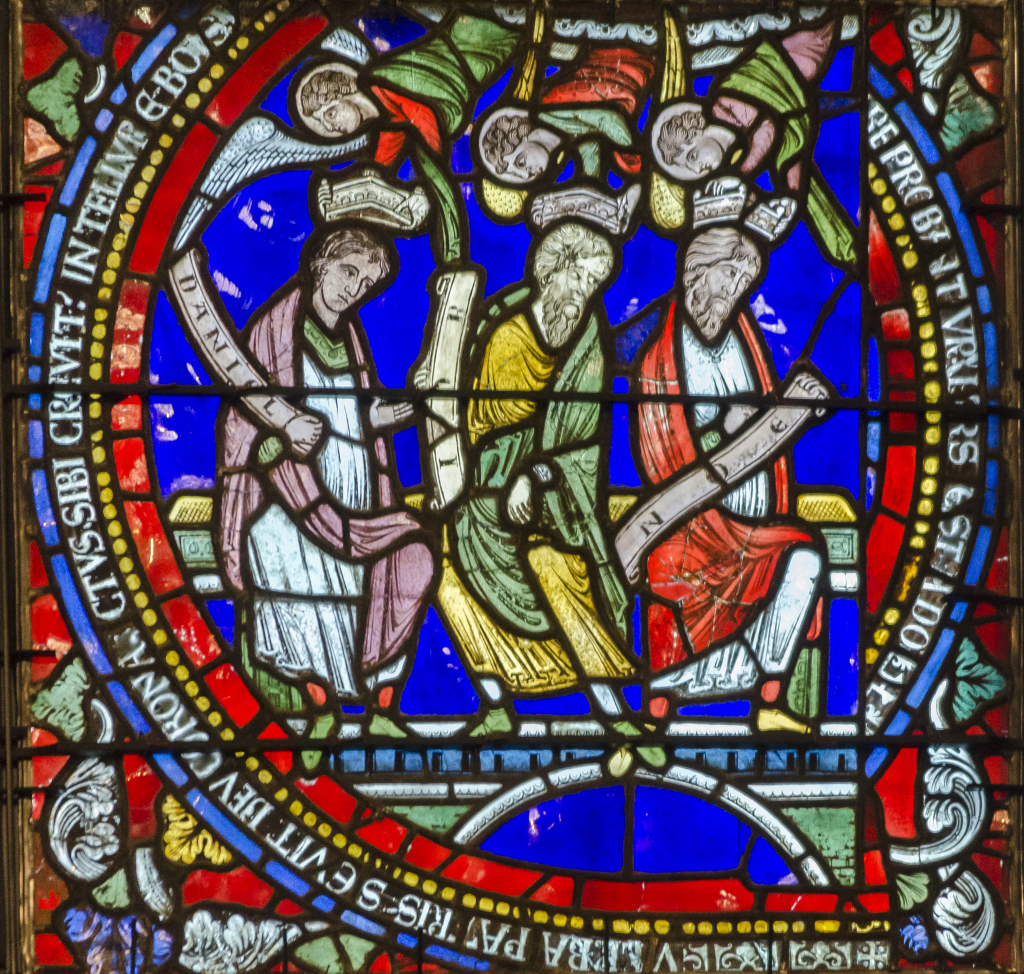
Stained glass of the three righteous men: Daniel, Job, and Noah

No person, group, institution, or nation can act unjustly forever. The prophet Ezekiel made it clear that everyone will be held accountable for injustice and wickedness, for crimes against humanity and against God.

Furthermore, there is no nation or group which can rely on a few persons who do right, while the rest of the people swim in injustice and unrighteousness. Righteous persons save only themselves; they cannot make decisions and take over the life of another person.

Ezekiel wanted to make sure his listeners got the message of individuals only saving themselves, and not riding on the coattails of others. The prophet went out of his way to communicate that each individual person will be held responsible for their own actions; they will be judged on what they themselves have done, and not what another has or has not done.

Even the family of a righteous person will not be spared divine judgment because of that individual’s righteousness. One shall be held accountable for what that one has done, period.

Specifically, in the text, God was ready to execute judgment on Jerusalem. War, wild animals, famine, and disease would come upon them because of unfaithfulness, injustice, and unrighteousness.

Just because the city had the temple, this would not save them. Just because there are a few righteous persons in the city, they would not save it. Just because a close loved one is faithful and righteous, will not mean that God would spare the city.

A few good works of a few people, do not cancel out pervasive and consistent evil which is perpetrated by many people. Each person is responsible for their own behavior. No one gets a pass, simply because they know certain people and are well-connected.

Evil is evil, no matter whether it is perpetrated by believers or unbelievers. No nation, and no person, is off the hook; all persons will be held accountable for doing justice, loving mercy, and walking humbly with God.

Even if three of the most righteous persons show up – Noah, Daniel, and Job, who were famous for their moral integrity – their combined righteousness and faithfulness would not keep away divine judgment from happening in an immoral and unethical society. Only those three alone would be delivered.

There is no such thing as salvation by proxy. Each individual person must work on themselves, without blaming others, inordinately depending on others, nor ignoring God and wishing God did not see, or does not exist at all.

Evil persons do not get any preferential treatment from God, just because they have a prominent position or are famous. The Lord, as Sovereign of the universe, has every right to exact divine retribution. And God will do it without showing favoritism.

Just as God shows mercy without prejudice, so will God extend judgment without any prejudice.

The presence of great light means that there is also the presence of great darkness. If we want a great God of love and mercy, then we must also accept the God of wrath and judgment; and vice versa.

We are made in God’s image, and not the other way around. It is our task to submit to the high, holy, and sovereign Lord of all. It is not God’s job to be the divine Santa Claus who submits to us. The Lord is no divine genie who we can keep in a bottle, and summon whenever we so desire.

No matter one’s theology or spirituality, everyone discerns that they are to be responsible in this life, and are accountable to forces greater than themselves.

This is one of those universal realities that all of us need to sync our lives with – or suffer the consequences.

Almighty God and Sovereign Lord of all, I embrace my accountability to you. Forgive me for when I live as though I need not give an account of what I said and did. I affirm that I am accountable for how I treat others; and I realize that what I do to others, positive or negative, I am doing to you, their Creator. Sustain me in faith and patience, I pray. Amen.