Caring For the Aged (1 Timothy 5:1-8)

Do not rebuke an older man harshly, but exhort him as if he were your father. Treat younger men as brothers, older women as mothers, and younger women as sisters, with absolute purity.

Give proper recognition to those widows who are really in need. But if a widow has children or grandchildren, these should learn first of all to put their religion into practice by caring for their own family and so repaying their parents and grandparents, for this is pleasing to God. 

The widow who is really in need and left all alone puts her hope in God and continues night and day to pray and to ask God for help. But the widow who lives for pleasure is dead even while she lives. Give the people these instructions, so that no one may be open to blame. Anyone who does not provide for their relatives, and especially for their own household, has denied the faith and is worse than an unbeliever. (New International Version)

Timothy was the young Pastor of the Church in Ephesus, having been appointed by his mentor, the Apostle Paul. Paul wrote to his protégé in order to clarify and remind Timothy of how to go about his ministerial duties amongst the congregation.

In dealing with older persons, Paul instructed that they must not be dealt with harshly. There needs to be gentleness and moderation in correcting any faults with elders. Old folks already take quite enough medicine they don’t like. No one, especially some whipper-snapper, ought to come along and add some bitter medicine to their regimen.

Instead, provide exhortation which is tolerable, and evidences genuine concern and humility. Make it good medicine.

Timothy was not to allow the older folks to get away with being stinkers. And the way to handle this is by being respectful, considerate, and gentle.

Since the Body of Christ is a family, older men need to be treated as fathers, and older women as mothers. The younger women, too, must be corrected, when necessary. Although it is a delicate task, it needs to be engaged with the same care as the older men.

If Timothy thought about his ministry with people as dealing with his own mother, then he would do it with a great deal of love, humility, grace, and wisdom. Not only is the message to be conveyed; the spirit behind the message is just as important.

Younger women are to be treated as sisters; and young men as brothers. The way everyone is handled is significant. All persons, without exception, need love and attention.

The Apostle pointed out that there are certain groups of people which require special attention. Therefore, distressed widows need to be honored and treated with high regard.

A father to the fatherless, a defender of widows,
    is God in his holy dwelling. (Psalm 68:5, NIV)

Widows are identified in Scripture as those who are under the special care of God. So, how we treat them, is how we are treating God.

Any widow in the church who had no little to no support were to be provided for by the church. In the earliest church, this was important enough to warrant the creating of a new church ministry of deacons. (Acts 6:1-6)

Those widows who have children and/or grandchildren are to be first and foremost cared for by their family. Paul was unequivocable on this point. He insisted that a family with needy members, such as widows, are to put their religion into practice by ensuring that their mother or grandmother or aunt or any widow in the family is given what they need to live.

The Apostle’s directive to Timothy is that the church must not be unnecessarily burdened. Paul’s larger concern, however, was that adult children should honor their parents. That is their first religious duty as Christians. They ought to make a real and substantial effort toward mom and dad by providing for them in their old age, when they need it.

“It is easier for one poor father to bring up ten children, than it is for ten rich children to provide for one poor father.”

Dutch proverb

The provision for needy parents is to be done with a spirit of gratitude, love, and appreciation. I understand that this admonition gets rather dicey when it comes to adult children who were raised by a mother or father who was, at best, a stinker, and at worst, downright mean or abusive.

Yet, the wise Christian will learn to find ways toward returning a curse with a blessing, and so, honors both the parent and God. This in no way requires ignoring one’s own needs; it just means that we will strive to discover how to honor and provide for an aged mom or dad.

Having said that, there is a wide difference between the widow who puts her trust in God, and the widow who lives frivolously with no concern for God or others. The pious widow with no family must be cared for by the church. And the dissolute widow is not to be treated the same. The church, as well as the family, will need to be creative in how to approach such widows.

Each case within both the church and the family needs to be considered on its own merits. There is not necessarily a one-size-fits-all approach in every situation with a needy person. The following verses are helpful for us, as we consider how to assist:

Jesus said to his disciples,

 “A new command I give you: Love one another. As I have loved you, so you must love one another.” (John 13:34, NIV)

“My command is this: Love each other as I have loved you.” (John 15:12, NIV)

And the Apostle Paul said to the Church in Galatia,

“Carry each other’s burdens, and in this way you will fulfill the law of Christ.” (Galatians 6:2, NIV)

Whatever we do, or not do, we are not to neglect needy persons in our family or faith community. To reject or deny such persons is tantamount to rejecting one’s Christian faith.

Let us strive for both duty and delight in caring for the needy amongst us. Both are important. Sheer duty without delight is mere drudgery; it cannot be sustained. And only delight without any duty is irresponsible; it is also unsustainable.

May God’s provision and blessing be with you, as you strive to honor both your biological family, and your spiritual family. Amen.

Pass Along Values (1 Kings 2:1-11)

David’s Dying Charge to Solomon, by Ferdinand Bol (1616-1680)

David’s time was coming to an end. So he commanded Solomon his son, “I’m following the path that the whole earth takes. Be strong and be a man. Guard what is owed to the Lord your God, walking in his ways and observing his laws, his commands, his judgments, and his testimonies, just as it is written in the Instruction from Moses.

“In this way you will succeed in whatever you do and wherever you go. So also the Lord will confirm the word he spoke to me: ‘If your children will take care to walk before me faithfully, with all their heart and all their being, then one of your own children will never fail to be on the throne of Israel.’ 

You should know what Joab, Zeruiah’s son, has done to me and what he did to the two generals of Israel, Abner, Ner’s son, and Amasa, Jether’s son. He murdered them, spilling blood at peacetime and putting the blood of war on the belt around his waist and on the sandals on his feet. So act wisely: Don’t allow him to die a peaceful death. 

“As for Barzillai’s sons from Gilead, show them kindness. Let them eat with you. When I was running away from your brother Absalom, they came to me. 

“Now as for this Shimei, Gera’s son—a Benjaminite from Bahurim—who is with you, he cursed me viciously when I went to Mahanaim. When he came down to meet me at the Jordan, I swore to him by the Lord, ‘Surely I won’t execute you with the sword.’ But you don’t need to excuse him. You are wise and know what to do to him. Give him a violent death.”

Then David lay down with his ancestors and was buried in David’s City. He ruled over Israel forty years—seven years in Hebron and thirty-three years in Jerusalem. (Common English Bible)

David

On David’s deathbed, he ensured that his son Solomon would be king. And David had some pragmatic advice to pass along, before he himself passed away.

Along with an encouragement to remain faithful to God’s covenant stipulations, David communicated some personal scores to Solomon that needed to be settled. Old general Joab, as well as Shimei, a servant from Saul’s old house, were threats to the new king’s reign in Israel and Judah.

Joab and Shimei

King David had a complicated relationship with Joab. At issue for David was the murder of two opponents to the king. Joab had killed them in a time of peace, and not because of a wartime situation.

On top of that, Joab had thrown his lot in with Adonijah, Solomon’s half-brother, who had tried to wriggle onto the throne before David was even gone.

And then there was the character Shimei. He had cursed David repeatedly when yet another half-brother to Solomon, Absalom, engaged in a coup attempt against his father.

Once the threat had passed, Shimei made a quick about face back to David. The king told Shimei that he would not kill him. But with Solomon, David communicated that he was completely free to do what needed to be done with the old rascal Shimei.

Fathers

Ideally, all fathers would have the chance to communicate to their children at the end of their lives. Yet, having been at the bedside of many a father in my work as a hospital chaplain, I’ve not seen many who pass along wisdom and instructions on their deathbed.

Fortunately, there are times when I can help facilitate the conversation between father and family. Yet, unfortunately, there are far too many times when fathers simply die with no loved ones present; or they badger someone to promise to stop doing something.

Rare, however, are the experiences of expressing some sound instruction, along with instructions about how to deal with life.

I realize that wills and documents do much of this work nowadays, yet I still argue that face-to-face communication which reinforces one’s values is always a good idea – especially at the end of one’s life.

Honestly, nobody really needs to wait until they are nearly gone to communicate important values and sage advice to loved ones. It can be done now, before it’s too late.

I’m talking about more than healthcare decisions for the actual end of life situation – but about the grace, forgiveness, wisdom, and/or moral values one wants their loved ones to know; or to reinforce those things that are of upmost importance.

It seems to me that thinking through the following values, and how to communicate them, can be done now, and, if appropriate and possible, at the end of one’s life:

Empathy

Treat others with compassion and understanding. Practice kindness. Consider the emotions of others. Seek to understand another’s point of view. Encourage family members to talk about their feelings. 

Therefore, as God’s choice, holy and loved, put on compassion, kindness, humility, gentleness, and patience. (Colossians 3:12, CEB)

Relationships

In the end, the only thing permanent and enduring is relationships. We cannot take any of our stuff with us. Prioritize time with people, especially family. It only makes sense to value loved ones by putting our time into them.

Be happy with those who are happy, and cry with those who are crying. Consider everyone as equal, and don’t think that you’re better than anyone else. (Romans 12:15-16, CEB)

Honesty

Telling the truth is not always easy, but it’s essential to maintaining trust between people. Life requires knowing and living by the truth.

“You are truly my disciples if you remain faithful to my teaching. Then you will know the truth, and the truth will set you free.” (John 8:31-32, CEB)

Love

Deep affection and attachment connects people and keeps them together. It’s important to verbally express love, as well as to demonstrate it with actions.

Don’t be in debt to anyone, except for the obligation to love each other. Whoever loves another person has fulfilled the Law. (Romans 13:8, CEB)

Commitment

Support one another in difficult times; and do not intentionally harm each other. Don’t shame your family for mistakes they’ve made. Instead, express loyalty and encouragement.

Be the best in this work of grace in the same way that you are the best in everything, such as faith, speech, knowledge, total commitment, and the love we inspired in you. (2 Corinthians 8:7, CEB)

Respect

Treat everyone, and especially family members, with the upmost care and politeness; and discourage disrespectful words and offensive behavior.

Submit to each other out of respect for Christ. (Ephesians 5:21, CEB)

Perseverance

Your family will face many complex challenges in the years ahead. Encourage them to embrace shared goals, practice self-care, and patiently work together in order to overcome obstacles. 

We even take pride in our problems, because we know that trouble produces endurance, endurance produces character, and character produces hope. (Romans 5:3-4, CEB)

It is always open season on passing along wise and good values, no matter whether it’s in a calm or a calamitous season of life.

Almighty God, enable me to be mindful of your mercy and happy to do your will. Bless my family with honest work, sound learning, and good manners. Save us all from violence, division, and confusion; and from pride and arrogance, and all evil. Protect us, and keep us united.

Grant Your wisdom to all in positions of authority and influence, so that there may be justice and peace at home, and obedience and submission everywhere. In times of prosperity, fill our hearts with grace and gratitude, and in times of trouble, help us trust in Your divine justice, righteousness, and goodness; through Jesus Christ our Lord. Amen. 

Ministry to the Poor and Needy (2 Corinthians 9:1-5)

If I wrote any more on this relief offering for the poor Christians, I’d be repeating myself. I know you’re on board and ready to go. I’ve been bragging about you all through Macedonia province, telling them, “Achaia province has been ready to go on this since last year.” Your enthusiasm by now has spread to most of them.

Now I’m sending the brothers to make sure you’re ready, as I said you would be, so my bragging won’t turn out to be just so much hot air. If some Macedonians and I happened to drop in on you and found you weren’t prepared, we’d all be pretty red-faced—you and us—for acting so sure of ourselves.

So to make sure there will be no slipup, I’ve recruited these brothers as an advance team to get you and your promised offering all ready before I get there. I want you to have all the time you need to make this offering in your own way. I don’t want anything forced or hurried at the last minute. (The Message)

Organizing relief efforts, and giving to relief organizations, is nothing new. Poverty and need has existed as long as humans have been on this earth. The constant rub is this: Some people aren’t in poverty, and some are.

So how do we get resources from the people who have them to the people who are really in need? Just as important, and perhaps more basic, how will folks care enough about the poor to give money and basic relief?

The Apostle Paul informed the Corinthian Church that he boasted about them to the Macedonians – about their eagerness to participate in ministry toward their fellow believers in need. The Macedonian believers had been ready to participate for quite some time.

In stating this, Paul intended to stir up the Corinthians about the offering for believers in Jerusalem. He had organized a delegation of Macedonians, along with persons from Paul’s own ministry team, to go to Corinth together. The last thing Paul wanted was to have the Corinthians unprepared to give.

Paul was a person who intended to do good, and then followed through with it. He held people accountable for their actions and inactions. He organized the benevolent offering for Jerusalem’s believers, and then made sure that all of the churches good intentions became reality.

Although Paul’s concern in organization and accountability may strike some as coercion for funding, it seems to me that a more plausible reason is that Paul simply wanted to try and ensure that everyone’s giving was done from a place of love, not coaxing or guilting.

The Apostle wanted believers and churches working together for good purposes. He wanted everyone to have a positive experience of helping and being united in spirit and purpose. The churches were young, and Paul was doing everything he could to encourage their growth in grace.

A good way of fostering unity and mission would be to have the churches participate in helping needy believers in Jerusalem. It was a very worthy and needed cause – and also served the cause of Christ.

What’s more, ministry to the poor has always been a hallmark of pure religion. A concern, dedication, plan, and accountable action on behalf of the poor helps everyone, and demonstrates authentic ministry.

My dear friends, pay attention. God has given a lot of faith to the poor people in this world. God has also promised them a share in his kingdom that he will give to everyone who loves him. (James 2:5, CEV)

We are to care about the needy because God cares about persons trapped in poverty. The poor are people; and all people are important. Jesus came to this earth to have a ministry to them; and he lifted a text from Scripture (Isaiah 61:1) to give his reason for doing so:

“The Spirit of the Lord is upon me because he has chosen me to bring good news to the poor.”(Luke 4:18, GNT) 

God has a lot to say about the poor and needy because they are dear to the divine heart. The Old Testament law was quite clear about how to treat the poor: 

Poor persons will never disappear from the earth. That’s why I’m giving you this command: you must open your hand generously to your fellow Israelites, to the needy among you, and to the poor who live with you in your land.(Deuteronomy 15:11, CEB)  

Let’s keep in mind that only the poor in spirit will enter the kingdom of heaven. Our trust is to be in God, and not in our money or our stuff. 

The genuine believer has a real humility that demonstrates grace to people who cannot offer them something in return. It’s easy to be merciful to those who will turn around later and scratch our backs. But it is altogether a different thing to give without any strings attached. 

God cares about the condition of our souls, and not the balance on our bank statements. Since God does not judge people on face value, nor on the state of their finances, then neither should we.

The Apostle Paul, in his ministry, sought to teach others in the way of Jesus by:

  • Turning people from only associating with those they are comfortable with, to lovingly reaching out to people very different from themselves
  • Changing people’s thinking from what they can obtain and consume, to becoming people of love and generosity with their words and their physical resources
  • Putting to death: a proud spirit that looks to get ahead; all personal petty agendas; accumulation of more power; and exertion of control – but instead, provide humble repentance and forgiveness

Ministry to the poor is a non-negotiable for the Christian church. Beyond only dispensing benevolent funds, the poor need relationships, connections, resources, and a chance to give back in ways they can contribute.

Lord God, you came to honor the least, the forgotten, the overlooked, and the misjudged. You came to make the last, the left behind, the misunderstood, and the undervalued, first. You came to give a warm welcome to the lost, the orphaned, the abandoned and the destitute.

Help us to be your ears to listen to their cries; and your voice speaking out love and acceptance. Help us to be your feet walking beside those in need; and your hands to clothe, feed and shelter them. You came for the least, the lost and last of this world. Lord, hear our prayer. Amen.

What Will You Do with Jesus? (John 5:1-18)

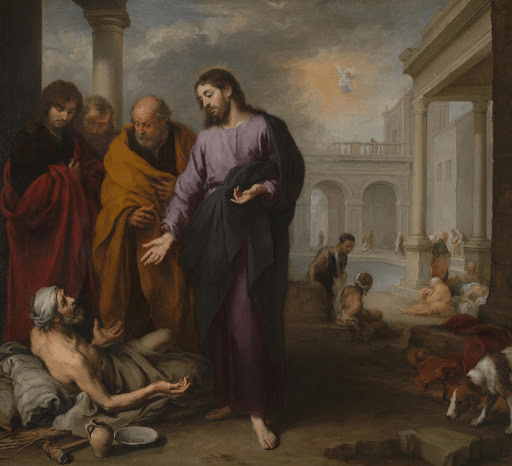
Healing the Paralytic, by Bartolomé Esteban Murillo, 1670

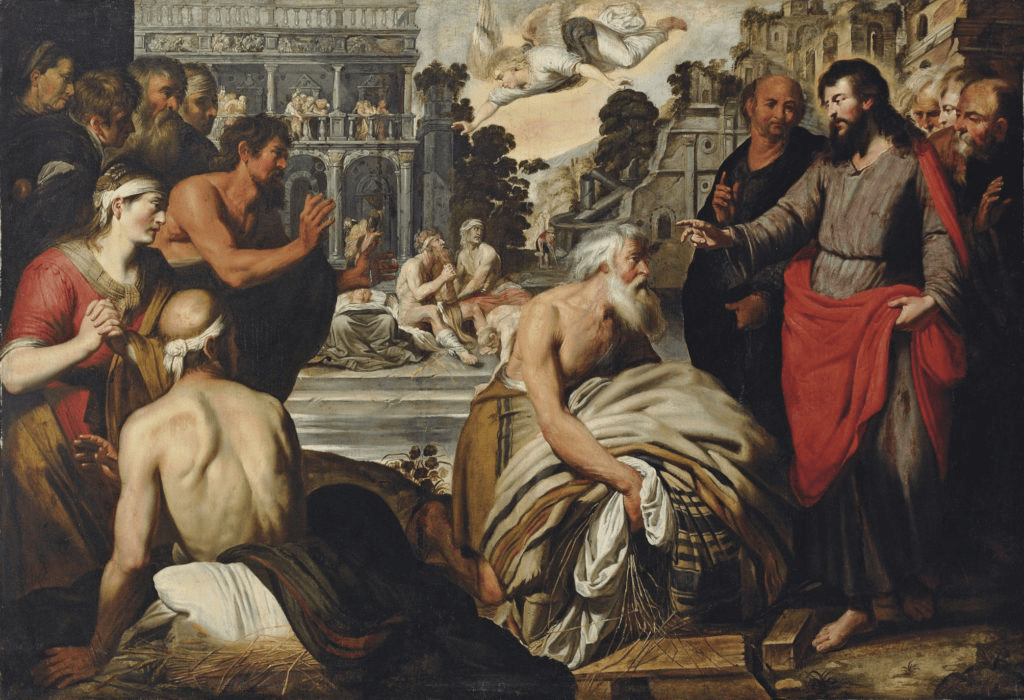
Sometime later, Jesus went up to Jerusalem for one of the Jewish festivals. Now there is in Jerusalem near the Sheep Gate a pool, which in Aramaic is called Bethesda and which is surrounded by five covered colonnades. Here a great number of disabled people used to lie—the blind, the lame, the paralyzed. One who was there had been an invalid for thirty-eight years. When Jesus saw him lying there and learned that he had been in this condition for a long time, he asked him, “Do you want to get well?”

“Sir,” the invalid replied, “I have no one to help me into the pool when the water is stirred. While I am trying to get in, someone else goes down ahead of me.”

Then Jesus said to him, “Get up! Pick up your mat and walk.” At once the man was cured; he picked up his mat and walked.

The day on which this took place was a Sabbath, and so the Jewish leaders said to the man who had been healed, “It is the Sabbath; the law forbids you to carry your mat.”

But he replied, “The man who made me well said to me, ‘Pick up your mat and walk.’ ”

So they asked him, “Who is this fellow who told you to pick it up and walk?”

The man who was healed had no idea who it was, for Jesus had slipped away into the crowd that was there.

Later Jesus found him at the temple and said to him, “See, you are well again. Stop sinning or something worse may happen to you.” The man went away and told the Jewish leaders that it was Jesus who had made him well.

So, because Jesus was doing these things on the Sabbath, the Jewish leaders began to persecute him. In his defense Jesus said to them, “My Father is always at his work to this very day, and I too am working.” For this reason they tried all the more to kill him; not only was he breaking the Sabbath, but he was even calling God his own Father, making himself equal with God. (New International Version)

Christ at the Pool of Bethesda, by Artus Wolffort, c. 1625

During one of the yearly Jewish festivals, on a Sabbath day, a miracle happened. Miracles of healing are typically accompanied by celebration and joy. But not so much with this one.

It’s one of those things about living in a messed up world of broken systems, that an invalid can start walking and there are people who have frowns and furrowed brows about it.

Granted, the man who was healed by Jesus may seem a bit hard to like in some ways. We don’t really know what he was into, but when Christ bestows healing on you, then says to stop sinning, it’s probably a significant sin to warrant the Lord’s exhortation.

Regardless of any sort of sin, the man appears to be paraplegic. Especially in the ancient world, this meant all sorts of problems had to be navigated – such as needing others to literally carry you around (no wheelchair or handicapped accessible anything), long periods of social isolation, lack of bodily control over your bowels and bladder, and the continual needs for cleanliness.

This made the man hard to like by many people just because he likely had strong body odors and had to crawl to get around if no one would help. He would not have been pleasant to look at. But he would have to make sure you did because, in the absence of any charity, the guy’s only option was to beg.

I’m glad there are greater forces in the world than indifference and dislike. There is grace – which is an act of bestowing honor and/or forgiveness to another person. It is not dependent upon whether one deserves it. Grace chooses not to hold something over or against another. It is a deep concern for others that comes from within and not from without.

“I do not understand at all the mystery of grace – only that it meets us where we are but does not leave us where it found us.”

Anne Lamott

Another gracious act that Jesus did was to honor the man’s dignity by respecting him with a question. By asking a question, we don’t assume we know what’s best for another. Sincere questions acknowledge another’s basic humanity. “Do you want to get well?” Jesus asked.

In the life of being an invalid and having little control over much of anything, including one’s own body, being asked a question is to receive the gift of autonomy.

There are many times in my work as a hospital chaplain that I speak with patients who don’t have a lot of control in their lives. I go out of my way to ask questions such as, “May I come in?” “Is it alright with you if I pull up a chair and sit down?” “Would you be okay telling me about what is going on?” “May I pray with you?”

This is important, because there are too many other people in this world who would just barge into a room, act like they own the place, and talk at them, and not with them – hence reinforcing to the person that they’re nothing compared to others, that they don’t have any real say.

The man’s response to Jesus was to essentially say that he is alone. He has no one to help him. Even though the man is in a city, surrounded by hundreds and thousands of others, he is lonely.

Not anymore. Jesus saw him, even inquired about him and learned about the man. Jesus Christ, the Lord of all, cared about a non-descript invalid and was sincerely curious about him. In a world of everyone for himself, Jesus championed the lonely and the lost.

A simple command to obey was all. Christ told the man to pick up his mat and walk. That’s it. Just as words created the world, so a few words created a whole new life for the man. So, he got up, and he walked.

It’s interesting that the religious leaders never seemed to notice the man when he was lame, but now that he’s up and walking around, they pay attention to his apparent work on a Sabbath.

The invalid was validated by Jesus, but Jesus, the one validated by the Father, was invalidated by the religious leaders, who are the spiritual invalids.

It was against the (their) rules to carry something around. Apparently, it was okay for people to be lonely, not contribute to society in meaningful and dignifying ways, and to suffer; but it’s not okay to walk and carry a mat.

Even worse, is anyone who would heal on the Sabbath and tell the healed person to walk and carry a mat. It was so bad, apparently, that it warranted persecuting such a person. But that’s what happens when people are forced to serve rules, instead of the rules serving people.

On top of it all, Jesus was working; and he justified it by stating that his Father keeps working. This was dangerously close to blasphemy by likening himself to God. For the religious leaders, not only was Jesus unethical in breaking the law, but he was also theologically immoral; he claimed a special relation with God.

The more that laypeople get to know Jesus, the more compelling he becomes; they want to follow him. But the more that clergy discover Jesus, the more angry they become and want to do away with him.

Ultimately, it is Jesus we must contend with, and not the law and our interpretations of scripture. We need to decide what we are going to do with Jesus… what will you do?…