Acts 2:14-24 – From Flaky to Faithful

Preaching of the Apostles (crayon on paper) by Peter Gorban, 1990

Peter stood up with the Eleven, raised his voice and addressed the crowd: “Fellow Jews and all of you who live in Jerusalem, let me explain this to you; listen carefully to what I say. These people are not drunk, as you suppose. It’s only nine in the morning! No, this is what was spoken by the prophet Joel:

“‘In the last days, God says,
    I will pour out my Spirit on all people.
Your sons and daughters will prophesy,
    your young men will see visions,
    your old men will dream dreams.
Even on my servants, both men and women,
    I will pour out my Spirit in those days,
    and they will prophesy.
I will show wonders in the heavens above
    and signs on the earth below,
    blood and fire and billows of smoke.
The sun will be turned to darkness
    and the moon to blood
    before the coming of the great and glorious day of the Lord.
And everyone who calls
    on the name of the Lord will be saved.’

“Fellow Israelites listen to this: Jesus of Nazareth was a man accredited by God to you by miracles, wonders and signs, which God did among you through him, as you yourselves know. This man was handed over to you by God’s deliberate plan and foreknowledge; and you, with the help of wicked men, put him to death by nailing him to the cross. But God raised him from the dead, freeing him from the agony of death, because it was impossible for death to keep its hold on him. (NIV)

In the New Testament Gospels of the Holy Bible, the Apostle Peter was a flake. He sometimes got it, and sometimes didn’t. Peter could discern Jesus was Messiah, but then would turn around and refuse that Christ had to die on a cross. He would get bold and walk on water, then, end up falling short and needing help from drowning. Peter stood tall for Jesus, and then denied him three times.

However, following the Gospels in the Acts of the Apostles, Peter is a completely changed man. He now gets it. He is brave. He confesses Christ with confidence and boldness. And, while the reader might be waiting for the other shoe to drop yet again, all the while Peter does not falter, flinch, or back down. Alright, Peter, way to go!

So, what is the difference between the Gospels and Acts with Peter? Why is there such a turnaround from flaky to faithful? The Scriptures make it plain: The Holy Spirit comes upon Peter. And he is never the same again. Everything falls into place for Peter. He proclaimed the life and death of Jesus in such a way that thousands changed their way of thinking, as well as their way of life, and placed their faith and hope in Christ as Savior and Lord. Not a bad day’s work for a former fisherman.

Peter’s message was pointed and straightforward: God raised Jesus up, forever changing the nature of death. Peter was dogmatic about stating that it wasn’t even possible for death to get a grip on Jesus. Oh, death thought it had him, the Grim Reaper believed he had Christ nailed to death for certain. Not so. The grave could not contain the immense and incredible power of divine love for humanity.
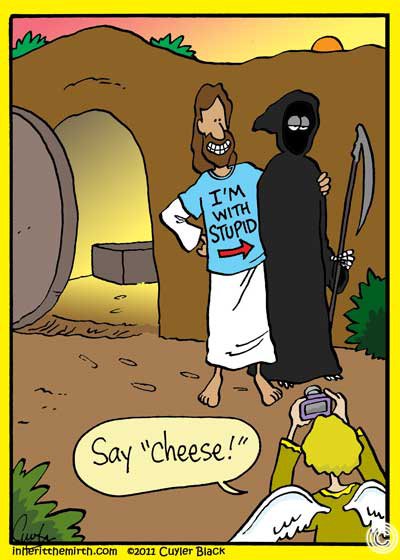
Inherit the Mirth

If it was impossible for death to keep its grip on Jesus, then there is absolutely nothing that can deter Jesus or hold him back from accomplishing what he wants to accomplish. Flaky believers are not going to frustrate Jesus or upset his plans; he’ll just send the Holy Spirit. 

We too often imprison ourselves in self-made spiritual jail cells, flaking-out in the Christian life, sometimes getting it right and once-in-a-while hitting upon some right combination we can’t explain, like a golfer who hits an amazing shot but can’t reproduce it no matter how hard he tries. The truth is: Jesus has conquered sin, death, and hell. By faith, we have forgiveness of sins in Christ and have the way opened to a new life in the Spirit. It isn’t a secret; it is a new reality.

The season of Lent is a time of remembering those things which hinder us in our walk with Jesus and repenting of our sins so that we can live anew. As we quickly approach Holy Week, the golf clubs of vulnerability, confession and prayer will keep us in God’s fairway and allow us to shoot par.

Gracious God, who raised Jesus from the dead, may the same power reside in me so that I can do your will in every situation through the power and presence of your Holy Spirit.  Amen.

Psalm 51:1-12 – Facing Our Darkness

Photo by cottonbro on Pexels.com

Have mercy on me, O God,
    according to your steadfast love;
according to your abundant mercy
    blot out my transgressions.
Wash me thoroughly from my iniquity,
    and cleanse me from my sin.

For I know my transgressions,
    and my sin is ever before me.
Against you, you alone, have I sinned,
    and done what is evil in your sight,
so that you are justified in your sentence
    and blameless when you pass judgment.
Indeed, I was born guilty,
    a sinner when my mother conceived me.

You desire truth in the inward being;
    therefore teach me wisdom in my secret heart.
Purge me with hyssop, and I shall be clean;
    wash me, and I shall be whiter than snow.
Let me hear joy and gladness;
    let the bones that you have crushed rejoice.
Hide your face from my sins,
    and blot out all my iniquities.

Create in me a clean heart, O God,
    and put a new and right spirit within me.
Do not cast me away from your presence,
    and do not take your holy spirit from me.
Restore to me the joy of your salvation,
    and sustain in me a willing spirit. (NRSV)

David experienced a lot of hard things. Through it all, he held fast to walking with God. Eventually, David became king. He used his power and authority to do exactly what God likes – showing grace and kindness to those in need. Except in the case of Bathsheba, another man’s wife. He made one unwise decision, which led to a bad decision, and then to another and another – until the prophet Nathan came and called David on the carpet.

Whereas King David began his reign using his royal position to show kindness, he ended up acting like any other worldly king by giving orders and using his authority to get what he wanted. Just as David sent others to do his personal bidding, God finally sent Nathan for a divine intervention.

If we confess our sins, God will forgive us. We can trust God to do this. He always does what is right. He will make us clean from all the wrong things we have done.

1 John 1:9, ERV

Nathan wisely helped David see his sin for what it really was. Irresponsibility, adultery, and murder are serious matters. The mental and spiritual gymnastics people make to justify their poor decisions always ends up devaluing what is right and making sin less heinous than it really is.

Good news can only be properly understood considering the bad news.

Without seeing our true predicament of being held in the vice grip of sin and unable to move, we will go on wondering why nothing ever goes like we want. A person who is lost, and doesn’t know it, is in the worst of situations. Calamity is just around the corner.

Like a restaurant owner who fails to see the health violations all around him, the business is about to be shut down with him scratching his head or blaming others for his misfortune. Only when the owner comes to recognize and agree with established health standards will there be a turn around and a renewed existence for the establishment.

We must agree and comply with God about how bad things really are without sugar coating any of it.

Only then can best practices be put into place which help everyone to be safe, healthy, and happy. To King David’s credit, he saw his terrible decisions and actions for what they were and faced them squarely with a repentant heart and a renovated life.

Thus, we have today’s psalm, crafted by David as a response to his own egregious wandering from how God wanted him to reign as king. David’s sin was mercifully outdone by God’s grace. The main event to the psalm is not David’s wrongs but God’s forgiveness. Prayer is the mechanism which accesses divine pardon to even the most awful of transgressions.

The appropriate posture of the devout Christian is to pray.

Specifically, to confess our great and many sins, shortcomings, and moral failures. This might sound negative and a major downer. Yet, to not look evil square in the face and call it out for what it is, is at best denial, and at worst, allows a bitter seed of unforgiveness to gestate in the depths of your soul. 

I believe one of the best ways to confront the darkness within is by using the ancient prayer book, the Old Testament Psalms. Sometimes when we pray apart from considering the psalms, our prayers go along the lines of something like, “Change my situation so I can praise you, God.” Rather, the psalms guide us toward a shift in direction by praying:

“Change me, God, because I am the problem.”

I encourage you to pray Psalm 51 out loud, slowly, with a generous amount of emotional flavor – even, and especially, if you don’t feel like it. Pray it over more than once, and perhaps several times punctuated throughout the day today. In doing so, you will be joining the faithful across the world who today offer God a prayer of subversion against the blackness on this earth.

What places in your life allow you the freedom to confess your sins?  What places seem to keep you from confession? How might a regular practice of repentance help you beyond this season of Lent?

May almighty God, who has promised forgiveness of sins to all who turn in faith, pardon you and set you free from all your sins, strengthen you for right living, and keep you in eternal life, through Jesus Christ our Lord. Amen.

Exodus 20:1-17 – Perspective Changes Everything

Welcome, friends! Sometimes in our lives we can get lost in our thinking – only seeing things from one perspective. God’s Word invites us to see differently – to view ourselves, others, and the world in ways that can change our lives. Click the videos below and let us explore that perspective…

Pastor Tim Ehrhardt
Words written and sung by Michael W. Smith

The instructions of the Lord are perfect,
    reviving the soul.
The decrees of the Lord are trustworthy,
    making wise the simple.
The commandments of the Lord are right,
    bringing joy to the heart.
The commands of the Lord are clear,
    giving insight for living.
Reverence for the Lord is pure,
    lasting forever.
The laws of the Lord are true;
    each one is fair.
They are more desirable than gold,
    even the finest gold.
They are sweeter than honey,
    even honey dripping from the comb.
They are a warning to your servant,
    a great reward for those who obey them.

How can I know all the sins lurking in my heart?
    Cleanse me from these hidden faults.
Keep your servant from deliberate sins!
    Don’t let them control me.
Then I will be free of guilt

    and innocent of great sin.

May the words of my mouth
    and the meditation of my heart
be pleasing to you,
    O Lord, my rock and my redeemer.

Amen. (Psalm 19:7-14, NLT)

Perspective Changes Everything

Perspective is everything. Nearly sixteen years-ago, me and my family were in a car accident. I was traveling on a highway in rural Iowa and a small car on a gravel road blew right through the stop sign without even slowing down. There was nothing I could do. I slammed into the rear quarter panel of his car, and he literally spun like a top off the highway and came to a stop. Both the driver and his girlfriend passenger were not injured. 

Two of my daughters were in the very back seat of our minivan, with my wife and dog as front seat passengers.  The girls were not harmed. However, my wife tore her shoulder’s rotator cuff trying to protect the dog and had to have surgery to repair it. My lower back was injured, but not in a way which surgery could repair. To this day I live with low-level chronic pain. Most days it’s not bad, maybe a one or two on the pain scale. But on a bad day I can barely walk across the room and need a cane to get around.

I have played the scene of the accident in my mind hundreds of times. I have thought over-and-over again about what I could have done to prevent the accident. Yet there was no way to avoid it. I thought about the fact that if we just would have left a minute earlier or a minute later from my parents’ house from where we were visiting, all would be fine. But I know that kind of thinking is a fool’s errand. I have pondered every possible scenario in my head and have gotten nowhere. 

It also took me awhile to forgive the young man who was driving the other car. He changed my life, and not in a good way. Although his insurance took care of everything and he was very repentant about the whole thing, I was understandably mad for a long time. I eventually did come to the point of forgiving him.

Over the years I have learned to live with my limitations. I have now accepted the sometimes-irritating pain as part of my life. Still, on occasion, I cannot help but think of what my life would be like today if I hadn’t been in that stupid senseless accident. 

“Everything that irritates us about others can lead us to an understanding of ourselves.”

carl jung

About six years ago I was praying alone in the church for which I was a pastor, at the time. God brought the accident to my mind. I said to God, “Lord, we’ve been through this accident hundreds of times together. I don’t want to think about it anymore. Why are you bringing this up now?”

Even though I wasn’t really looking for an answer to my question, God brought it up because the Lord knew I was finally ready to get a divine perspective on the accident. Out of the hundreds of times I went over that accident, the one perspective I never took was that of the young man – the other driver. God invited me to take the young driver’s view of what happened that day. So, I did.  I know that intersection like the back of my hand, so it wasn’t a hard exercise. 

I put myself in the driver’s seat of his car. I’m driving down the gravel road not paying attention to the fact that a stop sign is coming up. I blow through the sign onto the highway and right in front of a minivan who slams on the brakes just enough to plow into the rear quarter panel. I spin out like a top and come to rest only a few feet from a huge Iowa grain elevator.

For the first time in my life, I finally understood. God had a divine appointment for me that day. You see, if I had not come along just when I did, that young man and his girlfriend would have blown through the stop sign and struck that grain elevator. It would have killed them both instantly.

“Life is 10 percent what you make it and 90 percent how you take it.”

Irving Berlin

Suddenly, my perspective changed 180 degrees. I always thought about me and my family. I always considered my hardship and my change of life. But now I saw that God sent his servant to save two lives that day. Had I not struck his car, causing him to spin and come to a rest unharmed, two people would have died. 

Now, every time my back acts up and it effects how my life is lived, I’m reminded that it is a small price to pay for the lives of two human beings. Perspective changes everything.

The Bible invites us to view our lives from a different perspective. Our hurts and our pains, our sorrows and our sufferings, our changes, and our limitations, are all part of something much bigger God is doing in the world.  We are not always privy to God’s plans and purposes. Yet God’s Word challenges us to take a perspective of the world, of humanity, and of ourselves which is counter to how we often think.

In this season of Lent, we are invited to read God’s Word and practice repentance – literally, a change of mind.  We are invited to see the Ten Words (Commandments) as the glasses through which we are to view our relationship with God and our relationships with others (Exodus 20:1-17). Jesus, summarizing those Ten Words, put it this way: All the Law hangs on loving God and loving our neighbor. (Matthew 22:36-40)

The thread of those moral words, those ethical commands, runs through the entirety of God’s Word, the Bible. The psalmist reminds us that this Word is good, sweet, and more precious than gold (Psalm 19:7-14). The Apostle Paul reminds us that this Word is our wisdom to live by (1 Corinthians 1:18-25).  And Jesus, as the Word made flesh among us, lived that loving and gracious Word with perfect moral and ethical goodness.

The temple, as the place where God’s Word was read and observed, was not to be adulterated with making a profit – which was why Jesus drove out the moneychangers.  And he did it with flavor! (John 2:13-22) Later, after Jesus died and rose from death, the disciples remembered their master’s words and affirmed them as being the Word of God. They believed. Their faith and repentance changed the world.

God is inviting us to take up the Divine Word and see our lives, the lives of others, and every event and situation through that lens. We are to see Jesus, not only as a great teacher, a moral and good person, and a loving healer – but also as Lord and Savior. In a small way, I suffered so that someone else could live. Yet Jesus suffered sin, death, and hell in our place so that you and I could live – so that we might have the eternal life of enjoyment with God forever.

Allow the Word of God to shape your lives and form your thinking today and every day. You might not always know what God is doing, but you can be assured that everything God does is just, right, and good. 

May you know God’s peace today. May you know Christ better in this season as you reflect upon our Lord’s great sacrifice on our behalf.