Hosea 3:1-5 – Reconcile the Past

Then the Lord said to me, “Go and love your wife again, even though she commits adultery with another lover. This will illustrate that the Lord still loves Israel, even though the people have turned to other gods and love to worship them.”

So, I bought her back for fifteen pieces of silver and five bushels of barley and a measure of wine. Then I said to her, “You must live in my house for many days and stop your prostitution. During this time, you will not have sexual relations with anyone, not even with me.”

This shows that Israel will go a long time without a king or prince, and without sacrifices, sacred pillars, priests, or even idols! But afterward the people will return and devote themselves to the Lord their God and to David’s descendant, their king. In the last days, they will tremble in awe of the Lord and of his goodness. (New Living Translation)

Sometimes you have to get your behind in the past before you can put your past behind you.

The ancient nation of Israel was in a spiritual pickle. Gradually, over hundreds of years, they made small decisions of compromised religion which added up to a severe breach of faith with their historic God.

The relationship between God and God’s people, throughout the prophetic books of the Old Testament, is many times likened to a marriage of two spouses – God, the faithful spouse, and Israel, the unfaithful spouse who adulterated themselves by seeking the love of other gods.

This situation evoked feelings of sadness and anger within God. To help restore the broken marriage, the Lord used the prophet Hosea as an earthly illustration of the divine/human dilemma.

Just as Hosea graciously took a wife of dubious repute, so God mercifully took Israel. Just as Hosea’s wife, Gomer, slept with other men, so Israel went to bed with other gods. And just as Hosea remained faithful and actively sought to reconcile the past with his wife, so God tenaciously and dramatically honored the covenant relationship with Israel by showing steadfast love, despite her sordid past.

Israel needed to do her part by reconciling the past – returning to the Lord through acknowledging the truth of the situation and owning their responsibility to make things right.

Holy Scripture exhorts the believer to live according to truth. Whenever we fail to do so, we suffer spiritual loss. We are told to confess and reject unfaithful patterns of past behavior and not allow them to influence us today (Titus 2:12; 1 Peter 1:14, 18). 

Neglecting our responsibility inevitably causes emotional, mental and physical repercussions, as well as spiritual. In the New Testament, when the Apostle Paul said he was forgetting what is behind and straining toward what is ahead, he could say that because he had come to terms with and reconciled his own terrible unfaithful past with God. (Philippians 3:4-13)

It is both helpful and necessary to go back into one’s life and deal with the past on the basis of truth. In doing so, we honor our relationship with God. We must ask the Lord to turn the searchlight of truth on us and our past. 

Trust God to help you remember all the times in which you need to reconcile what has happened (or failed to happen). Make the choice before God to be as honest as you possibly can. 

The following are some suggestions from a former professor and mentor, the late Dr. Victor Matthews, (put in my own words) to carefully follow:

  1. Write out every time you were unfaithful or were hurt by another’s unfaithfulness (reject the temptation to just think and/or talk about it). Be complete, name the people involved, state what happened, do not try and protect yourself or other people and do not fantasize and let your thoughts run amok.
  2. Evaluate each past event on the basis of truth. If you were unfaithful, then confess it to God truthfully and receive forgiveness and cleansing (1 John 1:9). If you were hurt by someone, and it was their fault, then state out loud that “_______ should not have done that to me.” When you have finished writing out the event(s) deliberately stop and completely forgive the person(s) (Mark 11:25-26).  If you were at fault in some way, then confess that to God, as well.
  3. Resist the temptation to hurry with this process! Do not generalize by putting many events into one. Be specific and take the time necessary to get in touch with what God is trying to help you connect with.  This practice of reconciling the past is not introspection, so do not indulge in self-pity, self-criticism, or develop a martyr syndrome.
  4. Affirm that your inner critic, others, and any dark force may no longer use your past against you. “In the Name of the Lord Jesus Christ I take this event away from Satan and declare that he may not use it against me anymore!” (Ephesians 4:27; 5:11; 6:14).
  5. Receive the healing provided for those who believe and live according to God’s words and ways (Isaiah 53:5). “Now that I have made this right with you, O Lord, I receive the healing you have provided for me through the cross of Jesus Christ.” (Galatians 2:19-20)

When you have finished your work, then count it finished. When Jesus said, “It is finished!” he meant what he said. (John 19:30)

Reconciling the past means leaning into the finished work of Jesus for our complete healing. If and when we think of our unfaithful past, then firmly state: “I have dealt with that truthfully. It is settled, once and for all.” 

Whenever unfaithful, from this point forward, confess it, receive forgiveness, and make the affirmations of truth. In doing so, we are living by faith in the Son of God who loved us and gave himself for us. Amen.

Matthew 5:5 – Blessed Are the Meek

Blessed are the meek,
    for they will inherit the earth. (NIV)

To give us a flavor of Christ’s counter-cultural Beatitudes, when was the last time, or has anyone ever, described themselves to you as meek?

Whenever I have interviewed people for positions, both paid and voluntary, and asked them to tell me their strengths, I have never had anyone say to me, “I’m a meek person.”

Why would I want to be meek?

Far too often, we equate meek with weak. If someone is meek, we may wrongly reason they must be a washrag, or overly introverted, and maybe not taking proper initiative in life. Of all the character qualities we might aspire to, I doubt that meekness is on anyone’s top ten list of desired qualities.

Yet, of the few words in the Gospels which Jesus uses to describe himself, one of those words is meek. And even then, many English translations steer clear of the word. For example, the New International Version of the Bible says in translating the words of Jesus, “Come to me all you who are weary and burdened, and I will give you rest. Take my yoke upon you and learn from me, for I am gentle and humble in heart, and you will find rest for your souls. For my yoke is easy and my burden is light.” (Only the King James Version translates the word as “meek,” instead of “gentle.”)

What does it mean to be meek?

Meek and gentle are the same words. The original Greek word is πραεῖς (pronounced “prah-ace”). “Meek” is the word used in other ancient Greek literature for breaking a horse. It is to be changed from being a wild stallion who wants to go his own way, to a broken horse who is gentle before the Master and allows others on his back without bucking.

Consider, for example, the scene around Christ’s crucifixion. Jesus was naked, exposed, and vulnerable to the idle curiosity of the crowd and the vulgar frivolity of the soldiers who were having a party around his suffering. “If you are the king of the Jews,” they taunted, “save yourself.”

And yet the extraordinary thing is there was no spirit of revenge with our Lord. Jesus did not curse his tormentors. Instead, he prayed, “Father forgive them, for they don’t know what they’re doing.” (Luke 23:24)

It is important to notice the meekness that Jesus is speaking about in this Beatitude is not being a pushover. Meekness is not to be confused with being nice and easy-going. Meek and lowly as he was, Jesus could also take a whip to greedy money-changers in the Temple. We must not confuse meekness with weakness.

What characterizes a meek person?

Whereas poverty of spirit is more a humility before God, meekness is a humility toward other people. It is to be flat on our backs with only one way to look: up to God; and because we are in that position, there is no opportunity to look down on others. 

Meekness is a foundational Beatitude. Jesus considers it a necessary part of righteousness. I believe the word “meek” needs a renaissance. Even if we use the word “gentle” this will be a great advancement in how people interact with one another. So, what characterizes a meek person?

  • The meek have a desire to put other’s interests ahead of their own, because they know it is not all about them. They practice healthy rhythms of giving and receiving with others, without prejudice or favoritism.
  • The meek are more concerned with edifying and building up their brothers and sisters than justifying themselves. They don’t care who gets the credit. And they receive criticism well.
  • The meek are truly egalitarian and do all things with equity and inclusion. They make no distinctions between rich and poor, beautiful and ugly, intelligent and cognitive deficits, black and white, gay and straight, Democrat and Republican, or insider and outsider. In the meek person’s mind, every person is created in the image of God and therefore deserves respect, attention, and justice.

It is the meek who will inherit the earth – not aggressive people who believe in survival of the fittest, stepping on people to get where they want to go, or badgering others in order to get their way. 

Someone might protest, “But if I live this way, I’ll be pushed around.”  Meekness is not living without boundaries but is power under control. Maybe you will get stepped on – but you will inherit the earth.

How do I live as a meek person?

The three Beatitudes of being poor in spirit, mourning over sin, and meekness toward others are foundational to all that Jesus says and does. They are central to being Christ’s follower. Without them, there is only a contrived legalistic righteousness of our own without any real need of God. That is the way of pride, which is the straight and broad road to hell. 

Perhaps repentance is in order. It could be that too many people have made much more of themselves than what they truly are. Maybe we have adopted a soft attitude toward shame and shaming others, believing that some people need a bit of guilt from us to change their obnoxious ways. Perhaps we have paid scant attention to those who are in physical or spiritual poverty. And just maybe we have ignored and gossiped about others simply because we believe we are better than them.

A genuine follower of Christ lives a repentant lifestyle. The Apostle James said, “Confess your sins to one another, and pray for one another so that you may be healed” (James 5:16).  The way of Christ is the way of community. We are not to live ingenuine lives, hiding behind a mask of outward conformity. Now is the time for authenticity, living life as God intended it to be lived, as a disciple of Jesus in the way of spiritual poverty, mourning, and meekness – the narrow path that leads to salvation.

Non-retaliation happens when we realize our poverty of spirit and practice grief and lament. When we are flat on our backs before God, there is no place to look but up. And it means there is no ability to look down on others. It is to be broken and moldable before God. 

If you and I were part of the original crowd that listened to Jesus, there is hope. I have no ability to practice retaliation, even if I wanted to, because I have no earthly power. But that’s okay because, in this spirit of meekness, I take personal responsibility for my attitudes and my actions. I am neither worse nor better than any other person. I do not need to retaliate, even when egregiously wronged, because I can fully entrust myself to God alone who judges the living and the dead. 

Conclusion

It turns out that brokenness is the path to genuine righteousness. Jesus promised that the meek will inherit the earth. Christ didn’t just make that up. He was quoting Holy Scripture:

Do not fret because of those who are evil
    or be envious of those who do wrong;
for like the grass they will soon wither,
    like green plants they will soon die away.

Trust in the Lord and do good;
    dwell in the land and enjoy safe pasture.
Take delight in the Lord,
    and he will give you the desires of your heart.

Commit your way to the Lord;
    trust in him and he will do this:
He will make your righteous reward shine like the dawn,
    your vindication like the noonday sun.

Be still before the Lord
    and wait patiently for him;
do not fret when people succeed in their ways,
    when they carry out their wicked schemes.

Refrain from anger and turn from wrath;
    do not fret—it leads only to evil.
For those who are evil will be destroyed,
    but those who hope in the Lord will inherit the land.

A little while, and the wicked will be no more;
    though you look for them, they will not be found.
But the meek will inherit the land
    and enjoy peace and prosperity. (Psalm 37:1-11, NIV)

Jesus was saying that only the truly meek will learn contentment, joy, and satisfaction. Their ego is not so inflated that they insist they deserve more. Indeed, because as God’s people they are learning from him, the meek understand they are co-heirs with Christ in an inheritance of God’s kingdom.

May your meekness and gentleness be known to all.

*Above painting by Hyatt Moore

2 Corinthians 7:2-16 – Genuine Sorrow Changes Us

Make room for us in your hearts. We have wronged no one, we have corrupted no one, we have exploited no one. I do not say this to condemn you; I have said before that you have such a place in our hearts that we would live or die with you. I have spoken to you with great frankness; I take great pride in you. I am greatly encouraged; in all our troubles my joy knows no bounds.

For when we came into Macedonia, we had no rest, but we were harassed at every turn—conflicts on the outside, fears within. But God, who comforts the downcast, comforted us by the coming of Titus, and not only by his coming but also by the comfort you had given him. He told us about your longing for me, your deep sorrow, your ardent concern for me, so that my joy was greater than ever.

Even if I caused you sorrow by my letter, I do not regret it. Though I did regret it—I see that my letter hurt you, but only for a little while— yet now I am happy, not because you were made sorry, but because your sorrow led you to repentance. For you became sorrowful as God intended and so were not harmed in any way by us. Godly sorrow brings repentance that leads to salvation and leaves no regret, but worldly sorrow brings death. See what this godly sorrow has produced in you: what earnestness, what eagerness to clear yourselves, what indignation, what alarm, what longing, what concern, what readiness to see justice done. At every point you have proved yourselves to be innocent in this matter. So even though I wrote to you, it was neither on account of the one who did the wrong nor on account of the injured party, but rather that before God you could see for yourselves how devoted to us you are. By all this we are encouraged.

In addition to our own encouragement, we were especially delighted to see how happy Titus was, because his spirit has been refreshed by all of you. I had boasted to him about you, and you have not embarrassed me. But just as everything we said to you was true, so our boasting about you to Titus has proved to be true as well. And his affection for you is all the greater when he remembers that you were all obedient, receiving him with fear and trembling. I am glad I can have complete confidence in you. (New International Version)

“The only vice that cannot be forgiven is hypocrisy because the repentance of a hypocrite is itself hypocrisy.”

William Hazlitt (1778-1830)

I’m in the soul business. Not in the Detroit Mo-town Aretha Franklin kind of soul business (although that would be very cool) but in the sense of leading human souls to God and building them up in Christ. Key to the Christian life’s soul is the term “repentance.”  To repent means to turn around, to stop going in one direction and start going in another one. It is repentance which makes all the difference in the direction of our souls.

Certainly, no one can really judge the heart of another. Yet, today’s New Testament lesson lets us in on how to truly measure the sincerity of a person’s repentance. 

Worldly sorrow or grief does not lead to repentance, but disconnection and death. People with worldly sorrow beat themselves up but never really change direction. Like Judas Iscariot of old, they just hang themselves instead of admitting guilt to Jesus. 

Godly sorrow, however, leads to repentance, a change of direction. And here is the evidence of the genuine change: 

  • Owning the problem.
  • Eagerness to make things right.
  • Indignation over what has been done or said.
  • Discernment that there is more pain in avoiding the problem than there is confronting it.
  • Desire and energy to do what is best for the person who was wronged.
  • Willingness to accept whatever consequences which might result from the offense.

Crying and weeping might be necessary. Yet the tears can also be a cheap form of avoiding true repentance. 

Whether there are tears, or not, there must be solid action that changes direction and seeks to rectify offenses, as much as it is within our control to do so. 

Deliverance from the power of guilt and shame comes through repentance. There are no shortcuts or easy routes to the soul’s orientation to practical godliness. 

There is nothing romantic about repentance. It is typically messy, usually ugly, and often painful. Yet, there must be suffering before there is glory. Attempting to remove true repentance from personal transformation only eviscerates the Christian life and leaves our souls vacuous and empty.

Instead, we carefully, tediously, and patiently go about the important work of repentance, with all its deep sorrow, regret, vulnerability, challenge, awkwardness, and courage.

Holy God, I confess to you the things which I have said and done, as well as those things I have left unsaid and undone. And, yet your mercy is from everlasting to everlasting. Open my eyes to the ways I have offended others and failed to build them up. Help me to step boldly into repentance and faith in Jesus Christ, through the power of the Holy Spirit.  Amen.

A Big Glorious Vision of Worship

In the year that King Uzziah died, I saw the Lord, high and exalted, seated on a throne; and the train of his robe filled the temple. Above him were seraphim, each with six wings: With two wings they covered their faces, with two they covered their feet, and with two they were flying. And they were calling to one another:

“Holy, holy, holy is the Lord Almighty;
    the whole earth is full of his glory.”

At the sound of their voices the doorposts and thresholds shook, and the temple was filled with smoke.

“Woe to me!” I cried. “I am ruined! For I am a man of unclean lips, and I live among a people of unclean lips, and my eyes have seen the King, the Lord Almighty.”

Then one of the seraphim flew to me with a live coal in his hand, which he had taken with tongs from the altar. With it he touched my mouth and said, “See, this has touched your lips; your guilt is taken away and your sin atoned for.”

Then I heard the voice of the Lord saying, “Whom shall I send? And who will go for us?”

And I said, “Here am I. Send me!” (Isaiah 6:1-8, NIV)

Uzziah was a king of Judah who reigned for fifty-two years. For most of his rule, he followed God faithfully. Under Uzziah the Jews had enjoyed the best political stability, economic security, and consistent worship of God since the days of King Solomon, hundreds of years before. 

Yet, if one were to look below the surface of Judah, it was also a time of spiritual complacency, apathy in worship, taking prosperity for granted, and self-centered – often oppressing others. The nation needed a fresh experience of God, and it came through the prophet Isaiah.

The essence of worship is a recognition and celebration of the triune God. Worship is a relational rhythm between God and humanity in which God self-reveals and people respond.

Worship is an experience of seeing and hearing divine revelation; repenting from wayward actions; and renewing missional service.

Worshiping the triune God ideally happens every day. It’s a lifestyle – not the result of one cleverly planned hour on Sunday. The people of Isaiah’s day were going through the ritual motions of worship without having their hearts in it. Worship was a kind of rabbit’s foot for them in which, if they had regular attendance within the temple, they believed they could do whatever they wanted with their lives outside the temple. 

As a result, the people did not see or hear God in their worship. Authentic worship of God does not have to do with the environment, the fellowship, or the music. True worship of the triune God is a heart desire to see and hear God. 

If worship does not happen in the sanctuary, that is because worship fails to occur daily life. Real worship is a life-changing encounter with Father, Son, and Holy Spirit. It experiences God’s revelation and changes our view of him. Bona fide worship leads to repentance and changes our view of self. True worship brings spiritual renewal and changes our view of mission and service.

Revelation: Worship Changes Our View of God

Isaiah saw a vision of God in the majestic divine throne room. It was a grand and transcendent vision of a God who dominates the entire setting. The train of God’s robe filled the temple. This is Isaiah’s way of saying the vision was incredibly large. If the train of his robe fills up the temple, then God is an immense Being. Gaining a vision of God’s hugeness is what causes our human problems to be seen as small. 

One time the Assyrian King Sennacherib invaded the land and approached Jerusalem during the reign of Uzziah’s great grandson, Hezekiah. The Assyrians were the dreaded horde of the ancient world, and it seemed no one could withstand them. So, the people prayed:

King Hezekiah and the prophet Isaiah son of Amoz cried out in prayer to heaven about this. And the Lord sent an angel, who annihilated all the fighting men and the commanders and officers in the camp of the Assyrian king… So, the Lord saved Hezekiah and the people of Jerusalem from the hand of Sennacherib king of Assyria and from the hand of all others. God took care of them on every side. (2 Chronicles 32:20-22, NIV)

Isaiah’s vision included seraphs – angels with the job description to glorify God with ceaseless praise. Their physical description symbolizes their function: covering their face symbolizes humility in God’s presence; covering their feet identifies it as holy ground; and flying symbolizes their work to do God’s will.

The seraphs have two-thirds wing power for worship, and one-third wing power for work. If this is any indication how God’s creatures are to conduct their lives, we as humans have a great deal of adjusting to do to accommodate the worship of God.

The sound of worship that came from the seraphs was proclaiming God’s holiness. Isaiah’s view of God changed as a result. As he saw God’s glory, Isaiah saw God as much bigger than he had before. For example, European visitors who come to the United States sometimes have no frame of reference as to how spacious the geography of our country is.

Some have a notion they can make day trips to places like San Francisco, Houston, or New York City because where they live is much more geographically compact. But once they get here, they experience the land in all its glory, and they gain an appreciation for the bigness of America. We all need to experience God’s glory and see God’s holiness because it will cause us to repent of old ways of seeing.

Repentance: Worship Changes Our View of Self

Isaiah was reduced to nothing after seeing a vision of the holy God. Humans cannot see God’s glory without also seeing their sinful selves. Isaiah’s response to God was not praise, but confession. Show me a proud, self-centered, and arrogant person and I will show you a person who has not seen God. Isaiah was unable to cleanse his own sin. Isaiah needed God to purge and purify his uncleanness. The New Testament says:

If we live in the light in the same way as he is in the light, we have fellowship with each other, and the blood of Jesus, his Son, cleanses us from every sin… If we confess our sins, he is faithful and just to forgive us our sins and cleanse us from everything we’ve done wrong. (1 John 1:7, 9, CEB)

Seeing God completely unravels us, for we see our depravity for what it truly is:

  • When the Apostle Peter saw the Lord’s immensity and power through a miraculous catch of fish he fell at Jesus’ knees and said, “Go away from me, Lord; I am a sinful man.” (Luke 5:8) 
  • When the Apostle John had a vision of Christ’s glory, and heard his voice, he fell at the Lord’s feet as though dead. (Revelation 1:12-17)
  • When the prophet Ezekiel had a vision of God and saw the appearance of God’s glory, he fell facedown. (Ezekiel 1:25-28)
  • Even Daniel, perhaps the most righteous prophet of all time, when seeing a vision of God’s glory, fell prostrate with his face to the ground, totally overwhelmed with God’s holiness and his own human sinfulness. (Daniel 8:15-18)

There is wickedness and indifference in the world. People do not see God’s glory and holiness. Because, if they did, they would be totally undone and see the foulness and degradation of hate and injustice. They would turn from apathetic and complacent ways of living. The world and the church need a vision of a holy God that comes from meeting with God. Isaiah saw the Lord. And because he repented, he was then able to hear the voice of God.

Renewal: Worship Changes Our View of Service

God is calling us. God’s voice has gone out. If we do not hear it, it’s because we have not experienced God’s self-revealing and have not responded with repentance. Apart from worship, we are unable to hear God. While Isaiah was worshiping God, he saw, responded, and heard the Lord. The early church heard the voice of God to service and mission:

The church at Antioch had several prophets and teachers…. While they were worshiping the Lord and fasting, the Holy Spirit told them, “Appoint Barnabas and Saul to do the work for which I have chosen them.” Everyone prayed and fasted for a while longer. Next, they placed their hands on Barnabas and Saul to show that they had been appointed to do this work. Then everyone sent them on their way. (Acts 13:1-3, CEV)

Isaiah was willing. He didn’t ask any clarifying questions. He neither inquired what the mission would be nor questioned God as to the plan. Isaiah plainly said, “Here I am, send me.”  It was an unconditional response to hearing God. Isaiah made no deals with God, did not try and negotiate terms of service. Isaiah simply told God he was willing to be sent. 

Many people fill their lives with stuff and activity. And they are unable to hear the voice of God. There’s just too much noise drowning out God. We have uncritically, without any discernment through prayer and worship, filled our lives to overflowing with never-ending things to do. And we have even sanctified it and called it holy, as if God’s will for us is to be constantly on the go.

Someday, we must give an account of our lives. God will ask why we did not take a risk, get involved, and go out into the world with a deep sense of mission. Too many people will say, “I never heard the call!” Yet, God was calling. “Whom shall I send? And who will go for us?” says the triune God.

Conclusion

God’s glory was revealed to Isaiah. Isaiah responded to that vision with confession and repentance. This brought a renewed sense of mission to his life. Isaiah was then able to hear God’s voice calling him to service. It is not our ability God cares about. Because God can equip anybody for any type of work. Instead, it is our availability God cares about.

We need to put ourselves in a position to see and hear God. The obstacles to visioning God’s glory and hearing God’s voice are legion: inattention to God’s Word and God’s creation; no mindfulness to the Holy Spirit; intense, constant, and prolonged preoccupations; lack of availability to the ways of Jesus; little sleep; unhealthy habits; a dull spiritual sense; lack of personal and divine awareness; a paucity of spiritual practices and disciplines; and a failure to be able to experience a vision of God.

God has graciously revealed himself to us as Father, Son, and Spirit. The Trinity is not so much a doctrine to believe as it is a powerful reality to live into. If we see and hear God today it will cause us to repent and be renewed in mission and service.

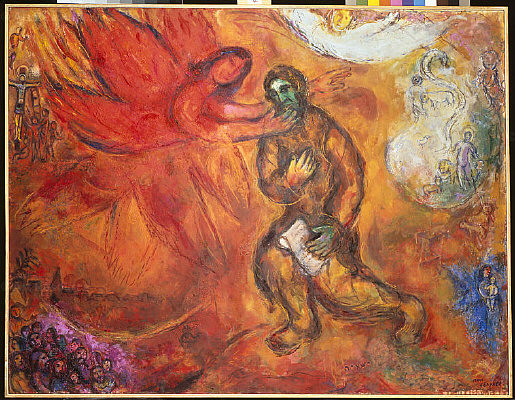
*Above painting of the prophet Isaiah by Marc Chagall, 1968