

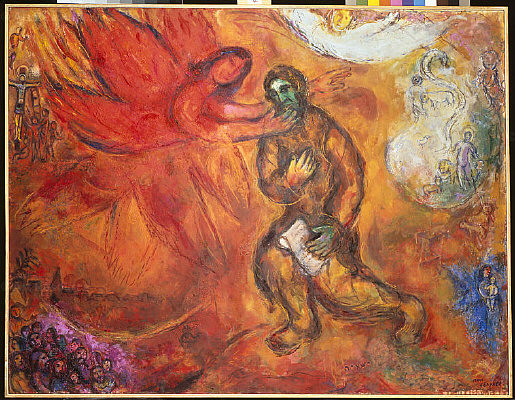
A Big Glorious Vision of Worship

In the year that King Uzziah died, I saw the Lord, high and exalted, seated on a throne; and the train of his robe filled the temple. Above him were seraphim, each with six wings: With two wings they covered their faces, with two they covered their feet, and with two they were flying. And they were calling to one another:

“Holy, holy, holy is the Lord Almighty;
    the whole earth is full of his glory.”

At the sound of their voices the doorposts and thresholds shook, and the temple was filled with smoke.

“Woe to me!” I cried. “I am ruined! For I am a man of unclean lips, and I live among a people of unclean lips, and my eyes have seen the King, the Lord Almighty.”

Then one of the seraphim flew to me with a live coal in his hand, which he had taken with tongs from the altar. With it he touched my mouth and said, “See, this has touched your lips; your guilt is taken away and your sin atoned for.”

Then I heard the voice of the Lord saying, “Whom shall I send? And who will go for us?”

And I said, “Here am I. Send me!” (Isaiah 6:1-8, NIV)

Uzziah was a king of Judah who reigned for fifty-two years. For most of his rule, he followed God faithfully. Under Uzziah the Jews had enjoyed the best political stability, economic security, and consistent worship of God since the days of King Solomon, hundreds of years before. 

Yet, if one were to look below the surface of Judah, it was also a time of spiritual complacency, apathy in worship, taking prosperity for granted, and self-centered – often oppressing others. The nation needed a fresh experience of God, and it came through the prophet Isaiah.

The essence of worship is a recognition and celebration of the triune God. Worship is a relational rhythm between God and humanity in which God self-reveals and people respond.

Worship is an experience of seeing and hearing divine revelation; repenting from wayward actions; and renewing missional service.

Worshiping the triune God ideally happens every day. It’s a lifestyle – not the result of one cleverly planned hour on Sunday. The people of Isaiah’s day were going through the ritual motions of worship without having their hearts in it. Worship was a kind of rabbit’s foot for them in which, if they had regular attendance within the temple, they believed they could do whatever they wanted with their lives outside the temple. 

As a result, the people did not see or hear God in their worship. Authentic worship of God does not have to do with the environment, the fellowship, or the music. True worship of the triune God is a heart desire to see and hear God. 

If worship does not happen in the sanctuary, that is because worship fails to occur daily life. Real worship is a life-changing encounter with Father, Son, and Holy Spirit. It experiences God’s revelation and changes our view of him. Bona fide worship leads to repentance and changes our view of self. True worship brings spiritual renewal and changes our view of mission and service.

Revelation: Worship Changes Our View of God

Isaiah saw a vision of God in the majestic divine throne room. It was a grand and transcendent vision of a God who dominates the entire setting. The train of God’s robe filled the temple. This is Isaiah’s way of saying the vision was incredibly large. If the train of his robe fills up the temple, then God is an immense Being. Gaining a vision of God’s hugeness is what causes our human problems to be seen as small. 

One time the Assyrian King Sennacherib invaded the land and approached Jerusalem during the reign of Uzziah’s great grandson, Hezekiah. The Assyrians were the dreaded horde of the ancient world, and it seemed no one could withstand them. So, the people prayed:

King Hezekiah and the prophet Isaiah son of Amoz cried out in prayer to heaven about this. And the Lord sent an angel, who annihilated all the fighting men and the commanders and officers in the camp of the Assyrian king… So, the Lord saved Hezekiah and the people of Jerusalem from the hand of Sennacherib king of Assyria and from the hand of all others. God took care of them on every side. (2 Chronicles 32:20-22, NIV)

Isaiah’s vision included seraphs – angels with the job description to glorify God with ceaseless praise. Their physical description symbolizes their function: covering their face symbolizes humility in God’s presence; covering their feet identifies it as holy ground; and flying symbolizes their work to do God’s will.

The seraphs have two-thirds wing power for worship, and one-third wing power for work. If this is any indication how God’s creatures are to conduct their lives, we as humans have a great deal of adjusting to do to accommodate the worship of God.

The sound of worship that came from the seraphs was proclaiming God’s holiness. Isaiah’s view of God changed as a result. As he saw God’s glory, Isaiah saw God as much bigger than he had before. For example, European visitors who come to the United States sometimes have no frame of reference as to how spacious the geography of our country is.

Some have a notion they can make day trips to places like San Francisco, Houston, or New York City because where they live is much more geographically compact. But once they get here, they experience the land in all its glory, and they gain an appreciation for the bigness of America. We all need to experience God’s glory and see God’s holiness because it will cause us to repent of old ways of seeing.

Repentance: Worship Changes Our View of Self

Isaiah was reduced to nothing after seeing a vision of the holy God. Humans cannot see God’s glory without also seeing their sinful selves. Isaiah’s response to God was not praise, but confession. Show me a proud, self-centered, and arrogant person and I will show you a person who has not seen God. Isaiah was unable to cleanse his own sin. Isaiah needed God to purge and purify his uncleanness. The New Testament says:

If we live in the light in the same way as he is in the light, we have fellowship with each other, and the blood of Jesus, his Son, cleanses us from every sin… If we confess our sins, he is faithful and just to forgive us our sins and cleanse us from everything we’ve done wrong. (1 John 1:7, 9, CEB)

Seeing God completely unravels us, for we see our depravity for what it truly is:

  • When the Apostle Peter saw the Lord’s immensity and power through a miraculous catch of fish he fell at Jesus’ knees and said, “Go away from me, Lord; I am a sinful man.” (Luke 5:8) 
  • When the Apostle John had a vision of Christ’s glory, and heard his voice, he fell at the Lord’s feet as though dead. (Revelation 1:12-17)
  • When the prophet Ezekiel had a vision of God and saw the appearance of God’s glory, he fell facedown. (Ezekiel 1:25-28)
  • Even Daniel, perhaps the most righteous prophet of all time, when seeing a vision of God’s glory, fell prostrate with his face to the ground, totally overwhelmed with God’s holiness and his own human sinfulness. (Daniel 8:15-18)

There is wickedness and indifference in the world. People do not see God’s glory and holiness. Because, if they did, they would be totally undone and see the foulness and degradation of hate and injustice. They would turn from apathetic and complacent ways of living. The world and the church need a vision of a holy God that comes from meeting with God. Isaiah saw the Lord. And because he repented, he was then able to hear the voice of God.

Renewal: Worship Changes Our View of Service

God is calling us. God’s voice has gone out. If we do not hear it, it’s because we have not experienced God’s self-revealing and have not responded with repentance. Apart from worship, we are unable to hear God. While Isaiah was worshiping God, he saw, responded, and heard the Lord. The early church heard the voice of God to service and mission:

The church at Antioch had several prophets and teachers…. While they were worshiping the Lord and fasting, the Holy Spirit told them, “Appoint Barnabas and Saul to do the work for which I have chosen them.” Everyone prayed and fasted for a while longer. Next, they placed their hands on Barnabas and Saul to show that they had been appointed to do this work. Then everyone sent them on their way. (Acts 13:1-3, CEV)

Isaiah was willing. He didn’t ask any clarifying questions. He neither inquired what the mission would be nor questioned God as to the plan. Isaiah plainly said, “Here I am, send me.”  It was an unconditional response to hearing God. Isaiah made no deals with God, did not try and negotiate terms of service. Isaiah simply told God he was willing to be sent. 

Many people fill their lives with stuff and activity. And they are unable to hear the voice of God. There’s just too much noise drowning out God. We have uncritically, without any discernment through prayer and worship, filled our lives to overflowing with never-ending things to do. And we have even sanctified it and called it holy, as if God’s will for us is to be constantly on the go.

Someday, we must give an account of our lives. God will ask why we did not take a risk, get involved, and go out into the world with a deep sense of mission. Too many people will say, “I never heard the call!” Yet, God was calling. “Whom shall I send? And who will go for us?” says the triune God.

Conclusion

God’s glory was revealed to Isaiah. Isaiah responded to that vision with confession and repentance. This brought a renewed sense of mission to his life. Isaiah was then able to hear God’s voice calling him to service. It is not our ability God cares about. Because God can equip anybody for any type of work. Instead, it is our availability God cares about.

We need to put ourselves in a position to see and hear God. The obstacles to visioning God’s glory and hearing God’s voice are legion: inattention to God’s Word and God’s creation; no mindfulness to the Holy Spirit; intense, constant, and prolonged preoccupations; lack of availability to the ways of Jesus; little sleep; unhealthy habits; a dull spiritual sense; lack of personal and divine awareness; a paucity of spiritual practices and disciplines; and a failure to be able to experience a vision of God.

God has graciously revealed himself to us as Father, Son, and Spirit. The Trinity is not so much a doctrine to believe as it is a powerful reality to live into. If we see and hear God today it will cause us to repent and be renewed in mission and service.

*Above painting of the prophet Isaiah by Marc Chagall, 1968

Amos 9:7-15 – A Promise of Restoration

“Are you Israelites more important to me
    than the Ethiopians?” asks the Lord.
“I brought Israel out of Egypt,
    but I also brought the Philistines from Crete
    and led the Arameans out of Kir.

“I, the Sovereign Lord,
    am watching this sinful nation of Israel.
I will destroy it
    from the face of the earth.
But I will never completely destroy the family of Israel,”
    says the Lord.
“For I will give the command
    and will shake Israel along with the other nations
as grain is shaken in a sieve,
    yet not one true kernel will be lost.
But all the sinners will die by the sword—
    all those who say, ‘Nothing bad will happen to us.’

“In that day I will restore the fallen house of David.
    I will repair its damaged walls.
From the ruins I will rebuild it
    and restore its former glory.
And Israel will possess what is left of Edom
    and all the nations I have called to be mine.”
The Lord has spoken,
    and he will do these things.

“The time will come,” says the Lord,
“when the grain and grapes will grow faster
    than they can be harvested.
Then the terraced vineyards on the hills of Israel
    will drip with sweet wine!
I will bring my exiled people of Israel
    back from distant lands,
and they will rebuild their ruined cities
    and live in them again.
They will plant vineyards and gardens;
    they will eat their crops and drink their wine.
I will firmly plant them there
    in their own land.
They will never again be uprooted
    from the land I have given them,”
    says the Lord your God.
(New Living Translation)

Guilt

Doom and hope, judgment and grace, suffering and glory. These are the movements and rhythms of the Old Testament prophets. The great sin of Israel which warranted divine wrath was not only that they trampled on the poor and needy. On top of it all, they saw nothing wrong with their way of life. 

This profound lack of awareness, rooted in the spiritual blindness of greed, is what led to judgment. It would take the form of having the Assyrian Empire come, seize the land, and take the people away to a place where they would have no chance to oppress others. Sadly, death would come to many.

“The work of restoration cannot begin until a problem is fully faced.”

Dan Allender

The sin of oppressing others and believing there’s nothing wrong with it comes with severe consequences. The people relied too much on their ethnicity. The ancient Israelites wrongly assumed that because they were the people of the covenant, this somehow inoculated them from disaster. Their belief in Jewish exceptionalism was their downfall.

Grace

Yet, all would not be an endless gloom. The Lord will not destroy completely. God’s anger lasts for a moment. However, God’s grace lasts forever. Restoration, renewal, and fruitful times will come because of God’s mercy. 

Yes, God pronounces judgment when it is warranted. But God also makes and keeps promises to people. In our lesson for today, the Lord promises to restore the fortunes of the people through rebuilding ruined cities and letting them inhabit them once again.

God steps in and graciously acts on behalf of all people because that is what God does. We might get the notion in our heads that God executes judgment to teach people a lesson or to make a point. In my line of work, it is common to hear people express the idea they are under divine punishment because of personal illness or hard circumstances. 

God, however, acts independently out of a vast storehouse of righteousness and mercy. The Lord maintains holy decrees while showing grace to the undeserving. The nation of Israel, in the days of the prophet Amos, deserved only judgment, not grace. 

It seems to me God would have been completely justified to never restore or renew a recalcitrant people. Yet, God’s grace overwhelms and swallows human sin. Try as you might to understand grace, you will end up befuddled. That’s because grace is wildly illogical, nonsensical, and unconditionally free. Grace shows radical acceptance where there ought to be only the punishing fire of hell.

Gratitude

The height of grace and the pinnacle of restoring the fortunes of Israel (from a Christian perspective) came through a baby and a humble birth in the small village of Bethlehem. Jesus came to save the people from their sins. God acted by entering humanity with divine free love so that there could be new life and fresh hope. 

So, let grace wash you clean. Allow mercy to renew your life. Receive the gift of gracious forgiveness, merciful love, and divine peace. Look ahead and see there is hope on the horizon. Give thanks for God’s indescribable kindness.

Merciful God, although you are careful to uphold your great holiness, your mercy extends from everlasting to everlasting. May the gospel of grace form all my words and actions so that true righteousness reigns in my life through Jesus, my Lord, in the power of the Holy Spirit. Amen.

Mark 14:26-31 – Pride Comes Before the Fall

Peter Disowns Jesus by Ethiopian artist Nebiyu Assefa

When they had sung a hymn, they went out to the Mount of Olives.

“You will all fall away,” Jesus told them, “for it is written:

“‘I will strike the shepherd,
    and the sheep will be scattered.’

But after I have risen, I will go ahead of you into Galilee.”

Peter declared, “Even if all fall away, I will not.”

“Truly I tell you,” Jesus answered, “today—yes, tonight—before the rooster crows twice you yourself will disown me three times.”

But Peter insisted emphatically, “Even if I have to die with you, I will never disown you.” And all the others said the same. (New International Version)

Learning to Trust

I have two sisters-in-law who were lifeguards when they were teenagers. One day I watched one of them handle a group of kids experiencing their first swim lesson. She went to each child and told them to put their ears in the water and their belly buttons in the air while she was holding them up. “When I count to three, you won’t feel my hands underneath you, but they’re there,” she said. Most of the kids frantically jerked their knees toward their chins and flailed their arms. Truth is, almost all people float when they assume a posture of rest. But people who think they will sink don’t keep their posture for long. 

The disciples had a hard time trusting Jesus. They just couldn’t seem to rest and relax with Jesus holding them up. After all, Jesus said and did things they were not expecting him to say and do. Jesus preached the necessity of humility and loving one’s enemies. He focused ministry on the least and the lost. 

Different Agendas

The disciples had not yet really bought into Christ’s kingdom agenda. They kept pulling their knees up, thinking Jesus was going to lead a rebellion against the Romans and put Israel back on the map. Bless their hearts, the disciples mistakenly believed Jesus was there to immediately restore the glory days of Jewish dominance in the land.

Despite Christ’s teaching and ministry, some folks believe God’s agenda ought to be restoring prayer in public schools and The Ten Commandments back in courthouses. But Jesus has a different agenda. Christ goes to the heart of the matter. New life is what he is after. Transformation leads to observance of God’s will so the least and the lost persons among us will be reached. 

Jesus turned the world upside-down by insisting not that people come to the temple but that the temple worshipers go to the people. It was not a popular teaching with the disciples, let alone everyone else. The disciples had greater (or so they thought) ideas about how things ought to go.  

Christ followers might neglect the upside-down teaching ministry of Jesus because we believe ourselves to be good people. We already assume we know what God wants. And we would never betray Jesus, right!?  O, sure, we sin occasionally, but not like murderers and child molesters. Our sins are respectable – a little resentment here, a little prejudice there, or a smidge of gossip just to make sure outsiders know and respect their place.

However, we must first hear the bad news before we can hear the good news. And once we hear the bad news and accept it, we need to receive God’s remedy for it. The disciples Peter and Judas are contrasting figures in grasping Christ’s message and responding to it.

Peter and Judas

Peter and Judas had similar ideas about how the future should look – seeing Israel restored to its previous glorious prominence. Judas was a religious and political Zealot. And Peter had no problem picking up a sword when it seemed the time was ripe for a political rebellion and takeover.

Peter insisted he would never turn on Jesus. Yet, Jesus flat-out told him that would happen. Sure enough, Peter did a big belly flop in the pool of denial by disowning Jesus three times.

Then there was Judas. He caught on quicker than Peter that Jesus wasn’t going to lead a military coup. Talking about wasting time on marginal people who couldn’t help usher-in a glorious revolution was the last straw for him.  After Judas clearly saw Jesus had no intention of fulfilling what he thought should happen, he actively sought an opportunity to betray him.

In fact, none of the disciples wanted to take a step of commitment into the world of suffering as the means of reaching others. They wanted glory, not suffering. But Jesus chose the cup of suffering.

Both Judas and Peter realized, after denying Jesus, they had made a terrible mistake. However, that is where the similarities end. Judas responded to his guilt by completing suicide.  Rather than throw himself upon the mercy of God, Judas handled the guilt himself. It was a refusal of grace.

Peter, instead, wept bitterly. He realized his poverty of spirit. He mourned over his sin. Later, Peter became a genuinely meek person with God’s righteousness taking root within him. Having received grace, Peter became a preacher of truth and grace.

Stubborn Pride

Renewal comes from spiritual transformation. It requires a brutally honest assessment of self and others. “I will never fall” comes from a heart that believes “I’m not so bad.” Our failures of faith stem ultimately from pride and a lack of trust. We keep pulling our knees up because we are too anxious to let the agenda of Jesus control our lives. 

Proud people have little need for prayer because they are self-sufficient. However, humble people pray a lot! They don’t want to fall into temptation and defame the name of the Lord. They pray because apart from Jesus Christ they know they’ll act like a cockeye little dog who thinks he is a big dog. Even Jesus himself felt the need to watch and pray so that he could face his hour of pain and suffering on behalf of humanity.

When Jesus was arrested, Peter followed him at a distance. That describes too much of our own following of Christ. We want to see how everything will shake-out before we commit. Jesus invites us to trust him, to commit, to make and keep promises before we even know what it all means. 

It could be that we need to acknowledge we’ve made a mess of our lives through being stubborn. Perhaps we have willfully held to our own ideas of how things ought to go, for far too long.

If you find yourself in a mess, whether it is of your own making or of somebody else’s, grace is the thing that can handle it. That is, coming to God with honesty and humility. Being willing to rest and relax when Jesus is telling you to. It’s okay to let your knees go down and stick the belly button out – to rest in Jesus.

Give us honest hearts, O God, and send your kindly Spirit to help us confess our sins and bring us the peace of your forgiveness, in Jesus Christ our Lord. Amen.

Isaiah 60:15-22 – A Renewed Vision of Peace

Isaiah 60 by Margaret Nagib

Instead of being abandoned,
    hated, and forbidden,
    I will make you majestic forever,
    a joy for all generations.
You will suck the milk of nations,
    and nurse at royal breasts.
    You will know that I am the Lord, your savior
    and your redeemer, the mighty one of Jacob.
Instead of bronze I will bring gold;
    instead of iron I will bring silver;
    instead of wood, bronze;
    and instead of stones, iron.
I will make peace your governor
    and righteousness your taskmaster.
Violence will no longer resound throughout your land,
    nor devastation or destruction within your borders.
You will call your walls Salvation,
    and your gates Praise.
The sun will no longer be your light by day,
    nor will the moon shine for illumination by night.
The Lord will be your everlasting light;
    your God will be your glory.
Your sun will no longer set;
    your moon will no longer wane.
The Lord will be an everlasting light for you,
    and your days of mourning will be ended.
Your people will all be righteous;
    they will possess the land forever.
They are the shoot that I planted,
    the work of my hands, to glorify myself.
The least will become a thousand,
    and the smallest a powerful people.
I am the Lord; at the right moment, I will hurry it along. (CEB)

The people of ancient times typically had a love/hate relationship with prophets. After all, the Lord’s messengers gave verbal punches to the gut with bad news of judgment. But they also were bearers of good news, as well. So, it is important to hold both judgment and grace together. We need to always keep in mind that, despite human foibles, grace exists and is the grand operating force in God’s big world.

Good news turns to great news when there is a realization that judgment is deserved, yet it won’t have the last word. God’s grace always prevails in the end. God has a tenacious resolve to work out good for people, not ill. Although the Lord dispenses justice, sometimes with a firm hand, there is an unflagging commitment to divine love which will shine through the darkest of times.

God expertly knows how to make a reversal in people’s situations from hopeless despair to incredible fortune (and, I might add, vice versa). The Lord truly has plans of goodness and well-being for humanity. Humiliation and powerlessness will give way to exaltation and empowerment. Peace will eventually overcome both the human heart and human institutions.

Salvation and deliverance from the ills which plague both body and soul comes from the God who specializes in penetrating the blackest darkness with overwhelming light. And it is much more than personal well-being. Isaiah’s prophecy communicates a cosmic vision of peace which thoroughly works its way in all the shadowy places of the world. It is a vision of a new world and new life.

Because of God’s action in a broken and bruised world, we can make some bold and hopeful theological claims for God’s people:

  • God’s good grace and steadfast love are the superior forces in the church and the world. Because grace and love are pure gifts from the Lord, they are not dependent upon whether we deserve them, or not. The sheer fact that we need them is what prompts God to give generously and unsparingly. A new heaven and new earth are coming. Sin and death are not permanent.

Then I saw a new heaven and a new earth; for the first heaven and the first earth had passed away. (Revelation 21:1, NRSV)

  • God is the center of every good thing that was, is, and is coming. God’s world runs on God’s providence and power, and not on human agency. God is in control. All the Lord’s good promises shall not fail but will be realized. For the Christian, those promises are ultimately fulfilled in the person and work of Jesus Christ. When circumstances are at their worst, faith is at its best.

In everything we have won more than a victory because of Christ who loves us. I am sure that nothing can separate us from God’s love—not life or death, not angels or spirits, not the present or the future, and not powers above or powers below. Nothing in all creation can separate us from God’s love for us in Christ Jesus our Lord! (Romans 8:37-39, CEV)

  • God’s promises extend well beyond the “spiritual” to all of life. God’s peace will work its way into the fabric of the whole world, not just individual hearts. God’s benevolent kingdom and ethical will shall be done on earth as it is always done in heaven. Just as every human institution and all creation have been profoundly touched by sin, so everything will be touched by grace and renewed. Our prayers are to encompass this grand scope of God’s renewing vision for the world.

May your Kingdom come soon. May your will be done on earth, as it is in heaven. (Matthew 6:11, NLT)

God’s plans are more than good and gracious; they are cosmic in their scope and include an expansive realm of peace which is so incredible that the Lord’s glory will overwhelm all darkness and shall shine forever. Human sin might seem as though it is so pervasive as to win the day, yet it will not always be this way. God’s light will penetrate, overcome, and dispel guilt, shame, and disobedience. And it has already begun…

Almighty God give us a new vision of you, of your love, of your grace and power; and then, give us a new vision of what you would have us do as your people, and an awareness that in the strength of your Spirit we can do it to your glory, through Jesus Christ our Lord. Amen.