I Concede (Job 42:1-6, 10-17)

By Bible Art

Then Job answered the Lord:

“I know that you can do all things
    and that no purpose of yours can be thwarted.
‘Who is this that hides counsel without knowledge?’
Therefore I have uttered what I did not understand,
    things too wonderful for me that I did not know.
‘Hear, and I will speak;
    I will question you, and you declare to me.’
I had heard of you by the hearing of the ear,
    but now my eye sees you;
therefore I despise myself
    and repent in dust and ashes.”

…And the Lord restored the fortunes of Job when he had prayed for his friends, and the Lord gave Job twice as much as he had before. 

Then all his brothers and sisters came to him, and all who had known him before, and they ate bread with him in his house; they showed him sympathy and comforted him for all the evil that the Lord had brought upon him; and each of them gave him a piece of money and a gold ring. 

The Lord blessed the latter days of Job more than his beginning, and he had fourteen thousand sheep, six thousand camels, a thousand yoke of oxen, and a thousand donkeys. He also had seven sons and three daughters. He named the first Jemimah, the second Keziah, and the third Keren-happuch. In all the land there were no women so beautiful as Job’s daughters, and their father gave them an inheritance along with their brothers. 

After this Job lived one hundred and forty years and saw his children and his children’s children, four generations. And Job died, old and full of days. (New Revised Standard Version)
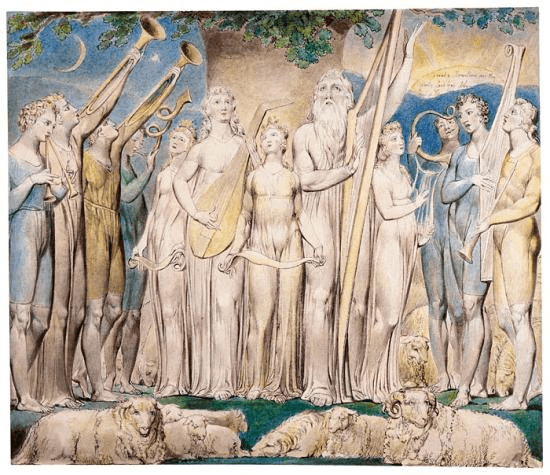
Job is restored, by William Blake (1757-1827)

Job was in awful suffering. He contended with God about it. Job’s friends contended with Job. In the end, God never gave a humanly suitable answer to the problem of suffering. Namely, because we cannot understand the answer, even if it is provided.

Indeed, the gap between God and humanity is quite pronounced. God is the Creator. We are creatures. Yet, God did vindicate Job.

That’s right God affirmed Job – and not Job’s companions. Even though Job did what many a believer in God today believes is wrong, perhaps even sacrilegious or sinful.

Job argued, confronted, grappled with, and even opposed God for the terrible troubles he faced in losing his family, his wealth, and his health. He fully engaged God.

Job’s friends, however, did no such thing. Instead, they argued, confronted, grappled with, and even opposed their friend Job. They fully avoided God.

In the end, Job conceded that he himself knows nothing. Yet, there is still the hint of complaint within him. This is good. Job did not stop engaging God. He remained faithful and devoted.

Let us never believe that faithfulness and devotion to God involves putting up a false front and nice polite piety. Prayer, in truth, is a hard wrestling with God, a struggling and working through all the difficulties of this unfair life.

God is not the least offended by our full, real, and raw engagement of him. But God is offended by avoiding such engagement altogether.

All of us, in reality, speak mostly in ignorance. We talk about things we don’t really understand. The only thing we can be 100% truthful about, however, is ourselves – about how we are really doing, feeling, experiencing, believing, struggling with, etc.

I myself am the true expert on me – and you, the expert on you. And this truth I can bring to God anytime, anywhere. The Book of Job affirms to me that this is the sort of devotion and sacrifice which the Lord is pleased with.

Job gained some knowledge and understanding through personally encountering God. The Lord God almighty, Creator of heaven and earth, actually spoke to Job in a direct revelation of the Divine presence.

This is an affirmation of Job’s integrity. But the godless, disintegrated, and fragmented person cannot see God or expect a personal audience with God.

Through all that Job had been through, he held to his integrity, and held onto God, both at the same time. In the end, he still did not understand why he had to go through such horrible suffering.

English translations of the Hebrew text don’t do it justice. There is always something lost in translation of any language to another. And it seems what is lost here is that Job was perhaps still protesting at the end. Yet, it comes across in English as Job despising and abhorring himself, as if he had done something very wrong.

“I despise myself,” misses the mark. Without getting into some deep grammatical Hebrew waters, I wonder if the phrase might better be rendered, “I protest.” What is meant to be conveyed is that Job still acknowledges what he originally held onto. Namely, that he has done nothing wrong, did not deserve what he went through, yet has never rejected God, nor lost faith in God.

Job did not need to repent of some secret sin, as his friends supposed. Job repenting does not mean because of sin; Job’s repentance was a change of position from mourner and complainer, to accepting the situation as it is, without answers.

So, this brings us back to the beginning of the book. God is God. There are celestial forces and operations in play we know nothing about. Humans are not God. Humans are never going to get most of what is happening in this world. And humans will inevitably experience hard and bad things – and not know why.

No answers given. No change of situation (yet). But Job changed. He changed his mind about how to live with what he was experiencing. He relinquished his complaint, and decided to keep living, even though he did not get answers.

Honestly, this response of Job is more consistent with my own experience of awful suffering, and more faithful to the text of Scripture. Much like Jacob wrestling with the angel, Job had to finally concede and relent, and continue on his life journey, come what may.

Following Job’s intercession for his friends, God restored Job to wealth and family. A significant piece of this restoration was Job’s wider community of friends and family who gathered around him, giving Job the consolation and comfort that the three “friends” in the book did not provide.

The community cared for Job, not through nice theological phrases, but with genuine fellowship. They shared together around the table, the community giving both a meal and contributing monetary gifts for Job’s needs.

The Book of Job ends, perhaps with as many, or more, questions than when it started. Answers, however, are not the point.

Rather, Job’s incredible and awful experience of suffering and redemption becomes an invitation for you and me to have a more expansive view of what a relationship with the living God truly looks like.

May God bless you with discomfort
At easy answers, half-truths, and superficial relationships,
So that you may live deep within your heart.

May God bless you with anger
At injustice, oppression and exploitation of people,
So that you may work for justice, freedom and peace.

May God bless you with tears
To shed for those who suffer pain, rejection, hunger, and war,
So that you may reach out your hand to comfort them
And turn their pain into joy.

And may God bless you with enough foolishness
To believe that you can make a difference in the world,
So that you can do what others claim cannot be done
To bring justice and kindness to all our children and the poor. Amen.


You Can’t Leverage a Leviathan (Job 41:1-11)

“Can you draw out Leviathan with a fishhook
    or press down its tongue with a cord?
Can you put a rope in its nose
    or pierce its jaw with a hook?
Will it make many supplications to you?
    Will it speak soft words to you?
Will it make a covenant with you
    to be taken as your servant forever?
Will you play with it as with a bird
    or put it on a leash for your young women?
Will traders bargain over it?
    Will they divide it up among the merchants?
Can you fill its skin with harpoons
    or its head with fishing spears?
Lay hands on it;
    think of the battle; you will not do it again!
Any hope of capturing it will be disappointed;
    one is overwhelmed even at the sight of it.
No one is so fierce as to dare to stir it up.
    Who can stand before it?
Who can confront it and be safe?
    —under the whole heaven, who?” (New Revised Standard Version)

Just as “Behemoth” is an English transliteration of the Hebrew word (Job 40:15), so is the word “Leviathan” (לִוְיָתָן). The reason for merely transliterating the words is that we don’t really know what sort of creatures they are with any certainty.

Yet, what we do know, is that both of them are strong and ferocious creatures, described by God as beyond the control of humans. They cannot be domesticated, or serve as pets. That’s because no human could ever hunt or capture one of them. Just to look at a Leviathan would cause a person to flee in fear.

The biblical character of Job had been through a lot. Back in the beginning of the Book of Job, he is described as a man who is upright and blameless. Because of this, Satan entered the picture, going to God and accusing Job of only being faithful because he was blessed. So, God allowed Satan to afflict Job, but not kill him.

Yet, Job knew nothing about this celestial conversation. All he knew was that he lost everything and everyone he cared about. On top of it all, Job experienced painful sores which left his health ravaged and his body unable to do much of anything.

Job’s three “friends” came to comfort him. But they did just the opposite by arguing with him and accusing him of secret sinning. All Job wanted was some vindication, some answers to his questions, and some sort of sense to all the senseless suffering.

After long speeches of both Job and his companions, God’s agonizing silence was finally broken. For several chapters (Job 38-41) God gives no answers, but instead, asks his own questions. The gist of God’s confrontational response comes down to this:

You are wondering about things that are way above your ability to know and understand. But what you need to know is that life consists in relationships, in dialogue and interaction with me, and especially with honesty and vulnerability which goes along with those relations.

Life cannot be boiled down to a nice, neat system of good people getting good stuff, and bad people getting bad stuff. Yell at me, and rage at me, if you must. Then you will be honest, real, and relating to me. But I have no tolerance for anyone who tries to be Me, and thinks they know how things actually are, and how they work.

There is no “The Universe For Dummies” by God on the way things operate in the universe. That’s because it cannot be dumbed-down enough for any human to grasp. All we have is relational interaction and connection.

We can’t even figure out what in the world creatures like Behemoth and Leviathan are, let alone understand how to deal with them. Methinks that despair has a much more prominent place for us humans than we realize. But that is a bigger discussion than Behemoth, and so, is for another time.

It could be that God talking of Leviathan – this big uncontrollable and unpredictable creature – is one way of helping us come to grips with our divine/human relationship.

You and I have absolutely no control over God. It’s not remotely possible, at all. And if nobody can domesticate, let alone capture, a Leviathan, then there is no possibility of ever using God as a personal pet for our own purposes.

Far too many of us humans, demand God to show up and explain himself; or we do all sorts of genuflections and pray volumes of words to try and leverage God into answering us and giving us what we want. But there is no leveraging a Leviathan.

Precious few persons on this earth simply let God be God; and choose to focus on being a real, vulnerable human who needs and wants God. Such persons do not try and capture God, because they have already been captured by God.

We are all at the mercy of God, and in no way can manipulate or cajole God toward our agenda for how we think things ought to go. We might as well try and catch a Leviathan.

Humanity does not hold onto God; God holds onto us. God is not obliged to serve us and do our bidding; but we are very much obliged to God in service and fidelity.

God, I believe, rightly seems perturbed by all of longwinded speeches, only because he was being treated as some sort of divine vending machine who dispenses the proper candy bar with an obligatory monetary oblation.

Do we actually believe that we can do a sort of spiritual credit card slide, and get a belly full of goodies? If you want good from God, then do good and be a good person, right?…

Um, no. Frankly, that kind of spirituality irks God. Good people sometimes get bad stuff. And that reality bothers some of us humans to no end.

There is a reason for all that occurs, but it’s way above our human pay grade to know and understand what it’s really all about. So, treat God as God, as the Sovereign of the universe, as the Holy One whom we must relate to in truth, honesty, realness, and vulnerability.

This is another day, O Lord. I don’t really know what it will bring forth. Regardless, make me ready for whatever this day may be. If I am to stand up, help me to stand bravely. If I am to sit still, help me to sit quietly. If I am to lie low, help me to do it patiently. And if I am to do nothing, let me do it gallantly. Make these words more than words, and please give me the Spirit of Jesus. Amen.

Questions Without Answers (Job 38:1-7, 38-41)

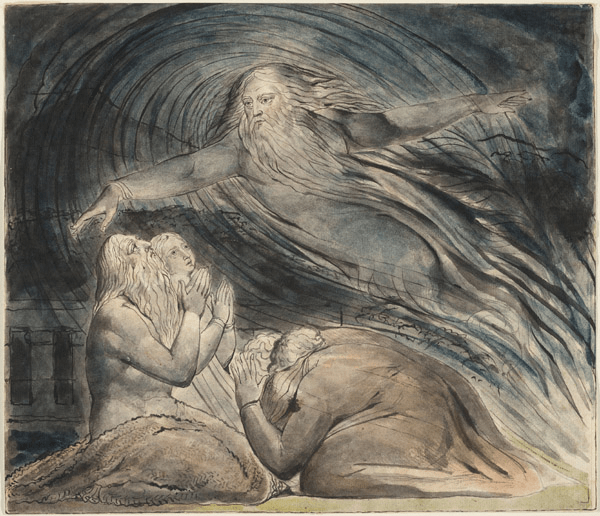
God Answers Job Out of the Whirlwind, by William Blake, 1805

Then the Lord answered Job out of the whirlwind:

“Who is this that darkens counsel by words without knowledge?
Gird up your loins like a man;
    I will question you, and you shall declare to me.

“Where were you when I laid the foundation of the earth?
    Tell me, if you have understanding.
Who determined its measurements—surely you know!
    Or who stretched the line upon it?
On what were its bases sunk,
    or who laid its cornerstone
when the morning stars sang together
    and all the heavenly beings shouted for joy?…

“Can you lift up your voice to the clouds,
    so that a flood of waters may cover you?
Can you send forth lightnings, so that they may go
    and say to you, ‘Here we are’?
Who has put wisdom in the inward parts
    or given understanding to the mind?
Who has the wisdom to number the clouds?
    Or who can tilt the waterskins of the heavens
when the dust runs into a mass
    and the clods cling together?

“Can you hunt the prey for the lion
    or satisfy the appetite of the young lions,
when they crouch in their dens
    or lie in wait in their covert?
Who provides for the raven its prey,
    when its young ones cry to God
    and wander about for lack of food? (New Revised Standard Version)

The Book of Job is rather long. After the initial two chapters which set the scene for Job’s awful suffering, we then get an extended and agonizing thirty-five chapters of speeches between Job and his companions. It’s a lot of words which generally go nowhere.

So, by the time we get to this point in chapter 38 of Job, we may likely say, “Finally, God speaks!” Indeed, this is the moment Job has anticipated.

Perhaps we are looking for something in Job’s story which may help us in our own story of suffering. Like Job, maybe we’re looking for vindication of our situation, a restoration to some semblance of life before the grief, or to have our reputation upheld.

But that is not what we get from God. For the next nearly four chapters, God only speaks in questions, and does not answer a single one of them.

If it’s answers to questions we’re searching for, it is unlikely you will get them, at least on this side of heaven. You are more likely to get even more questions than you started with. And then, imagine being questioned by God, and having no answers for God whatsoever.

Yet, that is the point. We humans know jack squat – absolutely nothing, in comparison to an omnipresent and omniscient God.

If it’s God’s voice you really want to hear, you may not know what you’re actually asking for. That was certainly true for Job and his friends. God’s questions are really rather rhetorical; there is no way any of us could really answer them with any sort of knowledge or understanding. It would be a bit like a parent asking their toddler to describe his own birth and how it happened.

God’s unanswerable questions revolve mostly around the workings of the universe. God is the Creator, and none of us were around when it all came into existence. So, of course, we have no answers.

Yet, with all of the questions, we quickly get the impression that humans have very little control over much of anything. And I think that perhaps God wants us to be aware of that reality.

It seems to me that with every question of God, we are led to believe that God is God, and is really big; and that we are not God, and are pretty dang small.

I don’t think any of this is meant to make us feel irrelevant or disposable. Rather, it gives us some needed perspective, that is, that our perspective on world issues, events, and problems is very narrow. But God sees the whole big picture and has a stellar full perspective of all things and all people.

The God in the Book of Job is no vending machine deity, in which we can pick-and-choose what we like and don’t like. There is no grand certainty that if we press the right buttons in prayer that we get what we want.

Therefore, God is not some automaton who predictably rewards the righteous, and punishes the wicked (according to our definitions of those terms). Yet this is the God that Job’s friends believed in – which is why they reflexively interpreted Job’s situation as Job himself being a sinful man.

Even Job believed in this sort of God, at least to some degree. Up to the point of his terrible trouble, he was good and righteous, and received due reward for his faithfulness. The divine system was serving Job well.

But then the system seems to have broken down. Job interpreted God as not doing the expected divine job of operating within the predictable divine structure.

Believers in every generation and era must come to grips with the reality that – although personal virtue and devotion are important – one’s piety does not necessarily lead to personal health nor wealth.

In other words, good guys don’t always win in this life, because having faith typically means we will actually suffer, rather than not.

This is, to me, good news. Why? Because it means, conversely, that persons victimized by violence, poverty, and loss are not necessarily to blame for their troubles. Frankly, there are times when bad things happen to us that are not our fault, and we don’t see any good reason for it happening.

Whenever God is silent, we might start to think that God is also absent. We may begin to entertain nihilist thoughts that nothing matters, that everything in this universe is just random chaos.

Yet, God’s response with all the questions lets us know that there is a solid structural foundation to this universe that we aren’t always aware of. In other words, there is meaning, purpose, and order to it all. We are not forgotten. God sees and remembers us.

I do believe there is a reason for everything. However, I do not believe that we are always privy to know what that purpose may be. Which means that oftentimes, like Job, we don’t have any answers to our existential questions of human tragedy and trouble. This line of thinking isn’t meant to be a cop out; it’s meant to help us accept that we are human.

Sometimes all we can do is affirm what we know to be true, and accept the limits of our own human understanding of things such as:

  • God is God. I am not.
  • God created the world. I didn’t.
  • God established order in the universe. I sometimes see order, and oftentimes see what looks like random chaos.
  • God is Love all the time. I love, but not always.
  • God is with us, even though I may not always sense or feel that divine presence.

Maybe what is most important is that we humans keep up our dialogue with God – our questions, musings, emotions, and expressions of faith and devotion. Because it is in the relationship that we discover the key to the universe.

O God, by whom the meek are guided in judgment, and light rises up in darkness: Grant us, in all our doubts and uncertainties, the grace to ask what you would have us to do, so that the Spirit of wisdom may save us from all false choices, and that in your light we may see light, and in your straight path may not stumble. Amen.

Directives For the Married and Divorced (1 Corinthians 7:10-16)

To the married I give this command—not I but the Lord—that the wife should not separate from her husband (but if she does separate, let her remain unmarried or else be reconciled to her husband) and that the husband should not divorce his wife.

To the rest I say—I and not the Lord—that if any brother has a wife who is an unbeliever and she consents to live with him, he should not divorce her. And if any woman has a husband who is an unbeliever and he consents to live with her, she should not divorce the husband. 

For the unbelieving husband is made holy through his wife, and the unbelieving wife is made holy through the brother. Otherwise, your children would be unclean, but as it is, they are holy. But if the unbelieving partner separates, let it be so; in such a case the brother or sister is not bound. It is to peace that God has called us. Wife, for all you know, you might save your husband. Husband, for all you know, you might save your wife. (New Revised Standard Version)

Having specifically addressed questions about sex; and having directly talked to the Christians in Corinth who were single; the Apostle Paul then turned to the married persons in the church. He gave directions about their concerns of divorce and how to handle a spouse who does not share the believing spouse’s Christian beliefs.

Divorce

Divorce is one of those things that no one plans on happening when they are married; and yet, it happens. The Apostle was realistic about the situation. He upheld the sanctity of marriage, while recognizing that the ideal of two people remaining together and blessing one another doesn’t always happen.

I find it interesting, as well as gracious and understanding, that Paul neither condemns nor denounces the divorced person. He assumes that both spouses have responsibility, and both can take initiative as partners in a marriage.

A Christian married to an unbelieving partner, according to Paul, ought to remain married. As long as the non-believing spouse is willing to remain in such a marriage, then it should continue.

The Apostle’s rationale is that peace, not divorce, needs to be the controlling characteristic of both the marriage and of the Christian life.

“Mixed” Marriage

Furthermore, Paul believed that Christians are not defiled by pagan spouses. This is important when it comes to the children of a Christian and non-Christian marriage. The relationship is sanctified by the presence of both the believing spouse and the Holy Spirit.

In addition, the Apostle saw that the Christian spouse is in a special position for God to work through them to the unbelieving spouse. On this point, Paul is sanguine and optimistic. Instead of worrying about impurity for the Christian, he foresaw an opportunity for purity in the non-Christian.

The Apostle Paul’s realism reminds us that if we are looking for ultimate satisfaction through marriage (or singleness and celibacy) it will never be found.

That’s because, as Christians, contentment and peace comes through giving our lives to serve the Lord Jesus in love. To love another, and offer the gift of self-sacrificial service to them, is the ultimate path to the way of Christ.

In losing our lives, we find them; in being last, we are promoted to first.

Marriage is beautiful. Divorce is ugly. Sometimes, despite a believer’s greatest efforts at being peaceful and loving, a divorce occurs. It takes two to have a marriage. There are times when the believing person must let their spouse go, that is, if that spouse wants to go.

Although divorce can be ugly and sad, full of broken dreams, and littered with missed expectations, it doesn’t need to stay that way. The divorced person, becoming single, now has the opportunity to bring something beautiful out of the brokenness.

Kintsugi

“Kintsugi” is a Japanese term for the art of repairing broken objects. The word literally means to “join with gold.” This art form uses a particular lacquer to reattach broken pieces. Then the newly attached joints are decorated with gold (or silver) powder.

The working idea behind the art of kintsugi is to embrace the flaws and the imperfections. By doing so, the artist can create a beautiful piece of art, stronger than the original.

Applying this to relationships, people no longer have to simply live with the shame of a broken marriage. We can assign value to people who are divorced, and stop trying to hide the relational damage. Through intentional efforts on healing, the scars left behind can truly become a source of beauty – instead of permanent ugliness.

Ikigai

Another Japanese concept which can be relevant for us is “ikigai.” It refers to having a reason for living, a sense of purpose and meaning to life. The idea behind ikigai is to help people find what is truly important to them, and then to live a life full of joy and purpose. Notice the concept is based on that which is internal – fulfillment, satisfaction, joy, and meaning – instead of external factors such as money, fame, power, or position.

Jesus joyfully lived his life on this earth to serve others. He came not to be served, but to serve, and to give his life as a ransom for many (Mark 10:45). If marriage was the ideal for everyone in this world, I’m quite sure Jesus would have modeled that for us by getting married. But he didn’t.

Neither marriage, nor singleness, is what really counts. Faith, expressing itself through love, is what actually counts. (Galatians 5:6)

And when Jesus was broken, the result became the salvation of the world. By his wounds, we are healed. (Isaiah 53:5)

All of this demonstrates for us where and what we are to assign meaning. And just because things don’t work out like we want, and leaves us in a state of brokenness, our lives can be transformed into a beauty beyond what we could have imagined.

This is the strength and ability of Christianity. Methinks we ought to let it have its way in our lives.

Almighty and everlasting God, the One who makes us whole in our brokenness, calls us to deeper faith, and delivers us from all things that hinder our devotion to you: Hear our prayer, Lord, and break open all we hold back from you, so that we may see a vision of your helping and healing presence in our lives and in our world, through Jesus Christ, in the power of the Holy Spirit. Amen.