The Logic of Faith and Prayer (Mark 9:14-29)

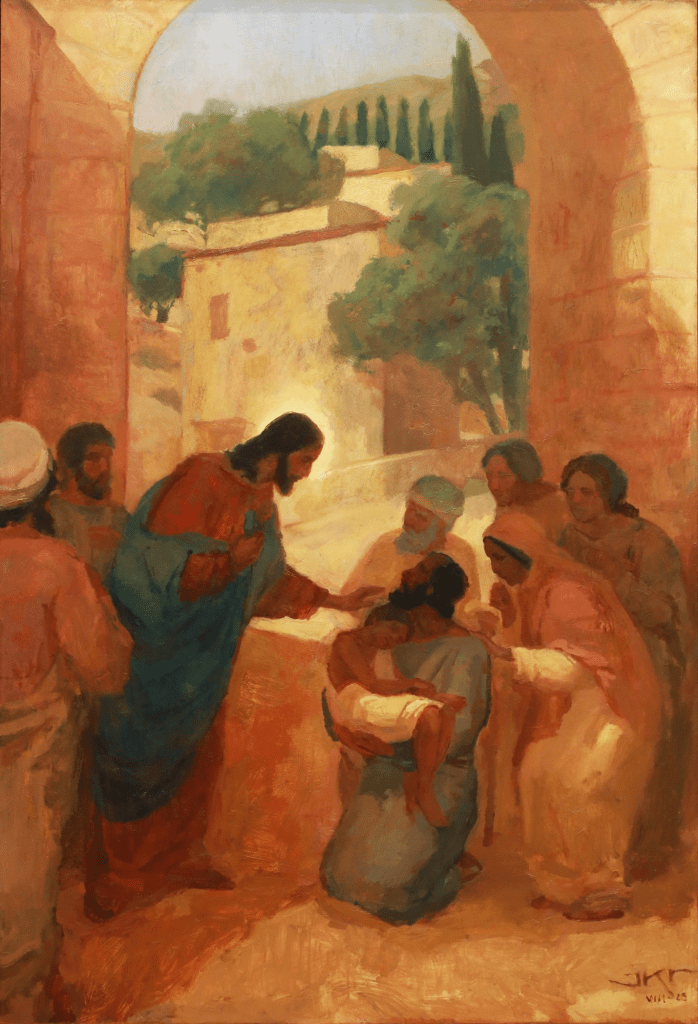
Help Thou My Unbelief, by J. Kirk Richards

When they came to the other disciples, they saw a large crowd around them and the teachers of the law arguing with them. As soon as all the people saw Jesus, they were overwhelmed with wonder and ran to greet him.

“What are you arguing with them about?” he asked.

A man in the crowd answered, “Teacher, I brought you my son, who is possessed by a spirit that has robbed him of speech. Whenever it seizes him, it throws him to the ground. He foams at the mouth, gnashes his teeth and becomes rigid. I asked your disciples to drive out the spirit, but they could not.”

“You unbelieving generation,” Jesus replied, “how long shall I stay with you? How long shall I put up with you? Bring the boy to me.”

So they brought him. When the spirit saw Jesus, it immediately threw the boy into a convulsion. He fell to the ground and rolled around, foaming at the mouth.

Jesus asked the boy’s father, “How long has he been like this?”

“From childhood,” he answered. “It has often thrown him into fire or water to kill him. But if you can do anything, take pity on us and help us.”

“‘If you can’?” said Jesus. “Everything is possible for one who believes.”

Immediately the boy’s father exclaimed, “I do believe; help me overcome my unbelief!”

When Jesus saw that a crowd was running to the scene, he rebuked the impure spirit. “You deaf and mute spirit,” he said, “I command you, come out of him and never enter him again.”

The spirit shrieked, convulsed him violently and came out. The boy looked so much like a corpse that many said, “He’s dead.” But Jesus took him by the hand and lifted him to his feet, and he stood up.

After Jesus had gone indoors, his disciples asked him privately, “Why couldn’t we drive it out?”

He replied, “This kind can come out only by prayer.” (New International Version)

Please, stick with me here, on what I see as the logic which undergirds this story:

God has authority over everything. God is powerful. Therefore, God can do the miraculous.

Humans have limited authority over some things. Humanity is sometimes strong, yet often weak. Therefore, humans must look outside themselves for a miracle.

God created people. Humans reflect the divine image and likeness of God. Therefore, God and humanity are inextricably linked.

God has miraculous power. Humans can have confidence (faith and hope) in God’s power. Therefore, miracles can happen when God’s power meets human confidence in that power.

God is personal. Humans are personal. Therefore, humans can know God.

God listens to human prayers. Humans have the ability to pray to God. Therefore, God’s power and human faith in that power are very much connected to each other.

Since God is authoritative, powerful, and personal, then God’s choice and ability to effect miracles is not an impersonal force which can be used and manipulated by humans, but rather is a gift to be prayed for and received with gratitude to God.

This then, is why Jesus seems exasperated with the experience of a botched exorcism, because:

  1. The father and the crowd have a profound lack of faith in God’s authority and power to personally effect the miraculous.
  2. The disciples have a disappointing lack of prayer in their own ministry.

The father of the son with the bad spirit was understandably desperate. And, on top it, disappointed with the disciples’ inability to do anything about the situation. The issue, however, is never about God’s ability – which is where the father went in talking to Jesus.

“If you are able” expresses little confidence in Christ.

Jesus emphatically replied that everything can be done for the one who believes. To which the father, still desperate, but then adding a healthy dose of honesty, confessed: “I believe; help my unbelief!”

That was all Jesus needed. The father’s humble and honest confession opened the soul’s door to receive the gift of faith. And the boy was rid of the bad spirit.

Furthermore, the father was also rid of his own bad spirit. The man was not demonized, like his son, nevertheless he possessed a spirit of ill confidence. The encounter with Jesus changed him, as well. It wasn’t just one person who walked away healed; both a father and a son were healed.

As often happened, the disciples left the scene with Jesus scratching their heads. They couldn’t figure out their own inability and failure to help the desperate father and his demonized son.

The bad spirit was indeed a stubborn one, and quite hard to deal with. Jesus told his disciples that one like this can only come out for those who nurture the spiritual habit of prayer.

Essentially, Jesus was saying that the vital connection between God and humans is dependent upon God. People don’t give orders to God, or act as the keepers and manipulators of divine power, like the ancient magicians did with their gods.

Rather, humans pray and ask for what they need, based upon the quality of their connection with God. This isn’t about the level of faith; it’s about whether there is any connection.

I can have lots of faith that my desk lamp will illuminate if I tell it to, but it won’t light unless I plug it in and turn it on. And if I do that, and the lamp will not turn on, then I know there is a problem with the connection – and not with my level of faith in making the lamp light up.

Everything in life must be maintained well, and taken care of. If it isn’t, it will eventually stop working, and may even fall into complete disrepair.

Faith and prayer are not simply tools which we wield with our own authority and autonomy. They must be developed and used with care for where they’ve come from.

Our prayers are opportunities for us to establish and maintain our vital connection with God via faith. Then, whenever we are in dire straits, the confidence is there, because of our connection with the Lord; nothing is hindering the power from flowing and lighting up the situation.

At its heart, Christianity is a relationship with God through Jesus Christ in the power of the Holy Spirit. And that relational connection has been brought about God, not me; and the means to maintain the relationship is from God, not me. Yet, we get to enjoy this beautiful access.

So, take advantage of it.

O Lord, our blessed Companion in life and death, your love is steadfast and never ends. Our wondering and weeping may linger in the night, but you give joy in the morning. Touch us with your healing grace so that, restored to wholeness, we may live our calling as your faithful resurrected people. Amen.


Recover the Relational Commands (1 Timothy 6:13-16)

In the sight of God, who gives life to everything, and of Christ Jesus, who while testifying before Pontius Pilate made the good confession, I charge you to keep this command without spot or blame until the appearing of our Lord Jesus Christ, which God will bring about in his own time—God, the blessed and only Ruler, the King of kings and Lord of lords, who alone is immortal and who lives in unapproachable light, whom no one has seen or can see. To him be honor and might forever. Amen. (New International Version)

Jesus is Lord, and Ceasar is not. The Apostle Paul’s letter to Timothy, in some ways, could be summed up in this way.

As Timothy ministered to the fledgling church in Ephesus, he was to continually keep his eyes on Jesus and take his cues for ministry on the apostolic teaching handed down to him. Timothy was not to get caught up in the fear of living in an Empire that commanded fealty to Ceasar as the supreme being over all.

Timothy was to flee all that is contrary to the sound doctrine of Christian faith. He was instead to pursue righteousness, godliness, faith, love, endurance and gentleness. Paul encouraged and exhorted Timothy to fight the good fight of the faith; and take hold of the eternal life to which he was called. Timothy was to live into his confession of Christ and his call from God.

Embrace Jesus as Lord, and quit trusting in Ceasar as Lord.

Although we see nothing subversive about today’s New Testament lesson, it very much was when Paul originally wrote it. The Apostle was essentially saying that, as Timothy goes about pastoring the church at Ephesus within the Roman Empire, he must always uphold the sovereignty and lordship of Jesus Christ as supreme – which, if seen by Roman authorities, would be taken as a subversive action against the state.

The Empire cares about submission to the state, and would see Jesus as Lord as Timothy and Paul teaching people to submit to a different ruler than Ceasar. And they would be right because neither Paul nor Timothy had any intention of engaging in the cult of Ceasar.

Contrary to the Roman imperial gods, and Ceasar himself, Paul lifted up the God who gives life to everything. It is this God – embodied in the Lord Jesus Christ – whom Timothy is encouraged to maintain a steadfast and consistent commitment to. And, what’s more, this commitment is to be carried out without any spot or blame.

Timothy had no need to bully people or shame others into accepting and holding onto the gospel. The means and the methods of how we embrace our charge from God matters a lot. By persevering in faith, holiness, and humility, Timothy would preserve himself and be of benefit to his listeners.

Believers are to keep up this spiritual commitment until Christ returns. It is always open season on gospel proclamation and Christian growth and maturity – lived with a gracious spirit.

By looking to Jesus, followers of Christ can maintain their witness. Times of discouragement are bound to come. And in those difficult seasons of life, we are not to change or switch our allegiance to the political powers. As important as government is, politicians are not saviors; and a particular system of government is not going to deliver us from our greatest oppressions.

The Apostle Paul described Jesus as the King of kings and Lord of lords, the blessed and only Ruler. Christ is  sovereign over all earthly powers.

Furthermore, God alone is immortal and lives in unapproachable light. God is pure light, and in the Lord there is no darkness. God’s glory is bright and blinding; therefore, no one can see God. To this God deserves honor and might forever.

The mighty and holy God will fulfill all divine promises. Paul was looking to reinforce some courage in Timothy by reminding him of the sort of God they both serve.

In our current and contemporary world, it’s easy to become discouraged. Injustice abounds. Hardness of heart is everywhere. An inability to truly see one another is rife. And people look everywhere and to anyone who appears successful. They want to know the secret in how to survive and thrive on this earth, in their workplaces, and in their homes.

But it’s no secret. The hard work of relationships is what it takes – both human and divine. There is no replacement or surrogate work to the labor of investing yourself into others lives. There’s no substitute for a relationship with God which involves prayer and basic Scripture reading, worship and spiritual disciplines; and face to face relations with actual real people – getting to know them, their joys, their fears, and what motivates them.

Until we recover things such as spiritual mentoring, spiritual practices, group prayer, congregational worship, and create the time for relationships, we shall continue to struggle with a fundamentally broken world and all of its dysfunctional relationships.

No matter the organization, the neighborhood, the family, or the church, we need real people to do honest real work. Whenever a manager, a block captain, a parent, or a pastor allows themselves to be vulnerable and authentic – and lives on the same level as those they serve – then no one is looking for a secret sauce to success.

The Christian’s path of life is always to involve humility, gentleness, mercy, purity, and peacemaking, in doing the work of right relations with the people around them. This is the way of Christ.

Trying to discover a process or a system – apart from the muck of relationships – will fail, every time. This is the way of Ceasar.

Paul took the time and invested the effort into his relationship with Christ. Then, he put himself in a position to mentor others in the faith. Furthermore, he encouraged people like Timothy to do the same. Apart from this work, there is no Christianity.

Believers in Jesus are here today because of Paul and Timothy and the body of teaching and work they passed on to others who, in turn, did the same.

You then, my son, be strong in the grace that is in Christ Jesus. And the things you have heard me say in the presence of many witnesses entrust to reliable people who will also be qualified to teach others. (2 Timothy 2:2, NIV)

It’s time to roll up your sleeves and fulfill the calling you have received, the calling of righteousness (right relationships) with both God and others – because Jesus is Lord, and Ceasar is not.

Eternal Father, you gave to your incarnate Son the holy name of Jesus to be the sign of our salvation: Plant in every heart, we pray, the love of him who is the Savior of the world, our Lord Jesus Christ; who lives and reigns with you and the Holy Spirit, one God, in glory everlasting. Amen.

Abide In Love (John 15:9-17)

As the Father has loved me, so I have loved you; abide in my love. If you keep my commandments, you will abide in my love, just as I have kept my Father’s commandments and abide in his love. I have said these things to you so that my joy may be in you and that your joy may be complete.

“This is my commandment, that you love one another as I have loved you. No one has greater love than this, to lay down one’s life for one’s friends. You are my friends if you do what I command. I do not call you servants any longer, because the servant does not know what the master is doing, but I have called you friends, because I have made known to you everything that I have heard from my Father. You did not choose me, but I chose you. And I appointed you to go and bear fruit, fruit that will last, so that the Father will give you whatever you ask him in my name. I am giving you these commands so that you may love one another. (New Revised Standard Version)

We Need Love

The world, in truth, spins on the axis of love. Without love, there is no beauty. Apart from love, we would all be living in a dystopian world of mere survival. But with love, there is life, hope, purpose, and meaning; there is fulfillment, satisfaction, and security. With love, our most basic needs as people are met.

So, love is a word that must be intentionally pursued and valued; because we cannot live without it.

The very word “love” gets used in various and different ways in our world. Jesus used the word in a sacrificial sense – that love willingly gives up one’s life for the benefit of another.

Love is large. It involves the whole person – body, mind, emotions, and spirit. Love in today’s Gospel lesson is used by Jesus as an action. And it’s even more than that. Christ defined love in the Upper Room to his disciples as a willingness to die – not necessarily for a spouse or a child – but for a friend, a fellow follower of Jesus.

It seems that for most Christians, giving up one’s life for another is not at the forefront of our idea of loving another. Yet, to love our neighbor as ourselves does involve the willingness to die so that another may live. To know precisely what this is like, we need look no further than the love which exists within God.

God is Love

Love is seen above all in the love of God the Father shown forth in God the Son. Because God so loves the people of this world, the Father sent the Son, Jesus, to give his life for us. And Jesus, embodying the very love of God, willingly gave himself on our behalf. It hearkens us to Christ’s earlier words about this:

“For God so loved the world that he gave his only Son, so that everyone who believes in him may not perish but may have eternal life.”

Jesus (John 3:16, NRSV)

Just as the Father loved the Son, and the Son loved us, so we are to love others with the same sort of sacrificial love which was graciously shown to us. The Apostle John made this plain in his first epistle:

God’s love was revealed among us in this way: God sent his only Son into the world so that we might live through him. In this is love, not that we loved God but that he loved us and sent his Son to be the atoning sacrifice for our sins. Beloved, since God loved us so much, we also ought to love one another. (1 John 4:9-11, NRSV)

Therefore, it is our privilege and responsibility to abide in this divine love and let it fill us to the full, so that God’s love moves powerfully in us and through us, for the life of the world.

Remain in Love

Love is the end result of an abiding relationship and close connection between Christ and his followers. We are to remain in the love of Christ, just as Christ remains in the love of God. Jesus asks nothing of us that he has not already modeled for us in his sacrificial service to the world. Living in union with Christ, loving Jesus, and keeping God’s commands are all a single package, bound up together in a mutual relationship.

We don’t need to wonder what God wants for us and from us: Love. The commands of Jesus are not general; they are focused and specific. Christ commands that we love one another. Our continuing work on this earth is to keep on loving people as Christ has loved us and gave himself for us.

No Greater Love

There is no greater love than that shown in the giving of one’s life for one’s friends. The power of God’s love is focused in Christ. It is confirmed in Christ’s resurrection from death. And it flows from Christ giving his life on the cross for us.

Yes, Christians are servants who are committed to serving others with sacrificial love. Yet, the disciples and all those who follow Christ are much more than servants; they are considered primarily as friends of Jesus.

Through the cross and resurrection of Christ, believers have discovered the divine power of love. There is no greater love than this. And it is this sort of love that binds Christians together as united in their mission to love as Jesus loved them.

We have been called, chosen, and appointed by Jesus to embody love’s mission and purpose. What’s more, we are equipped for the active work of love.

Whatever You Ask in Love

The very name of Jesus is love itself. So, whatever you ask, “in my name,” said Jesus, “the Father will give you.”

Because Christians are united to Christ, they are to remain in and abide with Christ. This relational connection opens up the power of prayer. And the content of those prayers – if we are truly in Christ – will always come from a place of love, be directed to love, and go to great lengths to accomplish love.

Prayer is an activity which is grounded in the abiding relationship of Father, Son, Spirit, and the Christian community. Love directs our prayers. And prayers are directed toward the action of love.

A confidence in the power of prayer is an abiding trust in the power of Love. With love animating our prayers and infusing our service, we are bold to ask God for what is right, just, and good in this world. Indeed, we pray that we will give love to each other with the love we have received from God.

Love and Joy

Being called and appointed by God to love is a privilege and a joy. There isn’t any begrudging service when love is involved. Perhaps one of the greatest prayers we can pray is to pray that our hearts be filled with love. If you don’t feel love for others, then pray for it. And be assured that you will receive it.

Love and joy go together like mashed potatoes and gravy, peanut butter and jelly, grits and honey. We know we are loving others if our joy is complete in doing so.

Jesus came to this earth so that we might experience an overflowing life of abundant love and joy. Christ longs for his joy to be in us, and for us to abide in his love. Our joy comes from knowing that we have been loved by God – chosen, called, and sent out into the world with love and for the purpose of love.

And it is this divine love that has the power to renew and transform everything – even the most troubling and stubborn of people and problems that you are presently facing. Indeed, if love is not the answer, then you are not asking the right question.

Creator God, by the mercies of your son, our Lord, Jesus, compel us to turn our hearts to his way of Love, so that we might follow Christ together as your faithful people. Dear Jesus, guide us in your way. Amen.

A Warning and a Reassurance (Isaiah 32:9-20)

Prophet Isaiah, by Sefira Lightstone

You women who are so complacent,
    rise up and listen to me;
you daughters who feel secure,
    hear what I have to say!
In little more than a year
    you who feel secure will tremble;
the grape harvest will fail,
    and the harvest of fruit will not come.
Tremble, you complacent women;
    shudder, you daughters who feel secure!
Strip off your fine clothes
    and wrap yourselves in rags.
Beat your breasts for the pleasant fields,
    for the fruitful vines
and for the land of my people,
    a land overgrown with thorns and briers—
yes, mourn for all houses of merriment
    and for this city of revelry.
The fortress will be abandoned,
    the noisy city deserted;
citadel and watchtower will become a wasteland forever,
    the delight of donkeys, a pasture for flocks,
till the Spirit is poured on us from on high,
    and the desert becomes a fertile field,
    and the fertile field seems like a forest.
The Lord’s justice will dwell in the desert,
    his righteousness live in the fertile field.
The fruit of that righteousness will be peace;
    its effect will be quietness and confidence forever.
My people will live in peaceful dwelling places,
    in secure homes,
    in undisturbed places of rest.
Though hail flattens the forest
    and the city is leveled completely,
how blessed you will be,
    sowing your seed by every stream,
    and letting your cattle and donkeys range free. (New International Version)

The biblical prophets spoke their prophecies for a reason, usually because there was some sort of injustice happening. And typically they addressed those with power, authority, and influence within society – who were doing something wrong, or were simply unaware of what was happening around them. In other words, the people ought to know better.

A Warning Against Complacency

The prophet Isaiah was specifically addressing particular folks, in our Old Testament lesson for today. Isaiah was calling out those who were complacent and living a life of ease. There was a chunk of society in Isaiah’s day who were safe, secure, affluent, comfortable, and rested on their laurels and their resources. Such persons didn’t ever think the thought that their lifestyle was temporary.

The warning of Isaiah was directed specifically to the well-off women in society. Concerning the rich and powerful, the biblical prophets had a tendency to address the women, e.g. the prophet Amos went after the women, calling them “the cows of Bashan.” (Amos 4:1)

The tone of Isaiah’s warning here is much more toward preparing the rich for a time when they won’t be able to rely on their wealth and affluence – they will be stripped of what they have. The women, Isaiah warned, need to prepare themselves for a time of grief.

In other words, they need to face up to what is about to occur, and not idle their lives away merrily as if nothing will ever happen to change their way of life.

Realize, Isaiah says, that the land will be emptied of life, and that resources will become scarce. You women will be reduced to near poverty. The once pride and joy of your nice house will quickly become, in no time at all, a turn of pride and joy in at least having a donkey to sit on.

The happy world they presently know will soon become nothing but a memory.

That is, until a new spirit takes over…

A Reassurance of Newness

Lamenting a loss will not happen forever. The grief shall eventually break. Not everything will be doom and gloom, as if it is some sort of new normal. Positive hope is also on the horizon. A spirit will be given, Isaiah insists, that will generate a wonderful restorative newness.

From a New Testament perspective, the spirit which is given is the Comforter. The Holy Spirit of God moves us through our grief and helps us realize a new lease on life.

“But when the Counselor comes, whom I shall send to you from the Father, the Spirit of truth who proceeds from the Father, He will bear witness of Me.”

Jesus (John 15:26, MEV)

The Spirit is the very force of God in the world, given to help us live into grace and truth – thus, turning injustice to justice, fear to faith, complacency to action, foolishness to wisdom. The desert is transformed into a garden, the dry land becomes lush and fruitful. All things are restored to vitality; people flourish and thrive again.

People’s needs, along with their great need for peaceful relational connections, will take their rightful place. Throughout the land there shall be human well-being. In other words, there is real peace – wholesomeness and integrity, with settled trust and rest in the plans and purposes of God.

In this present contemporary world of political instability for so many, instead of running about like Chicken Little believing that the sky is falling, people of faith can exhibit a peaceful confidence and a settled trust that grace and mercy will have the day.

We don’t need to live in fear, continually and anxiously vigilant to the bad thing around the corner. And when something good happens, we don’t have to wonder when the other shoe will drop. A good God has good purposes in store for humanity.

At the same time, those who are complacent and either cannot or will not see beyond the end of their nose, are served a merciful notice: They can become aware of how things really are – and do something about it.

Cycles of violence, pain, and injustice can and will be broken. Yet we must all do our part to become self-aware, acknowledge the arrogance within society, and determine that in faith we will trust in the name of the Lord who made heaven and earth; and that we will work for a better society and a more fruitful culture.

We are truly not far from the kingdom of God.

Almighty Father, who gave your only Son to die for our sins and to rise for our justification, give me grace to put away the leaven of malice and evil – so that I may always serve you in purity of heart and truthfulness of mind; through Jesus Christ your Son, my Lord, who lives and reigns with you and the Holy Spirit, one God, now and forever. Amen.