Longing For God (Psalm 63)

O God, you are my God; I seek you;
    my soul thirsts for you;
my flesh faints for you,
    as in a dry and weary land where there is no water.
So I have looked upon you in the sanctuary,
    beholding your power and glory.
Because your steadfast love is better than life,
    my lips will praise you.
So I will bless you as long as I live;
    I will lift up my hands and call on your name.

My soul is satisfied as with a rich feast,
    and my mouth praises you with joyful lips
when I think of you on my bed
    and meditate on you in the watches of the night,
for you have been my help,
    and in the shadow of your wings I sing for joy.
My soul clings to you;
    your right hand upholds me.

But those who seek to destroy my life
    shall go down into the depths of the earth;
they shall be given over to the power of the sword;
    they shall be prey for jackals.
But the king shall rejoice in God;
    all who swear by him shall exult,
    for the mouths of liars will be stopped. (New Revised Standard Version)

David, the psalmist, had a great longing for God.

This sort of longing has nothing to do with lustful desires which want something specific under the Christmas tree. To long for God is to have a deep inner wish for fulfillment and connection.

People have all sorts of longings in their lives, because they miss someone or are missing something important.

A parent longs for an estranged child to return, or at least to talk to them.

A spouse wishes to be with their loved one without the ravages of dementia.

A teacher has a deep longing to impact her students in a positive and profound way that will change their lives.

A person longs to see their friend realize the dream they have been seeking.

An individual has been living with chronic pain for years, and longs to be at least pain-free enough to enjoy the simple pleasures of taking a walk, visiting family, or going to a restaurant for a nice meal.

These longings, and thousands more, make up the future hope which keeps us going day after day. And they are all, in one way or another, related to the ultimate longing for divine connection.

Many types of longing come from a place of relationship, of love and support for another. It is this kind of longing that the psalmist had for God. The deep longing to experience a divine/human contact, to commune with the living God, is what motivated and fueled David throughout much of his life.

Like a person looking to satiate their thirst in a hot dry desert, is the one who actively seeks and goes after the longing they have. I believe that every person on planet earth has a deep abiding desire and need for something transcendent in this life, to encounter a power which is higher and greater than us – knowing that the basic nature of this power is loving and good.

My need for communion with God is on the same level as my daily need for water. I cannot survive without either of them.

Spiritual survival requires being watered and fed by an intimate relationship with our Creator. The presence of God is just as necessary and life-sustaining as food. Along with the psalmist David, God’s words are the spiritual food I need to live and survive.

Longing involves memory. Our various longings are often a remembrance of special events, seasons, or people. Deep hope activates those memories, and drives us to prayer, because God has the strength and the ability to honor those honest longings.

The greatness of God, and the divine purposes for this world, are heavy laden with longing. God’s heart longs for humanity to realize a renewed and revitalized relationship with God.

So, the Lord serves humanity in a myriad of ways, bringing deliverance from all that hinders us in a relationship with God, so that we might associate meaningfully and purposefully with what is good, right, and just.

We are invited by God to unpack the gift of faith, and the various spiritual gifts given to us, for the benefit of the church and the world.

God’s steadfast love is indeed better than life itself, because it is beyond what we humans can even conceive of as to what a good life truly is.

God is Love, and Love is God. Love transcends life and brings us to a place of connection beyond what our minds can imagine, and our hearts can only long for.

Since God is always gracious, loving, and good within God’s basic character, God always does what is good and loving. And that makes praise and adoration of God always open season.

Praising God reminds us of what God has done. The Lord is personally invested and involved in God’s big world. Thus, praise is quite appropriate whenever one is going through difficult times; because it accesses memories of God’s help in times past, enabling divine help in the present.

God’s gracious actions are both communal and personal. God not only helps others; God helps me. The Lord’s faithfulness endures throughout all generations. And God is big enough to notice me, and to help me in my own time of need.

Therefore, any occasion is appropriate in coming to God.

Are you in need of rest? Do you need encouragement? Are you in need of some help?

Then, come to God. Praise the Lord. Remember God. Consider the works God has done throughout history for God’s people. Do it during the day while working. Do it at night with your head on the pillow. Do it anytime, anywhere. Because God is there.

The Lord will provide – perhaps not on your timetable, yet God will nonetheless help, often in a way you may not expect.

Faith in God isn’t about trying to avoid God’s anger or wrath; faith is about syncing my wishes and my longings with the heart of God. That is called “repentance.” And it’s the way of finding our great inner longings satisfied.

We must tend to our relationship with the Lord; for God has made it possible to do so.

Receive this blessing from author John O’Donohue in his book, To Bless the Space Between Us: A Book of Blessings…

Blessed be the longing that brought you here
And quickens your soul with wonder.

May you have the courage to listen to the voice of desire
That disturbs you when you have settled for something safe.

May you have the wisdom to enter generously into your own unease
To discover the new direction your longing wants you to take.

May the forms of your belonging—in love, creativity, and friendship—
Be equal to the grandeur and the call of your soul.

May the one you long for long for you.

May your dreams gradually reveal the destination of your desire.

May a secret Providence guide your thought and nurture your feeling.

May your mind inhabit life with the sureness with which your body inhabits the world.

May your heart never be haunted by ghost-structures of old damage.

May you come to accept your longing as divine urgency.

May you know the urgency with which God longs for you.

Amen.

Lessons From a Genealogy (Ruth 4:18-22)

Now these are the descendants of Perez: Perez became the father of Hezron, Hezron of Ram, Ram of Amminadab, Amminadab of Nahshon, Nahshon of Salmon, Salmon of Boaz, Boaz of Obed, Obed of Jesse, and Jesse of David. (New Revised Standard Version)

No, I didn’t make a mistake about what the verses are for today from the Revised Common Lectionary. Yes, the Old Testament lesson is a brief genealogy. And yes, there is something to learn from this.

The Bible contains a lot of genealogies. Although they may be boring, with names we have difficulty pronouncing, every genealogy serves the same purpose that it does for your own family history.

Genealogies remind us of our connection with past generations. And this interconnectedness has influenced us in profound ways. You and I are the result of what history has produced. We are who we are, to a significant degree, because of the people who came before us.

By listing someone’s descendants in writing, it indicates an ongoing developing story which has happened, and continues to develop up to the present time, and even into the future.

One aspect about biblical genealogies that must be noted: Ancient compilers of genealogical lists did not often include every single person in the genealogy. They typically listed the more significant persons, and left out persons who barely dented history.

That’s because the biblical writer’s purpose in giving a genealogy was not necessarily to be exact and precise about each individual past actor. Rather, the writer usually has a moral and/or theological reason for providing the list.

For the writer of the Book of Ruth, the reason for this genealogy was to establish the bloodline and pedigree of King David. Perez was a son of the patriarch Judah (and Tamar). Boaz was a descendant of Judah. Boaz married Ruth, and they had a son, Obed, who was the grandfather of David.

I hope that you see the grace in every biblical genealogy. Including in our genealogy for today, we have two women, Tamar and Ruth. Both of them were unlikely candidates for producing a king. And even more unlikely to be included in greatest Christian genealogy of them all, the lineage of Jesus (Matthew 1:1-17)

The Gospel writer Matthew included in his genealogical list a note about Boaz. He was the son of Rahab. Yes, the same Rahab who was the prostitute in Jericho, and became a faithful woman included in God’s covenant community. (Matthew 1:5-6)

Ruth was a “heathen” woman from Moab, a nation which historically was hostile to Judah. Yet, through her own pious actions, Ruth became a worthy member of Judah, and listed as a great mother of the Jewish people.

The brief genealogy we have here is a part of an historical continuity in God’s covenant community. From Abraham to Judah to David to Jesus, and to the Christian Church, this both literal and spiritual heritage is brought about through a daughter-in-law of Naomi the Jew, Ruth.

None of us are truly alone. We are all connected as people. And Christians are spiritually linked to the covenant as God’s people, by faith.

Just as Abraham “believed God, and it was reckoned to him as righteousness,” so, you see, those who believe are the descendants of Abraham. And the scripture, foreseeing that God would reckon as righteous the gentiles by faith, declared the gospel beforehand to Abraham, saying, “All the gentiles shall be blessed in you.” For this reason, those who believe are blessed with Abraham who believed. (Galatians 3:6-9, NRSV)

This connection to the past, prevents us from having an over-individualistic faith in God and relationship to the Lord. We belong to the historical and worldwide communion of saints. We, both personally and communally, belong to God.

For the writer of the Book of Ruth, history is important. Genealogy is significant. God’s covenant matters. The Church’s life is bound up in the person of Christ, in King Jesus, Son of David, Son of Boaz and Ruth, Son of Abraham.

Not only do we belong to God, but we also belong to one another. We belong to ordinary people who showed extraordinary faith.

And it is through ordinary people that God works out divine purposes on this earth for the common good of all people.

We have many grandparents in the faith. We are linked to them by faith. There is a mystical spiritual connection that we enjoy with them. And that connection is shared with others of the faith, as well.

For by the grace given to me I say to everyone among you not to think of yourself more highly than you ought to think but to think with sober judgment, each according to the measure of faith that God has assigned. For as in one body we have many members and not all the members have the same function, so we, who are many, are one body in Christ, and individually we are members one of another. (Romans 12:3-5, NRSV)

Blessed Christ, you do not call us servants, but friends—companions on this mission to see love, peace, and hope made known. You do not leave us to fend for ourselves, but invite us into community with you and others. Draw us closer to you and one another, and help us to become companions and confidants in our collective journey of faith and perseverance. Amen.

You Can’t Leverage a Leviathan (Job 41:1-11)

“Can you draw out Leviathan with a fishhook
    or press down its tongue with a cord?
Can you put a rope in its nose
    or pierce its jaw with a hook?
Will it make many supplications to you?
    Will it speak soft words to you?
Will it make a covenant with you
    to be taken as your servant forever?
Will you play with it as with a bird
    or put it on a leash for your young women?
Will traders bargain over it?
    Will they divide it up among the merchants?
Can you fill its skin with harpoons
    or its head with fishing spears?
Lay hands on it;
    think of the battle; you will not do it again!
Any hope of capturing it will be disappointed;
    one is overwhelmed even at the sight of it.
No one is so fierce as to dare to stir it up.
    Who can stand before it?
Who can confront it and be safe?
    —under the whole heaven, who?” (New Revised Standard Version)

Just as “Behemoth” is an English transliteration of the Hebrew word (Job 40:15), so is the word “Leviathan” (לִוְיָתָן). The reason for merely transliterating the words is that we don’t really know what sort of creatures they are with any certainty.

Yet, what we do know, is that both of them are strong and ferocious creatures, described by God as beyond the control of humans. They cannot be domesticated, or serve as pets. That’s because no human could ever hunt or capture one of them. Just to look at a Leviathan would cause a person to flee in fear.

The biblical character of Job had been through a lot. Back in the beginning of the Book of Job, he is described as a man who is upright and blameless. Because of this, Satan entered the picture, going to God and accusing Job of only being faithful because he was blessed. So, God allowed Satan to afflict Job, but not kill him.

Yet, Job knew nothing about this celestial conversation. All he knew was that he lost everything and everyone he cared about. On top of it all, Job experienced painful sores which left his health ravaged and his body unable to do much of anything.

Job’s three “friends” came to comfort him. But they did just the opposite by arguing with him and accusing him of secret sinning. All Job wanted was some vindication, some answers to his questions, and some sort of sense to all the senseless suffering.

After long speeches of both Job and his companions, God’s agonizing silence was finally broken. For several chapters (Job 38-41) God gives no answers, but instead, asks his own questions. The gist of God’s confrontational response comes down to this:

You are wondering about things that are way above your ability to know and understand. But what you need to know is that life consists in relationships, in dialogue and interaction with me, and especially with honesty and vulnerability which goes along with those relations.

Life cannot be boiled down to a nice, neat system of good people getting good stuff, and bad people getting bad stuff. Yell at me, and rage at me, if you must. Then you will be honest, real, and relating to me. But I have no tolerance for anyone who tries to be Me, and thinks they know how things actually are, and how they work.

There is no “The Universe For Dummies” by God on the way things operate in the universe. That’s because it cannot be dumbed-down enough for any human to grasp. All we have is relational interaction and connection.

We can’t even figure out what in the world creatures like Behemoth and Leviathan are, let alone understand how to deal with them. Methinks that despair has a much more prominent place for us humans than we realize. But that is a bigger discussion than Behemoth, and so, is for another time.

It could be that God talking of Leviathan – this big uncontrollable and unpredictable creature – is one way of helping us come to grips with our divine/human relationship.

You and I have absolutely no control over God. It’s not remotely possible, at all. And if nobody can domesticate, let alone capture, a Leviathan, then there is no possibility of ever using God as a personal pet for our own purposes.

Far too many of us humans, demand God to show up and explain himself; or we do all sorts of genuflections and pray volumes of words to try and leverage God into answering us and giving us what we want. But there is no leveraging a Leviathan.

Precious few persons on this earth simply let God be God; and choose to focus on being a real, vulnerable human who needs and wants God. Such persons do not try and capture God, because they have already been captured by God.

We are all at the mercy of God, and in no way can manipulate or cajole God toward our agenda for how we think things ought to go. We might as well try and catch a Leviathan.

Humanity does not hold onto God; God holds onto us. God is not obliged to serve us and do our bidding; but we are very much obliged to God in service and fidelity.

God, I believe, rightly seems perturbed by all of longwinded speeches, only because he was being treated as some sort of divine vending machine who dispenses the proper candy bar with an obligatory monetary oblation.

Do we actually believe that we can do a sort of spiritual credit card slide, and get a belly full of goodies? If you want good from God, then do good and be a good person, right?…

Um, no. Frankly, that kind of spirituality irks God. Good people sometimes get bad stuff. And that reality bothers some of us humans to no end.

There is a reason for all that occurs, but it’s way above our human pay grade to know and understand what it’s really all about. So, treat God as God, as the Sovereign of the universe, as the Holy One whom we must relate to in truth, honesty, realness, and vulnerability.

This is another day, O Lord. I don’t really know what it will bring forth. Regardless, make me ready for whatever this day may be. If I am to stand up, help me to stand bravely. If I am to sit still, help me to sit quietly. If I am to lie low, help me to do it patiently. And if I am to do nothing, let me do it gallantly. Make these words more than words, and please give me the Spirit of Jesus. Amen.

I Am Among You As One Who Serves (Luke 22:24-30)

The Last Supper, by Mamdouh Kashlan (1929-2022)

A dispute also arose among them as to which one of them was to be regarded as the greatest. But he said to them, “The kings of the Gentiles lord it over them; and those in authority over them are called benefactors. But not so with you; rather the greatest among you must become like the youngest, and the leader like one who serves. For who is greater, the one who is at the table or the one who serves? Is it not the one at the table? But I am among you as one who serves.

“You are those who have stood by me in my trials; and I confer on you, just as my Father has conferred on me, a kingdom, so that you may eat and drink at my table in my kingdom, and you will sit on thrones judging the twelve tribes of Israel. (New Revised Standard Version)

Jesus and his disciples had prepared for the Passover meal. They ate and drank together. Christ gave them words which have endured throughout Christian history as the Lord’s Supper. He spoke of the bread as his body, and the cup as the new covenant in his blood. Jesus communed with them and communicated about his impending death.

It was a moving experience for all. The disciples received from their Lord an intense act of love; and a new humanity around Christ’s body and blood. Indeed, the essence of new life is self-sacrificial love.

And then… the disciples began quarreling with each other about positions, and titles, and honors, and who was better, and who would be top dog in God’s kingdom….

It was a moment that I think every parent can relate to, at some level. Sitting around a dinner table, enjoying a rich conversation, becoming close with one another as a family… and then the kids begin bickering with each other about the most mundane of things.

Just a minute ago, you believed you were getting somewhere, and experiencing a shared family bond of love, commitment, and purpose… and then, in a matter of seconds, it all crashes down in a ridiculous display of posturing and positioning of one sibling over another….

I admit, this has happened to me more than once, when my own kids were growing up. And I also admit that I lost my sanctification on more than one occasion, watching this crazy schizophrenic scene play out in front of me.

Which is why I have a lot of respect for Jesus in responding to his disciples with humility, calmness, and a forthright spirit. He addressed their puny questions in a way that rebuked them without making them feel like they just got a Dad lecture.

In the sort of table fellowship that Jesus practiced with his disciples throughout his earthly ministry, he consistently sought to undermine the existing systems of domination in all levels of society. Even the religious system of Christ’s day had a distinct stratifying of persons in an inequitable structure of power.

The kingdom of God, however, is different. God’s economy is characterized by equality, mutuality, diversity, and shared power. It’s all based in a communal, as well as individual, relational connection with the Creator God.

God almighty, Creator of heaven and earth, is gracious, merciful, and kind. The Lord brings rain on both the righteous and the wicked. Thus, any sort of claim to being greater or superior or better than another person or group of people, has no place around the table of Christ’s body and blood.

Catholics are no better than Protestants. Evangelical Christians have no superiority over Progressive Christians. The Coptic Church doesn’t have the high ground on Eastern Orthodoxy. Christians who observe the Lord’s Supper as a remembrance are not greater than those who discern the Table as a sacrament.

And if one has the ears to hear it, Christians really ought to know better than to believe they should have greater control over the world and its systems than Buddhists, Muslims, or Jews.

Puffing up one’s chest and insisting that “My Dad is better than your Dad” is the stuff of childish preoccupations, and not of God’s kingdom.

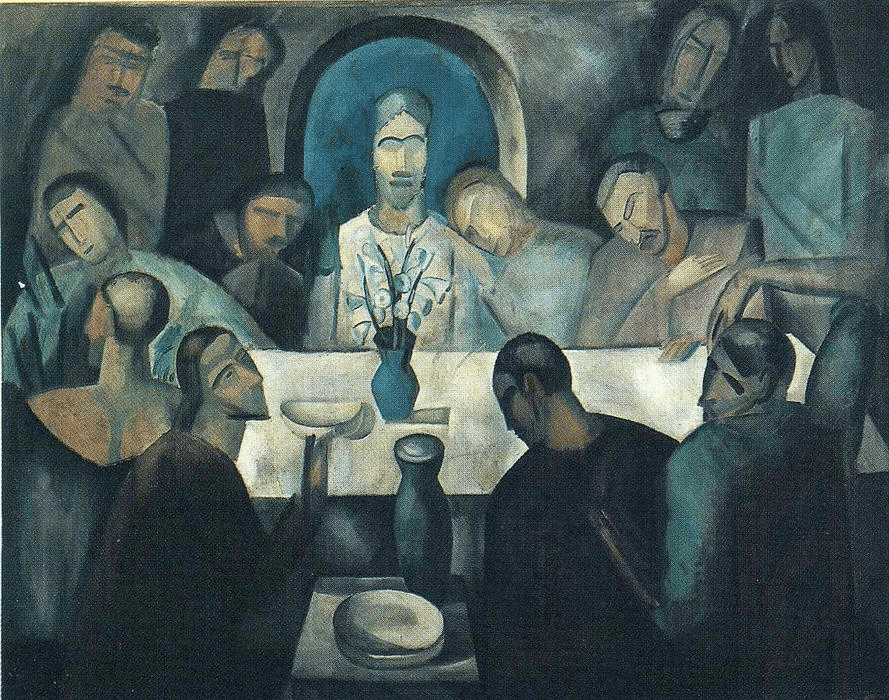
The Last Supper of Jesus, by André Derain (1880-1954)

There are plenty of people in this old messed-up world who lord their power and authority over others. If we take the words of Jesus seriously, Christians are not to be part of that structure and system.

And yet, here we are, in this contemporary time and place in history, having a chunk of the population thinking Christendom is the way to go, that a form of Christian Nationalism should be the political system – as if the kingdom of God and the kingdom of this world are what’s on the ballot.

Christians are the very folks who need to insist on serving, not leading; building up, not tearing down; loving, not hating; being integrated and connected, not fragmented and disconnected from others, as well as from reality.

Any sort of earthly power and authority the Christian has, must be used to include, help, and support, instead of excluding, ignoring, and destroying. The greatest among us must become like the youngest, and the leader like one who serves.

Christians must support and promote the idea of political office as a public service; and the concept of being a citizen as serving the common good of all persons, not just some persons.

Jesus came to this earth to serve. Therefore, his followers are also to serve. The words and ways of Christ centered in humble service, merciful justice, and prayer for one’s enemies. His followers must do no less.

Jesus Christ came to usher in a moral and ethical kingdom in which God’s gracious and benevolent will is done on this earth, as it is always done in heaven. He did not come to make sure Christians have lots of political power and authority over all the non-Christians.

Yes, indeed, we will be given power and authority – but not to baptize existing earthly structures so that the system serves the interests of Christians. We receive so that we can give. We give so that we might serve. And we serve because our Lord is a servant.

So, if Christians truly desire to bring change and transformation to this world, it will be through a compassionate and caring system of service to our fellow humanity – and not by imposing our beliefs and will upon others in a modern day form of the Inquisition.

Let us then, traffic in love; aspire to meekness; practice servanthood; and become the wait staff for the world’s needs.

That is what it really means to stand with Jesus in this time of trial.

Gracious and loving God, you work everywhere reconciling, loving, and healing your creatures and your creation. In your Son, and through the power of your Holy Spirit, you invite each of us to join you in your work.

I ask you to form me more and more in your image and likeness, through my prayers and worship of you; and through the study of Holy Scripture, so that my eyes will be fully opened to your mission in the world.

Send me into my family, church, community, workplace, and world to serve Christ with faith, hope, and love, through the power of the Holy Spirit. Amen.