Acts 4:23-31 – Why Not Us?

Hear My Plea by Rochelle Blumenfeld

The apostles Peter and John were arrested for preaching the good news about Jesus. After warning and threatening them to stop doing this, the ruling council of the Jews released them. This was the apostles’ response….

On their release, Peter and John went back to their own people and reported all that the chief priests and the elders had said to them. When they heard this, they raised their voices together in prayer to God. “Sovereign Lord,” they said, “you made the heavens and the earth and the sea, and everything in them. You spoke by the Holy Spirit through the mouth of your servant, our father David:

“‘Why do the nations rage
    and the peoples plot in vain?
The kings of the earth rise up
    and the rulers band together
against the Lord
    and against his anointed one.’

Indeed, Herod and Pontius Pilate met together with the Gentiles and the people of Israel in this city to conspire against your holy servant Jesus, whom you anointed. They did what your power and will had decided beforehand should happen. Now, Lord, consider their threats and enable your servants to speak your word with great boldness. Stretch out your hand to heal and perform signs and wonders through the name of your holy servant Jesus.”

After they prayed, the place where they were meeting was shaken. And they were all filled with the Holy Spirit and spoke the word of God boldly. (NIV)

The early believers in Jesus turned to God in a time of persecution. They found comfort in how God had worked in the past. The ancient church claimed the strength to carry on with speaking about Christ in their everyday lives. When they heard about threats against the apostles, the believers did not get angry or upset about how terrible things were. Instead:

The church decided to concentrate on corporate prayer together.

God is going to do what God is going to do. No government, nation, institution, group of people, or individual person can thwart God’s agenda for the church and world. God is sovereign over everything. We are not. Our place is to participate in God’s agenda through the ministry of prayer and speaking the word of God.

God acted in the past, on behalf of those first believers who came to Jesus and worshiped him with all their hearts. God is still transforming lives. It happened in ancient Jerusalem, throughout the history of the church, and in places today around the world. It can also happen with us.

Prayer is like breathing – inhaling more of God and exhaling less of me. Prayer takes the form of first remembering what God did in the past. Then, we pray specifically for our current situation which connects to the larger purposes of what God is doing. All the while we anticipate God will hear and act, just as has been done throughout history.

Remembrance is an important dimension to biblical prayer. Memory is necessary because we have a tendency toward forgetfulness. The older we get the more we tend to forget (probably because we have so much to remember!). So, continually rehearsing what God has done keeps us grounded in Scripture and tethered to what God can do now.

Remembering God’s saving actions and finding our own personal stories in the grand story of redemption helps us to pray in biblical ways.

The prayer of the early believers was a rehearsal of God’s mighty reputation, from creation to King David, to the redemptive events of Jesus. They reminded God of when, in the past, there was divine intervention. The church collectively quoted Psalm 2 about the Messiah. That psalm declares how the nations of the earth plot in vain because the Lord is the One who shall prevail over every hard circumstance. 

God bends each malevolent action toward the redemption and transformation of humanity. God will work out benevolent plans and purposes, even using people who have no acknowledgment of God. God is not surprised by our troubles and our tough situations.

God is never frustrated by people acting badly, because divine providence and guidance is in control, even if we cannot always perceive it or see it in the moment.

Remembering and rehearsing what God has done in the past helps us realize that, during any trouble, God is in control and will accomplish good plans on this earth. The prayer of the believers in Acts made the connection between what God has done and what they needed.

Photo by Pixabay on Pexels.com

Interestingly, the believers did not pray for relief from oppression or for God to judge their persecutors. Instead, they prayed for boldness to speak the word of God in the middle of their trouble. They rightly discerned that they needed to pray for courage to speak about Jesus. So, the church prayed for God to act in power, for God’s Word to go forth, and for Christ’s Name to be glorified.

God’s response to the prayer was immediate. The place where the church was praying shook. God did exactly what they asked for – filling them up with the Spirit, so that they spoke boldly about Jesus. Just as God empowered people for service in the past, so it was done in the present. What’s more, God will empower us with the same courage.

It is completely normal to simultaneously yearn for bravery while being afraid of getting a prayer for boldness answered. This is more than trying to overcome feelings of awkwardness or shyness. For the early believers, a very real and immediate danger to speaking up about Jesus was present.

It seems to me we need more people who know how to ask good questions and have the patience and attention to listen well and respond thoughtfully. It does no good to simply dispense answers to questions people aren’t asking. Speaking about Jesus does not mean making spiritual cold calls on strangers. And it certainly doesn’t involve being obnoxious or acting like a spiritual pester pup.

Discussing Jesus mostly means speaking casually, one-on-one, with a friend, co-worker, neighbor, or family member you already know. Too often we might try to fly under the radar and avoid people because we think talking about Jesus is going to be too hard, or out of our league.

Confidence and courage are not telling people what they ought to believe. It is rather like sharing a precious gift with someone. It begins in relationships with people we care about and extends to a relationship with God. It is about discovering God together, and not arm-twisting others to personal ethics or churchgoing.

Yet, it may still all sound too scary. So, maybe we start with this: “Tell me what’s going on.” Then listen. After listening, say, “I’ll pray for you.”  The next time you encounter the person, ask how that situation went.  Express that you’ll pray again. Keep doing it and watch what God will do through you.

When we pray for boldness, and courageously make ourselves available to God, then we are living sacrifices. This is our spiritual act of worship. (Romans 12:1-2) Who knows? Why not here? Why not now? Why not us? After praying, we might find our meeting places shaken, lives transformed, and everyone filled with God’s Holy Spirit.

God almighty, as you sent the Son, send us into the world with your compelling love. Help us by means of your Spirit, to share your good news of love, forgiveness, justice, peace, compassion, and care. Revive your Church, o Christ. Gracious God, work everywhere reconciling, loving, and healing your people and your creation. Open our eyes to your mission in the world. Send us to serve with Christ, taking risks to give life and hope to all people and all your creation. Amen.

1 Corinthians 15:50-58 – Keep the Easter(tide) Coming

He Is Not Here by He Qi

What I am saying, brothers and sisters, is this: flesh and blood cannot inherit the kingdom of God, nor does the perishable inherit the imperishable. Listen, I will tell you a mystery! We will not all die, but we will all be changed, in a moment, in the twinkling of an eye, at the last trumpet. For the trumpet will sound, and the dead will be raised imperishable, and we will be changed. For this perishable body must put on imperishability, and this mortal body must put on immortality. When this perishable body puts on imperishability, and this mortal body puts on immortality, then the saying that is written will be fulfilled:

“Death has been swallowed up in victory.”
“Where, O death, is your victory?
    Where, O death, is your sting?”

The sting of death is sin, and the power of sin is the law. But thanks be to God, who gives us the victory through our Lord Jesus Christ.

Therefore, my beloved, be steadfast, immovable, always excelling in the work of the Lord, because you know that in the Lord your labor is not in vain. (NRSV)

Throughout my years of conducting Easter Sunday services, I inevitably have someone mention to me after the glorious resurrection celebration how much they enjoy Easter music and cantatas. Then, the conversation oftentimes ends with some sort of statement on how it is too bad we only sing such songs once a year.

Here is my proposal: Then don’t just sing them once a year. Instead, rejoice with resurrection singing and gusto to God, who gives us the victory through our Lord Jesus Christ, for the next several weeks.

“I am the resurrection and the life. Those who believe in me, even though they die, will live, and everyone who lives and believes in me will never die.” – Jesus

John 11:25-26, NRSV

The hopes and expectations of Christians are realized in Christ’s resurrection. The good news of Easter cannot be contained or limited to a single day (Easter Sunday). That is why, according to the Christian Calendar, Easter is only the first of fifty days of celebration called “Eastertide” which leads to the day of Pentecost. Eastertide is a season designed especially for exploring the new life we have in Jesus and the joyful Christian life we can all experience.

Just as we would likely not think of taking only one vacation day in the year for renewal, so it is necessary to take more than one day to enjoy Easter. If nothing else, Eastertide gives believers an opportunity to let Christ’s resurrection percolate in our hearts so that we end up becoming people in real life who exhibit an alive spirit.  And, God knows, we could use much more of that in our congregations and our world!

“The message of Easter is that God’s new world has been unveiled in Jesus Christ and that you’re now invited to belong to it.”

N. T. Wright

If life, eternal life, and the necessity of being alive are all needs for us, then it only makes sense that we would want to take advantage of what Eastertide has to offer: A deliberate look at Christ’s resurrection, exploring its implications and impact for us. Simply assuming we all know about resurrection will not do, any more than my wife simply assuming I love her without looking her straight in the eye and telling her so. 

If Christ has not been raised, your faith is futile (1 Corinthians 15:17). Without an Eastertide, there’s a sin-as-usual kind of approach to life with a sort of shoulder shrug that says, “Meh, what’s a guy to do?”  Instead, we have the hope of life everlasting because Christ has risen from death. We have the hope of individual renewal, corporate revitalization, and worldwide revival because there is a risen Savior.

Spring is the time of year which can give shape to the rest of our seasons. Christ’s resurrection gives us a reason to rejoice, hope, persevere, and serve gladly, knowing that our labor in the Lord is not in vain. 

Easter is not over. It is just beginning. 

Therefore, throwing parties for Jesus is in order. Celebrating life, new life, is not only fun but biblical. Maybe some people outside the church look at Christians as uptight and repressed because we are not throwing the best parties and celebrations. 

After all, we have the highest reason possible to celebrate loudly with great passion and joy. Our joy can lead us to paint the town red, whoop it up, raise the roof; splurge, and be effusive with our worship. Christians, full of redemption and reconciliation, break out of their staid existence to hail King Jesus not just today but all through Eastertide because Christ is risen!  He is risen, indeed!

Almighty God, who through your only begotten son Jesus Christ overcame death and opened to us the gate of everlasting life: Thank you for giving me a reason to celebrate with joy my Lord’s resurrection. May I be raised from the death of sin by your life-giving Spirit and give the best party in the neighborhood; through Jesus Christ who lives and reigns with you and the Holy Spirit, one God, now and forever.  Amen.

Easter Sunday: Take the Stairs Out of the Shame Lounge

Welcome, friends! On this Resurrection Day, we consider the impact of Christ rising from death. The Lord’s resurrection is not only a doctrine to believe; it is a powerful reality to live into. Click the videos below, and let us celebrate new life in Jesus Christ….

Colossians 3:1-4, Pastor Tim Ehrhardt

“Death has been swallowed up in victory.”

“Where, O death, is your victory?
    Where, O death, is your sting?”

The sting of death is sin, and the power of sin is the law. But thanks be to God! He gives us the victory through our Lord Jesus Christ. (1 Corinthians 15:54b-57, NIV)

Isaiah 52:13-53:12 – Good Friday

Golgotha by Norwegian artist Edvard Munch (1863-1944)

The Lord says, “See, my servant will act wisely.
    People will greatly honor and respect him.
Many people were shocked when they saw him.
    His appearance was so damaged he did not look like a man;
    his form was so changed they could barely tell he was human.
But now he will surprise many nations.
    Kings will be amazed and shut their mouths.
They will see things they had not been told about him,

    and they will understand things they had not heard.”

Who would have believed what we heard?
    Who saw the Lord’s power in this?
He grew up like a small plant before the Lord,
    like a root growing in a dry land.
He had no special beauty or form to make us notice him;
    there was nothing in his appearance to make us desire him.
He was hated and rejected by people.
    He had much pain and suffering.
People would not even look at him.
    He was hated, and we didn’t even notice him.

But he took our suffering on him
    and felt our pain for us.
We saw his suffering
    and thought God was punishing him.
But he was wounded for the wrong we did;
    he was crushed for the evil we did.
The punishment, which made us well, was given to him,
    and we are healed because of his wounds.
We all have wandered away like sheep;
    each of us has gone his own way.
But the Lord has put on him the punishment
    for all the evil we have done.

He was beaten down and punished,
    but he didn’t say a word.
He was like a lamb being led to be killed.
    He was quiet, as a sheep is quiet while its wool is being cut;
    he never opened his mouth.
Men took him away roughly and unfairly.
    He died without children to continue his family.
He was put to death;
    he was punished for the sins of my people.
He was buried with wicked men,
    and he died with the rich.
He had done nothing wrong,
    and he had never lied.

But it was the Lord who decided
    to crush him and make him suffer.
    The Lord made his life a penalty offering,
but he will still see his descendants and live a long life.
    He will complete the things the Lord wants him to do.
“After his soul suffers many things,
    he will see life and be satisfied.
My good servant will make many people right with God;
    he will carry away their sins.
For this reason I will make him a great man among people,
    and he will share in all things with those who are strong.
He willingly gave his life
    and was treated like a criminal.
But he carried away the sins of many people
    and asked forgiveness for those who sinned.” (NCV)

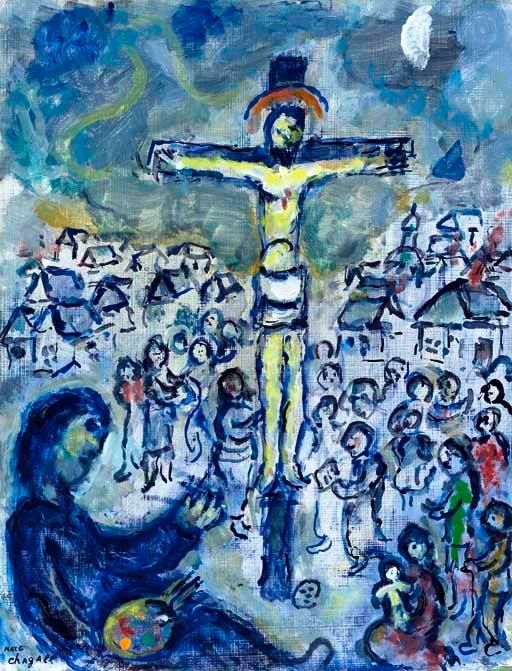
Le peintre et le Christ (The Painter and the Christ) by Marc Chagall (1887-1985)

With all the suffering in this world due to ongoing diseases, natural disasters, moral distress, and so much more, it might seem awkward that Christians everywhere would observe a day called “Good” Friday. 

Considering the hard circumstances of so many people, to call today “good” might appear cruel and out of touch with the world. Even for Christians, at first glance, “Good Friday” can seem a bit oxymoronic for a day observing the torture and death of an innocent man. 

Some would argue that Christ is no longer on the cross and we need to give all our focus on the resurrected Jesus and victory. No need for all this suffering stuff. Yet, the Resurrection only has meaning because of this very day, Good Friday. Without the Suffering Servant of Isaiah, there is no King Jesus. 

For Christians everywhere, this day is an incredibly good day because the crucifixion of Jesus Christ means the redemption of the world. On this day followers of Jesus remember and commemorate the events that led up to the cross; unpack those events and interpret them with profound meaning and significance; and worship Jesus with heartfelt gratitude because of the redeeming work of the cross.

The bulk of the New Testament Gospels of Matthew, Mark, Luke, and John are given over to the final week of Christ’s life, especially leading to the cross. Good Friday observances often take a somber form due to the brevity of Christ’s experience on the cross. 

On this day, Christians remember the last words of Christ, and recognize the significant impact his death had on the immediate persons around him. Believers also contemplate the lasting results of that singular death as an atoning sacrifice; perfect love; reconciliation between God and humanity; victory over evil; and the redemption of all creation.

Sadness, then, is far from the only emotive expression today. It is also appropriate to feel wonder, gratitude, and deep satisfaction for the accomplishment of deliverance from the power of sin. There is the recognition that something profound and meaningful has truly happened in the egregious suffering of Jesus. Thus, we not only remember the anguish of Christ, but what that horrible torment accomplished. In fact, the cross of Jesus is so significant that an eternity of considering its impact could never plumb the depths of its far-reaching effects.

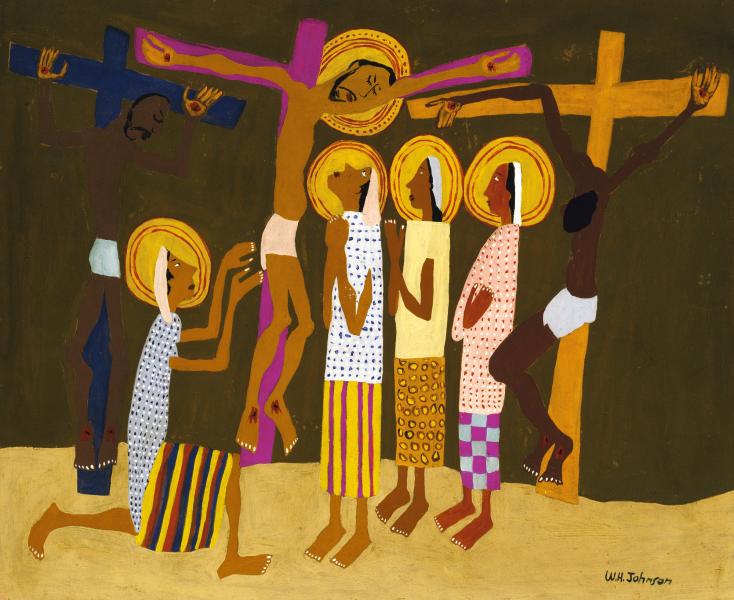
Mount Calvary by William H. Johnson (1901-1970)

With such profound meaning, one would think that Good Friday is a hugely observed day on the Christian Calendar. Yet, for a chunk of churches and Christians, it is not. The cross is not a popular subject. Maybe it’s because neither Christian nor non-Christian wants to ponder something so bloody and sad.

Episcopal priest Fleming Rutledge has adroitly put her finger on the issue: “Religious people want visionary experiences and spiritual uplift; secular people want proofs, arguments, demonstrations, philosophy, and science. The striking fact is that neither one of these groups wants to hear about the cross.”  Indeed, as the Apostle Paul has said, the cross of Christ is “a stumbling block to Jews and folly to Gentiles” (1 Corinthians 1:23).

A personalized religion which leaves the cross out of the picture (too much violence and sacrifice) might seem appealing yet will only leave us bereft of the communion of the saints both past and present. Consider the ancient witness of the Church:

“I believe in Jesus Christ, his only Son, our Lord… he suffered under Pontius Pilate, was crucified, died, and was buried; he descended to hell.”

Apostles’ Creed

“For our sake he [Christ] was crucified under Pontius Pilate; he suffered death and was buried.”

Nicene creed

Christ suffered “in both body and soul – in such a way that when he sensed the horrible punishment required by our sins ‘his sweat became like great drops of blood falling down on the ground.’  He cried, ‘My God, my God, why have you forsaken me?’  And he endured all this for the forgiveness of our sins.  Therefore, we rightly say with the Apostle Paul that we know nothing ‘except Jesus Christ, and him crucified;’ we ‘regard everything as loss because of the surpassing value of knowing Christ Jesus our Lord.’ We find all comforts in his wounds and have no need to seek or invent any other means than this one and only sacrifice, once made, which renders believers perfect forever.” –Belgic Confession, Article 21

And let us consider further the New Testament witness:

“Jesus suffered outside the gate in order to sanctify the people through his own blood.  Therefore, let us go forth to him outside the camp, and bear the abuse he endured.” (Hebrews 13:12-13, NIV)

“May I never boast of anything except the cross of our Lord Jesus Christ, by which the world has been crucified to me, and I to the world.” (Galatians 6:14, NRSV)

The extent of Good Friday goes far beyond a day on the calendar; it is the fulcrum upon which all of Christianity hinges. Because Christ suffered, our suffering has meaning. Each situation of trauma; every case of disease; all suffering and wholesale hard circumstances only make sense, in the Christian tradition, when they are viewed in solidarity with cross of Jesus Christ.

So, today, let Christians everywhere contemplate the cross, observe the salvation accomplished through Christ’s death, and offer prayers and petitions for those who need deliverance from the power of evil. Let us worship God in Jesus Christ because of the suffering on the cross.