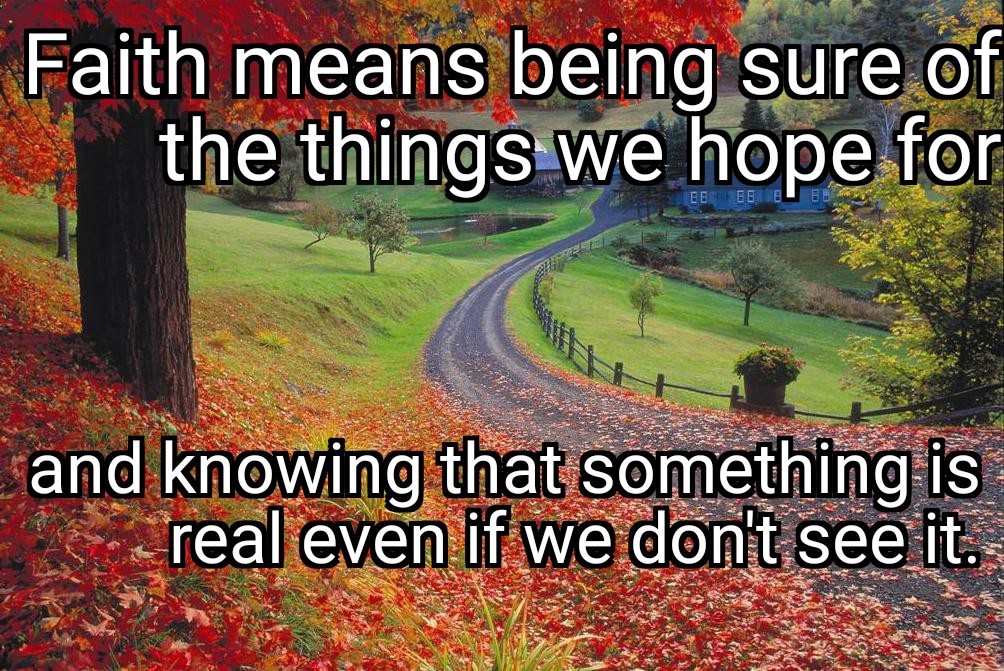
Hebrews 11:4-7 – Let the Future Shape Your Present

By faith Abel brought God a better offering than Cain did. By faith he was commended as righteous when God spoke well of his offerings. And by faith Abel still speaks, even though he is dead.

By faith Enoch was taken from this life, so that he did not experience death: “He could not be found, because God had taken him away.” For before he was taken, he was commended as one who pleased God. And without faith it is impossible to please God because anyone who comes to him must believe that he exists and that he rewards those who earnestly seek him.

By faith Noah, when warned about things not yet seen, in holy fear built an ark to save his family. By his faith he condemned the world and became heir of the righteousness that is in keeping with faith. (New International Version)

Faith is important. It’s part of us. We are all people of faith – maybe not sharing the same faith – but it is faith, none-the-less.

Belief transcends time. Faith is rooted in the past, experienced in the present, and future-oriented. In Christianity, faith is historically moored to the redemptive events of Christ’s incarnation, life, death, resurrection, and ascension. This historic faith has continuing ramifications into the present time. And it is a faith which believes Christ is coming again to judge the living and the dead.

All of this means our salvation encompasses past, present, and future. So, it is appropriate and accurate to say the Christian has been saved, is being saved, and will be saved. Deliverance from sin, death, and hell was achieved on the cross. We are presently in the process of being delivered from our sinful nature and the effects of a fallen world. And we will be completely delivered at the end of the age when there will be no more disease, death, or grief-stricken crying.

The New Testament brings out all these dimensions of time. Whereas the Apostle Paul tended to continually look back to the past of God’s action in history, the author of Hebrews consistently looks ahead and brings out the future orientation of our faith.

And that is what the great Hall of Faith in chapter eleven of Hebrews is about – giving repeated examples of individuals who transcended their present hard circumstances through realizing what will be eventually coming. All of them acted particular ways in the present time because of what they believed would happen in the future. In other words, people of faith allow their belief in what is coming to shape how they live now in daily life.

Abel took the absolute best of his flock and made it an offering, with the intent of giving God an appropriate gift. Whereas his brother Cain cobbled together some of the leftovers from his vegetable harvest and gave them a nonchalant toss to God. Then, he got upset when God looked with disfavor on it.

Abel’s actions demonstrated the attitude of his heart. His belief and his practice worked together. And the gift he gave to God cost him his life, as Cain was inflamed with anger and killed his brother. Only by looking ahead and seeing that God’s reward is better than anything this world can offer, can we endure hardship.

Enoch focused on pleasing God through his three-hundred year life, knowing he would then enjoy an eternity with the Lord who provides good rewards. Enoch displayed his faith through obedience to God. He believed God existed and that God is good.

Noah, despite the jeering of his neighbors, took one-hundred years of his life to build a big ark, believing without a doubt that God’s judgment was coming. The daily grind of constructing an ark for such a long time was made possible because Noah was looking ahead. His present actions were shaped by his forward thinking faith.

In each individual’s life, their daily actions were a result of their unshakable belief in what was to come.

Faith enables us to persevere patiently through any kind of adversity. Knowing we have a better reward ahead; realizing our present trouble will not last forever; and believing Christ will eventually make all things right in this world which has so much wrong – forms the foundation of our faith in such a way as to buoy us so that we do not drown in a sea of injustice, microaggressions, unhealthy power dynamics, as well as plain old meanness and insensitivity from others.

So, when we face those times which tempt us to get lost or stuck in an ever-enclosing existential angst, take a pause, back up the truck, and see a more expansive big picture view of yourself, your situation, and others. You’ll be glad you did.

Christ be with me, Christ within me,

Christ behind me, Christ before me,

Christ beside me, Christ to win me,

Christ to comfort and restore me.

Christ beneath me, Christ above me,

Christ in quiet, Christ in danger,

Christ in hearts of all that love me,

Christ in mouth of friend and stranger.

Amen.

-Prayer of St. Patrick

Hebrews 2:5-9 – Christ is Qualified

It is not to angels that God has subjected the world to come, about which we are speaking. But there is a place where someone has testified:

“What is mankind that you are mindful of them,
    a son of man that you care for him?
You made them a little lower than the angels;
    you crowned them with glory and honor
    and put everything under their feet.”

In putting everything under them, God left nothing that is not subject to them. Yet at present we do not see everything subject to them. But we do see Jesus, who was made lower than the angels for a little while, now crowned with glory and honor because he suffered death, so that by the grace of God he might taste death for everyone. (New International Version)

Christ’s suffering qualified him to unite people.

By Christmas eve of 1914, World War I had come to the point of trench warfare. On one point along the miles of trenches, on one side were the allied troops of French and Scots, and on the other side, Germans. That night, a Frenchman began singing Silent Night. Eventually his comrades joined in. Much to their surprise, the Germans on the other side of the trench, recognizing the familiar tune, began singing the song in their native tongue, along with them. The Scots then joined in with their bagpipes.

After the song, heads began to stick out from the trenches. Both sides realized they had a common celebration in song. This led to white flags going up on both sides, and then the unthinkable happened. Both trenches, allied and axis powers, enemies of one another, left their holes in the ground and met in the middle, exchanging pictures, and communicating with each other. The evening was capped off with the Scottish chaplain leading all the men together in a celebration of communion. The 2005 movie, Joyeux Noel, recounts the actual events.

Whenever we come together, expressed for the Christian through the sacrament of communion, it puts our differences in their proper perspective – we all come together as one, not seeing each other as rich or poor, black or white, American or Asian, or anything else.

The events of that Christmas eve in 1914, however, did not have a happy ending. The two sides found that, once the holiday passed, they did not have the will to fight their new brothers. The top brass on each side were upset and sent the Germans to the Russian front (and certain death); and the Scottish chaplain was defrocked for his actions and sent home never to pastor again, letting us see in dramatic fashion that unity has a price.

The book of Hebrews was originally written (or preached) to encourage and exhort struggling Jewish Christians. The author pointed them squarely at Jesus. The people were in danger of forgetting what the pioneer and champion of their salvation had done for them.

What’s more, they were in danger of reneging on their commitment to Christ. So, the entire book is dedicated to demonstrating and reminding discouraged believers that Jesus Christ is superior to everything, both in heaven and on earth.  Because of that truth, Jesus is worthy of our eternal devotion and remembrance.

Jesus is qualified to be our Savior and Lord. Every day and each minute of our lives are an opportunity for a fresh commitment to Jesus.

The regular practice of Christian communion and consistent spiritual practices are meant to lead us into celebrating our Savior’s work. The worldwide communion of saints is celebrating with us in remembering and committing ourselves afresh to the lordship of Jesus Christ.

A great victory has been won, not just in the trenches of human wars, but on the cross of Christ. This singular death on our behalf qualified Jesus to be our Savior from sin, once and for all.

Christ’s suffering qualified him to be our Savior.

Jesus suffered an inglorious and ignominious death. Yet, paradoxically, glory came through suffering. Jesus did not only suffer at his crucifixion; he experienced the full range of human suffering throughout his life.  He knew what it was like to face adversity and hardship. It is Christ’s suffering that helps us make sense of our own suffering.

We can only truly be free from all that binds us by embracing that which makes us suffer. And because we live in a fallen world, we all personally suffer in some way. In addition, entire groups of people suffer – whether it is religious persecution, racial profiling, class warfare, or government oppression. This suffering is very real, damaging, and dehumanizing, resulting in terrible living conditions and even death.

Maybe because of this reality, some tend to minimize their own suffering. After all, what is a harshly worded e-mail, trying to lose a few extra pounds, or an unexpected car repair compared to families devastated by COVID-19? It is all suffering none-the-less.

It is good to keep our life situations in proper perspective; and we must be careful to not tell God what he should and shouldn’t care about in this world. If the only things that matter and qualify as hardship and difficulty is human trafficking, the terrors of war, or grinding poverty, then you will soon find yourself plastering a smile on your face and nodding over-enthusiastically whenever someone asks you how you are doing. Happy with-it Christians are insufferable, (pun intended).

We must find commonality and solidarity with Jesus in our own personal and corporate suffering. An admission of weakness, trouble, hardship, or suffering is neither a lack of faith nor the unpardonable sin. Identifying with the adversity of our brothers and sisters in Christ throughout the world can be transformed into suffering that has meaning and significance. Our temporary sufferings now will someday result in the glory of being with Christ forever.

Christ’s suffering qualified him to be our compassionate helper.

Through the death of Jesus on the cross we have victory over Satan and all his wicked spirits.

I have heard more than one motivational speaker say: “If you could do one thing in your life and not be able to fail, what would it be?” The truth is, because of Christ’s atoning sacrifice, we have victory and can live our lives in confidence and commitment to Jesus.

Temporary failures and failings are not the end of the story. We possess a union with Christ because of the cross. Jesus is our champion. He stands with us in our suffering and temptations. 

In solidarity with all who suffer, along with brothers and sisters who agonize throughout the world, we have the blessed opportunity of bringing our troubles to a gracious God – thus finding forgiveness and hope. 

May your burdens be lifted, and may you know Christ, and him crucified, died, buried, risen, ascended, and coming again. Jesus knows you because he tasted death for you – and for everyone.

Merciful Lord help me to remember in these troubled times the cross you carried for my sake so that I may better carry mine and help others do the same. Since you tasted death that I might taste life, I forever belong to you and offer up all that I am and all I hope to be to the glory of Jesus Christ through the power of the Holy Spirit. Amen.

**Above picture: Christ the Redeemer statue in Rio de Janeiro, Brazil

1 Corinthians 2:1-10 – Where Does the Power to Change Come From?

When I came to you, I did not come with eloquence or human wisdom as I proclaimed to you the testimony about God. For I resolved to know nothing while I was with you except Jesus Christ and him crucified. I came to you in weakness with great fear and trembling. My message and my preaching were not with wise and persuasive words, but with a demonstration of the Spirit’s power, so that your faith might not rest on human wisdom, but on God’s power.

We do, however, speak a message of wisdom among the mature, but not the wisdom of this age or of the rulers of this age, who are coming to nothing. No, we declare God’s wisdom, a mystery that has been hidden and that God destined for our glory before time began. None of the rulers of this age understood it, for if they had, they would not have crucified the Lord of glory. However, as it is written:

“What no eye has seen,
    what no ear has heard,
and what no human mind has conceived”—
    the things God has prepared for those who love him—

these are the things God has revealed to us by his Spirit.

The Spirit searches all things, even the deep things of God. (New International Version)

We need the Holy Spirit of God.

Without the Spirit’s help, Jesus is merely one of thousands of individuals crucified in history – only an example of someone martyred for his faith. Yet, Jesus was infinitely more. Christians discern Jesus as the Son of God and Savior of the world. 

Through Christ’s life, death, resurrection and ascension, people can be redeemed from empty lives, saved from destructive life-patterns, and given the kind of security and purpose which God intended from the beginning. The Spirit’s role is to take these redemptive events of Jesus and apply them to our lives. 

Thus, Christian Trinitarian theology understands we are unable to see the truth about the cross of Jesus Christ unless God the Holy Spirit, sent by God the Father and the Son, breaks into our lives and does an intervention, showing us our denial about how we are really doing – as well as our delusions about who we really are.

Admitting we need the Holy Spirit of God means the power of Christianity and the Christian life rests with Jesus Christ and him crucified, and not with us.

We are, in many ways, powerless. I realize this is not a popular message, especially in Western society. Tell the average American they are powerless, and they’ll think you’re off your rocker. It sounds ridiculous. Some would argue that we have done well, thank you very much, on our own. We have a couple of cars, a house, a job, and a family. After all, we worked hard, and we did it.

However, any worldly success we gain, and getting the things we want, may lead us to the delusion we have the power to do whatever we want.

Oh, sure, we might reason, we have problems just like everybody else. After all, we cannot control everything.  But we are not completely powerless just because we have difficult circumstances and a few problem people in our lives. God will step in a take-over where I leave off, right?…

Wrong. Apart from the Holy Spirit of God, we are unable to become Christians and live the Christian life. If we believe we manage our lives fine, with some help from God, then we might be in denial about how much we place ourselves at the center of the world. And believe we should be able to deal with whatever comes at us in life. When our consistent response to adversity, or the realization we are not handling something well, is to try and fix ourselves, we are living the delusion we have the power to change.

A reflexive response in asking Google to find answers to our problems; dealing privately with our personal issues; expecting our willpower to be enough; passively resigning ourselves to mediocre lives because we have tried to change or be different; then this means we are feeding the delusion we do not really need the Holy Spirit of God. But just need more effort or information to overcome my problems. And when more doesn’t solve our issues, we easily become discouraged.

We need the true power source of the Christian life. We need the Holy Spirit applying the work of Jesus Christ to our lives so that we can live a victorious life.

Unfortunately, it typically takes a tragedy or crisis to break our delusion of power – a bad marriage, a family member’s addiction, a runaway child, a terminal illness, a bankruptcy, a death. How bad do you and I need to hurt before we will admit we are not managing our lives well, at all, and that the real power to change resides with the Holy Spirit?

There is power in the cross of Jesus Christ. The Apostle Paul believed this with all his heart. Although Paul was an intelligent and learned person, he did not rely on his abilities but on proclaiming the power of Jesus and him crucified. The crucifixion of Christ was a past action with continuing and forceful ripples into the present time.

The cross of Jesus is more than an historical event; it is an ongoing reality to experience for victory over all the brokenness of this world and all the mess we have made of things putting ourselves at the center of the universe.

The Reformer, John Calvin, repeatedly instructed and encouraged his Geneva congregation that the Spirit joins us to Christ, assures us of salvation, and grows us in confidence through the Scriptures. Calvin, although a genius, did not rely on his intellect or abilities but insisted we need the Spirit’s witness to mature as followers of Jesus.

There are tough situations and incredibly sad realities which are mysteries beyond our comprehension. They defy simplistic answers and are greater than our attempts to explain them. Hard problems stretch our faith. And they ought to cause us to cry out to God and Christ’s church for help because we are powerless to manage our lives.

We absolutely and totally need the Holy Spirit of God. Without the Spirit, we are lost. But with the Spirit we experience the saving power of Christ’s cross to deal with everything in our lives.

The Serenity Prayer: God grant me the serenity to accept the things I cannot change; courage to change the things I can; and wisdom to know the difference.  Living one day at a time; enjoying one moment at a time; accepting hardships as the pathway to peace; taking, as Jesus did, this sinful world as it is, not as I would have it; trusting that he will make all things right if I surrender to his will; that I may be reasonably happy in this life and supremely happy with him forever in the next. Amen.

John 16:16-24 – There Must Be Suffering Before Glory

Jesus went on to say, “In a little while you will see me no more, and then after a little while you will see me.”

At this, some of his disciples said to one another, “What does he mean by saying, ‘In a little while you will see me no more, and then after a little while you will see me,’ and ‘Because I am going to the Father’?” They kept asking, “What does he mean by ‘a little while’? We don’t understand what he is saying.”

Jesus saw that they wanted to ask him about this, so he said to them, “Are you asking one another what I meant when I said, ‘In a little while you will see me no more, and then after a little while you will see me’? Very truly I tell you, you will weep and mourn while the world rejoices. You will grieve, but your grief will turn to joy. A woman giving birth to a child has pain because her time has come; but when her baby is born, she forgets the anguish because of her joy that a child is born into the world. So, with you: Now is your time of grief, but I will see you again and you will rejoice, and no one will take away your joy. In that day you will no longer ask me anything. Very truly I tell you, my Father will give you whatever you ask in my name. Until now you have not asked for anything in my name. Ask and you will receive, and your joy will be complete. (New International Version)

“Even a happy life cannot be without a measure of darkness, and the word happy would lose its meaning if it were not balanced by sadness. It is far better to take things as they come with patience and equanimity.”

Carl Jung

An Unpopular Message

Jesus often said things that were neither expected nor wanted. Jesus consistently told his disciples there must be suffering before glory. The disciples either could not or would not hear of it. They didn’t sign up to follow Jesus into suffering! Trying to get people to pay attention to suffering is like trying to get a bunch of Baptists to put their names down on a sign-up sheet at church.

Christ was speaking to his disciples in the Upper Room, the last meal he had with them before his death. When they were called by Jesus three years earlier, the disciples were not expecting all the gibberish about leaving and grieving. To put this in contemporary terms, the disciples’ response was akin to saying, “I only think positive. I don’t listen to things that are negative.”

Suffering, death, and grief were far from the disciples’ expectations of how things would and should shake-out. They had such a hard time understanding what the heck Jesus was saying because his words were out of alignment with their assumptions. Yes, there would be glory and joy. First, however, there must be suffering and grief.

A Real Message

Just as a woman experiences terrible pain in childbirth, then ecstatic joy over seeing her child for the first time, so the Christian’s excruciating pain in this life points to the inevitable joy at the end of that suffering. In the scope of eternity, adversity and pain last only a moment. Glorious joy, however, will be forever.

In talking with his disciples about their disappointment, even depression, about Christ’s words of leaving and grieving, Jesus graciously gave them the gift of joy. Yes, there can be and is joy even in the mourning. Not every story has a happy ending.

I can say, however, that the grandest story of all – Jesus Christ’s suffering and death – has resulted in resurrection and ascension. It will all be complete when Christ returns to judge the living and the dead. Then, the grand narrative of redemption will realize its conclusion of no more crying, tears, or pain. There will be only unending joy.

For now, however, we still experience heartache along with the great joy of resurrection and new life. It can be confusing, living in the awkward state of simultaneous grief and joy. Yet, keep in mind, the grief is temporary. The despair will not last. Joy, on the other hand, has staying power and will be the permanent state of the believer. It is only the smaller stories which may or may not end well. The big story of redemption already has the ending written – joy without grief.

A Good Message

Christians serve a risen and ascended Lord. Therefore, we need not wait to be happy, and we need not expect everything must go our way. The good news is that there are always fresh opportunities to be happy through asking and receiving. Imagine a Partridge Family sort of bus coming around to all the bus stops of life. Happy times and music arrive around the clock. Chances are the opportunity to be happy has already arrived. Often, it is right in front of us; we just missed the bus because we were daydreaming about a future state of joy.

We are living days of constant change followed by ever new normal. Just as there was no going back to a three-year hiatus of walking with Jesus for the disciples, so we need to embrace new and different ways of life together here on planet earth. We have the gift of joy. Its just a matter of unpacking it.

Now to him who can do immeasurably more than all we ask or imagine, according to his power that is at work within us, to him be glory in the church and in Christ Jesus throughout all generations, for ever and ever! Amen.