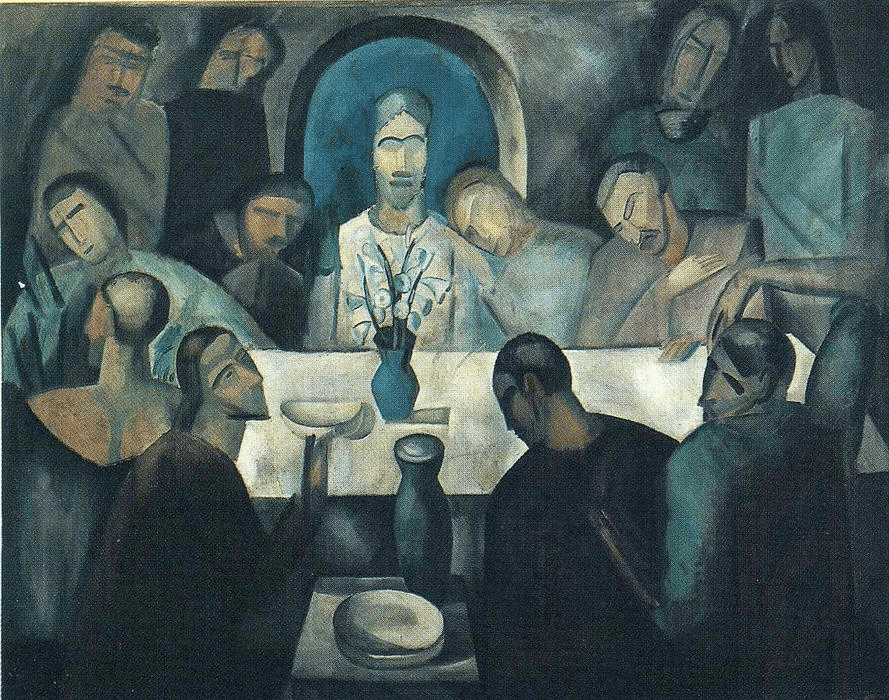
Truth Stumbles in the Public Square (Isaiah 59:9-19)

Therefore justice is far from us,
    and deliverance does not reach us;
we wait for light, but there is only darkness;
    and for brightness, but we walk in gloom.
We grope like the blind along a wall,
    groping like those who have no eyes;
we stumble at noon as in the twilight,
    among the vigorous as though we were dead.
We all growl like bears;
    like doves we moan mournfully.
We wait for justice, but there is none;
    for salvation, but it is far from us.
For our transgressions before you are many,
    and our sins testify against us.
Our transgressions indeed are with us,
    and we know our iniquities:
transgressing and denying the Lord
    and turning away from following our God,
talking oppression and revolt,
    conceiving lying words and uttering them from the heart.
Justice is turned back,
    and deliverance stands at a distance,
for truth stumbles in the public square,
    and uprightness cannot enter.
Truth is lacking,
    and whoever turns from evil is despoiled.

The Lord saw it, and it displeased him
    that there was no justice.
He saw that there was no one
    and was appalled that there was no one to intervene,
so his own arm brought him victory,
    and his righteousness upheld him.
He put on righteousness like a breastplate
    and a helmet of salvation on his head;
he put on garments of vengeance for clothing
    and wrapped himself in fury as in a mantle.
According to their deeds, so will he repay
    wrath to his adversaries, requital to his enemies;
    to the coastlands he will render requital.
So those in the west shall fear the name of the Lord,
    and those in the east, his glory,
for he will come like a pent-up stream
    that the wind of the Lord drives on. (New Revised Standard Version)
We in the United States of America are in a presidential election year. Soon Americans will be voting for their choice of president, as well as an array of federal, state, and local candidates on the ballot.

For many, these four year cycles of elections bring a lot of anxiety, dread, and perhaps most of all, anger. Television commercials and media outlets overflow with the most egregious forms of logical fallacies, and finger pointing, one could imagine.

According to the Pew Research Center, public trust in the U.S. federal government is at 22 percent. That figure is slightly up from 5-10 years ago when it hit an historic low of 15 percent. To put that in perspective, the public trust was at 73 percent in 1960, and 36 percent when Richard Nixon resigned from office due to the Watergate scandal.

In some ways, our contemporary situation is akin to the situation of ancient Judah when Isaiah was prophet. Peace and protection, justice and righteousness, were hard to come by. There was no real trust in government.

The Judeans of the time blamed everyone but themselves for their social and political troubles. They even blamed God. Citizens were not taking responsibility to effect good and right in the land.

It appears that nobody was accepting accountability for their own junk, and blaming God and others for their governmental woes. So, they turned away from each other, and God.

Politics, today as in Isaiah’s day, has become less about the vocation of statecraft and unselfish public servants promoting the welfare of citizens; it has become more about winning elections and possessing power. 

A party spirit rules the day, where, in the Unites States, Republicans and Democrats are more divided than ever with less and less ability to truly listen to one another in order to advance genuine justice, ethical righteousness, and social peace within both the nation and the world.

We, as citizens of both our local regions and of the world, must avoid getting sucked into the vortex of acrimonious speech and hate-filled rhetoric. 

Christians, especially those who desire to live and love like Jesus, need to be at the forefront of forsaking the hypocrisy of saying one thing and doing another; of envying power in order to satisfy personal agendas; and, of believing that malicious talk is justified if it accomplishes my wants and needs. 

We are not to keep looking for politicians, and everyone else whom we disagree with, to change. Rather, we ourselves are to practice repentance and allow the grace of God to transform and renew us. 

If what we speak in the public square is selfish and deceitful, we have no further to look than within, when it comes to turning from evil. A slow, careful, and serious reading of the prophet Isaiah becomes quite necessary. If it does not lead to repentance, we only have God’s displeasure to anticipate.

So, instead of continually insisting that others change or move over, let’s focus on us and seek the following:

  • Seek our better angels of humility, tolerance, and patience to guide our public discourse.
  • Open our eyes to see the image of God in others who are different from us and who see the world differently than we do.
  • Embrace civility and basic human respect for all persons, no matter who they are, as our presuppositions to all conversations.
  • Develop good listening skills so that we aren’t misinterpreting and misrepresenting another’s viewpoint.
  • Be willing, within our own communities of faith, to participate and worship together as the one people of God, without assigning other identities to each other which are not helpful.
  • Enlarge our hearts so that we are big enough people to hold the differing perspectives and politics of others without demonizing them.
  • Default to grace when we aren’t sure what to do say or do.

The Lord will not contend forever with injustice and unrighteousness in the world’s politics, including the extremely local politics of church, family, and neighborhood. Divine intervention cuts both ways, bringing deliverance and freedom, as well as judgment and retribution.

Let us, then, be found to be truthful and honest in all our words and ways; encouraging and helpful in all our public rhetoric and service. Let us seek the peace of everyone, both near and far.

God of truth and justice, you have every right to judge the world. Yet, instead of destroying the earth, you sent your Son to redeem lost humanity to yourself. May I, along with every creature you have made, come to our senses and speak truth with love; and act with integrity so that there is again righteousness throughout the land. Amen.

I Am Among You As One Who Serves (Luke 22:24-30)

The Last Supper, by Mamdouh Kashlan (1929-2022)

A dispute also arose among them as to which one of them was to be regarded as the greatest. But he said to them, “The kings of the Gentiles lord it over them; and those in authority over them are called benefactors. But not so with you; rather the greatest among you must become like the youngest, and the leader like one who serves. For who is greater, the one who is at the table or the one who serves? Is it not the one at the table? But I am among you as one who serves.

“You are those who have stood by me in my trials; and I confer on you, just as my Father has conferred on me, a kingdom, so that you may eat and drink at my table in my kingdom, and you will sit on thrones judging the twelve tribes of Israel. (New Revised Standard Version)

Jesus and his disciples had prepared for the Passover meal. They ate and drank together. Christ gave them words which have endured throughout Christian history as the Lord’s Supper. He spoke of the bread as his body, and the cup as the new covenant in his blood. Jesus communed with them and communicated about his impending death.

It was a moving experience for all. The disciples received from their Lord an intense act of love; and a new humanity around Christ’s body and blood. Indeed, the essence of new life is self-sacrificial love.

And then… the disciples began quarreling with each other about positions, and titles, and honors, and who was better, and who would be top dog in God’s kingdom….

It was a moment that I think every parent can relate to, at some level. Sitting around a dinner table, enjoying a rich conversation, becoming close with one another as a family… and then the kids begin bickering with each other about the most mundane of things.

Just a minute ago, you believed you were getting somewhere, and experiencing a shared family bond of love, commitment, and purpose… and then, in a matter of seconds, it all crashes down in a ridiculous display of posturing and positioning of one sibling over another….

I admit, this has happened to me more than once, when my own kids were growing up. And I also admit that I lost my sanctification on more than one occasion, watching this crazy schizophrenic scene play out in front of me.

Which is why I have a lot of respect for Jesus in responding to his disciples with humility, calmness, and a forthright spirit. He addressed their puny questions in a way that rebuked them without making them feel like they just got a Dad lecture.

In the sort of table fellowship that Jesus practiced with his disciples throughout his earthly ministry, he consistently sought to undermine the existing systems of domination in all levels of society. Even the religious system of Christ’s day had a distinct stratifying of persons in an inequitable structure of power.

The kingdom of God, however, is different. God’s economy is characterized by equality, mutuality, diversity, and shared power. It’s all based in a communal, as well as individual, relational connection with the Creator God.

God almighty, Creator of heaven and earth, is gracious, merciful, and kind. The Lord brings rain on both the righteous and the wicked. Thus, any sort of claim to being greater or superior or better than another person or group of people, has no place around the table of Christ’s body and blood.

Catholics are no better than Protestants. Evangelical Christians have no superiority over Progressive Christians. The Coptic Church doesn’t have the high ground on Eastern Orthodoxy. Christians who observe the Lord’s Supper as a remembrance are not greater than those who discern the Table as a sacrament.

And if one has the ears to hear it, Christians really ought to know better than to believe they should have greater control over the world and its systems than Buddhists, Muslims, or Jews.

Puffing up one’s chest and insisting that “My Dad is better than your Dad” is the stuff of childish preoccupations, and not of God’s kingdom.

The Last Supper of Jesus, by André Derain (1880-1954)

There are plenty of people in this old messed-up world who lord their power and authority over others. If we take the words of Jesus seriously, Christians are not to be part of that structure and system.

And yet, here we are, in this contemporary time and place in history, having a chunk of the population thinking Christendom is the way to go, that a form of Christian Nationalism should be the political system – as if the kingdom of God and the kingdom of this world are what’s on the ballot.

Christians are the very folks who need to insist on serving, not leading; building up, not tearing down; loving, not hating; being integrated and connected, not fragmented and disconnected from others, as well as from reality.

Any sort of earthly power and authority the Christian has, must be used to include, help, and support, instead of excluding, ignoring, and destroying. The greatest among us must become like the youngest, and the leader like one who serves.

Christians must support and promote the idea of political office as a public service; and the concept of being a citizen as serving the common good of all persons, not just some persons.

Jesus came to this earth to serve. Therefore, his followers are also to serve. The words and ways of Christ centered in humble service, merciful justice, and prayer for one’s enemies. His followers must do no less.

Jesus Christ came to usher in a moral and ethical kingdom in which God’s gracious and benevolent will is done on this earth, as it is always done in heaven. He did not come to make sure Christians have lots of political power and authority over all the non-Christians.

Yes, indeed, we will be given power and authority – but not to baptize existing earthly structures so that the system serves the interests of Christians. We receive so that we can give. We give so that we might serve. And we serve because our Lord is a servant.

So, if Christians truly desire to bring change and transformation to this world, it will be through a compassionate and caring system of service to our fellow humanity – and not by imposing our beliefs and will upon others in a modern day form of the Inquisition.

Let us then, traffic in love; aspire to meekness; practice servanthood; and become the wait staff for the world’s needs.

That is what it really means to stand with Jesus in this time of trial.

Gracious and loving God, you work everywhere reconciling, loving, and healing your creatures and your creation. In your Son, and through the power of your Holy Spirit, you invite each of us to join you in your work.

I ask you to form me more and more in your image and likeness, through my prayers and worship of you; and through the study of Holy Scripture, so that my eyes will be fully opened to your mission in the world.

Send me into my family, church, community, workplace, and world to serve Christ with faith, hope, and love, through the power of the Holy Spirit. Amen.

Isaiah 59:9-19 – (Un)Truth in the Public Square

Because of all this, justice is far from us,
    and righteousness beyond our reach.
We expect light, and there is darkness;
    we await a gleam of light, but walk about in gloom.
We grope along the wall like the blind;
    like those without eyes we grope.
We stumble at noonday as if it were twilight,
    and among the strong as if we were dying.
All of us growl like bears,
    and like doves we moan.
We expect justice, but there is none;
    we await salvation, but it is far from us.
Our rebellions are numerous in your presence;
    our sins testify against us.
Our rebellions are with us;
    we’re aware of our guilt:
    defying and denying the Lord,
    turning away from our God,
    planning oppression and revolt,
    muttering lying words conceived in our minds.
Justice is pushed aside;
    righteousness stands far off,
    because truth has stumbled in the public square,
    and honesty can’t enter.
Truth is missing;
    anyone turning from evil is plundered.

The Lord looked and was upset at the absence of justice.
Seeing that there was no one,
    and astonished that no one would intervene,
    God’s arm brought victory,
    upheld by righteousness,
    putting on righteousness as armor
    and a helmet of salvation on his head,
    putting on garments of vengeance,
    and wrapping himself in a cloak of zeal.
God will repay according to their actions:
    wrath to his foes, retribution to enemies,
    retribution to the coastlands,
    so those in the west will fear the Lord’s name,
    and those in the east will fear God’s glory.
It will come like a rushing river
    that the Lord’s wind drives on. (Common English Bible)

It is telling that when the word “politics” is used today, we immediately think of other words like, “polarized” “rancorous” and “corrupt.” The word “statecraft,” that is, the positive use of politics as a vocation in serving the common good of all persons, seems now like some anachronistic concept of the past.

Isaiah the prophet may have spoken over two millennia ago, yet his words are eerily relevant today, when he said, “Truth has stumbled in the public square.”

Politics, today as in Isaiah’s day, has become less about unselfish public servants promoting the welfare of citizens, and more about winning elections and possessing power. 

A party spirit rules the day, where, in the Unites States, Republicans and Democrats are more divided than ever with less and less ability to truly listen to one another in order to advance genuine justice, ethical righteousness, and social peace within both the nation and the world.

We, as citizens of both our local regions and of the world, must avoid getting sucked into the vortex of acrimonious speech and hate-filled rhetoric. 

Christians, especially those who desire to live and love like Jesus, need to be at the forefront of forsaking the hypocrisy of saying one thing and doing another; of envying power in order to satisfy personal agendas; and, of believing that malicious talk is justified if it accomplishes my wants and needs. 

We are not to keep looking for politicians, and everyone else whom we disagree with, to change. Rather, we ourselves are to practice repentance and allow the grace of God to transform and renew us. 

If what we speak in the public square is selfish and deceitful, we have no further to look than within, when it comes to turning from evil. A slow, careful, and serious reading of the prophet Isaiah is quite necessary. If it does not lead to repentance, we only have God’s displeasure to anticipate.

So, instead of continually insisting that others change or move over, let’s focus on us and seek the following:

  • Seek our better angels of humility, tolerance, and patience to guide our public discourse.
  • Open our eyes to see the image of God in others who are different from us and who see the world differently than we do.
  • Embrace civility and basic human respect for all persons, no matter who they are, as our presuppositions to all conversations.
  • Develop good listening skills so that we aren’t misinterpreting and misrepresenting another’s viewpoint.
  • Be willing, within our own communities of faith, to participate and worship together as the one people of God, without assigning other identities to each other which are not helpful.
  • Enlarge our hearts so that we are big enough people to hold the differing perspectives and politics of others without demonizing them.
  • Default to grace when we aren’t sure what to do say or do.

The Lord will not contend forever with injustice and unrighteousness in the world’s politics, including the extremely local politics of church, family, and neighborhood. Divine intervention cuts both ways, bringing deliverance and freedom, as well as judgment and retribution.

Let us, then, be found to be truthful and honest in all our words and ways; encouraging and helpful in all our public service; and seeking the peace of everyone in our own relational orbits.

Great God of truth and justice, you have every right to judge the world. Yet, instead of destroying the earth, you sent your Son to redeem lost humanity to yourself. May I, along with every creature you have made, come to our senses and speak truth with grace and act with integrity so that there is again righteousness throughout the land. Amen.

Mark 10:42-45 – True Leadership

Jesus called them together and said, “You know that those who are regarded as rulers of the Gentiles lord it over them, and their high officials exercise authority over them. Not so with you. Instead, whoever wants to become great among you must be your servant, and whoever wants to be first must be slave of all. For even the Son of Man did not come to be served, but to serve, and to give his life as a ransom for many.” (New International Version)

Leadership as Service

I remember a time when all politicians, government officials, and police were known as “public servants.” It was routinely assumed that such persons served the common good of all persons, regardless of who they are. I am also not delusional about the fact that, back in the day, just as today, there are those who served themselves first. However, at least, the ideal and vision of service was continually before the people.

Power is to be wielded for the benefit of the powerless. Authority is to be used to help those who cannot help themselves. Contemporary understandings of authority for many people today often do not have the common good as their guiding principles of leadership.

Misuse of Leadership

Rather, authority becomes the means of convincing others of the leader’s opinion or position. Power is used to influence, even arm-twist people toward the leader’s ideas. What’s more, those who enabled the leader to come to power expect that leader to use authority to benefit a particular agenda and only one slice of the human population. Lost is the vision of meeting needs for everyone, not just a certain constituency.

The ultimate use of power is to share it, even lay it down. Jesus did it in his incarnation, life, and death. He only took it up again after his mission was finished. We are to follow his cues on power and authority. We have opportunities galore to follow Christ in his leadership practice. For example, I once lived in a community with a large single parent family population. After talking with the elders of my church about this situation, they became excited about the prospects of reaching moms and children struggling to make it day to day.

The discussion did a hard turn of direction when I suggested we have some of those moms come in, sit around the table with us, and dictate what would constitute effective ministry which meets their needs. I was intentionally proposing that we, as church authority figures, share our power with the moms. The elders weren’t having it. One of them said outright, “Well, we can’t do that! We know better!” (than the moms do)

Whenever those in power and authority believe it is their mandate to make decisions without even having conversations with those whom those decisions effect, then they have become masters of small worlds, lords of folly, and ideational bullies. It is not the way of Jesus.

Appropriate Use of Leadership

Proper use of authority doesn’t mean we boss people around. It means we do what we need to do to help everyone in our scope of power. Taking charge must always begin with self. The self-control and self-discipline of the leader is the basis of leadership.

The heart of Christianity is loving service to one another as Christians, and humble service to a world which doesn’t believe, or act like us. Christian leaders are to focus on others’ well-being, success, and growth. They are to value character over career.

Christian disciples follow Jesus in the use of power and authority through:

  • Taking a humble posture of consulting and collaborating with others. And when decisions are made, they maintain relational connections.
  • Including others, and never vilifying or casting blame when stating a case for something.
  • Dealing with trouble and working to clear a toxic environment of noxious attitudes.
  • Directly confronting those they have an issue with, without creating destructive triangles to diffuse responsibility.
  • Encouraging a healthy dynamic of love and service which seeks listening before acting.

Leadership is more about being than about doing. Responsible use of authority comes from the person who understands themselves, is curious about others, and seeks to wisely apply Christ’s compassion to meet human need.

The Leadership of Jesus

Jesus healed people and delivered them from evil, sometimes at great risk to himself. He continually eschewed the perks of power to single-mindedly pursue the Father’s will. Even in his selection of disciples, Jesus purposely overlooked others to choose a rather motley band of men made up of uneducated country bumpkins, the poor, and the overzealous.

The Lord Jesus proclaimed a kingdom that belongs to children, using power to drive out demons and forgive sins. Christ delegated his authority to the disciples to do this same sort of work.

Jesus isn’t offering leadership theories; he is offering himself. Christ is our model of the appropriate use of power. Therefore, humbling ourselves must become our ambition! Our Lord, the ultimate authority above all authorities, humbled himself. Though being powerfully divine, he took the form of a servant, and became obedient to death, even the particularly shameful death on a cross—the ultimate humiliation. Yet God exalted Jesus Christ as Lord of the universe. (Phil 2:5-11)

Will you divest yourself of the pride in believing you know what is best for everyone around you? Will you cease speaking and start listening? Will you follow Jesus to the risky place of sharing power and authority with the powerless?

God, I am far too often influenced by what others think of me. I am always pretending to be either richer or smarter or nicer than I really am. Please prevent me from trying to attract attention. Don’t let me gloat over praise on one hand or be discouraged by criticism on the other. Nor let me waste time weaving imaginary situations in which the most heroic, charming, witty person present is myself. Show me how to be humble of heart, like you. Amen.