Psalm 125

             Psalms 120-134 comprise a collection of short songs of ascent meant to guide Jewish pilgrims in their communal trek up to the city of Jerusalem, and ultimately to the temple mount.  The rhythm of the pious ancient Israelites centered round particular festivals, seasons, and Sabbath.  Taking the annual pilgrimage to the Holy City was an especially anticipated time of year.  This yearly cycle brought both increased faith and needed spiritual stability to the people.  It reminded them of the sound theology that God cannot be moved, and he will always be there.
 
            “Those who trust in the LORD are like Mount Zion, which cannot be moved, but abides forever.”  One of the most fundamental of all truths about God is that he is consistent and constant in his basic nature, that he is forever present with his people.  If God seems or feels as though he is not there or is not listening, it is not that he is aloof or not paying any attention.  It simply means that he chooses to reveal himself when he chooses to reveal himself, and that our responsibility in the entire affair is to engage in consistent rhythms of spirituality that place us in a position to receive grace when God decides to give it.
 
            Therefore we must not despair but anticipate meeting with God, just as the Israelites of old looked forward and upward to their annual worship at the top of the mountain.  The truth is that God surrounds his people, even when we do not always perceive it to be so. 
            Ever-present God, there is no place where I can go where you are not.  Help me to so intuit your presence that it bolsters my faith and resilience for daily life in Jesus Christ.  Amen.

Psalm 11

            God is quite serious about people living in such a way that is righteous, that is, in right relationship with others.  He does not tolerate the wicked – those who only have regard for themselves and violate others with hateful speech and actions.  At the core of God’s very being, he “hates the wicked and the one who loves violence.”  We are to be righteous because God is righteous; we are to hate wickedness because God hates it.
 
            Anytime we talk about wickedness and righteousness, it typically is in the context of others who are violent and we who are not.  This is, at best, misguided, and, at worst, flat-out a self-deception.  It is easy to observe violence in others while ignoring our own part in wickedness.  We rarely equate violence with our words, but the sheer fact is that our tongues are prone to violent speech.  Whenever we seek to dominate a conversation; start an argument in order to win at all costs; put others down for their thoughts and ideas; engage in name-calling; or, speak against another behind his/her back; then we have come under the judgment of the God who abhors every form of violence.
 
            We often feel justified in our violent speech because of our supposed pure motives.  But this disregards the mental activity that takes place in our heads before we speak.  Too many people are prone to jumping to conclusions and thus misinterpret another’s words and actions.  If we would but stop and listen to ourselves, paying attention to the erroneous stories we can tell in an instant about others, then we would measure our words and seek to connect them with the righteous nature of God.  Righteous deeds spring from righteous thoughts based in truth. 
            Holy God, your perfect character and righteousness has always been and always will be.  Help me to connect so deeply with your goodness that my thoughts, words, and actions reflect your impeccable nature through Jesus Christ my Lord.  Amen.

Vulnerability


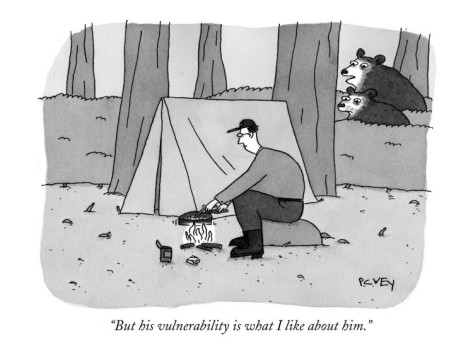
            Most people aren’t crazy about the word “vulnerable.”  We might like to see it in others, but have no intention of being vulnerable ourselves to anyone.  If you have ever poured out your heart to someone or a group of people and only got blank stares in return; if you sincerely loved someone and they did not love you back; if you have ever shared your genuine thoughts on something important to you and received only criticism; then, we may think that being vulnerable is a bad thing and not worth the emotional effort.
 
            Yet, vulnerability is an important, even vital practice for Christians.  In the Gospel of John, Mary displayed vulnerability in pouring expensive perfume on Jesus’ feet and wiping them with her hair, all the while exposing her true feelings for her Lord.  In return Mary got pushback and criticism from Judas.  But Jesus upheld Mary’s actions and told Judas to leave her alone.  Mary was clearly not concerned with how she might appear to others, but was completely focused on Jesus (John 12:1-8).
 
            When we go to the book of Psalms, even a cursory reading reveals a psalmist who is not afraid to explore the depth of human emotion, misery, joy, and praise of God.  It would be weird to think of King David as a man who was self-conscious about what others thought about him.  Instead, we get a wealth of vulnerable statements:  “All my longings lie open before you, O Lord; my sighing is not hidden from you” (Psalm 38:9); “As the deer pants for streams of water, so my soul pants for you, O God.  My soul thirsts for God, for the living God.  When can I go and meet with God?  My tears have been my food day and night, while men say to me all day long, ‘Where is your God?’” (Psalm 42:1-3).  One does not get more real, raw, and vulnerable than this:  “My heart is in anguish within me; the terrors of death assail me.  Fear and trembling have beset me; horror has overwhelmed me.  I said, ‘Oh, that I had the wings of a dove! I would fly away and be at rest” (Psalm 55:4-6); “I am worn out calling for help; my throat is parched.  My eyes fail, looking for my God” (Psalm 69:3).
 
            This is all a far cry from many contemporary Christians who feel the need to wear plastic smiles and insist everything is “fine.”  Maybe we need the person who will stand up and say they are finally learning patience by being among a group of really annoying co-workers.  Perhaps instead of laboring so hard to keep a check on ourselves, church will become a place that lends itself to a person bawling their eyes out with a whole cadre of others who will just sit and cry with them.
 
            But this kind of vulnerability will not happen unless we are first real with God, who is never fooled by our deceitful hearts.  Our evil-radar might be carefully attuned to others’ sin, but we are woefully inept at identifying the blackness within ourselves.  This is what makes places like the Psalms such counter-cultural texts; the psalmist sees his sin in stark relief to the holiness of God, and it absolutely slays him to know that his sin has offended God (Psalm 51).


            What is so amazing about all this is that God himself became completely exposed, naked, abandoned, alone and vulnerable on a cruel cross.  Yet, instead of being shamed by the whole thing, Jesus scorned the shaming power of his crucifixion and embraced the suffering as the means of victory for our salvation.  Vulnerability might seem ugly, but it turns whatever it touches into beauty.  God can change our weakest, worst, and most shameful places into incredible strength and newfound love.
 
            Therefore, any ministry worth its Christian salt will not forsake the broken and despised, the struggling and the lost.  Whenever we are too afraid to walk into the mud of people’s lives, including our own, and are enamored instead with every spiritually shiny thing that comes along, we have lost sight of our Lord whom we are to imitate in his vulnerability.  When Christian leaders pretend like they have all the answers and know what always should be done, they have lost touch with the Scriptures and need to take a Sabbath hiatus to read the entirety of the Psalms and connect with God.


            So, where do you go from here?  Stop running long enough to listen well, read carefully, rest liberally, and feel passionately with emotions both good and bad.  Just maybe you will find solidarity with Mary of old and “waste” your resources on simply being with Jesus.


Psalm 101

            King David was one serious dude when it came to dealing with wickedness and injustice.  He had a zero tolerance policy toward people who were deceitful and proud.  “Whoever slanders his neighbor secretly I will destroy.  Whoever has a haughty look and an arrogant heart I will not endure.”  Those are some strong words.  But they arise from David’s own personal integrity and practice of being a king who seeks after what is right and just.
 
            David said, “I will not set before my eyes anything that is worthless” (Psalm 101:3 ESV).  When I was a kid, I watched hours of television every day.  Even today I still remember names of actors and all the theme songs of the shows.  Early in my Christian life, I wrote out this verse in large print and put it just below my TV set so that I would always see it.  Maybe we all need to think about putting up Scripture verses in appropriate places around our house, workplace, and car.  Maybe we would think twice about visiting certain websites if we prominently place beside our computer:  “I refuse to take a second look at corrupting people and degrading things” (The Message).
 
            Good intentions are just that.  Instead, we all need an unequivocal commitment to a zero tolerance policy toward evil.  It is simply unacceptable to flirt with it.  Whatever we must do to remind ourselves of righteousness and whatever boundaries we need to set in order to curb our wagging tongues and put spiritual blinders on our wandering eyes is most necessary because “no one who practices deceit shall dwell in my house; no one who utters lies shall continue before my eyes.”
            Holy God of justice, I will make a covenant with my eyes to set before my eys no vile thing.  Help me to be strong in your mighty power so that my daily walk of faith in Jesus is righteous, free of guilt, and simply enjoyable.  Amen.