How Long, O Lord? (Psalm 80)

Hear us, Shepherd of Israel,
    you who lead Joseph like a flock.
You who sit enthroned between the cherubim,
    shine forth before Ephraim, Benjamin and Manasseh.
Awaken your might;
    come and save us.

Restore us, O God;
    make your face shine on us,
    that we may be saved.

How long, Lord God Almighty,
    will your anger smolder
    against the prayers of your people?
You have fed them with the bread of tears;
    you have made them drink tears by the bowlful.
You have made us an object of derision to our neighbors,
    and our enemies mock us.

Restore us, God Almighty;
    make your face shine on us,
    that we may be saved.

You transplanted a vine from Egypt;
    you drove out the nations and planted it.
You cleared the ground for it,
    and it took root and filled the land.
The mountains were covered with its shade,
    the mighty cedars with its branches.
Its branches reached as far as the Sea,
    its shoots as far as the River.

Why have you broken down its walls
    so that all who pass by pick its grapes?
Boars from the forest ravage it,
    and insects from the fields feed on it.
Return to us, God Almighty!
    Look down from heaven and see!
Watch over this vine,
    the root your right hand has planted,
    the son you have raised up for yourself.

Your vine is cut down, it is burned with fire;
    at your rebuke your people perish.
Let your hand rest on the man at your right hand,
    the son of man you have raised up for yourself.
Then we will not turn away from you;
    revive us, and we will call on your name.

Restore us, Lord God Almighty;
    make your face shine on us,
    that we may be saved. (New International Version)

What do you do when your life is not going as expected? How do you deal with the confusion of unwanted circumstances you didn’t ask for?

Nobody willingly signs up for chronic pain, constant hardship, debilitating situations, and unanswered prayer. And yet, all of us know what it feels like to have our hearts broken over a child, parent, or relative; or to be grief-stricken with either a physical malady, mental disease, emotional disorder, spiritual abuse, or some combination of them.

The psalmist most certainly knows your difficulty and your pain. That’s because he intimately knew God – and still had questions! In fact, all of us who worship and adore the Lord have faced the conundrum that God seems, at times, to be missing in action.

We may wonder, like the psalmist, where the God of the past is. Where is the One who manhandled enemies, provided for the godly, and brought abundant life? The Lord might sometimes seem to be foreign to our human condition, and far from our human experience of things.

There are plenty of stories in the Bible about God doing the miraculous, bringing deliverance, and extending help in dire situations. Yet, for many, in this present time, there is silence. Prayer after prayer brings nothing but bupkis from God. A sullen angst can easily settle into our spiritual bones.

It could also be that people we love and care for are experiencing too many hardships, boatloads of anxiety, and are wracked with worry. And we wonder why God has not risen up to answer our prayers on their behalf.

How long, Lord? Will you forget me forever?
    How long will you hide your face from me?
How long must I wrestle with my thoughts
    and day after day have sorrow in my heart?
    How long will my enemy triumph over me? (Psalm 13:1-2, NIV)

The very fact that with only a cursory look at the news there are children dying in war, senseless murders in the streets, and wanton destruction throughout the world, we may cry out, “Where is God in all this? Wake up! How long, O Lord, must we endure this!?”

Even the small tragedies of life might push us beyond what we can bear, because grief is stacked upon grief in a big lamentable sandwich of spiritual hurt. And if God seems nowhere to be found, our afflictions are multiplied.

The psalmist drew upon agricultural metaphors that his culture was quite familiar with. A society of farmers knows how much hard work is involved in their vocation – and the hours of anxiety and concern for the field to produce some crops and bear some fruit.

Farmers very much realize the power that nature can do through either drought or flood, hail or wind. The picture of the attentive farmer, gardener, and vinedresser is an apt picture of how God looks upon us.

I grew up on an Iowa farm. I have an intimate understanding of the requirements for tending to the land so that it will produce a crop, and yield a good harvest. Like many jobs, farming isn’t something that requires the same amount of attention every single day.

There are times and seasons for a high degree of activity, like planting in the Spring and harvesting in the Fall. At other times, there isn’t much to do but wait.

By no means does the farmer expect the plants to grow overnight. The faithful farmer learns to be patient, knowing that it will be weeks before anything breaks the ground; and that it will take all summer for the crops to grow and mature before they are ready for harvest.

In those times of inactivity, the corn stalks don’t start talking to one another about where the farmer went to, and whether he is off fishing or not. Even though the farmer is absent, the actions of the farmer are still very much evident.

Our own wonderings and questions about God’s presence and absence are all understandable and valid. Yet, we must keep in mind that there is continual evidence all around us that the Lord has been at work, and is still laboring as the Divine Gardener in ways we cannot see.

God is continually watching over us, ensuring that we have the proper conditions of sun, water, and good soil in order to grow, thrive, and produce a harvest of righteousness. We will still face the adverse circumstances of inclement weather, unfavorable weeds, and pests eating on and around us. Yet, we already and always have everything we need to live a successful spiritual life – without choking or starving to death.

We are not going to have all of our questions answered this side of heaven. We are, however, assured that God is good and can restore us when we are broken or failing to thrive. However, it just might take some time to do it, that’s all.

O God of heavenly powers, by the might of your command, drive away from our bodies all sickness and infirmity, and everything that brings us ill health of either body, mind, or spirit. Be present in your goodness with all your servants who are in need, that their weakness may be banished and strength restored; and that, with health renewed, they may bless your holy Name. Amen.

The Divine/Human Dialogue (Psalm 95)

Psalm 95: “If today you hear His voice, harden not your heart.” By Gina Lazarchik

Come, let us sing to the Lord!
    Let us shout joyfully to the Rock of our salvation.
Let us come to him with thanksgiving.
    Let us sing psalms of praise to him.
For the Lord is a great God,
    a great King above all gods.
He holds in his hands the depths of the earth
    and the mightiest mountains.
The sea belongs to him, for he made it.
    His hands formed the dry land, too.

Come, let us worship and bow down.
    Let us kneel before the Lord our maker,
    for he is our God.
We are the people he watches over,
    the flock under his care.

If only you would listen to his voice today!
The Lord says, “Don’t harden your hearts as Israel did at Meribah,
    as they did at Massah in the wilderness.
For there your ancestors tested and tried my patience,
    even though they saw everything I did.
For forty years I was angry with them, and I said,
‘They are a people whose hearts turn away from me.
    They refuse to do what I tell them.’
So in my anger I took an oath:
    ‘They will never enter my place of rest.’” (New Living Translation)

Praise and thanksgiving.

Complaining and grumbling.

Those two phrases are antithetical to each other.

And yet, out of the same mouth can come both worship and whining.

Maybe the psalmist was trying to teach us a thing or two by inviting us to sing and bow to the Lord, as well as hear God’s voice.

Worship and listening are meant to go hand in hand. Revelation and response are to be the spiritual rhythm of the believer. True worship is a divine conversation between us and God. The Lord speaks. We listen and answer. Back and forth we go together. God and God’s people are to be involved in a divine/human dialogue.

When the worship rhythm is off, then our response will be off.

And that is what happened to the ancient Israelites. They were miraculously delivered from their cruel bondage in Egypt. You can imagine the kind of praise and worship service the people had in the desert! After four-hundred years of slavery, freedom!

Yet, before you know it, the thanksgiving turned sour; there began some rumblings of grumbling.

At the first encounter of adversity, when there was no water to drink, it was as if the people had some sort of collective dementia take them over. Suddenly, hearts started hardening. Soon, everything coming out of the mouth was a constant stream of complaints, as if the entire world revolved around the complainers.

One minute, hands are raised in praise; the next minute, those same hands clench into fists shaking at God.

The people forgot that life is an ongoing dialogue with God – and not a one and done conversation of revelation and response.

God acted by delivering the people. The people responded with praise and thanksgiving. And they didn’t want it to stop. Yet, all of life is a rhythm. What goes up, comes down. Good times eventually fade into tough times. The real muster of any person or group is the response when the hardship comes.

The Lord purposely brought the Israelites out into the desert to face a difficult circumstance. God was teaching them to trust. The Lord wanted a response of faith and prayer to the adverse situation.

But the people weren’t looking for a dialogue. They were looking for water. And when they didn’t have it, their hearts hardened through murmuring, bellyaching, and dissatisfaction. Then, all the people could see was their own stuff – blinding them to others, especially God.

However, God was still in the conversation. The generation who saw the incredible deliverance from bondage would die in the desert, never setting eyes on the Promised Land. And it all began because of grumbling.

We need to take complaining seriously. Why? Because it rots the soul, like Mr. Grinch who incessantly complained every year about Christmas. Grumbling makes one into a Grinch-like creature, like the song says:

You’re as cuddly as a cactus
You’re as charming as an eel…

You got termites in your smile
You have all the tender sweetness
Of a seasick crocodile…

Your heart’s an empty hole
You got garlic in your soul.

It was only when the Grinch forsook his isolation of complaining and began connecting in conversation with the folks in Whoville, that he had his rhythm restored.

When the divine/human rhythm is off kilter, what will it take to get it back?

The author of the New Testament letter to the Hebrews helps us here. After quoting our psalm lesson for today, the writer responded to the biblical revelation by saying:

Be careful, brothers and sisters, that none of you ever develop a wicked, unbelieving heart that turns away from the living God. Encourage each other every day while you have the opportunity. If you do this, none of you will be deceived by sin and become stubborn. 

After all, we will remain Christ’s partners only if we continue to hold on to our original confidence until the end. Scripture says, “If you hear God speak today, don’t be stubborn. Don’t be stubborn like those who rebelled.” (Hebrews 3:12-15, God’s Word Translation)

Revelation and response is the rhythmic dynamism of the Christian community.

Lone Ranger Christians are an oxymoron, as well as moronic. We are hard-wired by God for community. All of us need to encourage one another – every day. Without the communal connections of encouraging conversations, it will be difficult to sustain a divine dialogue of God speaking, with people listening and responding in obedient faith.

Celebration is wonderful. We need times and experiences of celebrating deliverance from bondage. Eventually, when Christ returns, there will be unending worship in the form of jubilation.

That time is not yet here. This side of heaven, we must learn to engage God in ways which address our hardships and difficulties. Otherwise, our hearts will become stubborn and hard.

Let your heart become open enough to receive encouragement. And let it also be brave enough to encourage others.

Lord Jesus Christ, by your patience in suffering you caused earthly pain to be holy. And you gave us the example of obedience to your Father’s will. Be near me in my time of weakness and pain. Sustain me by your grace so that my strength and courage may not fail. Heal me according to you will. Help me always believe that what happens to me here is of little account if you hold me in eternal life, my Lord and my God. Amen.

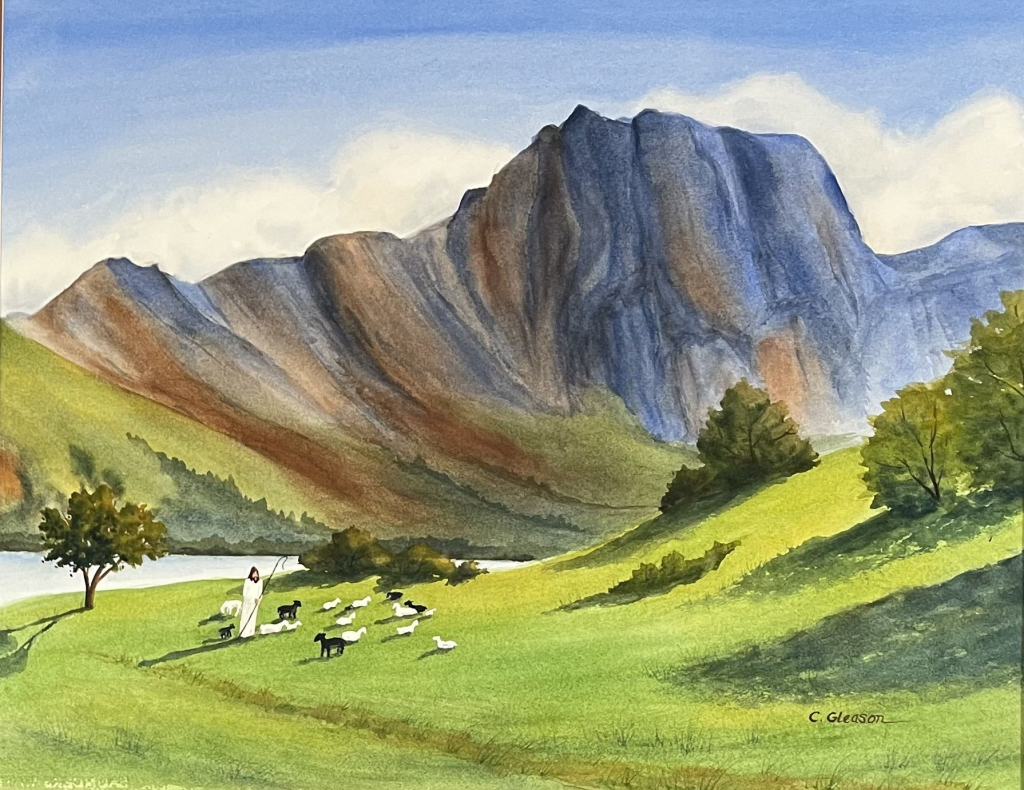
The Lord Is My Shepherd (Psalm 23)

Psalm 23, by Cliff Gleason

The Lord is my shepherd;
    I have all that I need.
He lets me rest in green meadows;
    he leads me beside peaceful streams.
    He renews my strength.
He guides me along right paths,
    bringing honor to his name.
Even when I walk
    through the darkest valley,
I will not be afraid,
    for you are close beside me.
Your rod and your staff
    protect and comfort me.
You prepare a feast for me
    in the presence of my enemies.
You honor me by anointing my head with oil.
    My cup overflows with blessings.
Surely your goodness and unfailing love will pursue me
    all the days of my life,
and I will live in the house of the Lord
    forever. (New Living Translation)

This is one of the best known places in the Bible – even for people who are not religious. And that is for good reason. The psalm is timeless in it’s relating to us in our human condition. It taps into our human need for a compassionate presence, secure protection, and abundant provision. I believe that, most of all, Psalm 23 effectively goes to our inner selves and reminds us of our greatest need: God.

My underlying conviction concerning this wonderful psalm is that the reason we adore it so much is because we humans have an innate primal desire for God. Whether we are consciously religious or not, our deepest longing is for connection with the Divine.

Much of humanity, it seems to me, have repressed this desire. Many people bury this longing underneath multiple layers of other interests and competing desires. Others experience the primal desire for God as a yearning for wholeness, completion, or fulfillment.

Yet, regardless of how particular individuals or groups may frame it, humanity’s basic need is to love and be loved – to move ever closer to the source of love. This inner craving is the essence of the human spirit, and it is captured well in a biblical psalm which pictures a person who settled into the God who is Love.

“Our hearts are forever restless until we rest in God.”

St. Augustine

With Psalm 23, our human longing is spelled out in a mere 50 or so words – we can imagine not only being transported, but also being actually transformed into an enjoyable divine/human relationship, set within an idyllic landscape of settled peace, safety, and strength.

Serenity for our anxious racing thoughts becomes a real hope, for there is a shepherd who protects the human flock and ensures that they have everything they need.

It is understandable that the relationship between God and humans is likened to that of a shepherd and sheep. In reality, sheep need a shepherd. They require someone to look out for them and provide for them. Sheep, in my opinion, are not stupid and clueless; they are skittish animals who only function well if they are non-anxious and at peace.

The presence of a caring shepherd makes all the difference. And, more than that, the shepherd does a myriad of needed things for the sheep that they are not able to do themselves, such as protecting them from wolves, finding adequate pasture to feed upon, and relieving them of the intestinal gas from eating all that grass which would literally kill them without the shepherd’s intervention.

Whereas human shepherds may or may not be faithful in their duties and extend genuine care to the flock, God is always present and loving. Moving to the rich pasture of the New Testament, Jesus is described as the Good Shepherd who will care for and preserve the sheep in every way needed. (John 10:1-21)

Psalm 23, by Cliff Gleason

Indeed, with Jesus as the consummate shepherd, people want for nothing and have everything they need. No wolf can snatch them out of his hand, and the mundane tasks of washing their feet is lovingly done for them. With Jesus, the deep yearning of the inner person becomes satisfied; the soul is restored.

Even the implements of a rod and a staff are used for good, and not for ill. An unfaithful shepherd will likely beat the sheep and berate them, only concerned for fleecing them to sell their wool on the market. But Jesus uses the rod to guide and direct in the way we ought to go, for our benefit and well-being. And the staff – the shepherd’s crook – is benevolently used to rein in the strays who don’t realize how in danger they’re in.

Truly, discipline and encouragement are not mutually exclusive concepts; they instead go together as two forms of loving leadership and care. Only those who take the time and effort to correct another are the ones who really care enough to do so.

In the shepherd’s presence, we can exist with a sense of security, even though there is danger all around us. Our longing for peace, and to be secure within oneself, is not a pipe dream, but a real possibility. To be provided for by God in the face of hard circumstances strengthens faith, awakens hope, and fosters love. It becomes an overflowing feast of the soul.

And this goodness is not fleeting. It can be a continuous present reality. Since God is good, all the time, and there is never a time when God is not good, we are continually and actively pursued and shepherded by goodness and not by harm, all the days of our lives.

The threat of death – and even death itself – cannot thwart the avenues of righteousness from being available to us. We can walk the true path toward inner peace and fulfillment, of genuine connection with God and others, without moral or spiritual harm.

There are good and right paths of life. Those avenues are guarded by a gracious God; they will never be destroyed or damaged. If the psalm is correct, and if my core convictions are right, then there is no longer any reasonable or justified basis for fear.

A good care-taking Shepherd is protecting the flock, and providing the sheep with everything they need. We can live a morally strong, ethically sound, and eminently happy life, without being constantly afraid.

Blessed and Good Shepherd of all, by laying down your life for the flock, you reveal your love for all. Lead us from the place of death to the place of abundant life, so that guided by your care for us, we may rightly offer our lives in love for you and our neighbors. Amen.

Hallelujah! (Psalm 150)

Psalm 150, by Christie Michael

Hallelujah!

Praise God in his holy place.
Praise him in his mighty heavens.
Praise him for his mighty acts.
Praise him for his immense greatness.
Praise him with sounds from horns.
Praise him with harps and lyres.
Praise him with tambourines and dancing.
Praise him with stringed instruments and flutes.
Praise him with loud cymbals.
Praise him with crashing cymbals.

Let everything that breathes praise the Lord!

Hallelujah! (God’s Word Translation)

The word “hallelujah” is an English transliteration of the Hebrew word, הַלְלוּ יָהּ, which when translated means, “praise Yahweh,” or “praise the Lord.” According to today’s psalm, there is a whole lot of hallelujah that is encouraged for us to do.

There is a time for quiet reflection and contemplation, and there is a time for jubilant shouts of praise. The biblical psalms mirror the full range of human emotion. Having moved through the ups and downs of doubt, curiosity, anger, lament, and trust, it is appropriate that the psalter ends with lots of joyful noise.

I grew up in a generation where children were expected to be quiet in church. Not surprisingly, as a child, I found the church worship service on Sunday to be the most boring hour of my week. After a Saturday of morning cartoons, sugary cereal, All-Star Wrestling, and playing outside in the dirt with my brother, Sunday morning was typically a big letdown.

All I have to say about that, and about cranky old women shushing kids in church, is that the adults somehow forgot to read Psalm 150. Maybe if us big people were better about encouraging our little people to dance in the aisles, blow a kazoo as loud as they can, and freely give a shout to the Lord, then perhaps there would be a lot fewer defections from church worship services.

But don’t think that I’m advocating for everyone to go all out noise, all the time. Just as it is neither necessary nor appropriate to always shout everything you say, and skip everywhere you go, so the worship of God needs to encompass the broad scope of the human condition. Silence, meditation, and stillness have their important place. In a desire to make church fun, some Christians have created imbalanced experiences of only victory in Jesus.

By Marc Chagall, 1977

One of the reasons I follow the Christian Year with its liturgical movements is that it holds and maintains the balance of worship and the theological tension of both crucifixion and resurrection. We need healthy rhythms of sorrow and joy, stillness and movement, quietness and shouting.

The Church is currently in the Christian season of Eastertide. It is a focused time of celebration – which is why we have biblical sections in this time of year like Psalm 150. This is the appropriate time to lift loud praise to God for the risen Christ and celebrate salvation and new life in Jesus.

I’m not really a numbers kind of guy, yet it’s easy to notice the word “praise” occurs 10 times in a psalm of just 6 verses. And 7 musical instruments are mentioned. Methinks we’re supposed to not miss something here.

Praise is to happen in heaven and earth, in all creation, out in the world as well as inside the walls of the church building. It is to be done with voice, dance, drums, horns, woodwinds, and stringed instruments. Because God has done wonderful and marvelous acts throughout the earth, people are to respond with profuse gratitude expressed with lots of emotion.

Just so you know, that means sourpuss Christians who wrongheadedly believe human feelings ought to be stuffed and suppressed, need some remedial theological education about who God is and exactly what he expects from people. Somebody, please dispense the laxative of Psalm 150 to loosen their spiritual constipation!

God gave us our breath, and we are to use it for praise. If we see the entire book of Psalms as a life, then it is fitting the final psalm ends with sanguine praise. Indeed, when a person is at end of life, do they have reason to praise? A life of walking with God through thick and thin will inevitably end with recounting the ways in which the Lord has shown up and delivered. They want musical praise filling their last days and minutes.

That is exactly what Duke Ellington did in the twilight of his life. On January 19, 1968, Ellington performed a concert of sacred music at St. John the Divine cathedral in New York City. Among the original songs he performed and later recorded was his musical interpretation of Psalm 150. He called it “Praise God and Dance.”

Duke Ellington said that this praise music, and the two other albums of sacred music he recorded, were “the most important thing I have ever done.” When Ellington performed “Praise God and Dance” at the ancient Church of Santa Maria del Mar in Barcelona, Spain, the congregation spontaneously burst into the aisles with dancing and singing.

The whole person is to be involved in praise – mind, body, emotions, and spirit – because Yahweh is the God of the whole earth, and not just of the spiritual dimension.

Make a joyful noise to the Lord, all the earth; break forth into joyous song and sing praises. Sing praises to the Lord with the lyre, with the lyre and the sound of melody. With trumpets and the sound of the horn make a joyful noise before the King, the Lord. (Psalm 98:4-6, NRSV)

I will bless you every day. I will praise your name forever and always. The Lord is great and so worthy of praise! God’s greatness can’t be grasped. (Psalm 145:2-3, CEB)

Praise the Lord! My whole being, praise the Lord. I will praise the Lord all my life; I will sing praises to my God as long as I live. (Psalm 146:1-2, NCV)

Shout praises to the Lord! Our God is kind, and it is right and good to sing praises to him. (Psalm 147:1, CEV)

Hallelujah! Amen.