There Is No God? (Psalm 53)

Nietzsche, by Norwegian artist Edvard Munch (1863-1944)

Fools say in their hearts, “There is no God.”
    They are corrupt; they commit abominable acts;
    there is no one who does good.

God looks down from heaven on humankind
    to see if there are any who are wise,
    who seek after God.

They have all fallen away; they are all alike perverse;
    there is no one who does good,
    no, not one.

Have they no knowledge, those evildoers,
    who eat up my people as they eat bread
    and do not call upon God?

There they shall be in great terror,
    in terror such as has not been.
For God will scatter the bones of the ungodly;
    they will be put to shame, for God has rejected them.

O that deliverance for Israel would come from Zion!
    When God restores the fortunes of his people,
    Jacob will rejoice; Israel will be glad. (New Revised Standard Version)

In 1888, the German philosopher Friedrich Nietzsche published his book, “The Antichrist.” Nietzsche used the phrase, “God is dead,” to express his idea that the Enlightenment, with its thorough rejection of all things subjective and intuitive, and the embrace of everything objective and observable, had eliminated the possibility of God’s existence.

Nietzsche simply named what a modern progressive society had become: We “enlightened” people have drained and divested ourselves of all divine mystery. Nietzsche wrote:

“God is dead. God remains dead. And we have killed him. How shall we comfort ourselves, the murderers of all murderers? What was holiest and mightiest of all that the world has yet owned has bled to death under our knives: Who will wipe this blood off us? What water is there for us to clean ourselves? What festivals of atonement, what sacred games shall we have to invent? Is not the greatness of this deed too great for us? Must we ourselves not become gods simply to appear worthy of it?”

Friedrich Nietzsche, The Antichrist

This was the nineteenth century equivalent of making the psalmist’s observation that there is a philosophy extant which states, “There is no God.” God is gone; humanity has replaced God with themselves.

Unlike Nietzsche, however, the psalmist takes the perspective of God, not humans. The Lord looks about for someone wise, someone who truly takes notice to see with spiritual eyes, hear with spiritual ears, discern a spiritual touch, smell the aroma of God, and taste that the Lord is good – rather than relying solely on the five basic human senses.

So, where is God? In the grave? No, he has risen, just as he said.

Just because there appears to be a profound absence of good in this world, does not necessarily mean that good is not here – or that God has somehow gone away, and perhaps never existed at all.

Any common fool can make bold proclamations whenever they embrace an epistemology all to themselves.

From God’s perspective, anyone can use their five physical senses. To only use them, and completely ignore other ways of knowing, is well, plain stupidity.

So then, where is God? Not hanging out with fools, drinking cheap dandelion wine, and smoking nasty inexpensive cigars. Rather, the Lord is in the company of the righteous; God is with wise persons who discern the divine presence.

Things are not always as they seem. Violence and oppression in the world does not warrant the interpretation that God is on vacation, doesn’t care, or simply doesn’t exist, at all. We are invited to see beyond or through the world’s crud to a Divine Being who is there, reachable, and very much cares about the state of humanity.

All of our human posturing and preening to appear that we have it all together is nothing more than a poorly produced television reality show to God. So, if the Lord chooses to change the channel, that does not translate that God is not viewing the screen.

Only a fool believes no one is watching.

If we ignore God, perhaps we should not be surprised or upset when divine Skittles from heaven don’t come raining down on us to enjoy.

Instead, we have the opportunity and the privilege of paying attention to the spiritual life.

There are divine resources available if we will but acknowledge, receive, and use them. Though they are abundant and free, we still have to ask for them with the humility that comes from realizing we are not the center of the universe.

Nietzsche is not exactly a person that many Christians would typically acknowledge, let alone refer to, and, for good reason. And yet, Nietzsche understood that when God is removed from societal norms, it leaves us with a nihilist worldview (the belief that nothing has any inherent importance, and that life lacks purpose and meaning).

I believe that Christianity, and/or a focus on the spiritual life, is a powerful and needed antidote to the despair of meaninglessness which is all around us.

If God is truly the ground of moral reality, and gives real shape to human purpose, then we have an effective way to center ourselves. Yet, if God is ignored to the point of being “dead” then there is nothing substantial for humanity to orient their lives around.

Try as we might to create, as Nietzsche did, an Übermensch(superman) in the form of the radically independent and strong person to fill the enormous spiritual void of God’s death, it is merely a façade covering our weakness and our foolishness as creatures.

I suggest we consider the psalmist as a reliable source of knowledge – that God is a force for justice and for good in the world – and that we explore what this means for us in our respective lives, families, communities, as well as in our public discourse and personal philosophy.

Is God gone? No, not really. It’s just that we humans tend to give God the stiff arm.

Almighty God, you called your church to be one, holy, universal and missional people. By your grace you have given us new life in Jesus Christ, and by your Spirit you have called us to proclaim his name throughout the nations. Awaken in us such a love for you and your world that we may boldly proclaim Jesus Christ by word and deed. May all people everywhere come to know you, and Christ’s power to save. Amen.

The Thundering Voice of the Lord (Psalm 29)

Ascribe to the Lord, O heavenly beings,
    ascribe to the Lord glory and strength.
Ascribe to the Lord the glory of his name;
    worship the Lord in holy splendor.

The voice of the Lord is over the waters;
    the God of glory thunders,
    the Lord, over mighty waters.
The voice of the Lord is powerful;
    the voice of the Lord is full of majesty.

The voice of the Lord breaks the cedars;
    the Lord breaks the cedars of Lebanon.
He makes Lebanon skip like a calf
    and Sirion like a young wild ox.

The voice of the Lord flashes forth flames of fire.
The voice of the Lord shakes the wilderness;
    the Lord shakes the wilderness of Kadesh.

The voice of the Lord causes the oaks to whirl
    and strips the forest bare,
    and in his temple all say, “Glory!”

The Lord sits enthroned over the flood;
    the Lord sits enthroned as king forever.
May the Lord give strength to his people!
    May the Lord bless his people with peace! (New Revised Standard Version)

I grew up in rural middle America, on the land, and working the land. All of that outdoor work of the farmer makes one very attuned to the weather. In fact, my dad could often predict a coming thunderstorm with an almost precise accuracy.

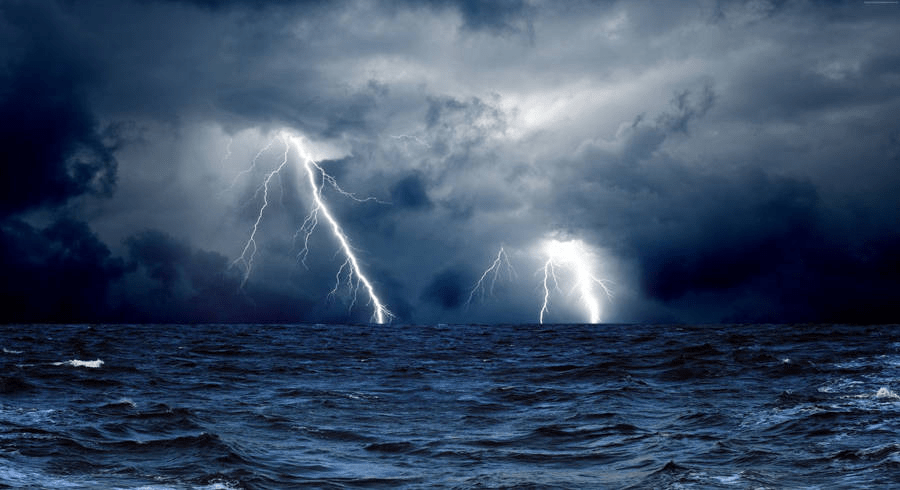
There is something of a weather report from the psalmist in today’s lesson. He describes a powerful storm forming and moving its way inland from over the sea. It does its damage as a result of high winds, incredible lightning, and of course, the loud rumble of thunder. It is this thunderous display of strength that is the voice of the Lord.

Seven times in Psalm 29 the psalmist repeats the phrase, “the voice of the Lord.” There’s a lot more going on than a meteorological thunderstorm; behind the storm is theological Being who controls all things. The Lord God almighty is not your run-of-the-mill ordinary local deity.

Israel did not have multiple gods of thunder, lightning, clouds, and rain; they worshiped Yahweh, one God, who was Lord of the entire storm, as well as the whole world. The point of the psalmist is that no one, no other god, can compete with this awesome God of Israel.

Yet, despite the theological reality of Israel and their God, there was an entire panoply of gods that the Canaanites worshiped in ancient Palestine. The Canaanite god Baal is mentioned many times in the Old Testament. Baal was the lord of the storm, the god who hung out in the clouds and brought needed rain for the crops to grow.

What’s more, ancient Israel was continually tempted toward the worship of Baal. There were even those who gave the ancient god credit for the harvest of crops. But the psalmist will have none of that business. The real lord of the storm, the actual power behind everything in the universe, is Yahweh.

This is why there is the invitation to praise the Lord. And it isn’t just people who are invited; the heavenly beings are called upon to praise. It’s likely that the psalmist is putting those pagan gods in their place by encouraging them to recognize who is really in charge and in control of all things.

Whatever is going on with the psalmist’s intention, there is clearly a universal and cosmic call to acknowledge the majesty and sovereignty of Yahweh and offer appropriate praise for the One who is over everything.

The description of the powerful thunderstorm is presented as evidence of Yahweh’s power, glory, and sovereignty. It’s as if the entire earth is a temple, with every creature on earth called upon to offer up their praise and honor. Beings in both heaven and earth join together in a great universal choir of praise to the God who makes all things possible.

Even when the rains turn into a flood and brings chaos, God is over those chaotic waters, as well. It is the Lord who brings order from chaos, and who tames the mighty waters. In the New Testament, Jesus demonstrated this godly power in front of the fearful disciples:

A great windstorm arose, and the waves beat into the boat, so that the boat was already being swamped. But he was in the stern, asleep on the cushion, and they woke him up and said to him, “Teacher, do you not care that we are perishing?” And waking up, he rebuked the wind and said to the sea, “Be silent! Be still!” Then the wind ceased, and there was a dead calm. He said to them, “Why are you afraid? Have you still no faith?” And they were filled with great fear and said to one another, “Who then is this, that even the wind and the sea obey him?” (Mark 4:37-41, NRSV)

God, as absolute Sovereign, is able to provide peace and well-being from fearful hearts and anxious minds. And this is something to celebrate, to offer gratitude to God for such absolute authority.

People today may not be tempted to worship Baal; but in the middle of our fear and anxiety of life’s many storms, we might search for help and deliverance from the stock market, technology companies, a capitalist economy, social networking, or our own hard work and ingenuity.

Those things may easily become the gods we worship – offering our time, commitment, money, and emotional energy to them – and leaving God in the dugout of our lives to be available, just in case, as a pinch-hitter. But this approach never accounts for the inevitable game being rained out – perhaps permanently.

Just as the wise person saves their money for the inevitable rainy day, so the spiritual person who is aware of God’s authority and power will wisely invest their time and energies into discovering this God. They will engage in spiritual practices designed for relatable connection.

The believer realizes that, although today might be bright and sunny, there will be a damaging thunderstorm in the future for which preparations must be made now.

The voice of the Lord can be a reassuring presence and a healing balm; or it can be a fearful and devastating experience. How you see it and prepare for it makes a big difference.

Glorious God, I worship and praise you in response to your voice. I join with all the voices of the earth, together with all the voices of the heavens, to praise your glorious name; and to bow down in awe before your mighty power. Amen.

Our Creator and Sustainer (Psalm 104:24-34, 35b)

Our Lord, by your wisdom
    you made so many things;
the whole earth is covered
    with your living creatures.
But what about the ocean
    so big and wide?
It is alive with creatures,
    large and small.
And there are the ships,
    as well as Leviathan,
the monster you created
    to splash in the sea.

All of these depend on you
    to provide them with food,
and you feed each one
with your own hand,
    until they are full.
But when you turn away,
    they are terrified;
when you end their life,
    they die and rot.
You created all of them
    by your Spirit,
and you give new life
    to the earth.

Our Lord, we pray
that your glory
    will last forever
and that you will be pleased
    with what you have done.
You look at the earth,
    and it trembles.
You touch the mountains,
    and smoke goes up.
As long as I live,
I will sing and praise you,
    the Lord God.
I hope my thoughts
    will please you,
because you are the one
    who makes me glad…

With all my heart
I praise you, Lord!
    I praise you! (Contemporary English Version)

In the wake of the Day of Pentecost, we are reminded by the psalmist that the Spirit was not only involved in forming the church, but was already experienced in forming creation. Everything about the Spirit’s work at the origins of the earth was immensely good, wonderfully complex, and intricately interrelated. Indeed, it all reflects the wisdom and majesty of God.

According to the psalmist, God is the Creator and is therefore sovereign over all of this vast dominion of earthly space and ecological systems. We humans are workers in this ordered world; and created in God’s image and likeness as the Lord’s vice-regents over this incredible domain. Humanity is thus both intimately connected with and distinctly separate from all the rest of the world.

This sustaining force of God includes gracious, loving, and compassionate guidance. Everything holds together and has its meaning within God. The breath of God – the Spirit – gives life to both our physical and spiritual selves.

The psalmist paints a picture of creation as full of life – with life itself as the highest expression of its purpose. Our delight in living and being comes from a profound connection with the Creator, Sustainer, and Guide of the universe.

Because of humanity’s deep connection with God and the rest of creation, everything we do as people on this earth impacts God and God’s big world. Every human action exerts an influence. Theology, anthropology, and ecology all exist with complex interconnectedness. God, people, and the world are bound to each other. Since God is relationship itself, relational connection is built into all creation.

Humanity is the apex and climax of God’s creative activity; yet, at the same time, we are but one piece within this intricate whole of creation. We humans are tasked by God to serve the earth and care for it – not to rule in such a way that exploits its grand resources, but to maintain and strengthen the existing connected systems of the earth.

This means we are meant to think of the common good of all earth’s citizens, as well as to consider future generations, and equip them to steward our vast world with practical wisdom and spiritual sensitivity.

Everything that brings disconnection, and thus harm, is to be weeded out and discarded. Wickedness, injustice, oppression, exploitation, unrighteousness, and arrogance are to be purged from the good earth, so that all creatures great and small can thrive and enjoy what God has provided.

Even the seemingly uncontrollable elements of this world – sea monsters and leviathans, chaos and evil – are ultimately subject to the sovereign God of this realm. It is the Lord who brings order from chaos, life from death, and calms the churning waters – quieting all of those ancient leviathans which cause so much of a stir.

It would be great if everyone everywhere found joy in their lives, brought God joy, and enjoyed being with everyone else and caring for all creation. Yet, those chaotic disconnecting powers are there – causing harm and division, splitting that which is designed to be connected, and disrespecting the inherent goodness of God’s image bearers and God’s world.

By being in harmony and in sync with God’s Spirit, we can work together against wickedness and not separate or dismantle what God has built and joined. Through our spiritual awareness, we can help, and not harm. In maintaining our proper spiritual connections, we can be agents of upholding the good, the right, and the just; and not underhandedly undermining God’s sovereignty.

Let us then offer our hallelujahs; our praise, adoration, and gratitude, to God who is the source of life. Because it’s awfully hard to be bad when you’re being good.

May you be able to say with the psalmist – and with all creation, including the trees and even the rocks – that with my whole heart I praise you, almighty God, Creator and Sustainer of heaven and earth.

And may your prayers be pleasing to the Lord and be full of mercy and love. Amen, amen.

Who Is In Control? (Psalm 47)

Ascension, by Angela Taylor Perry

Clap your hands, all you peoples;
    shout to God with loud songs of joy.
For the Lord, the Most High, is awesome,
    a great king over all the earth.
He subdued peoples under us
    and nations under our feet.
He chose our heritage for us,
    the pride of Jacob whom he loves.

God has gone up with a shout,
    the Lord with the sound of a trumpet.
Sing praises to God, sing praises;
    sing praises to our King, sing praises.
For God is the king of all the earth;
    sing praises with a psalm.

God is king over the nations;
    God sits on his holy throne.
The princes of the peoples gather
    as the people of the God of Abraham.
For the shields of the earth belong to God;
    he is highly exalted. (New Revised Standard Version)

Who is in control? This is really a big question. We humans seem almost obsessed with the issue of control.

Some people want to be in charge of regulating everything. Others want to exert force over nothing at all. And there are those who continually want to know the clear lines of authority and who is in control, at all times.

Control, in and of itself, is not a bad thing. In fact, it’s a good thing. Taking charge of a situation – and especially of oneself – is often needed. Leadership that is informed, decisive, humble, true, and right, is a must.

The problem comes whenever we try to exert domination over another person, or attempt to command an organization when it isn’t our responsibility to do so.

Ultimate control of all things belongs to God, and not to you or me. The psalmist is insistent that God is the Ruler of the universe; and that all things belong to the Lord. God’s commands are good.

The Lord’s dominion is known as the kingdom of God. Whenever people are in sync with this reality, then they are able to be joyful and celebrate the good, right, and just Being who is in control.

Yet, if people have problems trusting another; desire to always call the shots on everything; and command everyone; there you will find a host of miserable people – with the one trying to exert control as the most miserable of all.

People, instead, are called to self-control. We are to have charge over our own thoughts and actions. It’s important to have sobriety in our lives in which we can use proper restraint, as well as needed initiative.

Be alert and be of sober mind. Your enemy the devil prowls around like a roaring lion looking for someone to devour. (1 Peter 5:8, NIV)

In order to get our lines of authority in the proper places, and to participate in the established rhythms of control in the universe, we are commanded to clap, shout, and sing. Because God has ultimate control, divine initiatives are grounded in goodness, justice, righteousness, and deliverance from evil. The Lord has mercifully acted on behalf of people.

The Lord only asks of us to do things that he himself has done. The psalm states that “God has gone up with a shout.” We shout because God shouts. God rules over the nations, and was not simply some local deity that the ancient Israelites served and worshiped. The divine presence is with those who acknowledge God; they will hear the Lord’s shout.

“No misfortune is seen in Jacob,
    no misery observed in Israel.
The Lord their God is with them;
    the shout of the King is among them.
God brought them out of Egypt;
    they have the strength of a wild ox.” (Numbers 23:20-22, NIV)

We are also told to sing. The reason we do so is because the Lord is high above all people, and is king over the nations. This is something we need to say out loud and to sing, and to not only read silently in our heads. Our ears need to listen to the psalm, to hear the praises of God reverberating on our ear drums.

My people, hear my teaching;
    listen to the words of my mouth. (Psalm 78:1, NIV)

It is perfectly appropriate for Christians to use today’s psalm in reflection upon Ascension Day. Jesus has been lifted up into the sky; God has gone up with a shout. The Lord has equipped us for citizenship in the kingdom of God. We have solid grounds for celebration, shouting, and singing. Jesus is our King.

God put this power to work in Christ when he raised him from the dead and seated him at his right hand in the heavenly places, far above all rule and authority and power and dominion and above every name that is named, not only in this age but also in the age to come. And he has put all things under his feet and has made him the head over all things for the church. (Ephesians 1:20-22, NRSV)

Because of Christ’s ascension, believers in Jesus have the memory of the past, the experience of the present, and a hope for the future. With Jesus in control, there is no need for fear, or for trying to gain control for oneself.

Grant, we pray, Almighty God, that as we believe your only-begotten Son our Lord Jesus Christ to have ascended into heaven, so we may also in heart and mind there ascend, and with him continually dwell; who lives and reigns with you and the Holy Spirit, one God, for ever and ever. Amen.