Praise the Lord!

Praise the Lord!

Praise the Lord from heaven!
    Praise God on the heights!
Praise God, all of you who are his messengers!
    Praise God, all of you who comprise his heavenly forces!
Sun and moon, praise God!
    All of you bright stars, praise God!
You highest heaven, praise God!
    Do the same, you waters that are above the sky!
Let all of these praise the Lord’s name
    because God gave the command and they were created!
God set them in place always and forever.
    God made a law that will not be broken.

Praise the Lord from the earth,
    you sea monsters and all you ocean depths!
Do the same, fire and hail, snow and smoke,
    stormy wind that does what God says!
Do the same, you mountains, every single hill,
    fruit trees, and every single cedar!
Do the same, you animals—wild or tame—
    you creatures that creep along and you birds that fly!
Do the same, you kings of the earth and every single person,
    you princes and every single ruler on earth!
Do the same, you young men—young women too!—
    you who are old together with you who are young!

Let all of these praise the Lord’s name
    because only God’s name is high over all.
    Only God’s majesty is over earth and heaven.
God raised the strength of his people,
    the praise of all his faithful ones—
        that’s the Israelites,
        the people who are close to him.

Praise the Lord! (Psalm 148, CEB)

This is the Christmas season.  We are in the third day of the twelve days of Christmas.  This time in the Church Calendar gives focus to declare along with the angels and all of God’s creation:  Glory to God in the highest; praise the Lord!  Everything in all creation points to a creator who cares for us. 

These days between December 25 and January 5 are to be a great celebration because King Jesus has come and is the rightful Sovereign over all creation.  We are to grasp the meaning of Christ’s incarnation; and affirm the identity of Jesus as both full human and fully divine.  Beginning with Christ’s birth, we enter a reflection on the meaning of Christ’s life and prepare for the journey toward the cross and the empty tomb.

Today, however, we simply praise the Lord along with all creation.  This is what the psalmist calls us all to do.  The entire universe is called to praise the Lord.  Everything outside our earth is to give God glory.  Everything in the universe points to a God who is worthy to be praised.

Let us assume the distance between the earth and the sun (ninety-two million miles) was reduced to the thickness of a sheet of paper. If that is the case, then the distance between the earth and the nearest star would be a stack of papers seventy feet high. And the diameter of the galaxy would be a stack of papers three-hundred-ten miles high. Our galaxy is just a speck of dust in the universe, yet Jesus holds the universe together by the word of his power.

We serve a big God who is worthy to be praised, not only out there in the universe but here on earth.  The psalmist calls on all the earth to echo the adoration of God.  That means everything and everyone on earth – fish, animals, birds, even trees as well as people. 
Research in the field of bioacoustics has revealed that every day we are surrounded by millions of ultrasonic songs. For example, the electron shell of the carbon atom produces the same harmonic scale as a Gregorian chant.  Whale songs can travel thousands of miles underwater.  Meadowlarks have a range of three hundred notes. Supersensitive sound instruments have discovered that even earthworms make faint staccato sounds!

Arnold Summerfield, a German physicist, and pianist observed that a single hydrogen atom, which emits one hundred frequencies, is more musical than a grand piano, which only emits eighty-eight frequencies.  Science writer Lewis Thomas summed it up it this way: “If we had better hearing, and could discern the singing of sea birds, the rhythmic drumming of schools of mollusks, or even the distant harmonics of flies hanging over meadows in the sun, the combined sound might lift us off our feet.”

Praise the Lord.  We have a vision in this psalm of all creation praising God as one great big choir. Praise is to occur with both words and actions.  With words, praise is an expression of gratitude to God for who she is and what he has done.  With actions, praise is a posture of submission and an acknowledgement of dependence.

Therefore, through testimony we declare what God has done in our lives and how he is worthy to be praised and obeyed.  With the emphasis on praise in a season dedicated to joy, we must also recognize that for many people Christmas is difficult.  Loneliness, thin finances, unemployment, illness, strained relationships, and bittersweet memories can all be a discouraging contrast to the celebration going on around them.

Praise, however, is not just for the joyful; it can happen no matter the circumstances because the Christian’s happiness is not dependent upon positive situations but rather upon the person and work of Jesus.  It may not be easy to find our voice of praise along with everyone else, but we are not alone.  We can choose to join with all creation to praise the name of the Lord. 

A dear parishioner of mine shared this a few years ago after experiencing multiple surgeries in the year:

“I am thankful for a chance to get out of the house. Of course, my walker was with me.  I am amazed how quickly folks move over, slow down, and give me space when I am out with that thing….  At church it feels like I am parting the Red Sea! The reason I hate the walker is because it says to the whole world, ‘Hey, I’m broken!’  I realize we all have areas that we are broken, most of them we can hide or cover up. Why are we so ashamed to confess the truth? Who really has it all together? I know we love our privacy and shun pity. However, I have been shown so much grace, kindness, and compassion as I push this piece of aluminum around that I hope this experience continues to change me for the better. I hope in the future I will be sensitive to those who are broken on the inside as well as the outside. May the love of Christ give me eyes to see people as he does, precious and accepted, just as they are.”

That, my friends, is the reasonable and logical end of praising the Lord – to connect what God has done and is doing with what he can do through us as we glorify his name. By simply being who we are created to be, we praise the Lord along with all creation.  When we as people in God’s image, reflect that image in how we talk and how we live, we participate with the universe in declaring God is good. 

Praise is to be the glue that binds us all together. Let us praise the name of the Lord. To be more specific, let the church praise the Lord!  Let leaders everywhere praise the Lord!  Let healthcare workers praise the Lord!  Let salespersons and factory workers praise the Lord!  Let police and lawyers praise the Lord! Let the trees, mountains, and all living things praise the Lord!  Let engineers and educators praise the Lord!  Let the little children praise the Lord!  Let clerks and cashiers, waiters and waitresses, janitors and housekeepers praise the Lord!  Let the lost and the lonely praise the Lord along with the happy and satisfied. Let everything that has breath praise the Lord!  Praise the Lord!

Whether you are bursting to proclaim it, or struggle to say it and live it, praise the Lord along with everything in the universe because we serve a God who keeps us close to heart.  Praise the Lord!

What do you have to praise the Lord for today?

How do you express your praise, both personally and publicly?

Where is your favorite place to praise the Lord?

When does praise to God come easily for you, and when it is difficult?

Who do you like praising the Lord with?

May your life become a paeon of praise to the God who is worthy to receive all glory, honor, and praise. Amen


Psalm 89:1-4, 19-26 – Being Confident

Our Lord, I will sing
    of your love forever.
Everyone yet to be born
    will hear me praise
    your faithfulness.
I will tell them,
“God’s love
    can always be trusted,
    and his faithfulness lasts
    as long as the heavens.”

You said, “David, my servant,
    is my chosen one,
    and this is the agreement
    I made with him:
David, one of your descendants
    will always be king….”

In a vision, you once said
    to your faithful followers:
“I have helped a mighty hero.
    I chose him from my people
    and made him famous.
David, my servant, is the one
    I chose to be king,
    and I will always be there
    to help and strengthen him.

No enemy will outsmart David,
    and he won’t be defeated
    by any hateful people.
I will strike down and crush
    his troublesome enemies.
He will always be able
    to depend on my love,
    and I will make him strong
    with my own power.
I will let him rule the lands
    across the rivers and seas.
He will say to me,
‘You are my Father
    and my God,
    as well as the mighty rock
    where I am safe.’” (CEV)

I wonder where the world places its confidence. I also sometimes wonder where the church places her confidence. Poverty, injustice, starvation, human rights violations, and war have existed throughout time. We all recognize these and the awful problems they are for so many people. It is, however, quite another thing when it comes to our confidence in addressing them and how they will ever be eradicated.

If we view these great humanitarian issues as a matter of ignorance, we will pursue education as the means of tackling them. If we discern them as political issues, we will seek to elect officials who will take them on, and we will lobby to make things different. If we understand them as moral issues, we will agitate for change and speak prophetically into what we believe to be the sources of the problems. In truth, each of these approaches have merit and are necessary components to a full orbed attention of their multifaceted and complicated nature.

For the pious and devout, the ultimate confidence comes in basic faith and trust of the Divine. God’s faithfulness and steadfast love are the solid foundation from which the believer constructs her hope and confidence.

The psalmist is not one bit bashful in reminding God of divine promises. God swore to King David that his descendants would rule forever. At the time the psalmist crafted these words, it was not looking much like those promises were having any attention from the Lord.

The David spoken of in the psalm is interpreted in the Christian tradition as Jesus. King David of old was certainly no perfect man, and the psalmist presents an idealized version, looking ahead to messianic qualities of a coming Ruler. Those qualities include a concern for the common good of all persons without striving for personal power or being aloof; and an ability to be victorious over foes.

Advent, much like today’s Psalm, calls on people to rely upon and have confidence in divine promises – even when those promises seem far from being realized. It is the trust and hope of the faithful which perseveres in prayer for a coming redemption and a day when wars shall cease, the rights of people are thoroughly met, starvation eradicated, injustice turned to justice, and poverty done away with once for all. In other words, a sinless world free from the machinations of evil.

It is no small thing holding on to our confidence as believers when circumstances all around us are askew and askance. The author of the New Testament book of Hebrews had this to say to a struggling church who had a hard time seeing future promises fulfilled:

Remember those earlier days after you had received the light, when you endured in a great conflict full of suffering. Sometimes you were publicly exposed to insult and persecution; at other times you stood side by side with those who were so treated. You suffered along with those in prison and joyfully accepted the confiscation of your property, because you knew that you yourselves had better and lasting possessions. So do not throw away your confidence; it will be richly rewarded.

You need to persevere so that when you have done the will of God, you will receive what he has promised. For,

“In just a little while,
    he who is coming will come
    and will not delay.”

And,

“But my righteous one will live by faith.
    And I take no pleasure
    in the one who shrinks back.”

But we do not belong to those who shrink back and are destroyed, but to those who have faith and are saved. (Hebrews 10:32-39, NIV)

We keep going by remembering God’s faithfulness and steadfast love, and our past joy of committed faith. Then, like psalmist, we allow a song to bubble up and be sung about divine goodness. Never underestimate the power of memory and music to keep us on track toward living each day in faith and confidence.

May you be able to sing of God’s love forever.

May you give voice to God’s faithfulness.

May you express daily affirmations of faith in God.

May you bank on the promises of God.

May your faith be strengthened for the rigors of this life.

May your hope overflow.

May the love of God work in and through you to the glory of Jesus Christ. Amen.

I Could Sing of Your Love Forever by Encounter Worship Band.

Psalm 125 – She Rocks!

The God Who Surrounds Us by Irv Davis

The people who trust in the Lord
    are like Mount Zion:
    never shaken, lasting forever.
Mountains surround Jerusalem.
    That’s how the Lord surrounds his people
    from now until forever from now!
The wicked rod won’t remain
in the land given to the righteous
    so that they don’t use their hands to do anything wrong.
Lord, do good to people who are good,
    to people whose hearts are right.
But as for those people who turn to their own twisted ways—
    may the Lord march them off with other evildoers!

Peace be on Israel! (CEB)

Psalms 120-134 comprise a collection of short songs of ascent meant to guide Jewish pilgrims in their communal trek up to the city of Jerusalem, and ultimately to the temple mount.  The rhythm of the pious ancient Israelites centered round particular festivals, seasons, and Sabbath. 

Taking the annual pilgrimage to the Holy City was an especially anticipated time of year.  This yearly cycle bolstered their faith and gave the people some needed spiritual stability. The sameness of the routine and the ritual helped to remind the faithful of the solid theology that God cannot be moved and will always be there.

One of the most fundamental of all truths about God is divine consistency and constancy, that the Lord is forever present with God’s people. If God seems or feels distant or inattentive, it comes not from a place of uncaring. as though absent, aloof, or not listening.  It simply means the Lord self-reveals on a divine timetable, not a human one. Our responsibility in the entire affair is to engage in consistent rhythms of spirituality that place us in a position to receive grace when God decides to give it.

Therefore, we must not despair but anticipate meeting with God, just as the Israelites of old looked forward and upward to their annual worship at the top of the mountain. 

God continually surrounds people, even when we do not always perceive it to be so. 

Basic sound theology, as we possess abundantly in the psalms, is neither gender specific nor gender neutral. To have a full orbed understanding of the God of the psalms means we use both male and female pronouns in our descriptions.

To limit God as an old white guy, or only as male, truncates a strong view of true divinity.

What I am suggesting here is that we avail ourselves of the full compliment of metaphors to present a more complete picture of God. Language is our vehicle in communication about the Lord, so let us use it to its entire extent to present the Lord in all his/her grandeur, majesty, holiness, and strength.

For example, as the psalmist likens God to a mountain chain surrounding Jerusalem, if we only picture this in our imaginations as a man, we have not quite got an integral picture. Although a muscular Christianity might provide us with an understanding of God’s sheer brute power, a maternal Christianity gives us a strength of provision, care, and protection from a different angle.

When Jesus came to Jerusalem, the city surrounded by mountains, he did not use a masculine metaphor to communicate to the people; he used a maternal one:

“O Jerusalem, Jerusalem, the city that kills the prophets and stones God’s messengers! How often I have wanted to gather your children together as a hen protects her chicks beneath her wings, but you wouldn’t let me.” (Matthew 23:37, NLT)

When the Apostle Paul wanted to communicate to the Thessalonian Church his deep concern for them, he went for the maternal metaphor:

We could have thrown our weight around as Christ’s apostles (like a man). Instead, we were gentle with you like a nursing mother caring for her own children (like a woman). We were glad to share not only God’s good news with you but also our very lives because we cared for you so much. (1 Thessalonians 2:7-8, CEB)

Indeed, in my culture when we want to convey the ultimate protective behavior of another, we describe them as a “mother bear.”

The gist of theology is this: God cannot be tied down or limited to gender, race, ethnicity, class, etc. The Lord is God, and we are not. Therefore, it is perfectly appropriate, and I daresay necessary, to use both male and female pronouns and metaphors in describing God because the Lord of the universe created both male and female in his/her image. (Genesis 1:26-27)

This is neither taking liberal license of the psalms nor emasculating them; it is merely pointing out that God is Spirit, and we worship her/him in spirit and in truth. And the truth is that he is the mountains surrounding us as a manly sentinel over our lives; and she is the mountain chain encircling us with protective care for whom nobody better mess with us.

May the Lord do good to us, as the manly Rock of our salvation as well as the feminine Fortress of our souls, protecting us with the care of both a father and a mother.

Ever-present God, there is no place where I can go where you are not.  Help me to so intuit your divine presence that it bolsters my faith and resilience for daily life in Jesus Christ.  Amen.

Psalm 126 – Sorrow and Joy

When the Lord restored the fortunes of Zion,
    we were like those who dreamed.
Our mouths were filled with laughter,
    our tongues with songs of joy.
Then it was said among the nations,
    “The Lord has done great things for them.”
The Lord has done great things for us,
    and we are filled with joy.

Restore our fortunes, Lord,
    like streams in the Negev.
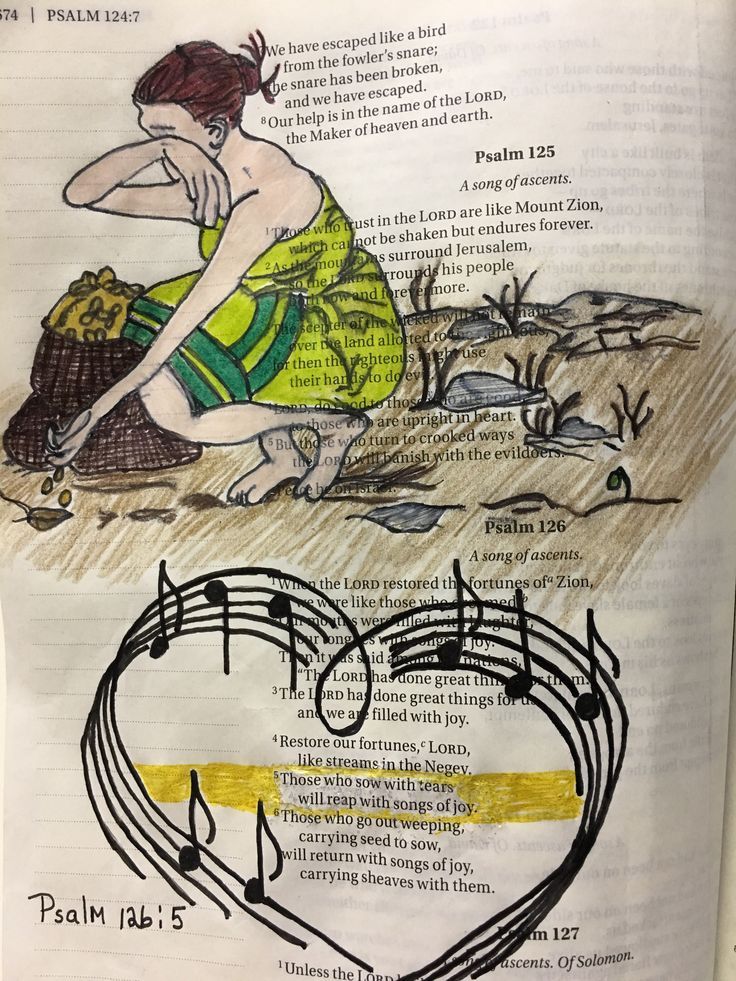
Those who sow with tears
    will reap with songs of joy.
Those who go out weeping,
    carrying seed to sow,
will return with songs of joy,
    carrying sheaves with them. (NIV)

Likely none of us awake in the morning, sit up on the edge of the bed and say to ourselves, “Well, let’s see, I think I’ll cry and be sorrowful today.” We might do that with joy, not with sadness. It can be easier to gravitate toward the fulfillment of dreams, laughter, and happiness than tears and weeping.

If we want to experience authentic joy, the path is through crying because it is our tears which find a better way.

Whether it comes from a certain denominational tradition, ethnic background, or family of origin dynamics, there are many Christians who love to emphasize Jesus as Victor and camp in resurrection power – while eschewing Christ as the man of sorrows, acquainted with grief and sadness.

It is from this place of continually viewing only one dimension of Christ’s redemptive work that pastoral care often falls far short of true help. Trying to engineer cheerfulness and create solutions to a person’s genuine grief is, at best, not helpful, and at worst, damaging to their soul. Such attempts will only lead to cheap joy.

Coming to the place of sincerely singing spontaneous songs of joy with a sense of abundant satisfaction comes through suffering and sorrow.

There must be a crucifixion before there is a resurrection. In the agrarian culture of ancient Israel, the metaphor of sowing a reaping connected well to the importance of planting tears and allowing them to flower later into an abundant harvest of joy.

Perhaps in American culture, a more apt metaphor would be financial investing and cashing out. The investment we put into attending to our grief with expressions of lament through tears, will eventually get a return, and we shall be able to cash out with a rich bounty of joy.

All good things in life are realized through a lot of blood, sweat, and tears. “Blessed are those who mourn,” said Jesus, “for they shall be comforted” (Matthew 5:4, NIV). Just as it takes both field crops and economic investments time to grow and mature, so the believer’s life is a process of spiritual development which is watered through tears and experiences the up-and-down sorrows of a market economy.

There is coming a day when our joy will be realized in full measure. The season of Advent reminds us that we must wait, and that we must suffer many things before we enter the kingdom of God and enjoy unending fellowship with our beloved Savior and King.

Great God almighty, with expectant hearts we await the coming of Christ. As once he came in humility, so now may he come in glory so that he may make all things perfect in your everlasting kingdom. For Christ is Lord forever and ever. Amen.