Psalm 62:5-12 – Our Place of Safety

Psalm 62 by Christa Rosier (1960-2011)

Only God gives inward peace,
    and I depend on him.
God alone is the mighty rock
    that keeps me safe,
    and he is the fortress
    where I feel secure.
God saves me and honors me.
    He is that mighty rock
    where I find safety.

Trust God, my friends,
    and always tell him
each one of your concerns.
    God is our place of safety.

We humans are only a breath;
    none of us are truly great.
All of us together weigh less
    than a puff of air.
Don’t trust in violence
or depend on dishonesty
    or rely on great wealth.

I heard God say two things:
   “I am powerful,
    and I am very kind.”
The Lord rewards each of us
    according to what we do. (CEV)

My girls, now grown with families of their own, are wonderful mothers. Recently, I got to hold my newest grandson, which is wonderful! A close second to that experience is watching Mom hold her baby. The little guy has not a worry in the world when he is in her arms. For there is no doubt of perfect love and security.

God is our place of safety. For the believer, it is as if we are a baby having finished nursing, lying peacefully and contentedly in God’s loving and secure arms. There is complete trust because God is the one holding us. Our enemies are nothing but a puff of smoke – toothless lions who can make all the noise they want but will never get a bite on us with God around.

I was reminded of yet another truth as I watched my daughter and grandson. Although tired, both are genuinely happy. Neither riches nor fame can ever buy security and happiness. God, as the source of steadfast love and perfect safety, is our Rock. The Lord’s power and kindness meld together in a wondrous and active care for us.

God’s kingdom is constructed on solid rock, not sinking sand. Trusting in violent vengeance, deceitful scheming, or great wealth might build an impressive looking edifice, but will only be destroyed in the first big wind that comes along. Depending upon God as our refuge and strength is building a relationship which will last and stand the test of time and tribulation.

Jesus, aware of the Psalm’s theology, drew upon the image of the rock to impress on his listeners the need for making wise choices (Matthew 7:24-29). The foundation is the key element. The house built on the rock will withstand the storm; the foundation built on sand will not. The cornerstone of faith’s foundation for the Christian is Jesus. The way of Jesus is the entrance into the kingdom of heaven, and the stabilizing presence of peace our lives need. Christ is our place of safety.

May the risen and ascended Christ, mightier than the hordes of hell, more glorious than the heavenly hosts, be with you in all your ways.

May the cross of the Son of God protect you by day and by night, at morning and at evening, at all times and in all places.

May Christ Jesus guard and deliver you from the snares of the devil, from the assaults of evil spirits, from the wrath of the wicked, from all base passions and from the fear of the known and unknown.

And the blessing of God almighty, the Father, the Son, and the Holy Spirit, be upon you and remain with you always. Amen.

Psalm 86 – Theology Proper

Psalm 86 by Ann Williams

Incline your ear, O Lord, and answer me,
    for I am poor and needy.
Preserve my life, for I am devoted to you;
    save your servant who trusts in you.
You are my God; be gracious to me, O Lord,
    for to you do I cry all day long.
Gladden the soul of your servant,
    for to you, O Lord, I lift up my soul.
For you, O Lord, are good and forgiving,
    abounding in steadfast love to all who call on you.
Give ear, O Lord, to my prayer;
    listen to my cry of supplication.
In the day of my trouble I call on you,
    for you will answer me.

There is none like you among the gods, O Lord,
    nor are there any works like yours.
All the nations you have made shall come
    and bow down before you, O Lord,
    and shall glorify your name.
For you are great and do wondrous things;
    you alone are God.
Teach me your way, O Lord,
    that I may walk in your truth;
    give me an undivided heart to revere your name.
I give thanks to you, O Lord my God, with my whole heart,
    and I will glorify your name forever.
For great is your steadfast love toward me;
    you have delivered my soul from the depths of Sheol.

O God, the insolent rise up against me;
    a band of ruffians seeks my life,
    and they do not set you before them.
But you, O Lord, are a God merciful and gracious,
    slow to anger and abounding in steadfast love and faithfulness.
Turn to me and be gracious to me;
    give your strength to your servant;
    save the child of your serving girl.
Show me a sign of your favor,
    so that those who hate me may see it and be put to shame,
    because you, Lord, have helped me and comforted me. (NRSV)

Today’s psalm is a prayer of David, asking God for help against enemies. David was a guy who knew what it was like to have evil men hate him and pursue taking his life through no fault of his own. I am not sure about your experiences with such people. Although I have never faced adversity to such a degree as David, I do know something about people who, to put it bluntly, just flat-out hate my guts. It feels awful, and it can be terribly draining emotionally and spiritually. Having disrespectful and rude people talk behind your back (and sometimes even to your face) is in direct contrast to who God is.

God is described by David as merciful and gracious, slow to anger, abounding in steadfast love, and faithful. Whereas insolent people objectify others and seek their own selfish agendas, God always acts in accord with a basic character of love and grace. Based upon the nature of God, we can choose to cry out, just like David did, to show us a sign of God’s favor. We can pray for God to provide us with some tangible communication of divine love in ways we can understand so that we can be helped and receive the kind of comfort we need through our adversity.

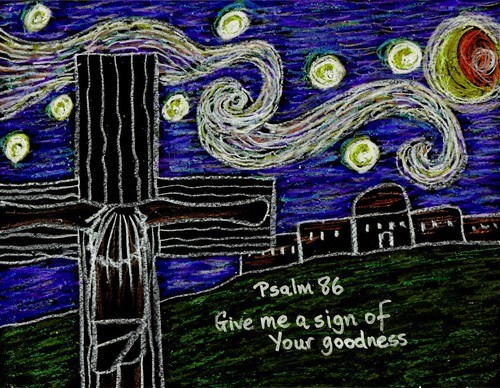
Psalm 86, chalk art by Scottish pastor and artist John Stuart, 2009

Be assured that with such a God, our pleas, cries, and tears will be noticed, affirmed, and answered. We can trust the sovereign Lord of all creation to address the insolence and injustice that exists around us and toward us.

All of this gets down to our view of God, our theological understanding of the basic Divine nature and purpose.  For some people, God is up there, somewhere, like some white-bearded old guy who is aloof to what is going on down here – there is neither anything personal nor personable about him, at all. For others, God is a force which binds all things together. In this theology, God exists, but you are never quite sure how to connect – it is like a crapshoot trying to get in touch with him.  For yet others, God is perpetually perturbed about something; he has a bee in his bonnet, and it is apparently our job to figure out what he is so sullen and upset about all the time so that we can appease him in some way.

However, the psalmist, David, sees God in wholly other ways than this. For David, God is personal, knowable, and reachable. David thought about God in ways which transcend either gendered or personality-type categories. Note the descriptions David provided: a willingness to forgive; an abiding, consistent, and steadfast presence of divine love; always having the time and desire to listen; possessing the power and ability to provide help and protection; being kind and merciful; not being easily angered; and extending needed comfort and consolation.

Now this is a God you can sink your teeth into – attentive, engaged, and anything but upset all the time. This is the reason why David has confidence to ask for deliverance, direction, and delight. Such a God is like a caring grandmother who seeks to always love and serve, and not a crotchety old curmudgeon who always seems bothered by everyone and everything.

If your theology, your view of God, cannot support and bear the weight of life’s hardest circumstances, then you need a different view of God! I invite you to see the God of David. Theology proper discerns the being, attributes, and works of God as fundamentally faithful and loving. This God has both the ability and the will to meet and satisfy your life’s greatest needs.

Great God of David, you are above all things and beside all things and with all things. You are uniquely positioned and powerful to walk with me through all the situations of my life. Thank you for sending the Son of David to make real your promises to me.  Amen.

Psalm 139:1-6, 13-18 – Specially Crafted by the Divine

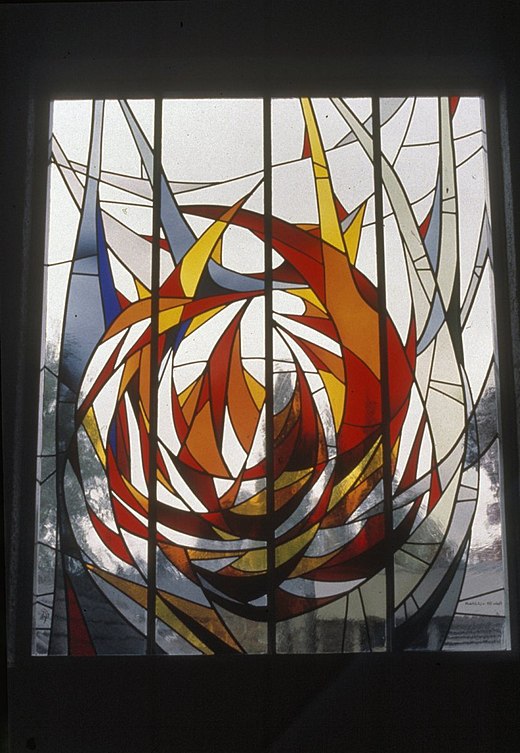
Psalm 139 stained glass by Dutch artist Ted Felen (1931-2016)

Lord, you have examined me.
    You know me.
You know when I sit down and when I stand up.
    Even from far away, you comprehend my plans.
You study my traveling and resting.
    You are thoroughly familiar with all my ways.
There isn’t a word on my tongue, Lord,
    that you don’t already know completely.
You surround me—front and back.
    You put your hand on me.
That kind of knowledge is too much for me;
    it’s so high above me that I can’t reach it….

You are the one who created my innermost parts;
    you knit me together while I was still in my mother’s womb.
I give thanks to you that I was marvelously set apart.
    Your works are wonderful—I know that very well.
My bones weren’t hidden from you
    when I was being put together in a secret place,
    when I was being woven together in the deep parts of the earth.
Your eyes saw my embryo,
    and on your scroll every day was written that was being formed for me,
    before any one of them had yet happened.
God, your plans are incomprehensible to me!
    Their total number is countless!
If I tried to count them—they outnumber grains of sand!
    If I came to the very end—I’d still be with you. (CEB)

It is no wonder so many people struggle with their self-image. Beautiful people reign in television and movies; the rich and powerful are highlighted in the media; and people with perfect teeth and immaculate attire are splashed in front of us in the daily barrage of advertisements. Meanwhile, the rest of us 99% of the population quickly notice we do not measure up to such a standard. You don’t have to be a people watcher to know that less than perfect bodies are the norm and that most folks do not have a budget to live like the other 1% humanity.

If we make comparisons with others too much and for too long, it gets downright depressing. Yet, into this dark abyss of one’s self-image enters the biblical truth that each one of us, no matter our station in life, was personally hand-crafted by a heavenly Being who loves us dearly. We are indeed fearfully and wonderfully made.

The Creator God took great care to make us and form us just so. The psalmist, David, praised God for the way we were created. The real standard from which we ought to judge ourselves is this: God knows us intimately, inside-and-out, and neither condemns us nor shames us but loves us wholly.

Psalm 139 by Dutch painter Ellen Van Randeraat, 2013

So then, rather than wasting our emotional energy and mental faculties on wishing we looked different or were more like so-and-so who seems to always have it all together, try practicing what David did: Praise God. 

Whenever we have the notion that we do not measure up to our imposed arbitrary standard, keep in mind that the only real measurement is grace. No matter who we are, the entire race of humanity has been created in the image of God, and, on that basis alone, we have inherent value, worth, and majesty. Let us, then, treat ourselves and others with the yardstick of grace.

The inner critic, that is, the inner judgmental dialogue we have with ourselves, needs to be replaced with the truth of Psalm 139. Although we might be rather hard on ourselves and say things in the reclusive parts of our minds and hearts that we would never say to others, nor tolerate others saying about someone else – God speaks to us with tender words of grace. Perhaps you think that only you know the depth of your own sorrows, hurts, fears, insecurities, and worries.  Except….

God. The Lord knows it all intimately – and is not one bit repulsed. You see, God knows that the answer to all the self-doubts is Divine care and protection. You and I have the freedom to plumb the recesses of our hearts and souls – to bring out all that is inside the cluttered closet of our minds and lay it all on the table without fear of God calling you what you call yourself.

Therefore, please do not quickly pass over the inspired words from Holy Scripture contained in today’s psalm. Take the time to carefully digest each phrase slowly so that the message becomes internalized and believed in real-time experience.

One of the theories of human psychology is that people are driven by two primary needs: 

  1. To intimately know another person.
  2. To be intimately known by another person. 

God knows us even better than we know ourselves – and still loves us! There is nothing we learn about ourselves that God does not already know. No human relationship can even come close to the level of knowing that God has for us and about us.

To know God is perhaps the greatest and highest pursuit we could ever enjoy. God is so immense and infinite that we will spend an eternity getting to know the Lord and will never get to the end of it. That is the kind of God we serve. Be encouraged today and always with the reality that you are known and can know God – and even more, loved deeply as a specially fashioned creature.

O God, thank you that I am wonderfully made in your likeness.  I praise you that I am fully accepted, even when I do not accept myself.  In Jesus Christ you have demonstrated the height of your love and mercy.  May this grace be with me every day so that I will conduct myself in a manner worthy of being part of the human family.  Amen.

Psalm 69:1-5, 30-36 – The Praise of Suffering

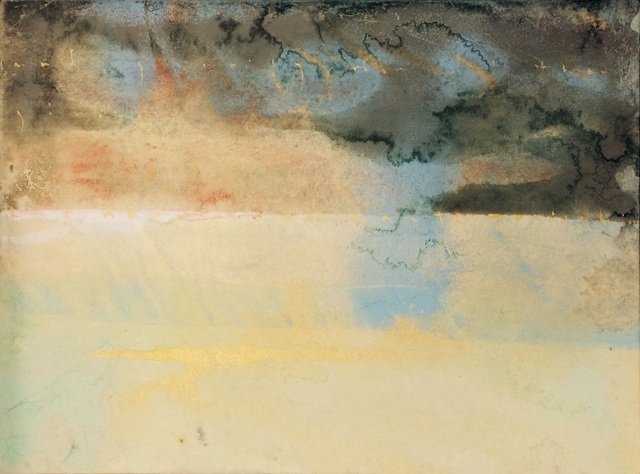
Psalm 69 by Japanese painter Makoto Fujimura

Save me, God,
    because the waters have reached my neck!
I have sunk into deep mud.
    My feet cannot touch the bottom!
I have entered deep water;
    the flood has swept me up.
I am tired of crying.
    My throat is hoarse.
    My eyes are exhausted with waiting for my God.

More numerous than the hairs on my head
    are those who hate me for no reason.
My treacherous enemies,
    those who would destroy me, are countless.
    Must I now give back
    what I did not steal in the first place?
God, you know my foolishness;
    my wrongdoings are not hidden from you….

I will praise God’s name with song;
    I will magnify him with thanks
    because that is more pleasing to the Lord than an ox,
    more pleasing than a young bull with full horns and hooves.
Let the afflicted see it and be glad!
    You who seek God—
    let your hearts beat strong again
    because the Lord listens to the needy
        and does not despise his captives.

Let heaven and earth praise God,
    the oceans too, and all that moves within them!
God will most certainly save Zion
    and will rebuild Judah’s cities
    so that God’s servants can live there and possess it.
The offspring of God’s servants will inherit Zion,
    and those who love God’s name will dwell there. (CEB)

As the Church’s and the Christian’s prayer book, the psalms offer a way to come to God when our feelings and emotions have us not knowing how to pray, at all.  If you are depressed because of people who would like to see you fail or are out to get you, then this is the psalm for you to pray!

When you are voiceless, the psalter can voice it for you. When you are unable to put your thoughts into words, the Scripture can word it for you. Two of the great attributes of God are divine power and love, which means that the Lord is more than able to do something about your situation, and it will always be done in a loving way.  Know today that God hears you and is working on a response to your lament – even if it is not in your own words but the words of Holy Scripture.

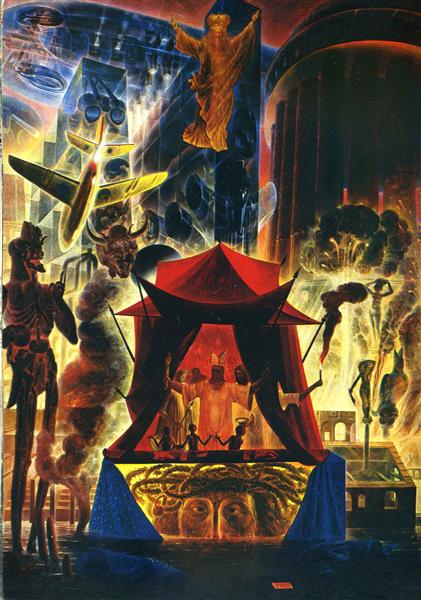
Psalm 69 by Austrian artist Ernst Fuchs, 1960

God will come through in God’s own good time. However, you can still praise the Lord right now, smack in the middle of your dilemma. David, the author of today’s psalm, chose to praise God, even though he did not get an immediate answer to his prayers. Perhaps God is more concerned to change us before changing our circumstances.

We need a solid theology of suffering. And that biblical psalms give it to us. I know of no one who wakes in the morning, sits on the edge of their bed, and says, “Gee, I want to suffer today and feel lots of emotional and spiritual pain.” No, we want happiness and joy, not agony and hardship. Yet suffering has much to teach us and the Lord is rarely quick to snatch us from its lessons. The hardship of personal suffering teaches us faith and dependence upon God, as well as leading us to ask for help from others so that we are lovingly supported.

“The way you look at things is the most powerful force in shaping your life.”

john o’donohue

Tribulations in life are common to all people without exception. The issue is whether we will submit to its hard-knock education, or not – whether we will become better people, or bitter. The Irish teacher and poet, John O’Donohue, penned a poem entitled, “For Suffering,” concerning the blessing of hard things:

May you be blessed in the holy names of those

Who, without knowing it,

Help to carry and lighten your pain.

May you know serenity

When you are called

To enter the house of suffering.

May a window of light always surprise you.

May you be granted the wisdom

To avoid false resistance;

When suffering knocks on the door of your life,

May you glimpse its eventual gifts.

May you be able to receive the fruits of suffering.

May memory bless and protect you

With the hard-earned light of past travail;

To remind you that you have survived before

And though the darkness is now deep,

You will soon see approaching light.

May the grace of time heal your wounds.

May you know that though the storm may rage,

Not a hair of your head will be harmed.

To Bless the Space Between Us: A Book of Blesings (Doubleday, 2008)

We have all likely at times felt the anguish of the psalmist – being so overwhelmed that it feels like we are drowning. The feeling is compounded exponentially when behind the sense of trying to keep our heads above water there are people who do not like us – maybe even hate us, to the point of undermining our work every chance they get.  It is in such circumstances we might experience sleepless nights hoping that somehow and someway God will show up.

The typical modus operandi for some within adverse situations is the age-old route of complaining and wishing things were different. Yet neither griping about our problems nor dishing out slander and gossip toward others is a healthy way of dealing with adversity. Just the opposite response is the proper path to the bone-crushing feeling of opposition: to praise God’s name with a song and magnify the Lord with thanksgiving. 

The reason the believer can engage in adoring God during trouble is not some Jedi-type mind trick to make us think more positively. Instead, the basis for praise is in knowing God. It is God who ultimately will deal with the wicked; it is the Lord who will bend to listen to our lament when times are hard. 

Thanking God for answers to prayer in advance of them being answered is a biblical thing to do. Having a faith robust enough to see ahead toward hope can bring love to a loveless situation, and usher in praise before the divine deed of deliverance is even accomplished.

Saving God, thank you for your deliverance!  I give you praise for loving me through sending your Son, the Lord Jesus, to this earthly realm so that I might experience salvation from sin, death, and hell. By Christ’s authority, in the power of the Holy Spirit given to me, I resist the enemy’s attempts to seize control of my life.  I belong to you, holy God. Amen.