Two Ways of Living: Blessed or Cursed

Blessed is the one
    who does not walk in step with the wicked
or stand in the way that sinners take
    or sit in the company of mockers,
but whose delight is in the law of the Lord,
    and who meditates on his law, day and night.
That person is like a tree planted by streams of water,
    which yields its fruit in season
and whose leaf does not wither—
    whatever they do prospers.

Not so the wicked!
    They are like chaff
    that the wind blows away.
Therefore the wicked will not stand in the judgment,
    nor sinners in the assembly of the righteous.

For the Lord watches over the way of the righteous,
    but the way of the wicked leads to destruction. (Psalm 1:1-6, NIV)

The Righteous and the Wicked

This psalm presents two ways we can choose to shape our lives: the way of the righteous and the way of the wicked, blessed or cursed. The way of the righteous leads to human blessing, flourishing, and living. The way of the wicked leads to human cursing, degenerating, and dying.

Distinguishing between the righteous and the wicked is not always as easy as it looks. Only at the end of the age, when Judgment Day comes, will we know for certain the righteous and the wicked.

To discern the difference between the two, let’s refer to the Reformer, Martin Luther, to help us. You might be familiar with Luther’s 95 Theses posted on the door of the Wittenberg castle church, sparking the Reformation of Christianity. Less familiar is the theological meat of Luther’s reforming spirit, his Heidelberg Disputation of 1518, written the year following the 95 Theses.

Theology of the Cross and Theology of Glory

Like Psalm 1, Luther contrasts two opposing ways. He calls these two ways the theology of the cross and the theology of glory. The cross, as expressed by Luther, is God’s attack on human sin. It is the death of Christ which is central to Christianity. Therefore, one must embrace the cross and rely solely upon Christ’s finished work on the cross to handle human sin. It is through being crucified with Christ we find the way to human flourishing and life. In other words, righteousness is gained by grace through faith in Christ.

The theology of glory is the opposing way of the cross. It’s important to understand Luther because he has a key which helps us unlock Scripture by not walking in the way of the wicked, as expressed in Psalm 1. For Luther, the wicked person, and the vilest offender of God, is not the person who has done all kinds of readily observable outward sinning. You, perhaps like me, have an idea in your head of what the worst of sinners is like. My guess is that it probably has something to do with certain lifestyles or evil acts. 

“Good” Works?

Luther, however, insisted the worst of sinners are people who do good works. Specifically, the wicked person is one who has clean living and does nice things but does them disconnected from God by wanting others to see their good actions. Another way of putting it: The wicked person seeks to gain glory for themselves rather than give glory to God.

Our good works can be the greatest hindrance to righteousness and living the way of the cross. It is far too easy to place faith in our good works, done apart from God, rather than placing complete trust in Christ alone. It can be too easy, doing good things, for the primary purpose of having others observe our goodness, rather than do them out of the good soil of being planted in God’s Word. 

The remedy for sin is the cross, and the sinner lives life apart from that cross, trusting in self, so that people will give personal recognition, respect, and accolades.

“It is impossible for a person not to be puffed by his good works unless he has first been deflated and destroyed by suffering and evil until he knows that he is worthless and that his works are not his but God’s.”

Martin Luther

Delight, or Not

The answer to this problem of doing good works to gain glory for self is not to avoid good works, but to do them from the good soil of being planted in God’s law and connected to Christ’s vine. The psalmist uses the word “law” in referring to Scripture as a whole, to all the acquired wisdom about how life is supposed to be lived in God’s world.

People who yield juicy abundant fruit have immersed themselves in the law. Because they delight in God; secretly rise early to meditate on God’s Word; privately read the Bible’s message; and pray to put that message into practice. They will be blessed. 

The wicked are too busy to notice the law. They serve to be seen and desire public recognition for their charity and works. But those works will not stand in the Judgment. Jesus described them this way:

“You are like white-washed tombs, which look beautiful on the outside, but on the inside are full of dead men’s bones and everything unclean….  On the outside you appear to people as righteous, but on the inside, you are full of hypocrisy and wickedness.” (Matthew 23:27, NIV)

Which is Which?

Identifying the righteous and the wicked is not as simple as saying the wicked are “those people” out there, and the righteous people are in here. The truly righteous person delights in God through the law. They have the humble sense they could easily drift from God if not staying connected, rooted in Jesus, and grounded in the way of the cross. 

The wicked, in contrast, are like chaff – worthless. They are arrogant and annoying – wanting all the attention which God rightly deserves. When I was a kid, I always wore a mask during the corn harvest because of the chaff and corn dust. Every year, from the time I was seven years old, I had the job of taking the tractor out and hitching up the wagons of corn and bringing them back. Then, I unloaded the wagon of corn into the auger which sent it up and into the corn bin. The corn dust flew everywhere. It was annoying and could easily take over my lungs if I weren’t masked up.

The wicked have nothing of substance to contribute to God’s kingdom – they add no value to what is going on. In fact, they are a hindrance to the harvest of souls God is trying to accomplish. Conversely, the righteous do good works which sprout from rich Iowa-type soil, producing a harvest of righteousness. 

The righteous person takes the time to know God’s law; satisfies the needs of those who are not able to pay them back or give them proper recognition; and cultivates relationships with those they help. The righteous are relational.

Righteous Job

The biblical character, Job, is an example of a righteous person. Job did all kinds of good works. And he did them because of his close walk with God. Job persevered through intolerable suffering and grief because he knew God. Job assisted the needy; helped others no matter their situation; championed the less fortunate; and gave glory to God even amid terrible trouble. Job did not throw in the towel when his reputation, his family, and his wealth were completely taken away. Instead, he said:

“Naked I came from my mother’s womb, and naked I will depart. The Lord gave and the Lord has taken away; may the name of the Lord be praised.” In all this, Job did not sin by charging God with wrongdoing. (Job 1:21-22, NIV)

Generosity marks the righteous because God is generous. Grace defines the righteous because God is gracious. Gentleness is the way of the righteous because Christ is gentle. Spiritual prosperity is born of a righteous relationship with Jesus Christ. The Lord watches over the way of the righteous.

Injustice and Judgment

However, the wicked perish. There are sixteen prophetic books in the Old Testament, all given to a single message: Judgment is coming because of wickedness. And the wicked turn out to be some of God’s covenant people. That’s because they selectively did their good works to gain glory for themselves. And they withheld the good they could have done because it did not add any value to their reputation or personal goals. 

For example, prophesying to those who fasted so that others would see their spirituality, the prophet Isaiah communicated God’s message:

“Is not this the kind of fasting I have chosen:
to loosen the chains of injustice
    and untie the cords of the yoke,
to set the oppressed free
    and break every yoke?
Is it not to share your food with the hungry
    and to provide the poor wanderer with shelter—
when you see the naked, to clothe them,
    and not to turn away from your own flesh and blood? (Isaiah 58:6-7, NIV)

God desires genuine spiritual growth. That happens when we eschew a theology of glory, and embrace a theology of the cross, which delights in God and God’s law, meditating on it day and night.

A Choice

We always have a choice between the way of the righteous and the way of the wicked, to embrace a theology of the cross or a theology of glory. Here is how that choice is framed in the book of Deuteronomy when the ancient Israelites were about to enter the Promised Land:

See, I set before you today life and prosperity, death and destruction. For I command you today to love the Lord your God, to walk in obedience to him, and to keep his commands, decrees and laws; then you will live and increase, and the Lord your God will bless you in the land you are entering to possess….

I have set before you: life and death, blessings and curses. Now choose life, so that you and your children may live and that you may love the Lord your God, listen to his voice, and hold fast to him. For the Lord is your life, and he will give you many years in the land he swore to give to your fathers, Abraham, Isaac and Jacob.” (Deuteronomy 30:15-20, NIV)

The idolatry which can easily seduce us are our own good works done for a human audience who will recognize and affirm. Jesus said we must play to the audience of one:

But when you give to the needy, do not let your left hand know what your right hand is doing, so that your giving may be in secret. Then your Father, who sees what is done in secret, will reward you.” (Matthew 6:3-4, NIV)

Our daily choice must be to love God supremely and give God glory for everything good in our lives. Perhaps Christianity needs another Reformation – one in which we do not just uphold the authority of Scripture, but reform our habits by loving God through basic disciplines of Bible-reading and simple obedience; and by loving our neighbor through giving them time and attention, the gift of relationship and friendship.

What will you choose this day?

Psalm 47 – Clap and Shout!

Sing, Clap, and Sound the Trumpets by Melani Pyke

Come, everyone! Clap your hands!
    Shout to God with joyful praise!
For the Lord Most High is awesome.
    He is the great King of all the earth.
He subdues the nations before us,
    putting our enemies beneath our feet.
He chose the Promised Land as our inheritance,
    the proud possession of Jacob’s descendants, whom he loves.

God has ascended with a mighty shout.
    The Lord has ascended with trumpets blaring.
Sing praises to God, sing praises;
    sing praises to our King, sing praises!
For God is the King over all the earth.
    Praise him with a psalm.
God reigns above the nations,
    sitting on his holy throne.
The rulers of the world have gathered together
    with the people of the God of Abraham.
For all the kings of the earth belong to God.
    He is highly honored everywhere.
(New Living Translation)

God is King. In the Christian tradition specifically, Jesus is King. Christ is the One who gives shape, form, and substance to the reign of God over the earth. This is what the Lord’s ascension to heaven communicates – that Jesus sits at the right hand of God the Father, exercising a benevolent rule as the rightful Sovereign over all creation.

This redemptive reality of the Lord’s good reign is a cause for praise. And this is what today’s psalm is all about. We, as the subjects of God’s kingdom, are called to praise the Lord.

The psalm tells us exactly how to praise the Lord because of powerful and compassionate authority: clap your hands and shout! For worshipers who believe acknowledgment of God is most appropriate with silence and contemplation, even a cursory reading of the psalms will inform them differently. Although it seems to me most worship experiences need more familiarity with silence, I also passionately believe they could use a whole lot more enthusiasm with clapping and shouting.

Depending upon where you fit in the spectrum of Christianity’s tradition of worship, high church or low church, very liturgical, or not, it behooves all churches to incorporate the full range of human expression to God – including both silence and shout, hands clasped reverently in prayer as well as exuberantly clapping in praise.

“Let all the rivers clap their hands; let the mountains rejoice out loud altogether.”

Psalm 98:8, CEB

It is biblical to applaud God! And it’s healthy, too – both spiritually and physically. Whenever we fail to pause in our feelings of happiness and enjoy the moment, it is more than a missed opportunity. Unacknowledged and unexpressed joy trains us to depress our feelings, eventually leading to depression itself. Yet, whenever we stop to outwardly demonstrate gratitude through the exuberance of shouting and clapping, it benefits everyone – God, others, and self.

Physically clapping and shouting helps keep the heart and lungs healthy, even playing a curative role with pulmonary problems. It gives relief to joint pain, gout, headaches, insomnia, and digestion. Shouting and clapping even sharpens the intellect and increases the brain’s ability. And, of course, applause is a social phenomenon which binds folks together in community.

For the psalmist, applause to the Lord is the appropriate response to God’s power and victory in the world. Since divine presence is everywhere – and that presence is merciful, just, and kind – we ought to pause long enough to acknowledge and celebrate a loving God watching over us with tender care and concern.

No matter the circumstance, God is with us. That reality alone is enough cause for exuberance and celebration. Even though evil still resides in this old fallen world, God is King, and still sits on the throne. The pastor and hymnwriter, Maltbie Davenport Babcock (1858-1901), had it right:

This is my Father’s world:
O let me ne’er forget
That though the wrong seems oft so strong,
God is the Ruler yet.
This is my Father’s world:
Why should my heart be sad?
The Lord is King: let the heavens ring!
God reigns; let earth be glad! 

It is not the attempt to gin-up human and personal confidence which enables us to face the foulness and degradation of this world. Rather, it’s the spiritual awareness of God’s presence and power which resides around us and within us. This is the basis of our confidence. It is the ground of our peace. It’s the reason for the believer’s joy, even amidst awful circumstances.

Our connection with one another as worshipers is the common acknowledgment of God’s rule and reign over all creation. And our link as followers of Jesus is the collective conviction that Christ is King, we are his subjects, and all things belong to God, including us.

Whenever we connect with this basic theology, spontaneous and joyous praise is the result. So, if we lack the joy of the Lord in our lives, the place to go is to use today’s psalm. Read it several times over, out loud. Shout the psalm! Clap while shouting the psalm! Sing the psalm aloud! Praise the risen and ascended Lord!

May it be so to the glory of God.

This Is My Father’s World, sung by Amy Grant.

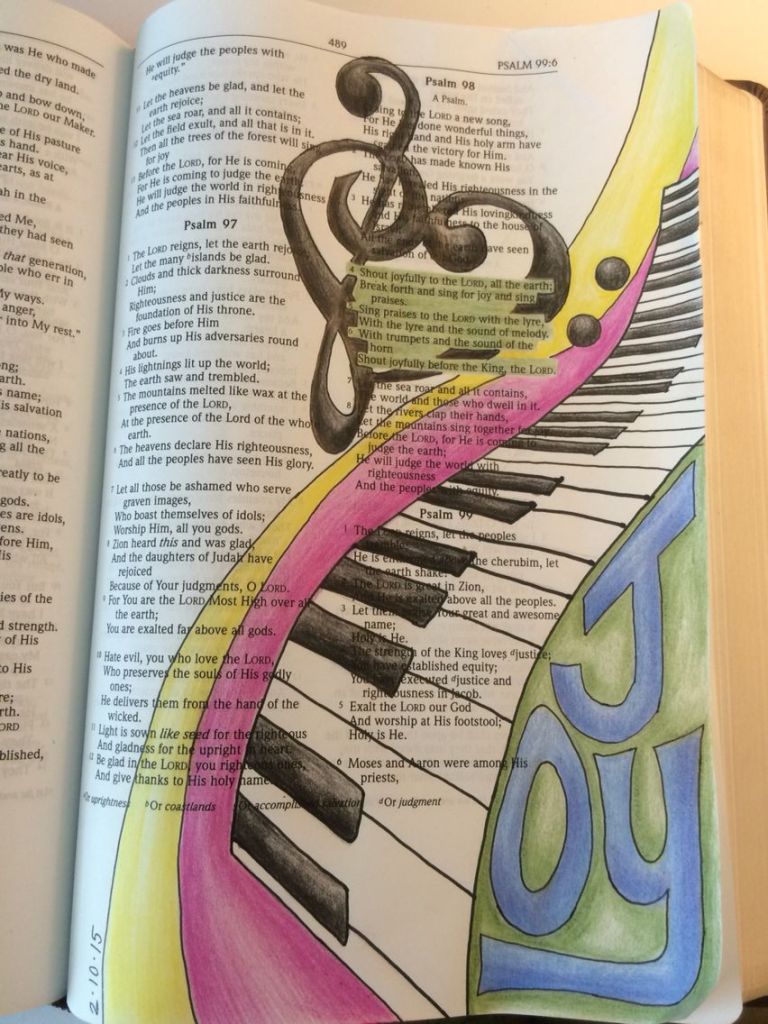
Psalm 98 – Sing a New Song

Sing to the Lord a new song
    because he has done wonderful things!
His own strong hand and his own holy arm
    have won the victory!
The Lord has made his salvation widely known;
    he has revealed his righteousness
    in the eyes of all the nations.
God has remembered his loyal love
    and faithfulness to the house of Israel;
    every corner of the earth has seen our God’s salvation.

Shout triumphantly to the Lord, all the earth!
    Be happy!
    Rejoice out loud!
    Sing your praises!
Sing your praises to the Lord with the lyre—
    with the lyre and the sound of music.
With trumpets and a horn blast,
    shout triumphantly before the Lord, the king!
Let the sea and everything in it roar;
    the world and all its inhabitants too.
Let all the rivers clap their hands;
    let the mountains rejoice out loud altogether before the Lord
    because he is coming to establish justice on the earth!
He will establish justice in the world rightly;
    he will establish justice among all people fairly. (Common English Bible)

Please notice the point of today’s psalm: Sing to the Lord a new song. Yes, a “new” song. This means we have an obligation to bring fresh music to our worship of God. This is a summons to get an original voice. Rather than going down the same ruts in our speaking and living, we are to exercise some creativity.

It seems as if those who want to stick with the “tried and true hymns” of the church have forgotten those hymns are only a few hundred years old in a church which is two-thousand years old. Back in the nineteenth century, a bitter worship battle ensued between those who wanted to sing the new hymns and those who had been singing the psalter for the past few hundred years.

The reason we sing new songs is because God is continually performing wonderful deeds in every generation. God has not only worked in the past; the Lord is doing the miraculous in the present, as well. The psalmist is thinking in cosmic, not provincial, terms. Included in the praising of new songs are a variety of creatures, along with all of creation.

Rivers Will Clap and Mountains Shout by Itamar Raz

We sing because of what God has done in the past, is doing in the present, and will do for the future. Creative and fresh praise that remembers previous divine works, experiences the now of the Spirit, and anticipates the coming of the Lord is the sort of praise called for in the psalm.

Being attentive to God’s mighty deeds helps us breakout into new vistas of living. Considering God’s works through new songs can become so invigorating that everyone and everything on earth is encouraged to join into the imaginative expression of praise.

We are to praise the Lord in this present time because of what God has done in the past, with a continual eye to the future when Christ will come again. If we don’t make the effort to offer praise that is fresh, creative, and thoughtful for our present time, then we ought not be surprised when a watching world gives a shoulder-shrugging “meh” to our tepid singing. And if such vibrant praise seems foreign, then the time is past due for a renewed focus on the works of God because the Lord really has done miraculous things for us.

Let’s jump start your creativity a bit:

  • Do some prayer walking through your neighborhood. See the community through another’s eyes.
  • Write in a journal or collect photos of significant experiences. No one needs to read or see it unless you want them to. Although, it’s a good idea to share with others.
  • Sketch, paint, or sculpt. Make a visual depiction of your joy or experience. It doesn’t matter if it looks like a second grade art project. It’s the process of creating that matters.
  • Participate in a new activity, like taking an online class or developing a different routine.
  • Don’t just do what somebody else did. Reflect on what is important to you. Then, make something to remind you of its value.

You are already a creative artist. You just might not know it, yet. Since you carry within yourself the DNA of a creative God, the Lord’s image and likeness within wants a creative outlet. Open yourself to the possibility of smelling colors, talking to trees, and listening to what animals have to say to you. In doing so, you just might discover that the miraculous has been under your nose all along.

Mighty God, your holy arm of power has done incredible works in history. What’s more, you have done influential works in my life, especially through deliverance from evil and transformation of heart.  For this, and for all your miraculously good work, I praise the gracious and wonderful name of Jesus Christ, my Savior and Lord. Amen.

Psalm 95 – Worship and Whining

Psalm 95 verse 4, by Cecelia Nedlin

Come, let us sing for joy to the Lord;
    let us shout aloud to the Rock of our salvation.
Let us come before him with thanksgiving
    and extol him with music and song.

For the Lord is the great God,
    the great King above all gods.
In his hand are the depths of the earth,
    and the mountain peaks belong to him.
The sea is his, for he made it,
    and his hands formed the dry land.

Come, let us bow down in worship,
    let us kneel before the Lord our Maker;
for he is our God
    and we are the people of his pasture,
    the flock under his care.

Today, if only you would hear his voice,
“Do not harden your hearts as you did at Meribah,
    as you did that day at Massah in the wilderness,
where your ancestors tested me;
    they tried me, though they had seen what I did.
For forty years I was angry with that generation;
    I said, ‘They are a people whose hearts go astray,
    and they have not known my ways.’
So I declared on oath in my anger,
    ‘They shall never enter my rest.’”
(New International Version)

Revelation and Response

Praise and thanksgiving. Complaining and grumbling. These two sets of words are antithetical to each other. Yet, out of the same mouth can come both worship and whining. Maybe the psalmist was trying to teach us a thing or two by inviting us to sing and bow to the Lord, as well as hear God’s voice.

Worship and listening are meant to go hand in hand. Revelation and response are to be the spiritual rhythm of the believer. True worship is a divine conversation between us and God. The Lord speaks. We listen and answer. Back and forth we go together. God and God’s people are in dialogue.

When the worship rhythm is off, then our response will be off. And that is what happened to the ancient Israelites. They were miraculously delivered from their cruel bondage in Egypt. You can imagine the kind of praise and worship service the people had in the desert! After four-hundred years of slavery, freedom!

The Rhythm is Off

Before you know it, the thanksgiving turned sour into grumbling. At the first instance of adversity, when there was no water to drink, it was as if the people had some sort of collective dementia set in. Suddenly, hardness of heart. Talk about fickle! One minute hands are raised in praise, the next minute, those same hands clench into fists shaking at God.

The people forgot that this was an ongoing dialogue – not a one and done conversation of revelation and response. God acted by delivering the people. The people responded with praise and thanksgiving. And they didn’t want it to stop. Yet, all of life is a rhythm. What goes up, comes down. Good times eventually fade into tough times. The real muster of any person or group is the response when the hardship comes.

God knew exactly what he was doing. The Lord purposely brought the Israelites out into the desert to face a difficult circumstance. God was teaching them to trust. The Lord wanted a response of faith and prayer to the adverse situation. But the people weren’t looking for a dialogue. They were looking for water. And when they didn’t have it, their hearts hardened through murmuring, bellyaching, and dissatisfaction.

However, God was still in the conversation. The generation who saw the incredible deliverance from bondage would die in the desert, never setting eyes on the Promised Land. And it all began because of grumbling.

Complaining is Unhealthy

We need to take complaining seriously. Why? Because it rots the soul, like Mr. Grinch who incessantly complained every year about Christmas. Grumbling makes one into a Grinch-like creature, like the song says:

You’re as cuddly as a cactus
You’re as charming as an eel…

You got termites in your smile
You have all the tender sweetness
Of a seasick crocodile…

Your heart’s an empty hole
You got garlic in your soul.

It was only when the Grinch forsook his isolation of complaining and began connecting in conversation with the folks in Whoville, that he had his rhythm restored.

The Need for Encouragement

When our rhythm is off kilter, what will it take to get it back? The author of the New Testament letter to the Hebrews helps us here. After quoting our psalm lesson for today, the writer responded to the biblical revelation by saying:

Be careful, brothers and sisters, that none of you ever develop a wicked, unbelieving heart that turns away from the living God. Encourage each other every day while you have the opportunity. If you do this, none of you will be deceived by sin and become stubborn. After all, we will remain Christ’s partners only if we continue to hold on to our original confidence until the end. Scripture says, “If you hear God speak today, don’t be stubborn. Don’t be stubborn like those who rebelled.”

Hebrews 3:12-15, God’s Word Translation

Revelation and response are the rhythmic dynamism of the Christian community. Lone Ranger Christians are an oxymoron, as well as moronic. We are hard-wired by God for community. All of us need to encourage one another – every day. Without the communal connections of encouraging conversations, it will be difficult to sustain a divine dialogue of God speaking, with people listening and responding in obedient faith.

Celebration is wonderful. We need times and experiences of celebrating deliverance from bondage. Eventually, when Christ returns, there will be unending worship in the form of jubilation. That time is not yet here. This side of heaven, we must learn to engage God in ways which address our hardships and difficulties. Otherwise, our hearts will become stubborn and hard.

Let your heart become open enough to receive encouragement. And let it also be brave enough to encourage others.

Lord Jesus Christ, by your patience in suffering you caused earthly pain to be holy. And you gave us the example of obedience to your Father’s will. Be near me in my time of weakness and pain. Sustain me by your grace so that my strength and courage may not fail. Heal me according to you will. Help me always believe that what happens to me here is of little account if you hold me in eternal life, my Lord and my God. Amen.