Learning to Trust (Psalm 4)

Answer me when I cry out, my righteous God!
    Set me free from my troubles!
        Have mercy on me!
        Listen to my prayer!

How long, you people,
    will my reputation be insulted?
How long will you continue
    to love what is worthless
    and go after lies?
Know this: the Lord takes
    personal care of the faithful.
The Lord will hear me
    when I cry out to him.
So be afraid, and don’t sin!
    Think hard about it in your bed
    and weep over it!
Bring righteous offerings,
    and trust the Lord!

Many people say,
    “We can’t find goodness anywhere.
    The light of your face has left us, Lord!”
But you have filled my heart with more joy
    than when their wheat and wine are everywhere!
I will lie down and fall asleep in peace
    because you alone, Lord, let me live in safety. (Common English Bible)

The psalmist, David, was a man after God’s own heart. But that did not mean that he was inoculated from trouble and hardship.

David had a lot of adversity and much difficulty throughout his life. So, it only made sense to him to cry out to the Lord for deliverance and help. God had helped David in the past, and David was confident that the Lord would help him yet again.

We all find ourselves in a tight spot, between a rock and hard place, at times. It’s what we do when we are in that position that is critical. David had a history of looking to God, seeking God’s grace, and soliciting answers to prayer.

David, the psalmist, was a real victim of slander and lies. More than once in his life, he had people out to get him, to actually take his life. Whatever your understanding of stress is, it doesn’t get much more stressful than someone hunting you down like an animal to literally kill you. I’m sure that many times David wondered how long this surreal madness was going to go on.

Whenever we are especially stressed, it can be hard to even breathe. If we aren’t mindful of ourselves, we will take lots of short staccato breaths that only feed anxious signals to the brain. It leaves us in a perpetual state of hypervigilance, almost unable to pray and have thoughts of God.

But we absolutely need to take deep breaths and trust in God’s sustaining presence. We’ll never get to sleep, nor stay at rest, without a sense of the divine presence.

Insomnia happens for a lot of reasons. Many people have diagnosed sleep disorders that are very real medical conditions. Others can’t get a good night’s rest because of poor sleep hygiene by not planning for adequate sleep, drinking too much caffeine during the day, inattention to a healthy diet, or a host of other habits. Some have issues of chronic pain which can make it difficult to sleep well.

And then there are yet others who suffer from racing thoughts, anxiety, and depression. The stress of their waking life is so significant that several hours of deep sleep seems only like some pipe dream. It’s impossible to sleep when the weight of the day is pressing on you. Finding a sense of calm before bed isn’t easy—especially when you can’t unplug from the demands of your day.

I am wondering if many of us will even allow ourselves to unplug and establish some quiet wind-down time. Reading a real book – not one on a backlit tablet device – or talking with a friend or family member are simple ways of easing our anxiety and letting rest come.

The psalmist, David, had a regular practice of meditating on Scripture, recalling the events of God, and expressing gratitude and praise for answered prayer. Each of us has a built-in spiritual rhythm just like we have a circadian rhythm. Always trying to buck those God-given rhythms will inevitably result in being “off,” at the least, and experiencing debilitating depression, at the worst.

Yet, when we learn to move with the unforced rhythms of grace, there is a groove we slip into which serves us well. In other words, what I am trying to say, is that by allowing ourselves to be human, we can discover health.

David neither had delusions, nor illusions, about his enemies, friends, others, and himself. He didn’t try to be somebody he was not. Instead, David had firm and confident convictions about God and the place of prayer.

By taking in a steady diet of David’s psalms, we can learn to hold together both faith and doubt, confidence and confusion, perseverance and perplexity, in ways which strengthens our faith.

Everyone of us who desire God must learn to trust; and it’s in the school of hard knocks where our faith is developed in order to sustain us for a lifetime of service and resilience.

There will always be those who believe ill of us through slander, lies, or outright oppression. In such times, let’s cry out to God for both peace and guidance; and ask the Lord for help in learning to breathe, lie down, and get some rest.

As our trust develops, we may even find the grace and courage to confront our oppressors, so that they can seek their own peace with God.

May Christ be with you, and within you;
May Christ go before you, and linger behind you;
May Christ be on your right, and on your left;
May Christ hover above you, and bring support beneath you;
May the Lord Jesus Christ completely and thoroughly surround you, now and forever. Amen.

Keep Your Spiritual Confidence (Psalm 135)

Praise the Lord!
    Praise the name of the Lord;
    give praise, O servants of the Lord,
you who stand in the house of the Lord,
    in the courts of the house of our God.
Praise the Lord, for the Lord is good;
    sing to his name, for he is gracious.
For the Lord has chosen Jacob for himself,
    Israel as his own possession.

For I know that the Lord is great;
    our Lord is above all gods.
Whatever the Lord pleases he does,
    in heaven and on earth,
    in the seas and all deeps.
He it is who makes the clouds rise at the end of the earth;
    he makes lightnings for the rain
    and brings out the wind from his storehouses.

He it was who struck down the firstborn of Egypt,
    both humans and animals;
he sent signs and wonders
    into your midst, O Egypt,
    against Pharaoh and all his servants.
He struck down many nations
    and killed mighty kings—
Sihon, king of the Amorites,
    and Og, king of Bashan,
    and all the kingdoms of Canaan—
and gave their land as a heritage,
    a heritage to his people Israel.

Your name, O Lord, endures forever,
    your renown, O Lord, throughout all ages.
For the Lord will vindicate his people
    and have compassion on his servants.

The idols of the nations are silver and gold,
    the work of human hands.
They have mouths, but they do not speak;
    they have eyes, but they do not see;
they have ears, but they do not hear,
    a nose, but there is no breath in their mouths.
Those who make them
    and all who trust them
    shall become like them.

O house of Israel, bless the Lord!
    O house of Aaron, bless the Lord!
O house of Levi, bless the Lord!
    You who fear the Lord, bless the Lord!
Blessed be the Lord from Zion,
    he who resides in Jerusalem.
Praise the Lord! (New Revised Standard Version)

Idolatry in the Bible is greatly discouraged. To trust in or worship an idol is a big deal in Holy Scripture, precisely because it is totally worthless. Trusting an idol to do anything for you would be like talking to a bowling ball and asking it to balance your checkbook. In other words, there is no chance whatsoever of a bowling ball or an idol helping you in your life with anything at all.

An idol has zero power or authority to accomplish what you need. Idols are impotent and helpless and can do nothing. Anybody who focuses on something that has no agency to act in the world will soon lose their own personal agency to act in the world. One who practices idolatry will become just like their idol: worthless.

So, if idolatry is so irrelevant, then why do many people put their trust in “gods” other than God? Because so many of us have a form of spiritual attention deficit disorder in which we become attracted to all the shiny deities in front of us. It is no coincidence that idols are consistently lacquered over with gold or silver in order to display an extravagant wealth, communicate prestige, and attract new worshipers.

Slick idol marketing presents that worthless thing as valuable, as something you cannot live without. This ability to seduce others into placing trust and value into the irrelevant object is largely why much of the Old Testament condemns idolatry and encourages destruction of idols.

But this is how you must deal with them; break down their altars, smash their pillars, hew down their sacred poles, and burn their idols with fire… The images of their gods you shall burn with fire. Do not covet the silver or gold that is on them and take it for yourself, because you could be ensnared by it; for it is abhorrent to the Lord your God. (Deuteronomy 7:5, 25, NRSV)

Idolatry drains the energy we could be using for worship and life toward the One true God. The idols are an affront to a committed life of faith relational connections. They are a distraction, siphoning away resources that are better used elsewhere. Perhaps most of all, idolatry skews our worldview; the idolator ceases using common sense, and begins moving toward useless endeavors that do not enrich the entire community.

Instead, we can praise the Lord, because God is good and has our best interests at mind. Not only that, but God also has the ability to follow through with divine promises made. A bowling ball can’t do that! (it can’t even make it so you can throw a perfect 300 bowling game).

God is gracious, and holds us close. We belong to God. Remember all the ways the Lord has delivered people in the past, and let that memory give you confidence moving forward.

One of the best ways to know if the worship of God is intact, is by noticing if worshipers act in generous, gracious ways to uphold the unity and peace of the faith community.

But if a community is characterized by division and special interest groups, and by distortions of faith that only champion their particular brand of belief, then you are likely looking at idolatry. If you observe this, get out fast, while you can.

Whenever people are able to bless one another and bless the world, they themselves have received blessing from God. But if they continually curse each other and bemoan the world, then its time to leave. This earthly life is too short for messing around with a bunch of useless idolatry that gets us nowhere.

Maintaining faith in God – and not in something or someone else – will enable us to deal with our doubts and see the power of the Lord all around us.

O God, come to my assistance; O Lord, make haste to help me. Glory to the Father, and to the Son, and to the Holy Spirit—as it was in the beginning, is now, and will be forever. Amen. Alleluia.

The Blessing of Unity (Psalm 133)

How very good and pleasant it is
    when kindred live together in unity!
It is like the precious oil on the head,
    running down upon the beard,
on the beard of Aaron,
    running down over the collar of his robes.
It is like the dew of Hermon,
    which falls on the mountains of Zion.
For there the Lord ordained his blessing,
    life forevermore. (New Revised Standard Version)

In the ancient world, the temple in Jerusalem sat at the highest point of the city. In fact, Jerusalem itself sits relatively high in its geographic region – about 2,500 feet above sea level. A person walking literally goes up to Jerusalem, and up even higher to the temple mount. It was here, at the highest point, that the worship of God happened.

And as the worshipers made their pilgrimage to Jerusalem, and then to the temple, they sang the psalms, including today’s psalm, where they anticipated meeting with God. The Psalms of Ascent (Psalms 120-134) all express a joy of coming together in faith to worship Yahweh.

To meet with God is to experience an abundant life and joyous unity. It is to be blessed, having a settled peace in being with God and God’s people.

From the vantage of Christianity, the great high place for Christians is the Easter celebration of Christ’s resurrection. Since Jesus rose from death, he raises us up from unbelief to faith, and from death to eternal life.

Everything for the believer in Jesus flows from this infinite and powerful fount of resurrection grace. And everything unites and galvanizes around the center of the person and work of Christ. Because of the resurrection, believers are united into one spiritual family; we are all brothers and sisters.

It is a very good thing that Christ has united us, and it is a very pleasant thing when we consider one another as kindred and maintain the unity that we have been given. And not only are we joined by the gracious action of God, but today’s psalm calls all people to worship God and be united together.

The abundant blessing of unity with each other is maintained by allowing it to flow. The psalm lets us know that the two liquid elements of oil and dew help us to keep things moving and flowing in the right direction for our sense of family and working together. And when those elements flow from the top of Mount Calvary, the result is a world of blessing.

Oil provides the lubrication for our unity here on this earth. This sort of oil was used to consecrate a priest for service.

Moses poured some of the anointing oil on Aaron’s head and anointed him, to consecrate him. (Leviticus 8:12, NRSV)

The consecrated oil was special, to be used for the purpose of anointing the priests. It was both expensive and precious, yet God encouraged liberality with it in the consecration ritual. The oil is poured out so lavishly on the priest’s head that it ran down over the beard and onto the collar of the robe.

This was, indeed, symbolic that God is not stingy, but generous; and that unity with both God and others is pleasant, and not an onerous chore. For the Christian, this recalls the Gospel story of Mary liberally pouring out an entire bottle of perfume on Jesus:

Then turning toward the woman, Jesus said to Simon, “Do you see this woman? I entered your house; you gave me no water for my feet, but she has bathed my feet with her tears and dried them with her hair. You gave me no kiss, but from the time I came in she has not stopped kissing my feet. You did not anoint my head with oil, but she has anointed my feet with ointment.” (Luke 7:44-46, NRSV) 

The Lord has always been a generous God. And because of Christ’s resurrection, a new life of abundance and generosity is possible. It’s like the dew of Mount Hermon.

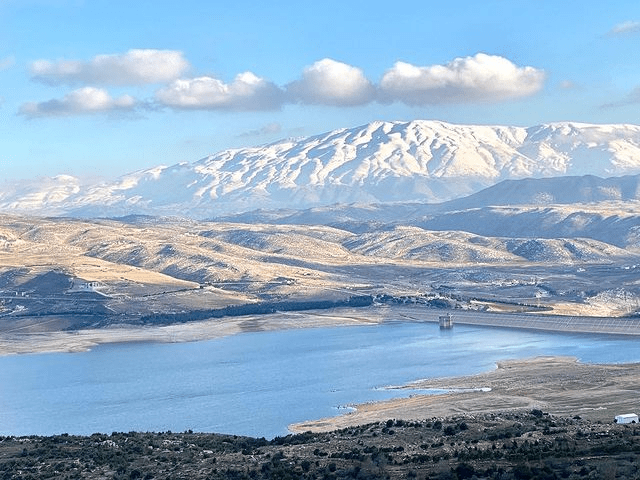
Mount Hermon is on the border between Lebanon and Syria

Mount Hermon is well north of the temple mount in Jerusalem. It too, is high up. Mount Hermon  rises to 9,232 feet and is the highest point on the east coast of the Mediterranean Sea. When the snow-capped ridge of the mountain melts, it liberally flows down and feeds the Jordan River, providing life for the valley.

Without Mount Hermon, there would be nothing and no one in the valley, which is why this water source is so important. Just like the oil flowing down Aaron’s beard, so the dew of Mount Hermon flows well beyond the mountain’s peak to provide abundant life. It enables us to come together united as one family in one place together.

Life and unity are not scarce. The resurrection of Christ opened the floodgates of heaven with life-giving grace, instead of death-dealing judgment, as in Noah’s day. Jesus is the wellspring of life who makes us one big family of faith by providing people with living water.

“Those who drink of the water that I will give them will never be thirsty. The water that I will give will become in them a spring of water gushing up to eternal life.” (John 4:14, NRSV)

No longer does life need to be quantified and measured in terms of years of time. Yes, we are mortal. But this will give way to immortality because a resurrected life is an everlasting life – made possible by Jesus.

My prayer and my hope is that our psalm for today will be like a glass of cold water on hot day when you are feeling parched. And this water will keep coming, as much of it as you need. The oil will keep flowing, with as much love and grace as you need for today. And there will be plenty more when tomorrow comes. It never runs out.

Perhaps you are encouraged with your own faith walk, but are awfully discouraged with the lack of unity in your family, neighborhood, church, workplace, nation, and world. Unity is not a piece of pie in which some get only a sliver, if any at all. In reality, there is plenty to go around. The power of the resurrection has made it possible.

In this present evil age, there are times of angry conflict and emotional distress, along with periods of great separation and sorrow. People everywhere who are divided and estranged from one another can hear God’s call to live together in unity. It is a call of love which beckons us to participate in the generous overflowing love of the Savior who has paved the way for an abundant life by bringing people together in faith.

Jesus prayed, “Holy Father, protect them in your name that you have given me, so that they may be one, as we are one.” (John 17:11)

The Call (Psalm 118:1-2, 19-29)

Call to Worship, by Darrell Black

Confess Yahweh, because he is good,

            because his commitment is permanent.

Yisrael is pleased to say,

            “His commitment is permanent”…

Open the faithful gateways to me;

            when I come through them, I shall confess Yahweh.

This is Yahweh’s gateway;

            faithful people come through it.

I will confess you because you answered me

            and became deliverance for me.

The stone that the builders spurned

            became the head cornerstone.

This came about from Yahweh;

            it’s been extraordinary in our eyes.

This was the day that Yahweh made;

            so that we would celebrate and rejoice in it.

Oh, Yahweh, will you deliver us, please?

            oh, Yahweh enable us to succeed, please.

Blessed be the one who comes in Yahweh’s name;

            we are blessing you from Yahweh’s house.

Yahweh is God; he has shone light to us

– tie the festal offering with cords to the horns of the altar.

You are my God and I will confess you;

            my God, I will exalt you.

Confess Yahweh, because he is good,

            because his commitment is permanent.

(The First Testament, A New Translation by John Goldingay)

This psalm is the last of the Hallel (praise) psalms (Psalms 113-118) used at the Passover meal. It includes a summons for the entire community to praise God; an individual thanksgiving to the Lord; and a communal speech.

The Call to Confession

We are invited and called upon to recognize and confess Yahweh’s enduring steadfast love, which is a lasting and permanent commitment toward God’s people. Why? Because it is through a tenacious love that never gives up that brings healing, wholeness, and health to the community. Our relatedness to God makes all the difference in life.

“The unrelated human being lacks wholeness, for he can achieve wholeness only through the soul, and the soul cannot exist without its other side, which is always found in a ‘You.’ Wholeness is a combination of I and You, and these show themselves to be parts of a transcendent unity.”

Carl Jung, The Psychology of Transference

When it comes to healing – whether it be physical, emotional, or spiritual – love must be involved. The need for healing implies brokenness. And love is relational. Therefore, in order to experience the wholeness of healing, there needs to be another.

Love extended to one who requires mercy creates the opportunity to see light in the other, and to feel it in your own. And that energy brings the healing wholeness of both body and soul.

Every divine/human encounter, and each gracious intervention of God to people, is the chance to bring wholeness through the power of love by means of relationship. Communal worship affords us the opportunity to experience the steadfast love and commitment of God – as well as to steward that love well, for others who need it.

The Call to Thanksgiving

Everyone is on board for thanksgiving, right? Well, not so much. Like most things, it’s complicated. On the one hand, we have those persons who seem to never express gratitude for anything; it appears they are only capable of cynicism and sarcasm. And, on the other hand, are those who are incessantly positive, always thankful, no matter the circumstance; for them, it seems they are never living in the reality of a messed up world.

A reflexive response of gratitude to everything is merely a cheap thanksgiving. And a constant stream of ingratitude is simply taking the easy road of complaint. Thanksgiving ought to be thoughtful and well-placed. Gratitude is really a spiritual discipline that requires constant practice until it becomes a solid life skill.

The psalmist pictures the king, David, leading a procession of worshipers as they approach Yahweh. It’s as if the king is teaching the people how to go about entering God’s presence, and what role thanksgiving has in this relationship between God and humanity.

Central to that relationship are offerings of praise and thanksgiving for divine deliverance. Specifically, it is acknowledging gratitude from the place of a spiritual cornerstone. This is the foundation from which an individual’s and an entire community’s faith is rested upon.

The New Testament locates this vital cornerstone as Christ. Jesus is,

“‘the stone you builders rejected,
    which has become the cornerstone.’

Salvation is found in no one else, for there is no other name under heaven given to mankind by which we must be saved.” (Acts 4:11-12, NIV)

Consequently, you are no longer foreigners and strangers, but fellow citizens with God’s people and also members of his household, built on the foundation of the apostles and prophets, with Christ Jesus himself as the chief cornerstone. (Ephesians 2:19-20, NIV)

The Call to Commitment

The permanence of God’s steadfast love and loyalty toward people demands a response. In Christianity, because of the Lord’s commitment to us – through the person and work of Jesus Christ – there is opportunity for a reciprocal response of commitment to God in Christ through the Spirit.

This response of genuine worship and thanksgiving avoids the crush of the constant critic, on the one hand, and on the other hand, steers clear of ignoring suffering.

As you come to him, the living Stone—rejected by humans but chosen by God and precious to him—you also, like living stones, are being built into a spiritual house to be a holy priesthood, offering spiritual sacrifices acceptable to God through Jesus Christ. For in Scripture it says:

“See, I lay a stone in Zion,
    a chosen and precious cornerstone,
and the one who trusts in him
    will never be put to shame.”

Now to you who believe, this stone is precious. But to those who do not believe,

“The stone the builders rejected
    has become the cornerstone,”

and,

“A stone that causes people to stumble
    and a rock that makes them fall.”

They stumble because they disobey the message—which is also what they were destined for.

But you are a chosen people, a royal priesthood, a holy nation, God’s special possession, that you may declare the praises of him who called you out of darkness into his wonderful light. Once you were not a people, but now you are the people of God; once you had not received mercy, but now you have received mercy. (1 Peter 2:4-10, NIV)

Holy Week is nearly upon us. The celebration and praise of Palm Sunday is coming, along with the suffering and death of Good Friday. This all sets the scene for a victorious resurrection which solidifies the Christian’s faith with the mortar of God’s steadfast love in Christ.

As we enter the Week, let us be open to the full range of thoughts and emotions that arise because of God’s loyal and loving commitment to us, and our reciprocal commitment to Christ. Let us be receptive to the call of love.

God of compassion and love, you know our faults and yet you call us to forgiveness instead of leveling judgment upon us. Keep us in your gracious presence, and give us your wisdom. Open our hearts to gratitude and commitment, and restore to us the joy of our salvation. Amen.