

Psalm 68:24-35 – A Mighty God Who Rides the Skies

O God, your march of triumph is seen by all,
    the procession of God, my king, into his sanctuary.
The singers are in front, the musicians are behind,
    in between are the young women beating the tambourines.
“Praise God in the meeting of his people;
    praise the Lord, all you descendants of Jacob!”
First comes Benjamin, the smallest tribe,
    then the leaders of Judah with their group,
    followed by the leaders of Zebulun and Naphtali.

Show your power, O God,
    the power you have used on our behalf
    from your Temple in Jerusalem,
    where kings bring gifts to you.
Rebuke Egypt, that wild animal in the reeds;
    rebuke the nations, that herd of bulls with their calves,
    until they all bow down and offer you their silver.
Scatter those people who love to make war!
Ambassadors will come from Egypt;
    the Ethiopians will raise their hands in prayer to God.

Sing to God, kingdoms of the world,
    sing praise to the Lord,
    to him who rides in the sky,
    the ancient sky.
Listen to him shout with a mighty roar.
Proclaim God’s power;
    his majesty is over Israel,
    his might is in the skies.
How awesome is God as he comes from his sanctuary—
    the God of Israel!
He gives strength and power to his people.

Praise God! (Good News Translation)

The biblical psalms are uniform in praising God for God’s inherent character and for how that character acts in the world.

Since God is an infinitely immense Being, our human language cannot begin to adequately contain or describe such divinity. Yet, words are what we have for trying to communicate the attributes of such an incredible and awesome God.

This is why the use of metaphors is significant. Whenever we can picture something we are familiar with, then imaginatively place God alongside it, it helps give us at least a rudimentary idea and feeling of who this God is, what this God is all about.

To gain a glimpse of God’s majesty and sovereignty over the universe, we are invited to see with our spiritual eyes, God riding the sky; to hear with our spiritual ears the thunderous shout which roars and reverberates throughout the cosmos.

We are also invited to respond to what we see and hear by using our power of words and speech to proclaim God’s power. And that power is well beyond our ability to describe. With all of the powerful forces in this world, they are but a mere puff of breath to the God who reigns supreme over all powers, both in heaven and on earth. God’s power is a thunderous beauty. God’s splendor and strength rise larger than thunderheads.

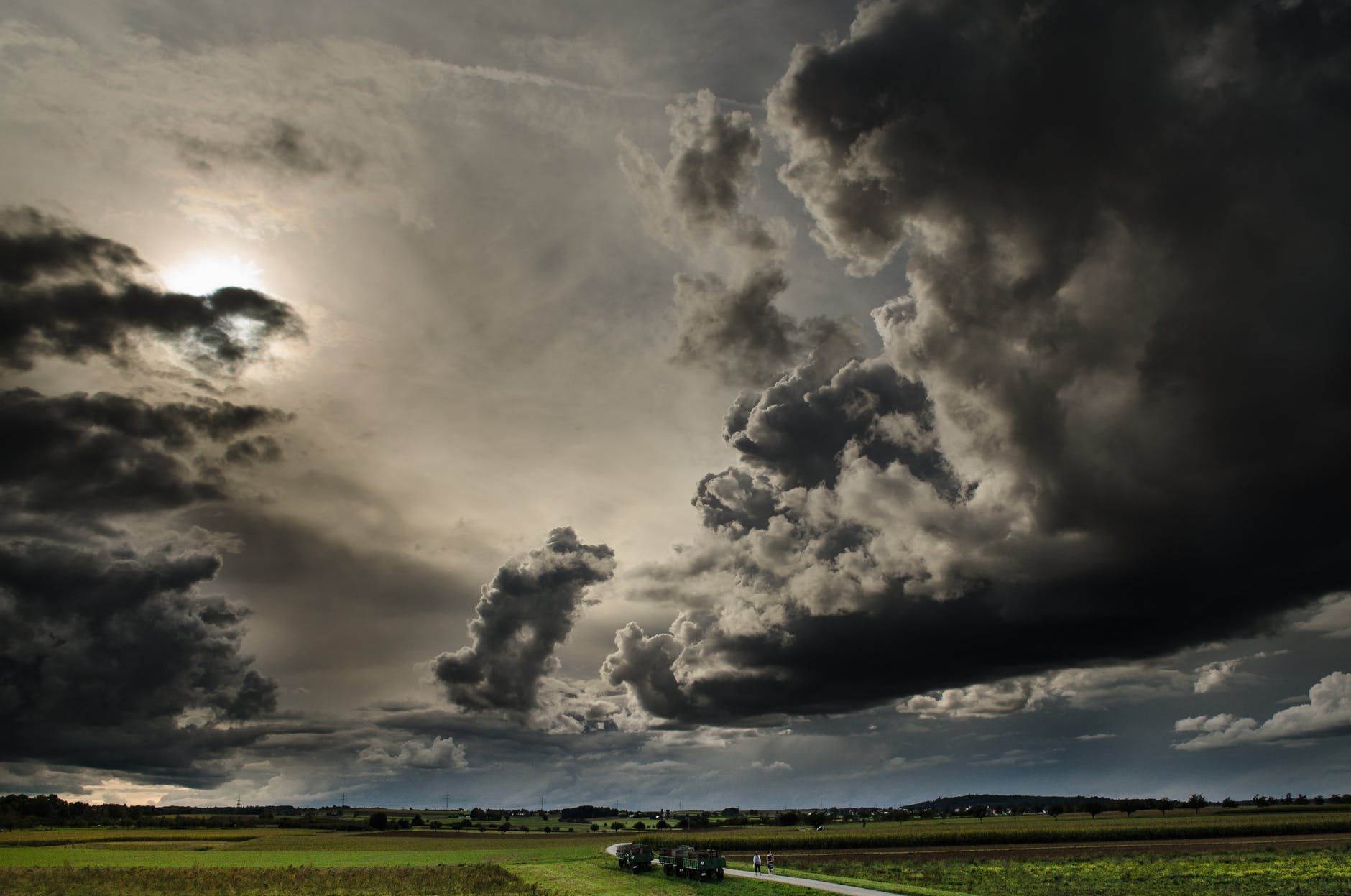
Having grown up in Midwest America, I’ve seen my share of large thunderheads (massive cumulus clouds which form just before a storm), thunderstorms replete with bright lightning and noise so awesome it shakes the farmhouse, and tornados with such force that they rip the roof off a barn as if it were a Lego building.

And God is bigger than that – stronger, louder, and brighter.

The appropriate response to such a God is to make music for the one who strides the ancient skies in a heavenly chariot yet stoops to listen and care about puny humans.

The reasonable response to such a God is to listen to the divine voice thundering in the world and submit to the sound which seems like it might split the heavens open.

To gain a mere glimpse of God’s strength and power will inevitably result in a response of giving up our all to the Lord of the universe, everything we have, and all that we are.

To know, even a tiny smidgeon, of such a God will bring our own loud shouts of proclaiming God’s goodness, grace, and generosity to anyone who will listen to us.

To glimpse what the psalmist sees will consume us with awe, as we intuitively connect with the glory which is constantly streaming from heaven.

God shares divine strength with people. God doesn’t have to do that. The Lord has no obligation to do so. Yet, it happens, despite our fickle praise and inconsistent devotion.

So, let’s give our highest praise to the God of the psalms. Let’s imbibe of God’s thunderous presence among us.

Then, we will likely be happier than a gopher in soft dirt; or a butcher’s dog; or a unicorn eating cake on a rainbow.

Eternal Trinity – blessed Father, Son, and Spirit – the awesome God whom I serve: The more I enter you, the more I discover, and the more I discover, the more I seek you. A massive thunderhead is but a small cloud next to you, the Godhead, the incredible Three-in-One.

Through you, almighty Lord, I shall come to know myself and my world. And that knowledge is a mighty love for humanity which spans longer and higher than the universe itself. May the love, unity, harmony, community, goodness, and power which is always present within yourself, mighty God, be present with me, your servant.

For just a molecule of You is enough to power me for eternity. Amen.

*Above photo by Moritz Bu00f6ing on Pexels.com

Psalm 130 – Believe, Hope, and Love

I cry out to you from the depths, Lord—

my Lord, listen to my voice!
    Let your ears pay close attention to my request for mercy!
If you kept track of sins, Lord—
    my Lord, who would stand a chance?
But forgiveness is with you—
    that’s why you are honored.

I hope, Lord.
My whole being hopes,
    and I wait for God’s promise.
My whole being waits for my Lord—
    more than the night watch waits for morning;
    yes, more than the night watch waits for morning!

Israel, wait for the Lord!
    Because faithful love is with the Lord;
    because great redemption is with our God!
He is the one who will redeem Israel
    from all its sin.
(Common English Bible)

Throughout church history, the book of Psalms has been used and understood as the Church’s prayer book.  Indeed, the psalms are much more than a collection of beautiful poems, words of assurance, and songs of praise – they are designed and meant to have regular and ongoing use as prayers. And I’m not just talking about the psalms being somebody else’s prayers; they are my prayers and your prayers. 

There are times when words fail us – where we find ourselves between a rock and a hard place and want to pray. Our stress and/or anxiety is so high, we can neither think straight, nor form anything coherent with our mouths. It’s in such times that the psalms present themselves to us as the path forward. 

What’s more, psalms are meant to be spoken out loud and more than once. And I’m not talking about saying them with a quiet mumble or a flat monotone.  No! These precious prayers of Holy Scripture are meant to be declared with full voice and a large amount of flavor!  They are to repeatedly roll off our lips with all the emotional and spiritual gusto which resides within us!  Tears and yelling are both appropriate and encouraged. 

For we do not possess a mere heady faith of thoughts and ideas; we also possess a faith that is robustly heartfelt, and dwells down deep in the gut where our bowels of compassion have their abode. 

Even with a cursory reading of today’s psalm, we can easily observe there’s more going on here than beliefs of faith, hope, and love. 

The psalmist is expressive, clinging to faith with a patient longing for God to make good on divine promises. It is chocked full of emotion, a prayer coming from the depths of the gut. The whole being is involved, and rightly so, because our faith affects the entirety of a person and everyone in the community of the redeemed.

If this psalm resonates with you in any way, let your proclamation of it be with the expanse of feeling inside you. After all, as people created in the image of God, we share God’s own deep sense of love – and love is genuinely love when it is outwardly expressed with a sacred combination of words, actions, and feelings.

Waiting, watching, hoping. We as humans do a lot of that. While we anticipate God’s response, we keep up the praying. We keep reminding God to be God. We encourage others to watch and wait and hope, all the while encouraging ourselves, as well.

Whenever we are stressed, more often than not, we thrash about, like a desperate swimmer in the middle of a lake, just trying to keep his head above water. Yet, the psalm tells us to do the counterintuitive: Don’t do something. Just stay there and relax. Why, in heaven’s name, should I do nothing?

Because the Lord will act.

And that action of God will redeem, renew, refresh, and revitalize. It will be new, like the morning dawn. A fresh day, that will not be like any other day before it.

God does his best saving work in the worst and most impossible of circumstances. We need not fear the overwhelming depths of difficulty and trouble. We can trust the Lord.

Perhaps the most awful of deep holes are emotional – deep depression and/or anxiety – a lostness inside oneself because of mental disorder. In such a dark oblivion, and terrible morass, one tries to survive into another hour, not just another day. Like a watchman waiting for the night to dissipate and dawn to break, there is a longing for God.

Deliverance and rescue seem slim. Hopelessness begins to calcify the spirit. Only love can release the hardening situation; the steadfast love of God is a gentle hammer, picking away at the grief.

This is a love which never gives up.

Today’s psalm begins as a desperate cry for help. It ends with an awareness of the need to trust, hope, and wait….

Blessed Jesus, in the comfort of your love, I lay before you the memories that haunt me, the anxieties that perplex me, the despair that frightens me, and my frustration at my inability to think clearly. Help me to discover your forgiveness in my memories and know your peace in my distress. Touch me, O Lord, and fill me with your light and your hope. Amen.

*Above painting of Psalm 130 by Virginia Wieringa

Psalm 9:9-20 – Assertive Anger and Confident Trust

The poor can run to you
    because you are a fortress
    in times of trouble.
Everyone who honors your name
    can trust you,
    because you are faithful
    to all who depend on you.

You rule from Zion, Lord,
    and we sing about you
    to let the nations know
    everything you have done.
You did not forget
    to punish the guilty
    or listen to the cries
    of those in need.

Please have mercy, Lord!
    My enemies mistreat me.
Keep me from the gates
    that lead to death,
    and I will sing about you
    at the gate to Zion.
I will be happy there
    because you rescued me.

Our Lord, the nations fell
    into their own pits,
    and their feet were caught
    in their own traps.
You showed what you are like,
and you made certain
    that justice is done,
    but evil people are trapped
    by their own evil deeds.
The wicked will go down
    to the world of the dead
    to be with those nations
    that forgot about you.

The poor and the homeless
won’t always be forgotten
    and without hope.

Do something, Lord!
    Don’t let the nations win.
    Make them stand trial
    in your court of law.
Make the nations afraid
and let them all discover
    just how weak they are.
(Contemporary English Version)

Everyone gets angry. Every single person on planet earth knows what anger feels like. And, to me, it makes sense that people get angry. After all, God gets angry. As people created in God’s image, we share God’s sense of justice and injustice.

That’s really what anger is: an emotional response to injustice. Whenever we are wronged or treated unfairly – or observe another person or group of people experiencing injustice – it stirs up our anger.

So, anger, in and of itself, is neither good nor bad. It just is. It’s what we do with our anger that gets dicey. A lot of human anger gets expressed in unhealthy ways by either passively stuffing it down into the soul and ignoring it; aggressively lashing out with verbal or physical violence; or passive-aggressively doing indirect jabs at the object of our anger.

The psalmist, however, takes another way of expressing anger. He is assertive, straightforward, and addressed God with his observations and feelings, as well as affirming that the Lord is the One who administers justice with fairness and equity.

When the poor are overlooked or oppressed by the rich, it is unjust. It creates anger, both human and divine. In their misery and hardship, they can flee to God, who is faithful to care for them and treat them with respect and dignity, as people carrying the divine image, like everyone else.

The nations of the earth are not all attentive to the needy. They don’t all serve their citizens and try to do right by them. Unfortunately, many people throughout the world groan under national leadership which is enamored with power and privilege – and forget those who are powerless, unable to lift themselves by their bootstraps.

Because of this reality, the psalmist petitions God. He asks, even insists, that God step in and act as judge and jury. It is an assertive use of anger that goes to the source of true help, to the Lord, who possesses both the will and the ability to overturn injustice and establish a right use of power.

Holy Scripture is consistent in its insistence on paying attention to those outside the halls of power. The prophets directed their message to issues of justice:

Learn to live right. See that justice is done. Defend widows and orphans and help those in need. (Isaiah 1:17, CEV)

Just look at those lawmakers who write evil laws and make life hard for the people. They are not fair to the poor. They take away the rights of the poor and allow people to steal from widows and orphans. (Isaiah 10:1-2, ERV)

He has told you, human one, what is good and what the Lord requires from you: to do justice, embrace faithful love, and walk humbly with your God. (Micah 6:8, CEB)

Do you know what I want? I want justice—oceans of it. I want fairness—rivers of it. That’s what I want. That’s all I want. (Amos 5:24, MSG)

Doing justice is taking up the cause of the powerless, the oppressed, and the needy among us in society. Because God cares, we care. To ignore the poor is to ignore God. To treat them unfairly is to flip the middle finger at God.

The Lord, thankfully, is a strong fortress for the oppressed and a protective force in times of trouble.

God remembers the prayers of the down-and-out.

Sooner, or later, those who are wicked in their dealings through exploitation of the powerless, will know firsthand, they are puny humans, and that God is immensely big.

Today’s psalm is both an angry petition, as well as an affirmation of faith. May it serve as a model for using our anger assertively, ordering our love rightly, and trusting our God confidently.

God almighty, you have given all peoples one common origin. It is your will they be gathered together as one family in yourself. Fill the hearts of humanity with the fire of your love and with the desire to ensure justice for all. By sharing the good you give us, may we ensure equity for all our brothers and sisters throughout the world. May there be an end to division, strife and war. May there be a dawning of a truly human society built on love and peace, through Jesus Christ, our Lord. Amen.

**Above image: The Kveshi Fortress in the nation of Georgia.

Psalm 108 – My Heart Is Unwavering

My heart is unwavering, God.
    I will sing and make music—
    yes, with my whole being!
Wake up, harp and lyre!
    I will wake the dawn itself!
I will give thanks to you, Lord, among all the peoples;
    I will make music to you among the nations,
    because your faithful love is higher than heaven;
    your faithfulness reaches the clouds.
Exalt yourself, God, higher than heaven!
    Let your glory be over all the earth!
    Save me by your power and answer me
    so that the people you love might be rescued.

God has spoken in his sanctuary:
“I will celebrate as I divide up Shechem
    and portion out the Succoth Valley.
Gilead is mine, Manasseh is mine;
    Ephraim is my helmet, Judah is my scepter.
But Moab is my washbowl;
    I’ll throw my shoe at Edom.
    I shout in triumph over Philistia!
I wish someone would bring me to a fortified city!
    I wish someone would lead me to Edom!”

But you have rejected us, God, haven’t you?
    You, God, no longer accompany our armies.
Give us help against the enemy—
    human help is worthless.
With God we will triumph:
    God is the one who will trample our adversaries.
(Common English Bible)

“Our faith is not meant to get us out of a hard place or change our painful condition. Rather, it is meant to reveal God’s faithfulness to us in the midst of our dire situation.”

David Wilkerson

Little did my wife and I know when we were married decades ago that our vows to one another would be put to the test time and time again over the years: a commitment to be with each for better or for worse; to hang in there whether rich or poor; to persevere in sickness or in health till the very end. Through all the ups and the downs, I am tremendously thankful that we are close and together. We have truly taken the stance that, no matter the circumstance, we will face it together.

Just as in a marriage, where there are times that stretch the relationship and the couple must make choices for the benefit of each other, so the follower of God will face difficulty as a believer and must decide to remain faithful. 

The psalmist decided on a steadfast heart toward, a committed and faithful stance which would stick to the Lord, no matter the circumstances. The psalmist also recognized God is forever faithful, that steadfast love would continually mark the relationship toward humanity.

If we lived by the whims of our feelings, many of us would never get out of bed in the morning, and not even bother to put on pants when we do. Yet, many believers take such an approach in their relationship with God: praying whenever it might fancy them to do so; and praising the Lord only when things are going their way. 

Yet, the psalmist chose to give thanks because of who God is. David, the psalmist, made the daily decision of being faithful by choosing to look at the faithfulness of God. The truth is that God is with us, and the Lord longs for us to recognize and enjoy it because that is the nature of a committed relationship.

It makes sense to tether oneself wholly and completely to a God who is consistently faithful and loving. The vicissitudes of life are unrelenting, having us ride waves of ups and downs. No one living in 2019 saw a pandemic coming in 2020 with all the changes associated with it. And who knows what the rest of this year will be like? Or next year?

There are a great many things we do not know. Yet, there are two unchangeable truths for which we can anchor our souls: God loves us; and God is with us. When all else is going to hell around us, the rock of the Lord’s presence and mercy is unfazed and endures.

So, in those times, when we feel like giving up or giving in, we can come back to a psalm like today’s, and choose to give thanks, sing, pray, and affirm our vows to God.

Remember your baptism. Remember to whom you belong. Remember the steadfast love of God and allow such love to shape your life – even when every circumstance around you is off and awry. Our relationship with the Lord will be tested time and time again, yet God is steadfast and will not let go.

For you Jesus Christ came into the world; for you he died and for you he conquered death. All this he did for you. We love because God first loved us.

Gracious God, bless and strengthen your people daily with the gift of your Holy Spirit; unfold to us the riches of your love, deepen our faith, keep us from the power of evil and enable us to live a holy and blameless life until your kingdom comes. Amen.