Psalm 28 – Prayer, Praise, and Possibility

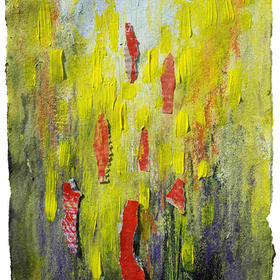
Psalm 28 by Dutch artist Wim van de Wege

I pray to you, O Lord, my rock.
    Do not turn a deaf ear to me.
For if you are silent,
    I might as well give up and die.
Listen to my prayer for mercy
    as I cry out to you for help,
    as I lift my hands toward your holy sanctuary.

Do not drag me away with the wicked—
    with those who do evil—
those who speak friendly words to their neighbors
    while planning evil in their hearts.
Give them the punishment they so richly deserve!
    Measure it out in proportion to their wickedness.
Pay them back for all their evil deeds!
    Give them a taste of what they have done to others.
They care nothing for what the Lord has done
    or for what his hands have made.
So he will tear them down,
    and they will never be rebuilt!

Praise the Lord!
    For he has heard my cry for mercy.
The Lord is my strength and shield.
    I trust him with all my heart.
He helps me, and my heart is filled with joy.
    I burst out in songs of thanksgiving.

The Lord gives his people strength.
    He is a safe fortress for his anointed king.
Save your people!
    Bless Israel, your special possession.
Lead them like a shepherd,
    and carry them in your arms forever. (New Living Translation)

The biblical character David, in frustration and agony, cried out for help, for God to hear his prayers. And, when his prayer was heard, David gave exuberant praise to the Lord for listening to him.

We are not told specifically of how that prayer was answered and what happened between the request and the response. It seems the juicy details are left out on purpose, so that maybe we would not get lost in the retribution but stick with the fact that there was a desperate need and the Lord stepped in and did something about it.

As I pondered this psalm and its lack of life-detail, I wondered about David’s situation:

Could it be that David gave God praise just for being heard by him? 

Was David cured in some way, or was he healed from the need to be healed? 

Was there even any actual deliverance that occurred? 

Did David come to praise God despite a lack of deliverance? 

Was David’s joy in his relationship with God conditional, or unconditional?

William Shakespeare’s Hamlet (c.1601 C.E.) put the question this way: “To be, or not to be, that is the question.” Hamlet’s soliloquy went on to say:

“Whether ’tis nobler in the mind to suffer
The slings and arrows of outrageous fortune,
Or to take arms against a sea of troubles,
And by opposing end them? To die: to sleep;
No more; and by a sleep to say we end
The heartache and the thousand natural shocks
That flesh is heir to, ’tis a consummation
Devoutly to be wish’d. To die, to sleep;
To sleep: perchance, to dream: ay, there’s the rub;
For in that sleep of death what dreams may come
When we have shuffled off this mortal coil,
Must give us pause: there’s the respect
That makes calamity of so long life;
For who would bear the whips and scorns of time,
The oppressor’s wrong, the proud man’s contumely,
The pangs of despised love, the law’s delay,
The insolence of office and the spurns
That patient merit of the unworthy takes,
When he himself might his quietus make
With a bare bodkin (knitting needle)?”

Hamlet, much like David of old, was miserable and burdened with a profound lack of power to change his circumstances. So, he reflects on life and death in a morbid and melancholy way. It’s not that Hamlet was contemplating suicide as much as he meditated on what life truly is and finding some meaning within it. Unlike David, Hamlet cannot find the courage to deal with his frustration and feels stymied with fear of the unknown.

If we are blatantly honest with ourselves, we must admit that far too often we have a particular outcome in mind that we want or expect God to do.  Our hopes become tethered to God doing something extremely specific so that, if it does not come to pass (or does not come quickly!) we become discouraged and disillusioned. Like Hamlet, we become lost in the shadows of our thinking and ponder some sort of escape.

So, here is another set of questions I am asking myself: 

If my adverse circumstances do not change, can I praise God anyway? 

Can I, like David, take joy in simply being heard? 

Can I find gratitude in all situations? 

Do I only express thanks and praise to God when things are going my way? 

Am I open to whatever God wants to do in my life, even if it is not what I would choose? 

Do I feel that I am above having to put up with the wickedness of this world? 

Am I expecting heaven on earth, or am I willing to suffer as Jesus did? 

I honestly believe the answers to those questions will determine the trajectory of our Christian experience. For the identity and meaning of all persons is found in the divine.

I praise you, O God, in the good and the bad, the easy and the difficult, the failures and the victories.  You are Lord over all things.  You are my strength and shield in every circumstance.  When I am weak, I am strong. I can do all things through Christ who strengthens me. Amen.

Psalm 34:1-8 – Deliverance from Trouble

I will praise the Lord at all times.
    I will constantly speak his praises.
I will boast only in the Lord;
    let all who are helpless take heart.
Come, let us tell of the Lord’s greatness;
    let us exalt his name together.

I prayed to the Lord, and he answered me.
    He freed me from all my fears.
Those who look to him for help will be radiant with joy;
    no shadow of shame will darken their faces.
In my desperation I prayed, and the Lord listened;
    he saved me from all my troubles.
For the angel of the Lord is a guard;
    he surrounds and defends all who fear him.

Taste and see that the Lord is good.
    Oh, the joys of those who take refuge in him! (New Living Translation)

Gratitude and praise are more than a nice thing. They have the power to spiritually form us, emotionally buoy us, and mentally change our brain chemistry for the better – not to mention connecting us with divine help.

Today’s psalm is a song of thanksgiving. The psalmist intentionally recalls being delivered by G-d from trouble and hardship. And he invites us to experience G-d’s salvation, as well.

Desperate people who are between a rock and a hard place need divine help. The Lord is able to intervene in both small and large ways. David, the psalmist, crafted this psalm in a time when he had no resources available to him. He was alone with nothing but the Lord. And that was plenty. Even a little bit of G-d is enough to thoroughly rescue.

Take note of the verbs used to describe G-d’s activity in helping David: “answered” “freed” “listened” “saved” “surrounds” and “defends.” These multiple actions of the Lord were all activated through David’s initiative with one single verb of his own: “prayed.”

It is one thing to pray because of expectation or routine. It is altogether a different thing to pray out of desperation from the depths of your gut.

So, when David encourages us to taste and see that the Lord is good and to take refuge in G-d, he is calling us to pray – to know something of God’s promises, presence, provision, and power and to actively ask, seek, and knock for help.

David, the psalmist, really wants us to experience prayer. He desires us to cry out on behalf of ourselves, as well as lifting up others to G-d. Yet, truth be told, helping those with afflictions and sickness through prayer is something we don’t always handle well.

We might too quickly and reflexively dispense our homespun opinions and ideas, as if we are experts on another’s situation, rather than hurrying to G-d in prayer. In our pride, we believe that if folks will just follow our recommendations that all will be well.

And then there are the silly and even hurtful things we say to others in their distress, rather than interceding for them before G-d. We may toss out a flippant and simplistic statement like, “God will heal — just pray.” Then, we leave them to do that alone. And sometimes, even after prayer, medicine, and doing the right thing, change doesn’t happen, and nobody knows quite what to do.

We can also be guilty of reducing trouble to only the physical when the trouble might be emotional, mental, relational, or any combination thereof. These are the hurts and troubles plaguing us all, because we live in a broken world where everyone needs redemption.

Many times, we have no problem believing G-d will work on behalf of others. We trust the Lord for deliverance and the miraculous for them. Yet, when it comes to us, we harbor serious doubts of whether G-d will rescue us, or even wants to.

There are a lot of things we just don’t know. However, what we do know is that the God of David promises help in Psalm 34, and to redeem lives from desperate situations. And this is why David could boldly invite us to tell of the Lord’s greatness, and call us to praise G-d’s name together.

May the risen and ascended Christ, mightier than the hordes of hell, more glorious than the heavenly hosts, be with you in all your ways. 

May the cross of the Son of God protect you by day and by night, at morning and at evening, at all times and in all places. 

May Christ Jesus guard and deliver you from the snares of the devil, from the assaults of evil spirits, from the wrath of the wicked, from all base passions and from the fear of the known and unknown.

May the blessing of God almighty – Father, Son, and Spirit – be upon you and remain with you always. Amen. 

Psalm 104:1-9, 24, 35b – God Is Bigger Than Our Fears

Psalm 104:3 by J. Michael Orr

I praise you, Lord God,
    with all my heart.
You are glorious and majestic,
dressed in royal robes
    and surrounded by light.
You spread out the sky
    like a tent,
    and you built your home
    over the mighty ocean.
The clouds are your chariot
    with the wind as its wings.
The winds are your messengers,
    and flames of fire
    are your servants.

You built foundations
for the earth,
    and it
    will never be shaken.
You covered the earth
with the ocean
    that rose
    above the mountains.
Then your voice thundered!
And the water flowed
    down the mountains
    and through the valleys
    to the place you prepared.
Now you have set boundaries,
    so that the water will never
    flood the earth again….

Our Lord, by your wisdom
    you made so many things;
    the whole earth is covered
    with your living creatures….
With all my heart
I praise you, Lord!
    I praise you! (Contemporary English Version)

The world is a gift from God.

When God created the heavens and the earth, Adam and Eve, the first humans, were the apex of God’s creative activity. Their charge, as people created in the image of God, was to steward the earth. And that mandate is still in effect. We are to take good care of this creation we inhabit.

However, due to the fall of humanity, there has always been a bent toward exploiting the earth for our own purposes, rather than carefully maintaining it. Wherever we see abuse of both land and lives, behind it is the fear of not having enough and not being safe enough. Our anxiety gets the best of us.

It seems to me that creation care must begin with ourselves. The lack of self-care inevitably works itself out by neither caring for other creatures nor creation. We need to acknowledge our fears and address them. Then, place those fears in the shining light of our Creator’s glory.

My kids grew up in the ‘90s watching Veggie Tales. The tunes were catchy and full of some solid truth about God. One of their favorites was “God is Bigger.” Here is the chorus:

God is bigger than the boogie man.
He’s bigger than Godzilla or the monsters on TV.
Oh, God is bigger than the boogie man,
And he’s watching out for you and me.

Today’s Psalm expresses the bigness of God – clothed with splendor and majesty, covered with light as with a garment, stretching out the heavens like a tent. Indeed, God is big – bigger than anything and everything. The Lord is sovereign and supreme over all creation, and always does what is right, just, and fair. God sees all and watches over the earth.

Sometimes we get lost in our situations, problems, and screw-ups. We get stuck in our anxiety and fears. We view them as larger than life and can become so overwhelmed and burdened with our inabilities, weaknesses, and lack of handling things well, that we lose sight of the reality that God is bigger than it all. 

Instead of fear and anxiety ruling the day, we can allow sound theology to purge the worry and trouble from our minds and hearts. Using today’s psalm to pray and praise God is a foundational way of beginning to put into perspective the issues and problems of our lives.

Confident living, and mitigating our fears, cannot simply be mentally or emotionally stirred up. Confidence needs a foundation, a basis in truth and reality. The believer’s assurance comes from the firm ground of God’s character and competence. Trust is born when we have a vision of a Divine Being, large and filling the universe with grace and justice.

Tending to our physical, mental, emotional, and spiritual health begins with a sense of divine largeness. Initiative and assertiveness can be freely exercised when we are secure and non-anxious because of God’s immense presence.

Caring for creation, and enjoying our great big world, is the logical action of being peacefully connected to the Creator of it all. We are all bound together as creatures and creation. We’re all made up of the same stuff.

Everything in the universe, including creatures and creation, share 97% percent of the same kind of atoms.

The crucial elements for life on Earth – carbon, hydrogen, nitrogen, oxygen, phosphorus and sulfur – are all found in abundance across the stars of our galaxy.

Our differences make us unique. Our similarities connect us. And we are inextricably connected to every atom in this universe. Just as we carry the DNA of our ancestors within our biological bodies, so we are all holding the same elements of the physical creation.

The ultimate connection, from a Christian perspective, is that Jesus holds it all together – thus making him the supreme Connector.

The Son is the image of the invisible God,
        the one who is first over all creation,

Because all things were created by him:
        both in the heavens and on the earth,
        the things that are visible and the things that are invisible.
            Whether they are thrones or powers,
            or rulers or authorities,
        all things were created through him and for him.

He existed before all things,
        and all things are held together in him.

He is the head of the body, the church,
who is the beginning,
        the one who is firstborn from among the dead
        so that he might occupy the first place in everything. (Colossians 1:15-18, CEB)

Christ is our connection to all things, reconciling us to our fellow creatures, creation, and the Creator. All the bigness of God lives in Jesus. In the face of the Lord, all fears melt away.

Almighty God, you are mighty big! My problems are really small as I glimpse your sheer immensity. Lord God, you are very great! I bless your holy name. Praise the Lord! Hallelujah, Amen.

Psalm 111 – Praise

painting by P.J. Bruzzi

Shout praises to the Lord!
    With all my heart
I will thank the Lord
    when his people meet.
The Lord has done
    many wonderful things!
Everyone who is pleased
with God’s marvelous deeds
    will keep them in mind.
Everything the Lord does
    is glorious and majestic,
    and his power to bring justice
    will never end.

The Lord God is famous
for his wonderful deeds,
    and he is kind and merciful.
He gives food to his worshipers
    and always keeps his agreement
    with them.
He has shown his mighty power
    to his people
    and has given them the lands
    of other nations.

God is always honest and fair,
    and his laws can be trusted.
    They are true and right
    and will stand forever.
God rescued his people,
    and he will never break
his agreement with them.
    He is fearsome and holy.

Respect and obey the Lord!
This is the first step
    to wisdom and good sense.
    God will always be respected. (Contemporary English Version)

Sometimes we forget. Difficult challenges, heavy stress, or daunting responsibilities might become the focus of our lives to such a degree that we lose sight of the big picture. Today’s psalm helps us to back up the truck and take a sweeping panoramic view. The backdrop to all those concerns we presently experience is a Divine Being who is unfazed by any trouble. In other words, God’s got this.

The basis for this settled faith is a realization of who God is and what God has done.

Whereas change and loss is a reality all people must navigate, it is a comfort to know there are some things which never change. God is the One who is the same yesterday, today, and forever. God’s character is always right, just, and good. And God makes good on all promises.

Throughout the psalter, there are admonitions to praise the Lord. I personally do not believe the reason for this is because God requires adoration, like some self-centered narcissist. No, I think it has to do with God knowing we have a need to praise.

Our brains are complex organs. There is a lot we don’t know about it. Yet, what we now know is that things like gratitude, adoration, beauty, affirmation, and praise changes our brain chemistry in a healthy way.

Yes, praising the Lord perfectly syncs with our brains in such a way as to cause mental health.

People’s lives are improved when we are attentive to God’s law, God’s promises, and God’s works. Attention to these will surely result in praise. Everything God has created is good. All creation bears witness to the beauty and majesty of its Creator.

Believers throughout the millennia are a great cloud of witnesses, testifying to the veracity of God’s benevolent and gracious deeds. And together with them, we anticipate with confident faith the culmination of God’s promises when Jesus returns. This is basic Christian theology – and it is theology which is robustly sustains us through any type of trouble.

People need to delight in what is good, right, just, and beautiful.

Our brains are designed for it. The acknowledgment of the good is a sacred conduit which links us to the Designer of all that is good. Enjoyment of food and drink, fellowship with friends, participation in family life, and worshiping together with believers who share our most cherished spiritual values, is a gift from a benevolent God. It is worthy of offering praise.

God feeds us in many ways – with both physical and spiritual food. Pausing for gratefulness and thanksgiving is an appropriate and mentally healthy way of responding to the gift of nourishment. And acknowledging that all God’s commands and laws are trustworthy, through lifting prayers of gratitude for such a rich bounty of spiritual food, moves us into a healthy groove of wellness.

All of this healthy living is the way of wisdom. Attention to God and God’s Word is the starting place for a wise way of being in the world. The biblical psalms are much like a tutor which teaches us the best paths to walk in our daily life.

When we take the narrow road of righteousness, we discover the gifts of understanding informed by wisdom, self-control established through sage counsel, and knowledge guided by love.

The activity which bookends and binds such gifts together is praise to the Lord. Praise is what opens us up to the possibilities of life as it is meant to be lived. To press the transformation and enjoyment even deeper, believers shout their praise with raucous noise.

For true spirituality is not always staid and silent. It is also boisterous and loud.

Open my lips, O Lord, and my mouth shall proclaim your praise. Let the words of my mouth and the meditation of my heart be acceptable in your sight, O Lord, my strength and my Redeemer. Glory be to the Father, to the Son, and to the Holy Spirit, as it was in the beginning, it is now, and ever shall be, forever and ever. Amen.