
For the Life of the World (John 6:1-21)

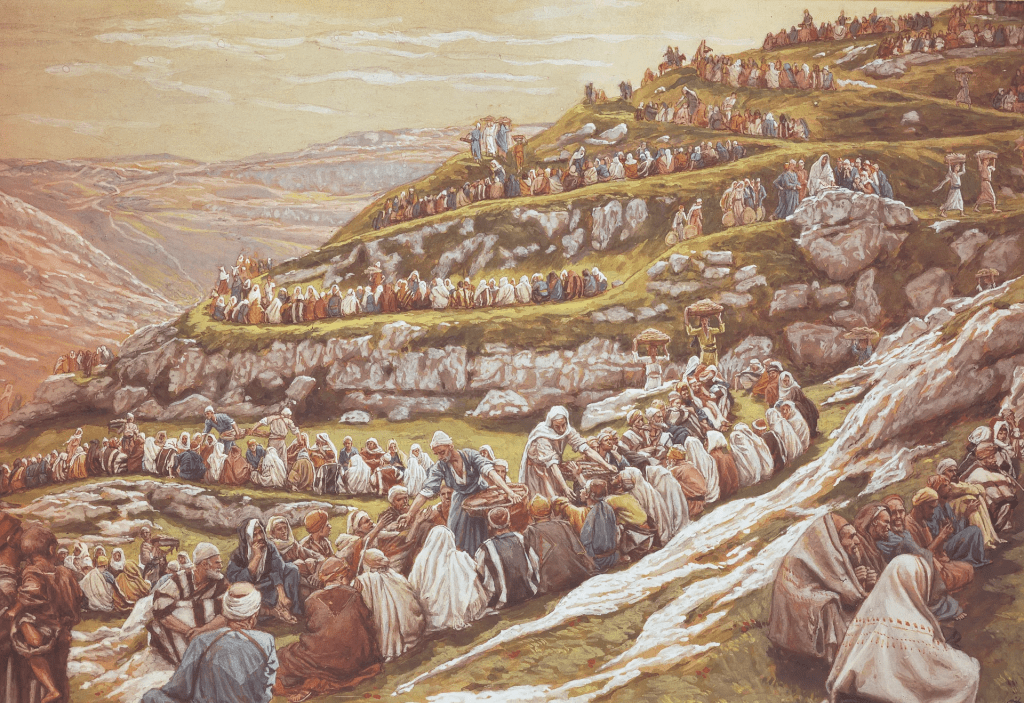
The Miracle of the Loaves and Fishes, by James Tissot, 1886

After this Jesus went to the other side of the Sea of Galilee, also called the Sea of Tiberias. A large crowd kept following him because they saw the signs that he was doing for the sick. Jesus went up the mountain and sat down there with his disciples. 

Now the Passover, the festival of the Jews, was near. When he looked up and saw a large crowd coming toward him, Jesus said to Philip, “Where are we to buy bread for these people to eat?” He said this to test him, for he himself knew what he was going to do. 

Philip answered him, “Two hundred denarii would not buy enough bread for each of them to get a little.” One of his disciples, Andrew, Simon Peter’s brother, said to him, “There is a boy here who has five barley loaves and two fish. But what are they among so many people?” 

Jesus said, “Make the people sit down.” Now there was a great deal of grass in the place, so they sat down, about five thousand in all. Then Jesus took the loaves, and when he had given thanks he distributed them to those who were seated; so also the fish, as much as they wanted. 

When they were satisfied, he told his disciples, “Gather up the fragments left over, so that nothing may be lost.” So they gathered them up, and from the fragments of the five barley loaves, left by those who had eaten, they filled twelve baskets. When the people saw the sign that he had done, they began to say, “This is indeed the prophet who is to come into the world.”

When Jesus realized that they were about to come and take him by force to make him king, he withdrew again to the mountain by himself.

When evening came, his disciples went down to the sea, got into a boat, and started across the sea to Capernaum. It was now dark, and Jesus had not yet come to them. The sea became rough because a strong wind was blowing. When they had rowed about three or four miles, they saw Jesus walking on the sea and coming near the boat, and they were terrified. But he said to them, “It is I; do not be afraid.” Then they wanted to take him into the boat, and immediately the boat reached the land toward which they were going. (New Revised Standard Version)

Christ Walking on the Waters, by Julius Sergius Von Klever, c.1880

The Deliverers Moses and Jesus

The Apostle John intended us to see the link between Moses and Jesus. God used Moses to bring deliverance of the people from slavery through a miracle at the Red Sea. The Lord also used him for a divine provision of manna in the wilderness.

And the Lord Jesus brought about a deliverance of the disciples from anxiety through a miracle on the Sea of Galilee. Christ also brought a divine provision of food in the middle of nowhere for thousands of people.

The miraculous displays by Jesus happened at the time of Passover, the very time that Jews celebrate the deliverance from Egypt. Just as divine power was exerted at the time of Moses in the original Passover, so also divine power likewise showed itself with Jesus in the supply of food and control of the sea.

What’s more, today Christians everywhere around the world remember God’s saving events with the elements of bread and cup, recalling divine deliverance and provision, and finding relief from their fears and anxieties.

A Miraculous Provision and Distribution of Food

It’s no coincidence that Jesus is pictured as sitting on a mountain – reminiscent of Moses on a mountain receiving the divine law and wisdom. The gathering of people around Christ was so great (thousands of them) and the need for food equally as great, that Jesus questioned his disciples concerning resources for such a large crowd.

Christ, of course, could have circumvented his disciples and simply provided the needed foodstuffs without them. Yet, he didn’t, on purpose. Always the rabbi and teacher, Jesus intended to give the disciples a lesson they wouldn’t forget.

After ascertaining that the only food available was a boy’s five barley loaves and two dried fish, Jesus knew that this was plenty, in order to feed up to 5,000 people. It was enough, because Jesus is enough. Only a small amount is needed to fill the bellies of thousands.

Sacramental Living, by Charissa Jaeger-Sanders

And, what is more, for those with the faith to see it, a little communion wafer and a small swallow from a cup is more than enough to satisfy and satiate the hungriest of faithful and penitent people.

Not only did the people eat as much as they needed and wanted, but there was also so much remaining food that the twelve disciples collected twelve baskets of bread. They could keep on ministering, providing, and distributing for people because little is much when God is in it. Long after Christ’s death and resurrection, his followers continued to give with the divine largess from Jesus.

Walking on Water

It had been a full day of teaching and miraculous ministry, in the full light for all to see. Christ’s power, however, is also operative at night. The darkness is not able to subdue continued miracles from Jesus.

For the Apostle John’s writings, darkness is almost always a theological statement, denoting that there are dark forces operative on this earth. And those powers definitely did not like Christ’s effective day of ministry.

The actual physical storm symbolized the chaotic and angry response of the sinister elements in the world. But despite the terrible conditions, Jesus calmly walked on the sea as the new Moses who takes charge of the water.

The disciples abject fear turned on a dime into exuberant joy, as they realized it was indeed Jesus who entered the boat. In addition, they experienced an immediate place of safe harbor.

Christ was standing in the divine tradition of bringing people from stormy circumstances and evil situations to the safe haven of God’s presence.

Jesus saves people from their fears and anxieties, their travails and ills, and their guilt and shame. Christ also provides everything we need, both material and immaterial. And he does it for the life of the world, for everyone who comes by faith.

Gracious Lord, you are the Sustainer of the hungry. Like a mother, you long to feed your children until each is satisfied. Turn our eyes to you alone, so that, aware of our own deepest longings, we will reach out with Christ to feed others with the miracle of your love. Amen.

Before We Chose God, God Chose Us

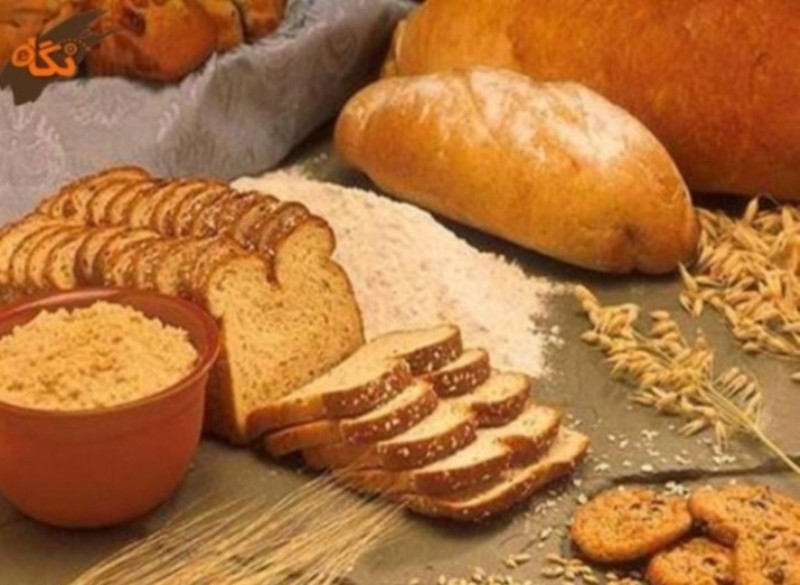
living bread

“Just as the living Father sent me, and I live because of the Father, so whoever eats me will live because of me.  This is the bread that came down from heaven, not like that which your ancestors ate, and they died.  But the one who eats this bread will live forever….  For this reason, I have told you that no one can come to me unless it is granted by the Father.” –Jesus (John 6:57-59, 65, NRSV)

It would be weird if someone insisted that they chose to be born.  I think most of us would respond something like, “Um, wait here just a moment,” then go and call the local psych ward.  That’s because we have no problem understanding that well before any of us were born, the love of two people conceived us.  Our choices within our family of origin are ours to own.  Yet, the initial choice to be a person on this planet was not ours to make.  We, rather obviously, are delusional to think otherwise.

The same is true on the spiritual plane.  Just as life is a gift given to us, so to be born again and have eternal life is a gracious grant given to us by God.  Yes, if we are Christians somewhere along life’s journey we chose Jesus.  Yet, long before our own individual choices were made, before the foundation of the world, God himself conceived of us and decided to give us the gift of faith to believe.

Before we get in a huff about the perceived lack of control on our part, stop and consider what a crazy hot mess of an apocalypse there would be if you or I were in charge.  Whatever issues people might have with God, having someone else in the driver’s seat is a bit like putting Homer Simpson as the sentinel guarding the donuts.  Probably not the best of ideas.

I would rather stick with Jesus, even when his words seem edgy and scandalous.  After all, telling folks they need to “eat me” could really go sideways in a hurry.  It’s no wonder that the early church often got accused of practicing cannibalism at the Lord’s Table.

God in Christ chose us so that we could enjoy an incredible restored relationship with our Creator.  Jesus, the Jew that he was, often spoke with deep layers of meaning.  What on the surface might seem super-strange is meant to convey things in a much richer and fuller way.  If it confuses some people, then maybe we need to sit with Christ’s words for a bit before simplifying them into some mish-mash of blither that ends up having no real meaning at all.

Beyond the sheer literal description of eating the body of Christ and drinking his blood, and merely flattening it out to mean Christian communion with wine and wafers, it could just be that Jesus wanted us to grab hold the grace of discovering the following five realities of his merciful passion up close and personal.

  1. Participation

To ingest Jesus is to participate in him.  It is to have a close, intimate connection and union with him.  Jesus identifies with his people so closely that it is as if we have absorbed him into our very being as much as any food nutrients.

I once lived near an old fence line.  The fence was long gone but one lone fence post remained.  A tree had grown up alongside and then around the post.  The post remained because the tree assimilated and engulfed it.  The only way to remove the fence post would be to cut down the tree – they were that much a part of each other.

We are in union with the Lord Jesus.  No one is snatching us out of his clutches.  We participate in his life.  We live because he lives.  We make choices because he first chose us.

  1. Provision

When we eat, what we eat, how we eat, and whom we eat with are anything but ancillary issues to the ancient Near Eastern mind and practice.  Food is a gift, a gracious gift given to us by a merciful Father who has our best interests at mind.  At the very heart of God is a hospitable bent that invites the misfit person, the misunderstood, the misanthrope, the miscellaneous, and any other “mis-sed” person into his wonderful provision of food.

Eating meals for most people around the world isn’t just about food; it’s about offering the acceptance of hospitality and communicating encouragement and recognition through lively conversation with the dignity of listening to another.  We severely truncate the power of meals when food is just gobbled quickly down alone by ourselves to satiate our growling stomachs.

Christ’s words about himself being the living bread that comes from heaven is chocked full of meaning.  On the heels of just having fed the five-thousand with bread, Jesus not only connects himself with the manna God gave the Israelites in the desert, but also lets his followers know that he is the only provision that will truly satisfy the most intense hunger.  “Blessed are those that hunger and thirst for righteousness,” he explained in his greatest Sermon, “for they shall be filled” (Matthew 5:6, NIV).

Through the provision of food, God invites us into his life.  What’s more, we are ushered into the realm of those who are recognized, seen, and accepted – regardless of our glaring warts, quirky idiosyncratic ways, and shadowy sins.  That’s because when God creates, he provides.  And when he provides, he graciously gives his blessing.

  1. Protection

Maybe it goes without saying that, by now, God will protect those whom he engrafts into his very life.  Yet, it still needs to be said with deliberate unction: God protects his own.

Getting back to the food thing, God’s meal-deal includes a generous portion of protection.  To come under a person’s roof to enjoy a meal together is to come under the owner of that home’s protection.  God never intended to save us, feed us, and provide for us without giving us everything we need for life and godliness in this present evil age (2 Peter 1:3).

All the implements we need to both defend ourselves and move forward with offense are graciously given to us.  The helmet of salvation, the breastplate of righteousness, the belt of truth, the shield of faith, the shoes of peace, and the sword wielding Word of God are all for our protection.  We only need to put them on, pick them up, and use them (Ephesians 6:10-20).

  1. Profession

The nub and the rub of Christ’s discussion about being living bread is that people need to eat him, that is, him only.  In other words, you only get to God through Jesus.  Period.  No exceptions.  Understandably, this was a hard teaching.  It was so hard that, when his followers grasped what in the heck he was saying, a big chunk of them left.  They didn’t sign up for this kind of exclusive rhetoric and crap about only being one real bread.

It has always been the scandal of Christians throughout the ages to insist that Jesus is the way, the truth, and the life, and that no one can come to the Father except through him (John 14:6).  But there it is.  And no amount of watering it down makes it go away.

I love and adore a variety of people.  I have many friends from different faith traditions and belief structures.  I would die for every one of them.  I would come to their side at any time they call me.  And I believe they need Jesus.  I believe everyone needs Jesus.  I understand that not everyone wants Jesus, or acknowledges him, or believes he is who he claims to be.  Nevertheless, to try and mitigate or diffuse or minimize Christ’s very hard words is doing a disservice and an injustice to what Jesus was truly saying and claiming.

To profess Jesus as Lord and Savior is a gift that is being received from a gracious and merciful gift-giver, who is God.

  1. Perpetual

The simple observation about eating is that you don’t just eat once, never to eat again.  Nope, we continually eat every single day, most of us doing it multiple times in the day.  We in the West have refrigerators full of food, some of which ends up getting moldy and no good.  Maybe we stockpile food because we don’t connect it with Jesus.  If God is the One who truly gives the grace of a decent meal, perhaps we would feel less prone to buy food and eat it like it’s going out of style.

We are to eat Jesus.  Not once.  Not twice.  But continually.  Every day.  Christ is the perpetual feast.  We are to come to him day after day, receiving his gift of sustenance for us in every sense of the concept.

We can choose to come to Jesus because he has first given himself to us.  Before we chose God, God chose us by giving us deliverance from our misguided ways through the merciful work of Jesus.