Protest As Faith

But when they opposed Paul and became abusive, he shook out his clothes in protest and said to them, “Your blood be on your own heads!” (Acts 18:6)

“Your name will no longer be Jacob, but Israel, because you have struggled with God and with humans and have overcome.” (Genesis 32:28)

Deliver us from the evil one. (Matthew 6:13, NIV)

If it looks like terrorism, talks like terrorism, and acts like terrorism, it’s probably terrorism.

I have become exasperated in numerous ways in the past few days – not only from the federally-sponsored terrorism which is presently oppressing and abusing the Twin Cities of Minnesota, but also from some “Christians” who say ungracious and unfeeling statements concerning what is happening in where I presently live.

The greater Minneapolis/St. Paul area is now my home, so that my dear wife and I can be near our middle daughter and her family who reside in south Minneapolis.

At the least, it isn’t helpful to make comments, such as the following, which I have heard multiple times from some “Christians:” “Well, if the leaders and people of Minnesota would just give a little cooperation, then everything would be okay,” and “Don’t you think Minnesota leadership is creating this protest scene to hide fraud investigations?”

At worst, those comments are a projection that put the deportations and deaths of Americans squarely on the actual victims, instead of the real perpetrators. I, for one, will not stand for that sort of attitude and rhetoric, and as it turns out, neither will my fellow Minnesota residents.

Because even the “unbeliever” knows right from wrong and the face of evil when they see it up close and personal.

When I hear blatant lies from federal officials which contradict my own eyes, ears, and experience; and see it coming from persons with a cross dangling from their neck, I begin to better understand the biblical stories of defiant faith in the midst of this present darkness (e.g. Luke 18:1-8).

Maybe such “Christians” would like to explain to my grandchildren why they shouldn’t be afraid when I.C.E. helicopters hover over their home…

Perhaps such professing “believers” would like to try and reassure my 36-year-old Christian white daughter of three children that she is safe and has nothing to worry about…

Maybe such church folk would like to try and console the hundreds of grieving families who lament the injustice done to their loved ones…

Just once, I wish these “Christians” would take seriously the Gospel admonitions to love neighbor, welcome the stranger, and provide for the needy who are near them, no matter who they are and without prejudice. (Matthew 22:39; 25:31-46)

The experience of faux faith from others is what creates the conditions for protest. And I strongly argue that there is such a thing as biblical protest. It can take many forms.

I find myself giving protest to God. Yes, the Lord God Almighty, Creator of heaven and earth. And I do so because I believe this is what I am called to do for this time and for this place.

The biblical characters of Job, Abraham, Jacob, and Moses, along with the psalmists and the prophets, all protested God to make things right in the middle of unjust circumstances and victimization.

They all struggled and wrestled with God concerning their respective situations. Yet, they never let go of the Lord and their own faith, holding fast to God’s justice, God’s goodness, and God’s righteousness – trusting God when they don’t understand why and what the heck is going on.

The Lord responded to those struggling believers’ uppity protests in a favorable way (Genesis 18:26-32; Exodus 32:14; Job 42:7). Pleading to God when unjust evil is running amok is to rectify injustice. Keeping silent is to passively accept evil, making one complicit to the injustice.

Believe it or not, God is perfectly fine, and actually likes it, when humans remind God of who God is in God’s very character. Because God is just, right, good, holy, and loving all the time, God’s people fully expect these inherent character qualities of God to work themselves out in practical ways on this earth.

We express the depth of our faith by tenaciously clinging to what we know about God, instead of running from God, or simply relying upon ourselves, doing whatever the heck we want to do, and putting a spiritual veneer over the lies, as if we are really pleasing God.

Furthermore, Christian history is replete with godly protest. For example, Black spirituals, sung by enslaved African-Americans, such as “Wrestle On, Jacob” and “I Will Not Let You Go, My Lord” were forms of pious irreverence against the entire slave system through complaints to God.

For decades I have found the psalms to be my best expression of defiant faith. Along with the psalmist I pray with fervor and flavor:

Rouse yourself! Why do you sleep, O Lord?
    Awake, do not cast us off forever!
Why do you hide your face?
    Why do you forget our affliction and oppression?
For we sink down to the dust;
    our bodies cling to the ground.
Rise up, come to our help.
    Redeem us for the sake of your steadfast love. (Psalm 44:23-26, NRSV)

I looked for pity, but there was none;
    and for comforters, but I found none.
They gave me poison for food,
    and for my thirst they gave me vinegar to drink.

Let their table be a trap for them,
    a snare for their allies.
Let their eyes be darkened so that they cannot see,
    and make their loins tremble continually.
Pour out your indignation upon them,
    and let your burning anger overtake them.
May their camp be a desolation;
    let no one live in their tents.
For they persecute those whom you have struck down,
    and those whom you have wounded they attack still more.
Add guilt to their guilt;
    may they have no acquittal from you.
Let them be blotted out of the book of the living;
    let them not be enrolled among the righteous.
But I am lowly and in pain;
    let your salvation, O God, protect me.

I will praise the name of God with a song;
    I will magnify him with thanksgiving.
This will please the Lord more than an ox
    or a bull with horns and hoofs.
Let the oppressed see it and be glad;
    you who seek God, let your hearts revive.
For the Lord hears the needy
    and does not despise his own who are in bonds. (Psalm 69:20-33, NRSV)

May the Lord take notice of defiant faith, and bring justice to the nations. Amen.

I Concede (Job 42:1-6, 10-17)

By Bible Art

Then Job answered the Lord:

“I know that you can do all things
    and that no purpose of yours can be thwarted.
‘Who is this that hides counsel without knowledge?’
Therefore I have uttered what I did not understand,
    things too wonderful for me that I did not know.
‘Hear, and I will speak;
    I will question you, and you declare to me.’
I had heard of you by the hearing of the ear,
    but now my eye sees you;
therefore I despise myself
    and repent in dust and ashes.”

…And the Lord restored the fortunes of Job when he had prayed for his friends, and the Lord gave Job twice as much as he had before. 

Then all his brothers and sisters came to him, and all who had known him before, and they ate bread with him in his house; they showed him sympathy and comforted him for all the evil that the Lord had brought upon him; and each of them gave him a piece of money and a gold ring. 

The Lord blessed the latter days of Job more than his beginning, and he had fourteen thousand sheep, six thousand camels, a thousand yoke of oxen, and a thousand donkeys. He also had seven sons and three daughters. He named the first Jemimah, the second Keziah, and the third Keren-happuch. In all the land there were no women so beautiful as Job’s daughters, and their father gave them an inheritance along with their brothers. 

After this Job lived one hundred and forty years and saw his children and his children’s children, four generations. And Job died, old and full of days. (New Revised Standard Version)

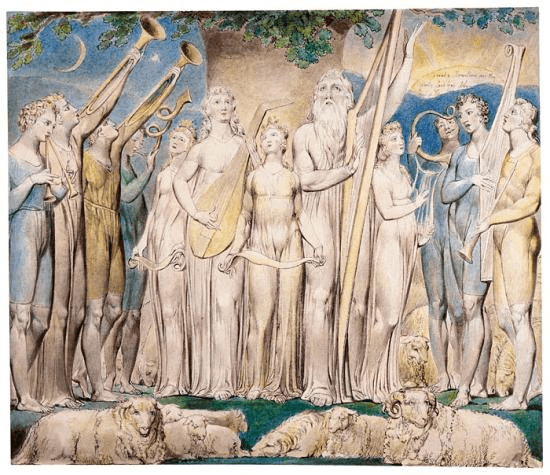
Job is restored, by William Blake (1757-1827)

Job was in awful suffering. He contended with God about it. Job’s friends contended with Job. In the end, God never gave a humanly suitable answer to the problem of suffering. Namely, because we cannot understand the answer, even if it is provided.

Indeed, the gap between God and humanity is quite pronounced. God is the Creator. We are creatures. Yet, God did vindicate Job.

That’s right God affirmed Job – and not Job’s companions. Even though Job did what many a believer in God today believes is wrong, perhaps even sacrilegious or sinful.

Job argued, confronted, grappled with, and even opposed God for the terrible troubles he faced in losing his family, his wealth, and his health. He fully engaged God.

Job’s friends, however, did no such thing. Instead, they argued, confronted, grappled with, and even opposed their friend Job. They fully avoided God.

In the end, Job conceded that he himself knows nothing. Yet, there is still the hint of complaint within him. This is good. Job did not stop engaging God. He remained faithful and devoted.

Let us never believe that faithfulness and devotion to God involves putting up a false front and nice polite piety. Prayer, in truth, is a hard wrestling with God, a struggling and working through all the difficulties of this unfair life.

God is not the least offended by our full, real, and raw engagement of him. But God is offended by avoiding such engagement altogether.

All of us, in reality, speak mostly in ignorance. We talk about things we don’t really understand. The only thing we can be 100% truthful about, however, is ourselves – about how we are really doing, feeling, experiencing, believing, struggling with, etc.

I myself am the true expert on me – and you, the expert on you. And this truth I can bring to God anytime, anywhere. The Book of Job affirms to me that this is the sort of devotion and sacrifice which the Lord is pleased with.

Job gained some knowledge and understanding through personally encountering God. The Lord God almighty, Creator of heaven and earth, actually spoke to Job in a direct revelation of the Divine presence.

This is an affirmation of Job’s integrity. But the godless, disintegrated, and fragmented person cannot see God or expect a personal audience with God.

Through all that Job had been through, he held to his integrity, and held onto God, both at the same time. In the end, he still did not understand why he had to go through such horrible suffering.

English translations of the Hebrew text don’t do it justice. There is always something lost in translation of any language to another. And it seems what is lost here is that Job was perhaps still protesting at the end. Yet, it comes across in English as Job despising and abhorring himself, as if he had done something very wrong.

“I despise myself,” misses the mark. Without getting into some deep grammatical Hebrew waters, I wonder if the phrase might better be rendered, “I protest.” What is meant to be conveyed is that Job still acknowledges what he originally held onto. Namely, that he has done nothing wrong, did not deserve what he went through, yet has never rejected God, nor lost faith in God.

Job did not need to repent of some secret sin, as his friends supposed. Job repenting does not mean because of sin; Job’s repentance was a change of position from mourner and complainer, to accepting the situation as it is, without answers.

So, this brings us back to the beginning of the book. God is God. There are celestial forces and operations in play we know nothing about. Humans are not God. Humans are never going to get most of what is happening in this world. And humans will inevitably experience hard and bad things – and not know why.

No answers given. No change of situation (yet). But Job changed. He changed his mind about how to live with what he was experiencing. He relinquished his complaint, and decided to keep living, even though he did not get answers.

Honestly, this response of Job is more consistent with my own experience of awful suffering, and more faithful to the text of Scripture. Much like Jacob wrestling with the angel, Job had to finally concede and relent, and continue on his life journey, come what may.

Following Job’s intercession for his friends, God restored Job to wealth and family. A significant piece of this restoration was Job’s wider community of friends and family who gathered around him, giving Job the consolation and comfort that the three “friends” in the book did not provide.

The community cared for Job, not through nice theological phrases, but with genuine fellowship. They shared together around the table, the community giving both a meal and contributing monetary gifts for Job’s needs.

The Book of Job ends, perhaps with as many, or more, questions than when it started. Answers, however, are not the point.

Rather, Job’s incredible and awful experience of suffering and redemption becomes an invitation for you and me to have a more expansive view of what a relationship with the living God truly looks like.

May God bless you with discomfort
At easy answers, half-truths, and superficial relationships,
So that you may live deep within your heart.

May God bless you with anger
At injustice, oppression and exploitation of people,
So that you may work for justice, freedom and peace.

May God bless you with tears
To shed for those who suffer pain, rejection, hunger, and war,
So that you may reach out your hand to comfort them
And turn their pain into joy.

And may God bless you with enough foolishness
To believe that you can make a difference in the world,
So that you can do what others claim cannot be done
To bring justice and kindness to all our children and the poor. Amen.