Colossians 1:15-23 – Worship That Is Fit for a King

The Son is the image of the invisible God, the firstborn over all creation. For in him all things were created: things in heaven and on earth, visible and invisible, whether thrones or powers or rulers or authorities; all things have been created through him and for him. He is before all things, and in him all things hold together. And he is the head of the body, the church; he is the beginning and the firstborn from among the dead, so that in everything he might have the supremacy. For God was pleased to have all his fullness dwell in him, and through him to reconcile to himself all things, whether things on earth or things in heaven, by making peace through his blood, shed on the cross.

Once you were alienated from God and were enemies in your minds because of your evil behavior. But now he has reconciled you by Christ’s physical body through death to present you holy in his sight, without blemish and free from accusation— if you continue in your faith, established and firm, and do not move from the hope held out in the gospel. This is the gospel that you heard and that has been proclaimed to every creature under heaven, and of which I, Paul, have become a servant. (New International Version)

Jesus is King. Neither you, nor I, are. 

A simple statement; yet, not easily engrafted into daily life. 

The original sin of Adam and Even was rebellion – to break the bonds of loving authority God provided for them. We (especially us Americans) have this nasty anti-authoritarian strain which runs rather deep in us. 

As a child, when my middle daughter was grappling with the implications of faith in Christ, she once blurted out an honest cry that we can likely resonate with: “I just don’t want another person in my life telling me what to do!” 

Indeed, Jesus is King; we are not.

The New Testament lesson for today is rich with the pre-eminence and lordship of Jesus Christ: 

  • All things were created through Jesus and for him. 
  • Everything in all creation is held together by Jesus. 
  • Christ is the head of the church. 
  • In Jesus Christ, complete divinity exists and reigns. 
  • Jesus made peace through the cross because he had the authority and the qualifications to do so. 
  • Broken relationships and proper lines of authority are now restored and redeemed in Christ.

We can also likely relate to, at times, indulging an illusion of being in control and independently dictating the course of our lives. Yet, mercifully, Jesus is the great Sovereign, and this is a good thing – because in Christ we find reconciliation and purity of life. 

“The supreme thing is worship. The attitude of worship is the attitude of a subject bent before the King… The fundamental thought is that of prostration, of bowing down.”

G. Campbell Morgan

Because Christ is King, we really ought to submit to him. In fact, we need to pay some attention to how our bodies are to submit to his lordship.

When the body moves to animating physical actions of submission, this helps the heart to follow. Whole person worship involves engaging the mind, spirit, emotions, and, yes, the body. To neglect the body in worship is to truncate the ability to connect with God in Christ.

A typical metaphor for the Church is the “Body of Christ.” We can live into that phrase through an embodied spirituality of submission. Our individual bodies are temples of the Holy Spirit, important for expressing worship. (1 Corinthians 3:16)

God created us with literal physical bodies. And Jesus has a literal physical body. Bodies are important for whole person worship. This means the physical postures we take in worshiping King Jesus are significant. We need to pay attention to them.  

A healthy practice for Christians is to kneel in the presence of the Lord. I realize some Christian traditions do it as a part of their worship, and some do not. Some like it, some don’t. Yet, bowing, even prostrating oneself (if you are physically able!) can be a powerful symbol of the heart’s desire and disposition to submit to the lordship and authority of Jesus Christ. 

Crawling out of bed in the morning onto one’s knees and beginning the day aiming to live into the will of God, and ending the day in the same manner, are a practical means of remembering who Jesus is and who we are.

I believe all believers need to feel free in adopting a physical posture of worship which helps them connect with God in Christ. For some, that will be sitting in a comfortable position in contemplation. Others will want to stand, raise their hands, even dance in praise.

It also behooves us to let our bodies respond to whatever is happening with us spiritually. Exuberant praise needs the expression of hand clapping and toe tapping. Confession of sin needs a bit of bowing, kneeling, even prostrating. For prayer, hands open and palms facing up to receive blessing from God is a good bodily position of worship.

You get the idea. Just remember we need to strive for congruence in our worship, that is, what is happening with our outward bodily movements needs to match what is occurring inward with our spirits. And when the two are in sync, meaningful worship can happen – worship of submission fit for a king.

Sovereign God, in your mercy you have sent your Son, the Lord Jesus, who has brought reconciliation to a once broken relationship.  I bow before you in obedience, submission, and worship.  Let me live a cross-shaped life through enjoying the peace you have given me in Christ in both body and soul. Amen.

Philippians 2:5-11 – Palm Sunday

In your relationships with one another, have the same mindset as Christ Jesus:

Who, being in very nature God,
    did not consider equality with God something to be used to his own advantage;
rather, he made himself nothing
    by taking the very nature of a servant,
    being made in human likeness.
And being found in appearance as a man,
    he humbled himself
    by becoming obedient to death—
        even death on a cross!

Therefore, God exalted him to the highest place
    and gave him the name that is above every name,
that at the name of Jesus every knee should bow,
    in heaven and on earth and under the earth,
and every tongue acknowledge that Jesus Christ is Lord,
    to the glory of God the Father. (NIV)

I often take the posture of kneeling or prostrating when I pray. I do this, not because I think my prayers are more effective that way, but because this embodies my petitions with a recognition of Christ’s lordship over my life. Also, for me, there is no experience quite like using the kneelers on church pews and bowing together in a common experience of recognizing the lordship of Jesus Christ.

I sometimes ponder a question as I am on my knees: What kind of people would we be if we looked like these verses in Philippians?  The Apostle Paul said to the church in Philippi that their “attitude” should be the same as that of Christ Jesus. Their mindset, the way they think about everything, ought to be just like the mind of Christ. If we want to know how to think well and live well, how to relate to others in a good way, then we ought to thoroughly adopt the mind and the attitude of Jesus.  

How we should think and live comes from God. Within the life of the triune God exists three persons: Father, Son, and Spirit. Within this great three-in-one God exists perfect love, absolute holiness, united harmony, and constant respect. The Holy Scriptures tell us that just as God is holy, we are to be holy. Just as God is love, so we are to love one another. Just as God is harmonious, we are to live in harmony with one another. And just as God is supremely exemplified in the person of Jesus as a humble servant, so we are to practice humility and service in all our relations.

None of this is optional for the Christian. There is no place in the believer’s life for pride, posturing, and power-broking. There is to be humility, taking the posture of lowliness, and using any kind of influence for the benefit and encouragement of others – just like Jesus did while on this earth.

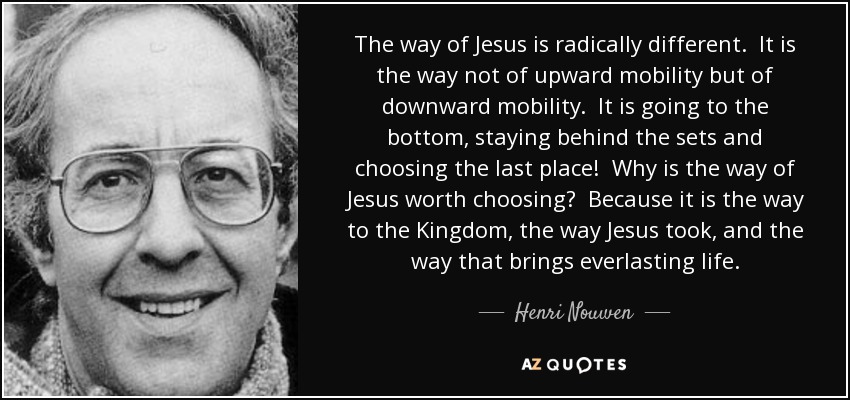
In a world pre-occupied with power and control, safety and security, influence and throwing its weight around, there is Jesus. He did just the opposite of engaging in upward mobility; he practiced downward mobility, and in doing so Christ descended into greatness as Lord and Savior.

Jesus did not consider equality with God as something to be grasped. The pre-incarnate Christ did not sit in heaven as the second person of the Trinity and hold onto his lofty position with tight fists – he did not grasp it tightly. When Jesus came to this earth, there was a humble willingness to open his hands and relinquish his rights and privileges as God. Christ made himself nothing, taking the very nature of a servant. Jesus gladly, not reluctantly, emptied himself for us. Jesus became one of us.

The television series, Undercover Boss, is a reality show in which high-level corporate executives leave the comfort of their offices and secretly take low-level jobs within their companies to find out how things are really working and what their employees are honestly thinking about their jobs and what is happening. In the process of this undercover mission, they learn of the perceptions about their companies, the spirit of their work forces and — maybe — something about themselves as well.

None of the executives cease to be executives. They just make a willing decision to take the lowest level job in their own company to hopefully benefit the employees and the entire corporation. The best episodes are when the most generous executives go above and beyond helping the employees around them at the end of the show. 

Jesus descended to earth. He never ceased to be God. Yet, Christ willingly put his kingly robe in the closet and donned Dickies and work boots. He came among us and purposely limited himself to identify with us fully – and secured for us the greatest generosity imaginable – an answer to the problem of guilt and shame through forgiveness of sins.

Jesus became a servant. He completely tied himself to us. Jesus did not come to this earth seeking to be served, but sought to serve and give his life as a ransom for many. Christ kept going lower and lower to the point of descending to the greatest humiliation of all – death on a cross. Jesus endured the ultimate shame of the ancient world by dying a terrible death. The King of the universe was killed by vicious humanity so that he might redeem and save those very same people from their terrible plight of bondage to evil.

We are to be humble people, embracing a lowly status of slaves to God and to one another. The ancient Philippian church had a real problem with pride which is why Paul talked about emulating the mind and attitude of Christ in his humiliation. The following are exhortations Paul gave to the Philippians, which were to reflect the practice of humility in relationships:

  • Whatever happens, conduct yourselves in a manner worthy of the gospel of Christ (1:27). 
  • Do nothing out of selfish ambition or vain conceit, but in humility consider others better than yourselves (2:3). 
  • Continue to work out your salvation with fear and trembling (2:12). 
  • Do everything without complaining or arguing (2:14). 
  • Join with others in following my example and take note of those who live according to the pattern we gave you (3:17). 
  • Do not be anxious about anything, but in everything, by prayer and petition, with thanksgiving, present your requests to God (4:6). 

Because of Christ’s humble obedience to the Father, he was exalted from the lowest place to the highest place.  King Jesus is on the throne, above everyone and everything. Because of his descent to this earth, Christ has ascended in glory and honor. We can now see God in a new way, through Jesus. And when we do, it causes us to kneel in prayer and profess that Jesus Christ is Lord.

In the ancient world, this was subversive language. If Jesus is Lord, Caesar is not, and ultimate allegiance does not belong to the Roman Empire. If Jesus is Lord, the local gods are not. And in our day, it is no different. Historical characters and religious deities may come and go, but the issue of ultimate allegiance still pertains to us. If Jesus is Lord, no politician or celebrity is owed lordship status. Pride and arrogance are to be put down at every turn in favor of humble service and loving actions.

If we are to follow Jesus Christ truly and really, we will practice downward mobility and embrace humility. Bowing, kneeling, and prostrating will become second nature to us as we give our unflagging allegiance to Jesus. We will accept our creaturehood and God as Creator. We will live in the reality that Jesus is Sovereign over all creation. 

As we enter the Christian Holy Week, let us acknowledge and know the humiliation and exaltation of Christ….

Just watch my servant blossom!
    Exalted, tall, head and shoulders above the crowd!
But he didn’t begin that way.
    At first everyone was appalled.
He didn’t even look human—
    a ruined face, disfigured past recognition.
Nations all over the world will be in awe, taken aback,
    kings shocked into silence when they see him.
For what was unheard of they’ll see with their own eyes,
    what was unthinkable they’ll have right before them.

Who believes what we’ve heard and seen?
    Who would have thought God’s saving power would look like this?

The servant grew up before God—a scrawny seedling,
    a scrubby plant in a parched field.
There was nothing attractive about him,
    nothing to cause us to take a second look.
He was looked down on and passed over,
    a man who suffered, who knew pain firsthand.
One look at him and people turned away.
    We looked down on him, thought he was scum.
But the fact is, it was our pains he carried—
    our disfigurements, all the things wrong with us.
We thought he brought it on himself,
    that God was punishing him for his own failures.
But it was our sins that did that to him,
    that ripped and tore and crushed him—our sins!
He took the punishment, and that made us whole.
    Through his bruises we get healed.
We’re all like sheep who’ve wandered off and gotten lost.
    We’ve all done our own thing, gone our own way.
And God has piled all our sins, everything we’ve done wrong,
    on him, on him.

He was beaten, he was tortured,
    but he didn’t say a word.
Like a lamb taken to be slaughtered
    and like a sheep being sheared,
    he took it all in silence.
Justice miscarried, and he was led off—
    and did anyone really know what was happening?
He died without a thought for his own welfare,
    beaten bloody for the sins of my people.
They buried him with the wicked,
    threw him in a grave with a rich man,
Even though he’d never hurt a soul
    or said one word that wasn’t true.

Still, it’s what God had in mind all along,
    to crush him with pain.
The plan was that he gives himself as an offering for sin
    so that he’d see life come from it—life, life, and more life.
    And God’s plan will deeply prosper through him.

Out of that terrible travail of soul,
    he’ll see that it’s worth it and be glad he did it.
Through what he experienced, my righteous one, my servant,
    will make many “righteous ones,”
    as he himself carries the burden of their sins.
Therefore I’ll reward him extravagantly—
    the best of everything, the highest honors—
Because he looked death in the face and didn’t flinch,
    because he embraced the company of the lowest.
He took on his own shoulders the sin of the many,
    he took up the cause of all the black sheep. (Isaiah 52:13-53:12, MSG)