1 Samuel 18:6-30 – Saul’s Deep Anxiety

When the men were returning home after David had killed the Philistine, the women came out from all the towns of Israel to meet King Saul with singing and dancing, with joyful songs and with timbrels and lyres. As they danced, they sang:

“Saul has slain his thousands,
    and David his tens of thousands.”

Saul was incredibly angry; this refrain displeased him greatly. “They have credited David with tens of thousands,” he thought, “but me with only thousands. What more can he get but the kingdom?” And from that time on Saul kept a close eye on David.

The next day an evil spirit from God came forcefully on Saul. He was prophesying in his house, while David was playing the lyre, as he usually did. Saul had a spear in his hand, and he hurled it, saying to himself, “I’ll pin David to the wall.” But David eluded him twice.

Saul was afraid of David because the Lord was with David but had departed from Saul. So, he sent David away from him and gave him command over a thousand men, and David led the troops in their campaigns. In everything he did he had great success, because the Lord was with him. When Saul saw how successful he was, he was afraid of him. But all Israel and Judah loved David because he led them in their campaigns.

Saul said to David, “Here is my older daughter Merab. I will give her to you in marriage; only serve me bravely and fight the battles of the Lord.” For Saul said to himself, “I will not raise a hand against him. Let the Philistines do that!”

But David said to Saul, “Who am I, and what is my family or my clan in Israel, that I should become the king’s son-in-law?” So, when the time came for Merab, Saul’s daughter, to be given to David, she was given in marriage to Adriel of Meholah.

Now Saul’s daughter Michal was in love with David, and when they told Saul about it, he was pleased. “I will give her to him,” he thought, “so that she may be a snare to him and so that the hand of the Philistines may be against him.” So, Saul said to David, “Now you have a second opportunity to become my son-in-law.”

Then Saul ordered his attendants: “Speak to David privately and say, ‘Look, the king likes you, and his attendants all love you; now become his son-in-law.’”

They repeated these words to David. But David said, “Do you think it is a small matter to become the king’s son-in-law? I’m only a poor man and little known.”

When Saul’s servants told him what David had said, Saul replied, “Say to David, ‘The king wants no other price for the bride than a hundred Philistine foreskins, to take revenge on his enemies.’” Saul’s plan was to have David fall by the hands of the Philistines.

When the attendants told David these things, he was pleased to become the king’s son-in-law. So, before the allotted time elapsed, David took his men with him and went out and killed two hundred Philistines and brought back their foreskins. They counted out the full number to the king so that David might become the king’s son-in-law. Then Saul gave him his daughter Michal in marriage.

When Saul realized that the Lord was with David and that his daughter Michal loved David, Saul became still more afraid of him, and he remained his enemy the rest of his days.

The Philistine commanders continued to go out to battle, and as often as they did, David met with more success than the rest of Saul’s officers, and his name became well known. (New International Version)

Anxiety can warp our thinking, cause pain in our gut, and darken our heart. Maybe that statement seems a bit harsh. After all, everyone becomes anxious, at some time or another. Anxiety is endemic to the human experience; it is something we all have in common. Whenever anxiety takes root in the life of a person, it bears the fruit of irrational fear and deep insecurity. 

King Saul was jealous of David’s success in battle. Behind Saul’s personal anxiety was the concern that David was stealing the limelight. It made Saul angry, David getting all the attention. Since Saul was the leader in charge, he continually put David in overwhelming situations where it seemed likely he would fail. But instead of failure, David was wildly successful in everything he did. 

Today’s Old Testament lesson makes it clear David’s achievements were because the Lord was with him. This made Saul even more anxious and afraid, possessing malevolent motives behind everything he did toward David. Even though it might not have looked evil on the outside, in reality, the interior life of Saul was a mess. And it made him plain stupid.

When Saul observed God was with David, it only reinforced his fear and led him down a dark path. In contrast to Saul, David had godly character, developed in the lonely place of the pasture. It led him on a lighted trail toward the will of God.

Genuine integrity is always forged in the secret place where no one is looking. If we are merely concerned for outward performance and/or perfectionism, all sorts of anxieties can develop and twist our sense of reality. Yet, if we pay attention to the inner person, and allow God to create a deep faith within, then we can stand strong, even when there are those who have ill will against us.

Search me, O God, and know my heart.  Test me and know my anxious thoughts.  See if there is any offensive way in me and lead me in the way everlasting.  Amen.

*Above painting by Chinese artist He Qi

**Above statue of King Saul at the University of North Carolina Art Museum

1 Samuel 17:1-49 – Faith in Action

The story of David and Goliath is one of the best known stories in the entire Bible. It’s a classic example of what can be accomplished through one person who chooses to exercise faith. Puny David taking on giant Goliath has served as one of the greatest inspirations for believers through the centuries – seeing God give victory to people against dramatically overwhelming odds.

Whereas the New Testament exhorts us to live by faith, this Old Testament narrative demonstrates what can happen when a person of faith decides to put that faith into action.

Old Testament stories are framed in a way to help the reader or listener discern the differences between the characters of the story – to understand the contrasts between good and bad. So, then, the account of David and Goliath revolves around four character contrasts so that we will learn the lessons of faith God wants to teach us.

First Contrast: David and Saul

David is brave. Saul is fearful. In the ancient world, a typical tactic of warfare, when the battle lines were drawn, was to choose a champion from each side. They would fight together, just the two of them, on behalf of the entire army. It was a fight to the death, and the losing side would submit to the winning side. 

This was a way of preventing the terrible carnage of war. It also created some incredible individual champions.  A champion would be selected not only for his ability to fight, but also for his impressive stature so that there was an intimidation factor to it all.

Saul was the King of Israel. He was the logical choice for the combat since he was a head taller than all the other Israelites and a rather impressive looking soldier. But compared to Goliath, Saul looked like a midget.  The intimidation factor worked. Saul was downright afraid and not about to put himself out there to face a giant.

David is brave because he has faith in God. Saul is fearful because he is not a man of faith in God. The opposite of faith is not unbelief, but fear. As the muscle of faith grows through trusting God in the daily stresses of life, fear is better confronted and managed. The development of faith is a process, and it takes time.

Considering this story in light of Father’s Day, Dads have the daily opportunity of being a hero to their kids through faith in God. That means dealing with two great fears: being found inadequate; and, being controlled by another person or circumstance.

Those two fears were evident in Saul. He felt inadequate because he compared himself to Goliath. He felt controlled by the situation because the Philistines were picking a fight. So, he froze. There are many men who would rather do nothing than be labelled as inadequate or controlled.

David, in contrast, had plenty of practice facing down foes as a shepherd – the bear and the lion – who threatened the sheep. David was often out in the countryside all by himself, guarding the sheep, and his skills were improved in a place where no one was looking.

The way to progress our faith is to be assertive in owning our relationship with God through prayer and Bible reading (or listening on a Bible app) on a daily basis. It’s something everyone can do.

Second Contrast:  David and the Israelites

It was not only Saul who was intimidated by Goliath; the entire army of Israel was hiding behind the battle lines cringing in fear. David, however, discerned no reason to avoid this bullying blowhard. It appears he is the only person able to see Goliath as a small person in comparison to a big God. By faith, David understands Goliath is no match for God.

So, we see that one person full of faith can accomplish the impossible – whereas an army full of fear cannot accomplish a thing. 

We might tend to believe everything has to be large with a big splash to it – that only then can we accomplish big things for God. But really, if we want to achieve something for God, we need to step out in faith and do it – instead of recruiting an army of people or hiding in the group, nursing our fears and anxieties.

No one can do your personal faith work for you; you must do it. The Beaver Cleaver philosophy of life says, “Gee, Wally, if I get in trouble or in a pickle, I’ll just ignore it and hope it goes away….” But Goliath is not going anywhere. He will still be there tomorrow.

Third Contrast: David and Goliath

Goliath represents the other extreme to the fear of Saul and the Israelites. He had absolutely no fear, including any fear of God. Goliath trusted in himself, his abilities, and his stature. David, however, trusted in God alone.

The story gives a detailed description of Goliath’s weapons and physical appearance because Goliath trusted in his aptitude and the ancient technology of his day to face down the Israelites. Conversely, David was small and too young to even be considered for military service. He was too small to wear anybody’s armor. But David did not need any of that – he just needed his faith.

Humanly speaking, David appears insignificant; there is nothing about him that caused anyone to think there was something special or different about him. Goliath, however, was the Arnold Schwarzenegger of his day, ready to terminate anybody who got in his way.

It can be easy to trust in ourselves, another person, or our technology to accomplish something in the face of insurmountable odds, instead of looking to God. The battle is not ours; it is the Lord’s.

Most things in life take a great deal of bravery – especially parenthood! It takes more than copious Dad speeches (and I had a lot of speeches for my kids). Fatherly courage requires modeling for boys what they are expected to become and modeling for girls what they should expect from males.

Children need to observe men who have courage to do the right thing, even when it has personal cost. They need to see them bravely shouldering responsibilities – even when they don’t feel like it. Kids need to see men who demonstrate the courage to be vulnerable, as well as strong and self-disciplined. They need to experience fathers and men with courage to pay attention to them – even, and especially, when those men are angry or disappointed with their own choices.

Fourth Contrast:  David and Eliab

Eliab was David’s big brother. Eliab was a soldier in the army. David was just a kid. It did not matter he was a kid; David was concerned for God’s name and glory. In contrast, Eliab was concerned about his little brother being an embarrassment and superseding him.

When we choose to step out in faith and act, there will likely be opposition, even among family and fellow believers. But David did not let a little criticism stop him. Criticism and opposition will inevitably happen. David was determined to please God, not his brother. He did not wilt and was not deterred from his concern to face down Goliath.

Conclusion

If we want to be brave in the Christian life; if we desire to live a life full of faith in Christ that deals with problems; then, the story of David and Goliath will serve as an inspiration in those times we feel less than mighty for God. 

Goliath was defeated and fell because David trusted God. The issue is not how much faith we have, but in whom our faith is placed. David trusted God. Saul did not even acknowledge God. Goliath trusted in himself. Eliab was too busy quibbling about things that didn’t matter. 

What is your response?

1 Samuel 17:55-18:5 – True Friendship

As Saul watched David go out to fight the Philistine, he asked Abner, the commander of his army, “Abner, whose son is this young man?”

“I really don’t know,” Abner declared.

“Well, find out who he is!” the king told him.

As soon as David returned from killing Goliath, Abner brought him to Saul with the Philistine’s head still in his hand. “Tell me about your father, young man,” Saul said.

And David replied, “His name is Jesse, and we live in Bethlehem.”

After David had finished talking with Saul, he met Jonathan, the king’s son. There was an immediate bond between them, for Jonathan loved David. From that day on Saul kept David with him and wouldn’t let him return home. And Jonathan made a solemn pact with David because he loved him as he loved himself. Jonathan sealed the pact by taking off his robe and giving it to David, together with his tunic, sword, bow, and belt.

Whatever Saul asked David to do, David did it successfully. So, Saul made him a commander over the men of war, an appointment that was welcomed by the people and Saul’s officers alike. (New Living Translation)

“One of the most beautiful qualities of true friendship is to understand and to be understood.”

Seneca (5 B.C.E.-65 C.E)

We may have numerous acquaintances; social media friends; friends we do activities with; family friends and cousin friends; and even some good close friends. However, there are few, maybe only one or two people, who are so close as to be your best friend and a kindred spirit.

That person is the one whom you know always has your back; is the first person you call in the middle of the night in an emergency; and is the confidant you can say anything to, and they won’t freak out about it. They will always shoot straight with you and are your biggest encourager and fan. There is nothing they would not do for you.

I hope you have such a friend because they are rare gems. Such relationships typically begin by hitting it off well together. Usually, some event or particular place brings two people to a point of discovering they have such commonality of thinking and a commitment to living a certain way that their hearts are immediately drawn to each other. This is exactly what happened to Jonathan and David.

Before Jonathan and David’s friendship emerged, Jonathan (King Saul’s son) took it upon himself to step up and step out in single-handedly taking on the Philistine army. Jonathan faced them with only his armor-bearer behind him, climbed a cliff to other side where the Philistines were, and attacked all by himself. One guy deliberately went against an entire army. 

While six-hundred Israelite soldiers were hiding, too afraid to face the enemy, Jonathan took it upon himself to act. It was not a rash action but a decision of faith:

Jonathan said to his young armor-bearer, “Come on, let’s go over to the fort of these uncircumcised men. Maybe the Lord will act on our behalf. After all, nothing can stop the Lord from saving, whether there are many soldiers or few.” (1 Samuel 14:6, CEB) 

Jonathan passionately believed the Lord was with him and would achieve the victory. Indeed, God sent a panic throughout the Philistine camp when Jonathan acted. The result was a complete rout.

David had his own act of faith with the Philistine giant, Goliath. While everyone in the Israelite camp was fearful of the larger than life enemy, David saw him through the eyes of faith, and stepped up to challenge someone twice his size. 

It just so happens, that on that day, Jonathan had a front row seat to the entire event. It was immediately after David killed Goliath that Jonathan knew this was a guy with remarkably similar sensibilities. David possessed Jonathan’s same passion for God; same zealous faith that takes enormous risk; same heart for God’s people and God’s name. They clicked – and became kindred spirits, as if knowing the one of them was to know the other.

It was true friendship at its absolute best. Jonathan had David’s back. There was nothing he would not do for him, and vice versa. So, he made a covenant with David. And it turned out to be a lasting commitment neither of them ever regretted. 

Jonathan did not make the covenant with David just to buddy-up with the new popular person. No, Jonathan is a timeless example of one who was humbly unselfish. He gave up his robe and his weapons to David. This was a magnanimous gesture. Jonathan believed David was the next true king, so he gave his kingly objects to him.

As the king’s son, Jonathan stood in line to be the next king. In fact, everything we know about Jonathan informs us he would likely be a darn good king. Yet, Jonathan recognized David was a more worthy candidate than himself. So, he gave up his right to the throne and handed over his symbols of potential kingship.

Jonathan delighted in David’s success. He joyfully watched David become a great warrior and successful leader. Jonathan was always the first one to give David a pat on the back and do whatever was needed in supporting him. 

Jonathan didn’t mind that David upped him on the battlefield and commanded ever larger numbers of soldiers.  Jonathan could have pulled rank on David as the king’s son – but he never did, because he honestly believed his friend was the real king.

“If Christ Jesus dwells in a person as his friend and noble leader, that person can endure all things, for Christ helps and strengthens us and never abandons us. He is a true friend.”

St. Teresa of Ávila

In the New Testament, we see a person with the same spirit and devotion as Jonathan. John the Baptist was out in the wilderness being a literal wild man. And he gained quite a following. All kinds of people went out into the desert to be baptized by John and to be his disciples. Yet, John recognized that he himself was not the true king. Concerning Jesus, John said:

“This is the one I told you would come! He is greater than I am because he was alive before I was born.” (John 1:15, CEV)

“I am not the Messiah…. I am the voice of one calling in the wilderness, ‘Make straight the way for the Lord.’” (John 1:20, 23, NIV)

“Though his ministry follows mine, I’m not even worthy to be his slave and untie the straps of his sandal.” (John 1:27, NLT)

“I have seen and testified that this one is God’s Son.” (John 1:34, CEB)

John never became jealous, envious, or concerned that his cousin Jesus was greater than himself. In fact, he celebrated it:

“I am so happy that he is here. He must become more and more important, and I must become less important.” (John 3:29-30, ERV)      

John was focused on God. He therefore was able to respond rightly and humbly to Jesus, the true king. 

Jonathan was focused on God, and so was able to respond rightly and humbly to David, the true king.

Jesus is both king and friend. Jesus can be your kindred spirit, the one who always has your back. You can call, and he will be there. And we can delightfully watch Christ increase while we decrease. His success is our success. 

Divine friendship is possible. God’s people can enjoy incredible unity because Jesus has gone before us – he has won the victory over sin, death, and hell on our behalf. By faith we step out and act with the knowledge God is with us.

Jesus said, “No longer do I call you servants, for a servant does not know what his master is doing; but I have called you friends, for all things that I heard from My Father I have made known to you.” (John 15:15, NKJV)

**Above wood sculpture of Jonathan and David by Olen Bryant (1927-2017)

1 Samuel 16:14-23 – The Work of God

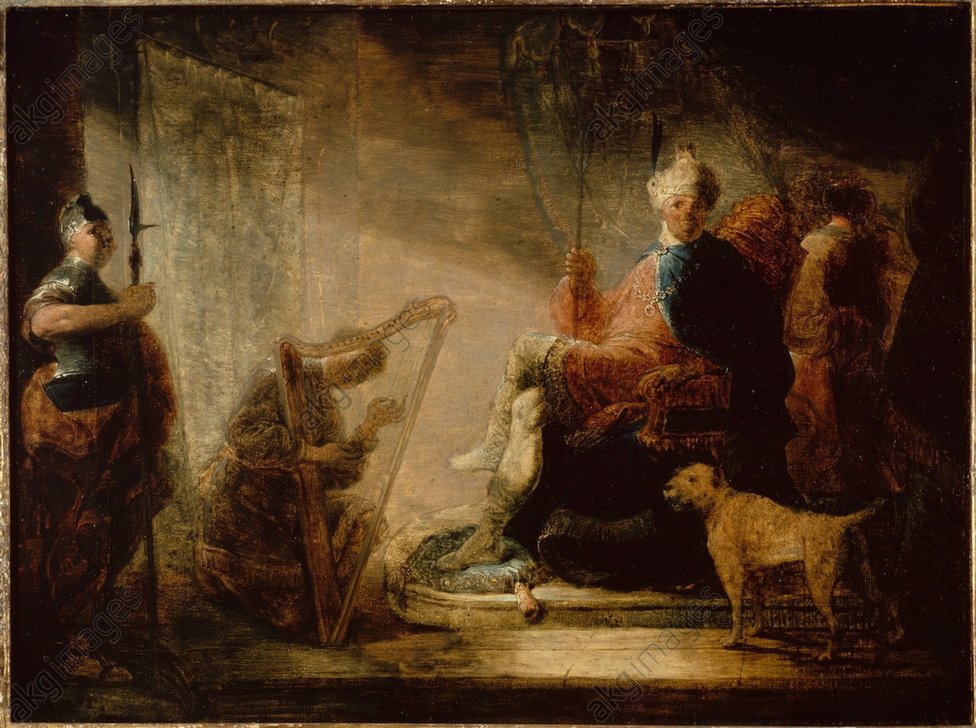
Now the Lord’s spirit had departed from Saul, and an evil spirit from the Lord tormented him. Saul’s servants said to him, “Look, an evil spirit from God is tormenting you. If our master just says the word, your servants will search for someone who knows how to play the lyre. The musician can play whenever the evil spirit from God is affecting you, and then you’ll feel better.”

Saul said to his servants, “Find me a good musician and bring him to me.”

One of the servants responded, “I know that one of Jesse’s sons from Bethlehem is a good musician. He’s a strong man and heroic, a warrior who speaks well and is good-looking too. The Lord is with him.”

So, Saul sent messengers to Jesse to say, “Send me your son David, the one who keeps the sheep.”

Jesse then took a donkey and loaded it with a homer of bread, a jar of wine, and a young goat, and he sent it along with his son David to Saul. That is how David came to Saul and entered his service. Saul liked David very much, and David became his armor-bearer. Saul sent a message to Jesse: “Please allow David to remain in my service because I am pleased with him.” Whenever the evil spirit from God affected Saul, David would take the lyre and play it. Then Saul would relax and feel better, and the evil spirit would leave him alone. (Common English Bible)

In the realm of God, everything seems upside-down. Those who are first are last, and the last are first. The rich are really poor, and the poor are actually rich. People of low position are the highest in God’s realm, while those at the top are really at the bottom. The religious insiders, appearing close to God, are on the outside; and the outsiders, seemingly far from God, are really the insiders and close to the Lord.

If we judge circumstances according to human standards of fair-play and what seems right to us, God’s ethics might not make much sense. There are two extreme responses to this reality of God’s odd working in the world. 

One response is to try and nail down everything we don’t understand, to create a black and white world where every question has an answer, and all things are certain so that we know exactly how God works, all the time. 

The opposite response is to never try answering anything about the mysterious working of God, saying, “whatever will be, will be.” Somewhere in the middle of the extremes is probably a good place to be – working to know God better and how divinity operates in the world, while being comfortable with mystery and discerning we will never completely understand everything in this life.

There are times we feel confident of what God is doing. Other times, maybe most of the time, we are clueless as to how God is working. We do not have all the answers to God’s activity. Yet, there is still a lot we know about God. The Lord worked in quite different ways with Saul than with David.  

The difference in the two characters, Saul and David, hinges upon the presence and absence of God. God withdrew divine presence from Saul. King Saul’s deliberate and consistent disobedience of God’s direct commands led to the divine absence. Not only did God leave Saul, but an evil or bad spirit from the Lord tormented him. That reality might be something way off your understanding of how God works with people.  God departed from Saul and put him in a situation of inflicting pain.

Bear in mind, in a biblical worldview, there are not two equally opposing forces of God and Satan. Rather, Lucifer is a created being who aspired to be like God and fell from heaven. God stands alone as the one sovereign Being who controls all things in heaven and earth. 

Saul is not an isolated occurrence of experiencing a bad spirit. For example, God hardened the heart of Pharaoh so that he acted harshly against the people of Israel (Exodus 9:12; 10:20, 27; 11:10). From a strictly human perspective, it seemed God was kicking the can down the road, pushing off the people’s deliverance. Yet, the Lord was orchestrating deliverance from bondage, and a redemption far beyond what the Israelites could have ever imagined. 

Sometimes, we are privy to God’s working. For example, in the days of the Judges:

Abimelech ruled over Israel three years. But God sent an evil spirit between Abimelech and the lords of Shechem; and the lords of Shechem dealt treacherously with Abimelech. This happened so that the violence done to the seventy sons of Jerubbaal might be avenged and their blood be laid on their brother Abimelech, who killed them, and on the lords of Shechem, who strengthened his hands to kill his brothers. (Judges 9:22-24, NRSV)

In whatever way we understand an evil spirit from God in the life of Saul, the point to grasp is that God is aware and in control – whereas Saul is a disturbed man due to his own bad choices. Some ancient interpreters of the story view this as an act of mercy on God’s part, by not just eradicating Saul altogether, but, instead, giving Saul an opportunity to turn his life around and again experience the presence of God.

Keep in mind, just because someone experiences mental or emotional pain in the form of depression or anxiety or other disorder, does not necessarily mean there is a bad decision behind it. To go down that route is to take the extreme position of living in the black and white world of trying to be certain of everything. We only need consider the life of Job to know that pain, even extreme pain and horrible circumstances, does not necessarily mean sin is at the root of it all. (Job 2:7-10)

“People with absolute certainty are usually the misguided souls who confidently tell other people in terrible circumstances how God is either punishing them or that this will all work out in some fairy tale ending of the miraculous (which it rarely does).” 

Mit Tdrahrhe

On the other extreme, those embracing only mystery simply say to people in pain to trust God and accept your situation because God has a plan (not helpful, even hurtful). So, what is helpful?

The servants of Saul knew what was helpful. They asked the king to put out an ad for a music therapist. And the best one they could find was David. The problem of Saul’s anguish needed the answer of a good harpist. 

Saul got some relief from pain, got a chance to perhaps come back to God, and David (already the next anointed king) got to learn the job of leading first-hand from the bottom-up by being in Saul’s service.

David needed to learn lowly service before becoming an exalted king. God could have simply knocked Saul off the throne and did away with him (which would make sense to a lot of people). Instead, God graciously gave young David time to observe the duties of a king.

God isn’t off his rocker. God knows what he is doing. God knew both Saul and David, inside and out. And, the Lord intimately knows each person, family, faith community, nation, and people group. If anyone claims to know precisely what God is doing and should do, they are a spiritual huckster speaking from ignorant pride. Conversely, if anyone throws up their arms in exasperation, mumbling how nobody can know God’s working, they are spiritually immature and irresponsible.

How we act or not act, what we say and do not say, is all a function of our theology – our real view of God. So, what might we take away from this story?

  1. The mystery of God and the certainty of people do not mix well. Claiming to always know what God is doing is delusional and just doesn’t help anyone.
  2. The clarity of God through divine commands, and the apathy of people to them, is a bad situation.  Claiming to never know what God is doing is a cop-out (because God has spoken clearly about a lot of things, like the Ten Commandments).
  3. Unlike Saul, do the best you can in the circumstances before you. Many situations we cannot avoid. However, in every situation we can control our response.
  4. Like David, be an agent of comfort, healing, and blessing to others. Most of the psalms were written in times of doubt, distress, and disturbance. We can take those psalms and pray them directly to God in the midst of our own discomfort.

We are in God’s hands, all of time. There is never a time when we are outside of God’s sight or ability to work.  The Lord’s arm is not too short to accomplish good purposes. God is our strong tower and mighty fortress for every life circumstance.

**Above painting: David playing the harp for King Saul, by German painter, Januarius Zick, 1750