Don’t you know? Haven’t you heard? Wasn’t it announced to you from the beginning? Haven’t you understood since the earth was founded? God inhabits the earth’s horizon— its inhabitants are like locusts— stretches out the skies like a curtain and spreads it out like a tent for dwelling. God makes dignitaries useless and the earth’s judges into nothing. Scarcely are they planted, scarcely sown, scarcely is their shoot rooted in the earth when God breathes on them, and they dry up; the windstorm carries them off like straw. So to whom will you compare me, and who is my equal? says the holy one.
Look up at the sky and consider: Who created these? The one who brings out their attendants one by one, summoning each of them by name. Because of God’s great strength and mighty power, not one is missing. Why do you say, Jacob, and declare, Israel, “My way is hidden from the Lord, my God ignores my predicament”? Don’t you know? Haven’t you heard? The Lord is the everlasting God, the creator of the ends of the earth. He doesn’t grow tired or weary. His understanding is beyond human reach, giving power to the tired and reviving the exhausted. Youths will become tired and weary, young men will certainly stumble; but those who hope in the Lord will renew their strength; they will fly up on wings like eagles; they will run and not be tired; they will walk and not be weary. (Common English Bible)
Strength, endurance, and perseverance are vital resources which come from the reservoir of spiritual resources. One does not simply will it into reality, and, poof! It is there! No, these resources must be drawn from a source that is reliable and continual.
Whenever you and I are persuaded to use an unreliable and/or limited resource, like our own, or some slick marketed one, we are not revived or restored to keep going and persevere through a given situation. In such times, we may naively think that God is absent, and cry, “God ignores my predicament.”
But God isn’t sleeping. The Lord hasn’t gone out to lunch or taken a bathroom break. God is not the problem.
We actually thought we could handle our own junk, independently, without any help, saying, “I’ve got this!” Maybe, for a while, you did. But then the strength ran out; weariness overwhelmed you. All of sudden, it seems, you have overestimated yourself, and underestimated God.
With no steady and reliable resource to draw from, your brain’s thinking became distorted, and your heart’s confidence sunk. That’s because the sovereign and majestic God is the One who gives power and life, and there was trust in other things beside the Lord.
Yet, placing our hope in the God who is there, is to plunge into an inexhaustible and gracious pool of strength. God enables us to fly and soar above our human predicaments and our daily problems. With the power God provides, we can carry-on and follow-through with the demands, duties, and desires of life on this earth which God created for us.
To draw from the deep well of God, it is thus extremely necessary to meet with this God on a regular and consistent basis. If food and drink for the body requires multiple daily attention and time, then filling the soul is just as, and even more, important.
This need for daily spiritual food and drink is why I choose to engage in the Divine Hours, also known as the Daily Office, or Fixed Hour Prayer. At certain set times in the day I break away from what I’m doing to give attention to the soul by drawing from the merciful resources of God.
Perhaps this might be for you, as well, a fresh way to address your parched and needy soul.
Here is a link to the Divine Hours, based on the book of prayers compiled by Phyllis Tickle:
Yet, no matter the particulars of how we address meeting with God, consistently drawing from the well of grace is vital to our spiritual and emotional health.
Set me free, O God, from the bondage of my sins, and give me the liberty of that abundant life which you have made known to me in your Son our Savior Jesus Christ; who lives and reigns with you and the Holy Spirit, one God, now and forever. Amen
Adoration of the Magi, Basilica of the National Shrine of the Immaculate Conception, Washington D.C.
“Arise, shine, for your light has come, and the glory of the Lord rises upon you. See, darkness covers the earth and thick darkness is over the peoples, but the Lord rises upon you and his glory appears over you. Nations will come to your light, and kings to the brightness of your dawn.
“Lift up your eyes and look about you: All assemble and come to you; your sons come from afar, and your daughters are carried on the hip. Then you will look and be radiant, your heart will throb and swell with joy; the wealth on the seas will be brought to you, to you the riches of the nations will come. Herds of camels will cover your land, young camels of Midian and Ephah. And all from Sheba will come, bearing gold and incense and proclaiming the praise of the Lord. (New International Version)
We are drawn to light. I don’t know if you have ever been in a situation with complete darkness surrounding you. When things are totally dark, we begin to fear and panic.
I grew up in a rural area in which there were no lights at night, other than the moon and the stars. More than once, I got myself into a situation, when the sky was overcast, in which I didn’t have a flashlight and could not see my hand in front of my face. I was groping to discern any little bit of light that I could see. Without the light, I was lost.
Our souls are also drawn to light. We no longer want to have darkness enveloping us; we cannot live with the darkness residing within our hearts. This is one reason why the Magi were attentive to the bright star over Bethlehem, and traveled toward it. We have a need for light because nobody can abide in darkness for too long.
The glory of the Lord is associated with bright light. Spiritually, we can find ourselves in such darkness that it’s impossible to discover light, unless God shows up displaying divine mercy and glory.
The Christian season of Epiphany has to do with this divine light. Each year on January 6, on the Church Calendar, and after the twelve days of Christmas, is the celebration of Epiphany.
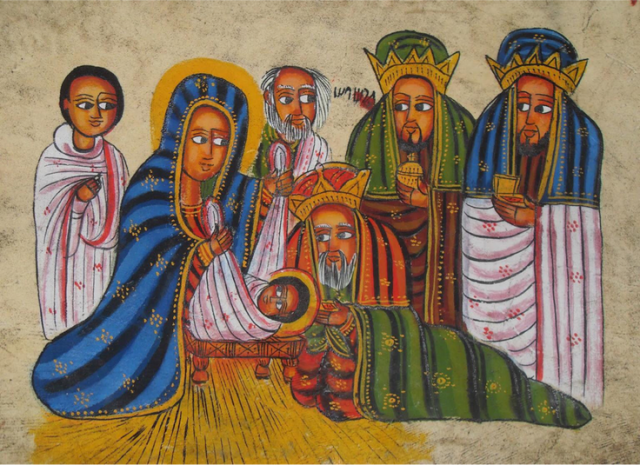
The Three Kings, Ethiopian Orthodox Church
It is a celebration of light – that Christ came to this earth as a child and became like us. Epiphany helps to bring a vision and understanding of God’s glory to all kinds of people in the world.
“Epiphany” literally means “manifestation” or “appearance.” The event most closely associated with this season is the visit of the Magi to Jesus. Included in this time of the year between the seasons of Christmas and Lent is a special emphasis on the teaching and healing ministry of Jesus.
The people walking in darkness have seen a great light; on those living in the land of deep darkness a light has dawned. (Isaiah 9:2; Matthew 4:16, NIV)
The great celebration and focus of these weeks is that salvation is not limited to Israel but extends to the Gentiles, as well.
“I will also make you a light for the Gentiles, that my salvation may reach to the ends of the earth.” (Isaiah 49:6; Luke 2:32; Acts 13:47, NIV)
In this season of Epiphany, the manifestation of God’s grace is one of the most scandalous truths of Christianity: God graces common ordinary people, who seem far from God, with the gift of Jesus.
God grants repentance that leads to life for all kinds of people, no matter what their race, ethnicity, class, or background. It is a wondrous and astounding spiritual truth that God’s merciful concern is not limited to a certain type of person or a particular group of people.
Grace is (and ought to be) the guiding factor in how we interact with people.
Losing sight of grace leads to being critical and defensive. Like King Herod of old, a graceless person becomes enamored with earthly power and control. But embracing grace, leads to humility, so that we see the image of God in people very different from ourselves.
Like the Apostle Peter, who learned in a vision to bring the gospel to non-Jews, old legalisms begin to wear away so that people from all walks of life can have access to Jesus and his gracious saving and healing ministry.
Grace brings down barriers and causes us to do away with unnecessary distinctions between others. And so, the appropriate response to such a grace is to glorify God for this marvelous and amazing work.
It is a gracious and merciful reality that the Magi, or Wise Men, who were really pagan astrologers, were directed to the Messiah. A light was provided to lead them to Jesus. Apart from God’s care and intervention they would have remained in darkness.
And it is no less true for people today. This old broken world has a lot of shadowy places to it; there is darkness all around. All kinds of people have no light at the end of the tunnel of their lives for hope and new life. But the gospel of Jesus Christ brings that light to those walking around with no ability to see. And Jesus exhorted his followers to be the reflectors of divine light for the world.
“Let your light shine before others, that they may see your good deeds and glorify your Father in heaven.”
Jesus (Matthew 5:16, NIV)
Sometimes, maybe oftentimes, the best way to bring resolution to our own troubles and problems is through helping others make sense of their lives through the gracious light of Christ so that they can see an appearance, an epiphany, of what their lives can be in the gracious rule of the kingdom of God.
As we celebrate Epiphany and journey with Jesus through his earthly upbringing and into his gracious ministry to people, let us keep vigilance to not let our light grow dim. Instead, let us hunger and thirst after Christ’s righteousness so that our joy is full and our light is bright.
God of radiant light, your love illumines our hopes before we know them, and our needs before we ask. Kindle your flame within us, that in our prayers and service, we may know your transforming presence at work in the world around us. All this we ask through Jesus Christ, our Lord. Amen.
Before I was born, the Lord appointed me; he made me his servant to bring back his people, to bring back the scattered people of Israel. The Lord gives me honor; he is the source of my strength.
The Lord said to me,
“I have a greater task for you, my servant. Not only will you restore to greatness the people of Israel who have survived, but I will also make you a light to the nations— so that all the world may be saved.”
Israel’s holy God and savior says to the one who is deeply despised, who is hated by the nations and is the servant of rulers: “Kings will see you released and will rise to show their respect; princes also will see it, and they will bow low to honor you.”
This will happen because the Lord has chosen his servant; the holy God of Israel keeps his promises.
The Lord says to his people,
“When the time comes to save you, I will show you favor and answer your cries for help. I will guard and protect you and through you make a covenant with all peoples. I will let you settle once again in your land that is now laid waste. I will say to the prisoners, ‘Go free!’ and to those who are in darkness, ‘Come out to the light!’ They will be like sheep that graze on the hills; they will never be hungry or thirsty. Sun and desert heat will not hurt them, for they will be led by one who loves them. He will lead them to springs of water.
“I will make a highway across the mountains and prepare a road for my people to travel. My people will come from far away, from the north and the west, and from Aswan in the south.”
Sing, heavens! Shout for joy, earth! Let the mountains burst into song! The Lord will comfort his people; he will have pity on his suffering people.
But the people of Jerusalem said,
“The Lord has abandoned us! He has forgotten us.”
So the Lord answers,
“Can a woman forget her own baby and not love the child she bore? Even if a mother should forget her child, I will never forget you. (Good News Translation)
What is the source of your strength?
Where do you go when you are weak?
To whom do you look, whenever you need support?
And what do you do whenever things go sideways, or somebody pulls the rug out from underneath you?
How do you handle circumstances that have gone awry?
What if you feel hurt, abandoned, misunderstood, neglected, disrespected, or discarded?
It makes sense to me that one would want to put trust in something or someone who is steady, unchanging, and (like God) eternal. Is anyone ever really restored if the restoration project is done with temporary or shoddy materials?
Restoration is a major theme in the prophetic books of the Old Testament. In today’s lesson, God speaks of bringing Israel back to her original calling and purpose. This would be accomplished through the nation of Israel and focused upon God’s Servant, the Lord’s Messiah.
The scope and vision of what the Savior would do is enunciated by God: rescue people, lead them home, and show unending mercy. The Servant of the Lord is made a light for the nations so that God’s salvation may reach to the ends of the earth.
“Messiah” is more than a Jewish thing. The Christian tradition discerns Jesus as the Servant, the Savior of both Jews, and Gentiles – Christ is given to reach the entire planet.
The incarnation of Christ was meant for more than gathering Israel together, as if it were some sort of Bill Gaither Homecoming tour. Rather, Messiah’s place and power is so significant that it is to be shared with everyone in the world. Although Israel was to be a holy entity, and separate from the surrounding culture, their mandate had always been to be a light to the nations.
This has great import for Christ’s Church and every individual believer in Jesus. The church is much more than a country club which only caters to club functions and members. The church is a missional community with an outward focus, as well.
It has always been God’s vision to reach the nations. The Lord wants more than one group of people; God wants everyone. Along with caring for its own, the church is designed as a missionary enterprise which puts significant resources into shining the light of Christ to every nook and cranny of creation.
However, we are a wounded people, living in a culture whose first response to differing voices is to accuse, attack, and injure. Our hurts are carried by all of us collectively and personally, and it gives rise to bitterness, isolation, and resentment. When our hope runs dry, we become marked by cynicism, apathy, and escapism.
The vision of Isaiah gives us an alternative approach. Reflection on God’s mercy, salvation, and loving guidance leads to repentance. We freely turn from all of our unholy thoughts, words, and deeds. It leads to a restoration of our true calling as missionaries of faith, hope, and love to the broken world around us.
Restoration – divine restoration with rich everlasting spiritual resources – brings healing of the stresses and anxieties that plague our planet, and ourselves.
Since God has a missionary heart, all of God’s people are missionaries to the world. It therefore behooves each believer to be taught, trained, and led into God’s restorative mission to the nations.
Let us, then, build caring relationships and extend loving actions both to those within the church and toward those outside of Christian fellowship, so that God’s intentions are carried out. For we know that not one person on planet earth is forgotten by God.
Restoring God, you bring us back to close relation and fellowship so that we might extend your gracious purposes throughout the world. Revive us again, God, so that we can hear your call to the nations through our Savior, Jesus Christ. Amen.
The Spirit of the Sovereign Lord is on me, because the Lord has anointed me to proclaim good news to the poor. He has sent me to bind up the brokenhearted, to proclaim freedom for the captives and release from darkness for the prisoners, to proclaim the year of the Lord’s favor and the day of vengeance of our God, to comfort all who mourn, and provide for those who grieve in Zion— to bestow on them a crown of beauty instead of ashes, the oil of joy instead of mourning, and a garment of praise instead of a spirit of despair. They will be called oaks of righteousness, a planting of the Lord for the display of his splendor.
They will rebuild the ancient ruins and restore the places long devastated; they will renew the ruined cities that have been devastated for generations…
“For I, the Lord, love justice; I hate robbery and wrongdoing. In my faithfulness I will reward my people and make an everlasting covenant with them. Their descendants will be known among the nations and their offspring among the peoples. All who see them will acknowledge that they are a people the Lord has blessed.”
I delight greatly in the Lord; my soul rejoices in my God. For he has clothed me with garments of salvation and arrayed me in a robe of his righteousness, as a bridegroom adorns his head like a priest, and as a bride adorns herself with her jewels. For as the soil makes the sprout come up and a garden causes seeds to grow, so the Sovereign Lord will make righteousness and praise spring up before all nations. (New International Version)
This section of Isaiah’s prophecy looks forward to a better day. After centuries of downward spiraling into disobedience, the people found themselves on hard times.
In the prophet’s day, God’s people and their lives needed to be rebuilt, restored, and renewed; they needed salvation and deliverance; and the good news of healing, freedom, and comfort.
The proclamation of the year of the Lord’s favor is a reference to the Old Testament command to practice the year of Jubilee. The Jubilee was to occur every fiftieth year of Israel’s existence in the Promised Land. For forty-nine years there were individuals and families that would incur debt; indenture themselves into servitude in order to survive; perhaps land in a debtor’s prison; and, work hard in the fields that they once owned.
The Jubilee Year, by Yoram Raanan
These were, indeed, hard times. But after the forty-nine years, on the fiftieth year, the debts were erased; slaves were freed; fields allowed to rest; and, the land restored back to its original owners.
God’s deliverance is not only spiritual, but also very tangible and real. Salvation is not just otherworldly, merely looking forward to the end of the age; there’s also the anticipation of transformation here and now.
The recipients of good news are those who are in bad circumstances. God turns toward the oppressed, the brokenhearted, the captives, the prisoners, those who mourn, and the faint of spirit. God really does have a special concern for the lowly and the weak.
It’s significant to note that, Israel as a whole, found themselves in need – not because they were victims of adverse situations – but because they failed to obey the stipulations of their covenant with God.
For example, we have no evidence that the Israelites actually even practiced the Jubilee. By the time fifty years came down the pike, after God gave them the Promised Land, they had slid so far down the spiritual drain that it was completely off their radar to practice a Jubilee.
It seems no one had any intention of forgiving debts, freeing their indentured servants, giving back the land to original owners, and providing the land itself with a well-deserved Sabbath rest.
To not practice the Jubilee was to rob people of their land and be unjust to them. Yet, God loves justice and hates robbery. God pays attention to those who are not getting their very real and tangible needs met. So, God speaks words of hope and deliverance for those in circumstances beyond their ability to cope with.
The first few verses of today’s Old Testament lesson are the words that Jesus turned to and read in the synagogue when he began his earthly ministry. Christ is the ultimate fulfillment of this promise to deliver and provide. He came to usher in a Jubilee celebration that would have no end.
It may be easy to overlook these verses, believing that they don’t pertain to us. Gentiles are under no obligation to practice a Jubilee. After all, many people are blessed, both material and spiritual. Furthermore, we can always identify persons who are in much more need than we are.
And yet, it’s important to recognize that the maladies of our hearts are very real. There are specific conditions in our lives that leave us in bondage and in need of restoration, renewal, and revitalization, just like the Israelites of old.
Therefore, we must not suppress those realities and those needs, but name the conditions which are packed away in a closet of our heart deep inside us, such as:
the love of things and money
severed relationships
old grudges
hidden addictions
domestic violence
denial of depression
secret affairs
fear and anxiety
anger and hatred
hoarding of resources and greed
Outward smiles and small talk conversations may hide the truth from others, but they do nothing to hide ourselves from a God for whom everything is laid bare.
The good news is not just for someone else who has “obvious” needs. The gospel must touch our lives and bring us freedom, so that we can pass on good news to the legion of social ills that make our world sick.
There are people all around us who need spiritual and emotional, mental and material help. Yet we will not have eyes to see them, or hearts to help them, if we ourselves stuff our burdens so deep within that we are blind and unable to see others.
What’s more, on the other hand, we may too easily misread these verses in a manner it was never intended to be heard, as if we are more in need than we actually are:
“The Lord’s Spirit of consumer choices is upon me, because the Lord has anointed me to preach good news to the middle-class. He has sent me to bind up the half-hearted, to proclaim more options for the limited, and release from Black Friday for the buyers, to proclaim the year of the Lord’s Cyber-Monday.”
We may not be so crass as to say this out loud, but we might tend to misinterpret Bible passages, so as to avoid our own great poverty of heart.
And when we become expert at stuffing our emotions and our needs, we then fail to see the year of Jubilee. We may believe that other people, “those people,” need Isaiah’s words. However, we are also in need of the year of Jubilee.
The truth for many is that they are either one paycheck, one prodigal kid, one mental health diagnosis, one serious illness, one drink, one affair, or one bad decision away from being one of “those people” – the people we typically identify as in need – the ones that bad things happen to – the ones we do not want to live next door to us.
We may not yet be vulnerable enough to admit our situation; and so, we keep practicing the denial of our spiritual poverty. Everyone is brokenhearted about something or someone, such as:
a wayward son or daughter
an unfulfilled dream
a lost relationship
a difficult illness or health diagnosis
a crisis situation
In addition, everybody is in bondage to something we would rather not admit; everyone needs renewal and restoration.
What should we do? Where are we to turn?
Let’s turn from the things that have caused us to be in poverty and in prison, and delight in the Lord our God. Rejoice in the Lord.
God will make a sprout come up, and cause it to grow.
God will rebuild our ruined souls.
God will restore the places of our lives that have been devastated.
God will even renew the places that have not seen renewal for generations.
It begins with you and me allowing the justice of God to work within us, and not only for other people.
God cannot bring comfort to those who do not mourn; the Lord cannot turn grief into joy if there is no acknowledgment of a dire situation. To be an oak of righteousness, there must be a confession of despair and an allowance of the justice of God through Jesus Christ to work its way completely through us.
Let the Lord replace a head of grief with a crown of beauty. Let God place a garment of praise to replace the stinky clothes of grumbling. And, in this season of Advent, herald the coming of the Christ child as the hope of us all, to the glory of God. Amen.