Isaiah 52:13-53:12 – Good Friday

Golgotha by Norwegian artist Edvard Munch (1863-1944)

The Lord says, “See, my servant will act wisely.
    People will greatly honor and respect him.
Many people were shocked when they saw him.
    His appearance was so damaged he did not look like a man;
    his form was so changed they could barely tell he was human.
But now he will surprise many nations.
    Kings will be amazed and shut their mouths.
They will see things they had not been told about him,

    and they will understand things they had not heard.”

Who would have believed what we heard?
    Who saw the Lord’s power in this?
He grew up like a small plant before the Lord,
    like a root growing in a dry land.
He had no special beauty or form to make us notice him;
    there was nothing in his appearance to make us desire him.
He was hated and rejected by people.
    He had much pain and suffering.
People would not even look at him.
    He was hated, and we didn’t even notice him.

But he took our suffering on him
    and felt our pain for us.
We saw his suffering
    and thought God was punishing him.
But he was wounded for the wrong we did;
    he was crushed for the evil we did.
The punishment, which made us well, was given to him,
    and we are healed because of his wounds.
We all have wandered away like sheep;
    each of us has gone his own way.
But the Lord has put on him the punishment
    for all the evil we have done.

He was beaten down and punished,
    but he didn’t say a word.
He was like a lamb being led to be killed.
    He was quiet, as a sheep is quiet while its wool is being cut;
    he never opened his mouth.
Men took him away roughly and unfairly.
    He died without children to continue his family.
He was put to death;
    he was punished for the sins of my people.
He was buried with wicked men,
    and he died with the rich.
He had done nothing wrong,
    and he had never lied.

But it was the Lord who decided
    to crush him and make him suffer.
    The Lord made his life a penalty offering,
but he will still see his descendants and live a long life.
    He will complete the things the Lord wants him to do.
“After his soul suffers many things,
    he will see life and be satisfied.
My good servant will make many people right with God;
    he will carry away their sins.
For this reason I will make him a great man among people,
    and he will share in all things with those who are strong.
He willingly gave his life
    and was treated like a criminal.
But he carried away the sins of many people
    and asked forgiveness for those who sinned.” (NCV)
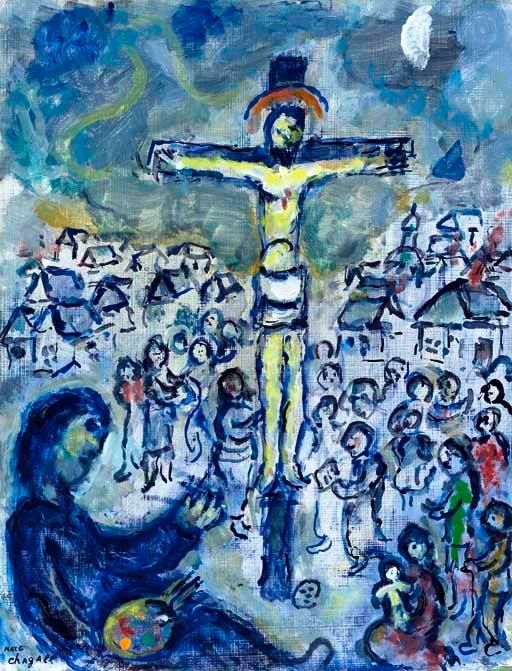
Le peintre et le Christ (The Painter and the Christ) by Marc Chagall (1887-1985)

With all the suffering in this world due to ongoing diseases, natural disasters, moral distress, and so much more, it might seem awkward that Christians everywhere would observe a day called “Good” Friday. 

Considering the hard circumstances of so many people, to call today “good” might appear cruel and out of touch with the world. Even for Christians, at first glance, “Good Friday” can seem a bit oxymoronic for a day observing the torture and death of an innocent man. 

Some would argue that Christ is no longer on the cross and we need to give all our focus on the resurrected Jesus and victory. No need for all this suffering stuff. Yet, the Resurrection only has meaning because of this very day, Good Friday. Without the Suffering Servant of Isaiah, there is no King Jesus. 

For Christians everywhere, this day is an incredibly good day because the crucifixion of Jesus Christ means the redemption of the world. On this day followers of Jesus remember and commemorate the events that led up to the cross; unpack those events and interpret them with profound meaning and significance; and worship Jesus with heartfelt gratitude because of the redeeming work of the cross.

The bulk of the New Testament Gospels of Matthew, Mark, Luke, and John are given over to the final week of Christ’s life, especially leading to the cross. Good Friday observances often take a somber form due to the brevity of Christ’s experience on the cross. 

On this day, Christians remember the last words of Christ, and recognize the significant impact his death had on the immediate persons around him. Believers also contemplate the lasting results of that singular death as an atoning sacrifice; perfect love; reconciliation between God and humanity; victory over evil; and the redemption of all creation.

Sadness, then, is far from the only emotive expression today. It is also appropriate to feel wonder, gratitude, and deep satisfaction for the accomplishment of deliverance from the power of sin. There is the recognition that something profound and meaningful has truly happened in the egregious suffering of Jesus. Thus, we not only remember the anguish of Christ, but what that horrible torment accomplished. In fact, the cross of Jesus is so significant that an eternity of considering its impact could never plumb the depths of its far-reaching effects.
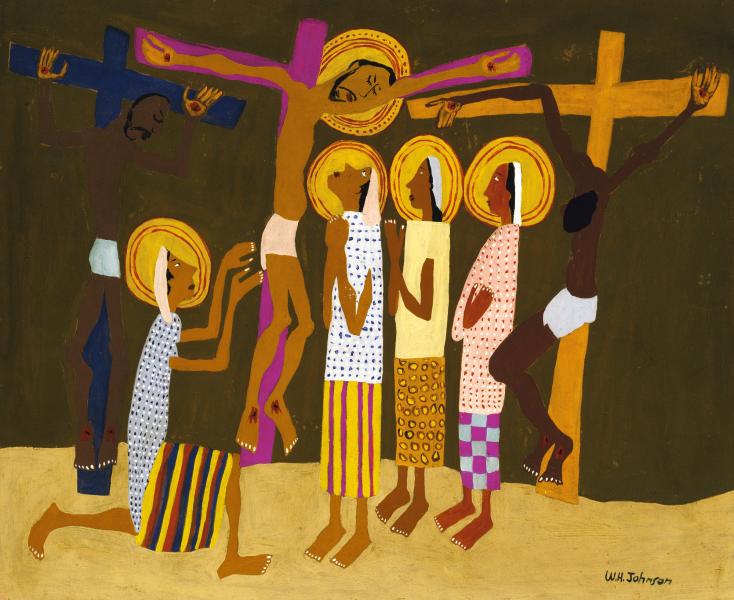
Mount Calvary by William H. Johnson (1901-1970)

With such profound meaning, one would think that Good Friday is a hugely observed day on the Christian Calendar. Yet, for a chunk of churches and Christians, it is not. The cross is not a popular subject. Maybe it’s because neither Christian nor non-Christian wants to ponder something so bloody and sad.

Episcopal priest Fleming Rutledge has adroitly put her finger on the issue: “Religious people want visionary experiences and spiritual uplift; secular people want proofs, arguments, demonstrations, philosophy, and science. The striking fact is that neither one of these groups wants to hear about the cross.”  Indeed, as the Apostle Paul has said, the cross of Christ is “a stumbling block to Jews and folly to Gentiles” (1 Corinthians 1:23).

A personalized religion which leaves the cross out of the picture (too much violence and sacrifice) might seem appealing yet will only leave us bereft of the communion of the saints both past and present. Consider the ancient witness of the Church:

“I believe in Jesus Christ, his only Son, our Lord… he suffered under Pontius Pilate, was crucified, died, and was buried; he descended to hell.”

Apostles’ Creed

“For our sake he [Christ] was crucified under Pontius Pilate; he suffered death and was buried.”

Nicene creed

Christ suffered “in both body and soul – in such a way that when he sensed the horrible punishment required by our sins ‘his sweat became like great drops of blood falling down on the ground.’  He cried, ‘My God, my God, why have you forsaken me?’  And he endured all this for the forgiveness of our sins.  Therefore, we rightly say with the Apostle Paul that we know nothing ‘except Jesus Christ, and him crucified;’ we ‘regard everything as loss because of the surpassing value of knowing Christ Jesus our Lord.’ We find all comforts in his wounds and have no need to seek or invent any other means than this one and only sacrifice, once made, which renders believers perfect forever.” –Belgic Confession, Article 21

And let us consider further the New Testament witness:

“Jesus suffered outside the gate in order to sanctify the people through his own blood.  Therefore, let us go forth to him outside the camp, and bear the abuse he endured.” (Hebrews 13:12-13, NIV)

“May I never boast of anything except the cross of our Lord Jesus Christ, by which the world has been crucified to me, and I to the world.” (Galatians 6:14, NRSV)

The extent of Good Friday goes far beyond a day on the calendar; it is the fulcrum upon which all of Christianity hinges. Because Christ suffered, our suffering has meaning. Each situation of trauma; every case of disease; all suffering and wholesale hard circumstances only make sense, in the Christian tradition, when they are viewed in solidarity with cross of Jesus Christ.

So, today, let Christians everywhere contemplate the cross, observe the salvation accomplished through Christ’s death, and offer prayers and petitions for those who need deliverance from the power of evil. Let us worship God in Jesus Christ because of the suffering on the cross.

Isaiah 43:8-13 – God Is Sovereign and I Am Not

Photo by Rachel Claire on Pexels.com

Bring my people together.
They have eyes and ears,
    but they can’t see or hear.
Tell everyone of every nation
    to gather around.
None of them can honestly say,
    “We told you so!”
If someone heard them say this,
    then tell us about it now.

My people, you are my witnesses
    and my chosen servant.
I want you to know me,
to trust me,
and understand
    that I alone am God.
I have always been God;
    there can be no others.

I alone am the Lord;
    only I can rescue you.
I promised to save you,
    and I kept my promise.
You are my witnesses
that no other god did this.
    I, the Lord, have spoken.
I am God now and forever.
No one can snatch you from me
    or stand in my way. (CEV)

I confess that I am an unabashed Calvinist – a Protestant theologian, pastor, and chaplain in the Reformed tradition. What that means to me is that I believe in God’s unconditional election of persons to salvation and new life. Maybe that means nothing to you, and to others it means everything. For many folks, it is just some churchy mumbo-jumbo which is rather irrelevant to the real stuff of the Christian life. 

I do not agree. It seems to me to be quite important. The heart of Reformation faith is a focus on God’s sovereignty, majesty, power, and grace. It is God who justifies, and not any human. That means there are no conditions to which God is beholden to act.

God works in the world according to divine free will and is not dependent upon anyone or anything to accomplish good purposes and fulfill good promises.

Today’s Old Testament lesson is a soaring view of God’s grace and powerful control. Yes, indeed, throughout all eternity God is God. There is none who can thwart the Lord’s plans. God acts freely and mercifully and nothing can cancel out those actions. Nothing can separate us from the love of God. 

We might jump from finger to finger in our puny attempts at autonomy, but we are not getting out of God’s hand! 

This really ought to be a comfort to every believer. God’s decrees will be fulfilled, and there is not one thing any wicked person can do to subvert divine initiatives. Furthermore, there is absolutely no way we can screw-up God’s purposes. We simply do not have such power. Our great task as believers is to rest secure in God’s will and place our trust in the One who knows exactly what he is doing in the world.

So, take a few minutes, draw a few deep breaths, and think on the wonderful truth that God is sovereign. To help you, here is the great opening to the Reformed confession, The Heidelberg Catechism, giving us a glimpse into the majesty of God:

Q: What is your only comfort in life and in death?

A: That I am not my own,

but belong with body and soul,

both in life and in death,

to my faithful Savior Jesus Christ.

He has fully paid for all my sins

with his precious blood,

and has set me free

from all the power of the devil.

He also preserves me in such a way

that without the will of my heavenly Father

not a hair can fall from my head;

indeed, all things must work together

for my salvation.

Therefore, by his Holy Spirit

he also assures me

of eternal life

and makes me wholeheartedly willing and ready

from now on to live for him. Amen.

Isaiah 60:15-22 – A Renewed Vision of Peace

Isaiah 60 by Margaret Nagib

Instead of being abandoned,
    hated, and forbidden,
    I will make you majestic forever,
    a joy for all generations.
You will suck the milk of nations,
    and nurse at royal breasts.
    You will know that I am the Lord, your savior
    and your redeemer, the mighty one of Jacob.
Instead of bronze I will bring gold;
    instead of iron I will bring silver;
    instead of wood, bronze;
    and instead of stones, iron.
I will make peace your governor
    and righteousness your taskmaster.
Violence will no longer resound throughout your land,
    nor devastation or destruction within your borders.
You will call your walls Salvation,
    and your gates Praise.
The sun will no longer be your light by day,
    nor will the moon shine for illumination by night.
The Lord will be your everlasting light;
    your God will be your glory.
Your sun will no longer set;
    your moon will no longer wane.
The Lord will be an everlasting light for you,
    and your days of mourning will be ended.
Your people will all be righteous;
    they will possess the land forever.
They are the shoot that I planted,
    the work of my hands, to glorify myself.
The least will become a thousand,
    and the smallest a powerful people.
I am the Lord; at the right moment, I will hurry it along. (CEB)

The people of ancient times typically had a love/hate relationship with prophets. After all, the Lord’s messengers gave verbal punches to the gut with bad news of judgment. But they also were bearers of good news, as well. So, it is important to hold both judgment and grace together. We need to always keep in mind that, despite human foibles, grace exists and is the grand operating force in God’s big world.

Good news turns to great news when there is a realization that judgment is deserved, yet it won’t have the last word. God’s grace always prevails in the end. God has a tenacious resolve to work out good for people, not ill. Although the Lord dispenses justice, sometimes with a firm hand, there is an unflagging commitment to divine love which will shine through the darkest of times.

God expertly knows how to make a reversal in people’s situations from hopeless despair to incredible fortune (and, I might add, vice versa). The Lord truly has plans of goodness and well-being for humanity. Humiliation and powerlessness will give way to exaltation and empowerment. Peace will eventually overcome both the human heart and human institutions.

Salvation and deliverance from the ills which plague both body and soul comes from the God who specializes in penetrating the blackest darkness with overwhelming light. And it is much more than personal well-being. Isaiah’s prophecy communicates a cosmic vision of peace which thoroughly works its way in all the shadowy places of the world. It is a vision of a new world and new life.

Because of God’s action in a broken and bruised world, we can make some bold and hopeful theological claims for God’s people:

  • God’s good grace and steadfast love are the superior forces in the church and the world. Because grace and love are pure gifts from the Lord, they are not dependent upon whether we deserve them, or not. The sheer fact that we need them is what prompts God to give generously and unsparingly. A new heaven and new earth are coming. Sin and death are not permanent.

Then I saw a new heaven and a new earth; for the first heaven and the first earth had passed away. (Revelation 21:1, NRSV)

  • God is the center of every good thing that was, is, and is coming. God’s world runs on God’s providence and power, and not on human agency. God is in control. All the Lord’s good promises shall not fail but will be realized. For the Christian, those promises are ultimately fulfilled in the person and work of Jesus Christ. When circumstances are at their worst, faith is at its best.

In everything we have won more than a victory because of Christ who loves us. I am sure that nothing can separate us from God’s love—not life or death, not angels or spirits, not the present or the future, and not powers above or powers below. Nothing in all creation can separate us from God’s love for us in Christ Jesus our Lord! (Romans 8:37-39, CEV)

  • God’s promises extend well beyond the “spiritual” to all of life. God’s peace will work its way into the fabric of the whole world, not just individual hearts. God’s benevolent kingdom and ethical will shall be done on earth as it is always done in heaven. Just as every human institution and all creation have been profoundly touched by sin, so everything will be touched by grace and renewed. Our prayers are to encompass this grand scope of God’s renewing vision for the world.

May your Kingdom come soon. May your will be done on earth, as it is in heaven. (Matthew 6:11, NLT)

God’s plans are more than good and gracious; they are cosmic in their scope and include an expansive realm of peace which is so incredible that the Lord’s glory will overwhelm all darkness and shall shine forever. Human sin might seem as though it is so pervasive as to win the day, yet it will not always be this way. God’s light will penetrate, overcome, and dispel guilt, shame, and disobedience. And it has already begun…

Almighty God give us a new vision of you, of your love, of your grace and power; and then, give us a new vision of what you would have us do as your people, and an awareness that in the strength of your Spirit we can do it to your glory, through Jesus Christ our Lord. Amen.

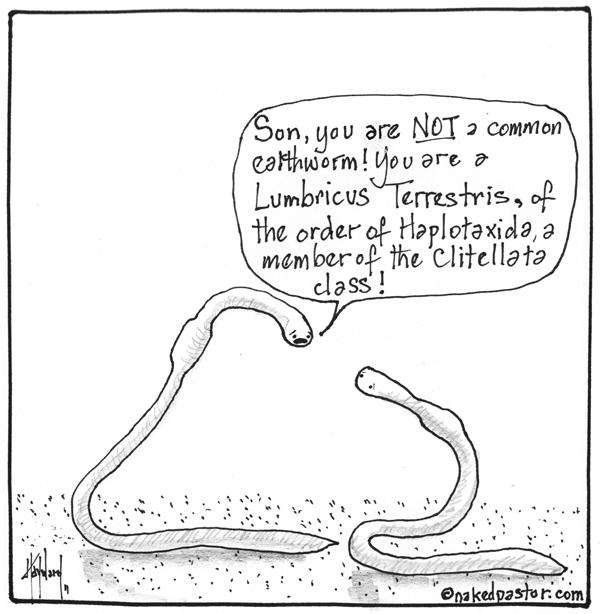
Isaiah 41:14-20 – For Such a Worm as I

Do not fear, you worm Jacob,
    you insect Israel!
I will help you, says the Lord;
    your Redeemer is the Holy One of Israel.
Now, I will make of you a threshing sledge,
    sharp, new, and having teeth;
you shall thresh the mountains and crush them,
    and you shall make the hills like chaff.
You shall winnow them and the wind shall carry them away,
    and the tempest shall scatter them.
Then you shall rejoice in the Lord;
    in the Holy One of Israel you shall glory.

When the poor and needy seek water,
    and there is none,
    and their tongue is parched with thirst,
I the Lord will answer them,
    I the God of Israel will not forsake them.
I will open rivers on the bare heights,
    and fountains in the midst of the valleys;
I will make the wilderness a pool of water,
    and the dry land springs of water.
I will put in the wilderness the cedar,
    the acacia, the myrtle, and the olive;
I will set in the desert the cypress,
    the plane and the pine together,
so that all may see and know,
    all may consider and understand,
that the hand of the Lord has done this,
    the Holy One of Israel has created it. (NRSV)

Each morning I rise and read God’s Holy Word. It is a discipline I have been doing for over forty years. In the past few years, I have begun reading more slowly and with greater contemplation – because the goal is not to check off having read some verses on a Bible reading plan. The aim is to connect meaningfully with God. The desired result is to hear the voice of the Lord, and to let the Scriptures do their incredible work in our hearts.

One of the ways I connect with Scripture, after having read the verses for the day several times, is to write it in my own words…

“My dear servant, there is no need whatsoever to worry yourself,

though others say about you,

            ‘That guy is nothing, only a wormy maggot!’

I am your holy God,

            who saves and protects you.

I’ll let you be like a big ol’ log

            covered with sharp spikes.

You will grind and crush

every mountain and hill in front of you

            until they turn to dust.

A strong wind will scatter the dust of unholy jerks

            in all directions.

Then you will celebrate

and praise me, your Lord,

            the holy God who watches your life.

When your financial budget no longer budges

and your bank accounts lie empty

            and you have no idea where to turn,

I, your Lord, and your God

will come to your rescue.

            I will not forget you.

I will make rivers of abundance flow

            on the desolate mountain peaks of your life.

I will send streams of life

to fill your empty valley of life’s tribulations.

Dry and barren places in your life

will flow with springs

            and become a lake of grace and goodness.

I will fill the parched desert areas of your needy life

            with all kinds of fruitful trees –

apple trees, olive trees, fig trees,

oak and walnut, elm and maple, fir, and pine,

like in the original garden,

all your needs will be met in and through me, your God.

Everyone will see this

            and know that I,

the holy Yahweh God whom you love and serve,

            created every bit of it.”

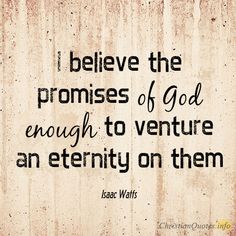
Whichever way we choose to view ourselves, as worm and insect, or as majestic person in the image of God, the spiritual reality continually before us is that the Lord will provide, bless, and care for us. We are the recipients of God’s gracious salvation. Although many modern hymnals do not include Isaac Watt’s, At the Cross, and if they do, the original words have been changed – it matters little. Because the action of deliverance belongs to God, and neither to you nor me. And even though we seem but lowly worms next to God, the Lord chooses to treat us with deference, accommodation, and care. Any low view of self is quickly eradicated in the face of such divine love.

Stanza 1:

Alas! and did my Savior bleed?

And did my Sov’reign die?

Would He devote that sacred head

For such a worm as I? 

Chorus:

At the cross, at the cross,

Where I first saw the light,

And the burden of my heart rolled away –

It was there by faith I received my sight,

And now I am happy all the day. 

By Isaac Watts (1674-1748) and published in 1707.