An Embodied Spirituality

By Unknown artist

It is normal to feel guilty at this time of year about our bodies. Some of the more common goals for a new year are to lose weight, stop smoking, get in shape, have better sleep hygiene, and generally learn better self-care.  I am not going to add to the burden of guilt but emphasize something important: Our bodies are the vehicle given to us to glorify God. Our spirituality is quite embodied. (1 Corinthians 6:19-20)

One of the reasons we fail our bodies is that we do not always make the biblical connection of seeing our material selves with the same importance as the immaterial.  The Apostle Paul brought up a discussion about the body to the Corinthian Church because Corinth was a Greek city thoroughly imbibed with a Platonic philosophy of life.  At the core of Plato’s view of humanity was that the immaterial and the spiritual were of higher value than the body.  For Plato, the body is a necessary evil.  He referred to our souls as being imprisoned within the flesh.  When we die the soul is released and is freed from its bodily prison.

Western civilization has been significantly influenced, even today, by Plato’s view of humanity. Yet, that is not a biblical view of the body.  Instead of being a prison, the body is a temple, a sacred place which is no better and no worse than the soul.  When we die, we will not be disembodied souls, but will experience a bodily resurrection at the end of the age.  Eternity will be spent existing in a real glorified body free from sin. (1 Corinthians 15)

Since the body is sacred, and we glorify God with our bodies, then we must steward them just like we would steward any other physical material possession we own.  We have bought into Platonic philosophy when we treat our cars better than we treat our bodies.  If a warning light comes on in our cars, we get it checked by the mechanic.  He fixes the issue and tells us what we need to do to prevent it from happening again, and we listen to him. 

Far too often, when warning lights go off in our bodies, we ignore them until our bodies literally break down and we must go to the doctor.  And even then, the doctor tells us to do something, and we do not do it.  We never avoid the advice of our mechanic, and yet we do it with our doctor.  We need to adopt the biblical wisdom of glorifying God on this earth through our bodies. 

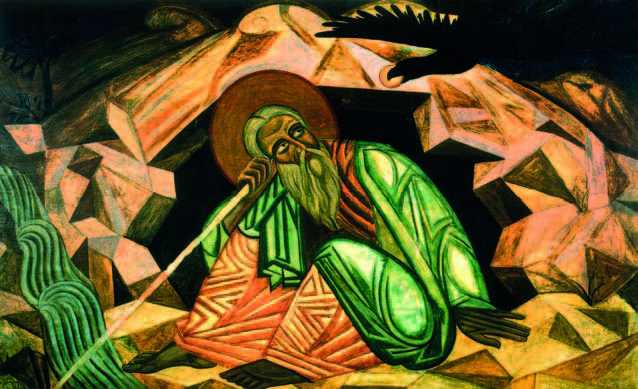
God’s care for our bodies can be found, for example, in the Old Testament prophet, Elijah. After Elijah experienced a great spiritual victory, he became the target of evil Queen Jezebel.  Elijah ran for his life and was severely burned-out from intense spiritual struggles with the queen’s prophets of Baal (1 Kings 19:1-3).  At that point, God did not come to Elijah and give him a sermon or exhortations about getting over it.  No, God restored Elijah’s body. And the Lord wants to restore our bodies, as well.
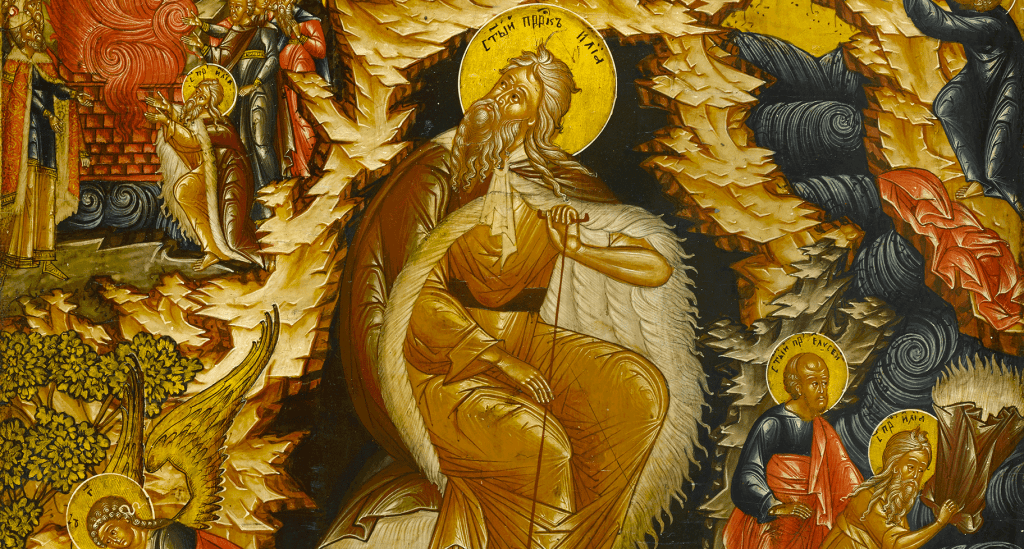
19th century Russian Orthodox icon of the prophet Elijah in the wilderness

First, Elijah needed sleep (1 Kings 19:5-6).  Millions of Americans are sleep deprived and live with a significant sleep debt (thus being continually cranky and out of sorts).  Insurance companies know this is a major issue because improper sleep habits have caused various auto accidents and fatalities. I once kept a crazy schedule with not many hours for sleep.  One day, during rush hour, I drove through a downtown expressway in bumper-to-bumper traffic and fell asleep.  I woke up about two minutes later and was still alive driving down the highway.  I sincerely believe God graciously drove the car for me.  That was my “wake up” call to change the way I was treating my body.

Second, Elijah needed to eat well (1 Kings 19:6-8).  For us, that means eating healthy.  One source of being overweight is failing to make the connection that eating is a spiritual activity.  Food is important to the kingdom of God.  It was eating that got us into trouble to start with and resulted in the fall of humanity.  Eventually, we will come full circle with eating being the activity we engage in at the end of the age – a redeemed view of food and eating together with Jesus at the marriage supper of the Lamb (Revelation 19:1-10).  God cares about food – what we eat and how much of it we consume.  He cares because we do not own our bodies – we steward them for God.

Third, Elijah needed some vigorous exercise (1 Kings 19:8-9).  He walked all the way to Mount Horeb, which was over a month’s travel.  But that exercise was essential to his well-being, both physically and spiritually.  It was only after he slept, ate well, and walked that Elijah was ready to meet with God in a powerful experience.

Our physical fitness is a spiritual issue, and so, needs prioritization.  I am under no illusions or delusions about the difficulty of this. I prefer brownies to broccoli and rather like sleeping instead of exercise. Yet, I work at being physically fit and caring for my body.  I am personally motivated toward health because I love God and want to please the Lord with my body. After all, my body was important enough to be redeemed through the Cross of Christ.

This is not about willpower – it is about Christian stewardship. I look at my body the same way I look at borrowing something from another person: I return it in the best condition I can. When the Lord takes me someday, I do not want it to be because I hastened my own death through disregard of my God-given body.

If I were God, donuts would be health food, sitting back in the recliner would build muscle, and two hours of sleep at night would be sufficient. But I am not God, so I submit to doing what it takes to have an embodied spirituality. We are to enjoy life through making the connection between the spiritual and the physical because that is the way God created us.

It is never too late to be a proper steward of the body.  Our physical anatomy is an amazing work of God and incredibly receptive to healthy choices. Here are a few of the choices we can make…

Remember the positives

Remember that care of the body is worth it.  Being fit feels great and equips us for the will of God.  Keep the long view in mind.  Sacrificing a temporary pleasure is worth the eventual gain.

Start small

I will not be doing any triathlons anytime soon, or ever. We need to be realistic and set appropriate goals without comparison to others. Start small and build up over time with slow incremental change. The place to begin is by rearranging our schedules so that our bodies become a priority.  Maybe it is time to make that doctor’s appointment you have been putting off.

Join others

Accountability and fun can and ought to go together. For example, preparing meals together is a chance to connect with a friend or family member. Discover and maintain a consistent rhythm of health that works for you and is enjoyable.

Reframe it

People often give up their best laid plans because they are disconnected from the rest of their lives. Reframing our view of the body as a spiritual activity helps connect and align our mind, body, and spirit in the wholeness God designed for us.

Start today

It takes time for something to become a habit. All good things are a process of realization. Consider and plan today, asking for God’s direction. Get the Lord in on it from the beginning and let it be an offering to him.

May you find the joy, contentment, and satisfaction of living with a body properly cared for and ready for use to the glory of God.

Malachi 3:16-4:6 – Turning Hearts

Then those revering the Lord,
    each and every one, spoke among themselves.
        The Lord paid attention and listened to them.
Then a scroll of remembrance was written before the Lord
        about those revering the Lord,
            the ones meditating on his name.
On the day that I am preparing,
says the Lord of heavenly forces,
        they will be my special possession.
        I will spare them just as parents spare a child who serves them.
You will again distinguish between the righteous and the wicked,
        between those serving God and those not serving him.

Look, the day is coming,
        burning like an oven.
All the arrogant ones and all those doing evil will become straw.
    The coming day will burn them,
says the Lord of heavenly forces,
        leaving them neither root nor branch.
But the sun of righteousness will rise on those revering my name;
        healing will be in its wings
            so that you will go forth and jump about like calves in the stall.
You will crush the wicked;
        they will be like dust beneath the soles of your feet
            on the day that I am preparing,
says the Lord of heavenly forces.
Remember the Instruction from Moses, my servant,
        to whom I gave Instruction and rules for all Israel at Horeb.
Look, I am sending Elijah the prophet to you,
        before the great and terrifying day of the Lord arrives.
Turn the hearts of the parents to the children
    and the hearts of the children to their parents.
            Otherwise, I will come and strike the land with a curse. (CEB)

According to the U.S. Census Bureau, twenty-five million children in America — one out of every three — live in biological father-absent homes. The National Fatherhood Initiative reports that nine in ten American parents agree this is a “crisis.”  Consequently, there is a “father factor” in many social issues today. Children with involved fathers do better across every measure of child well-being than their peers in father-absent homes.

From a biblical perspective, the relationship between fathers and children is hugely important not only for the well-being of family and society, but for God’s people.  Fathers in ancient Israel were the primary instructors of God’s covenant to their children.  This responsibility was critical to ensuring success in Israel and obeying their God. 

The fact of the matter in the prophet Malachi’s day was this: The fathers blew it.  The last verse of the Old Testament ends on a note of coming judgment. However, that is not the end of the story because the prophet Elijah will come to turn the hearts of the fathers to their children and vice versa.

John the Baptist, Jesus said, was the Elijah to come:

From the days of John the Baptist until now, the kingdom of heaven has been subjected to violence, and violent people have been raiding it. For all the Prophets and the Law prophesied until John. And if you are willing to accept it, he is the Elijah who was to come. Whoever has ears, let them hear. (Matthew 11:12-15, NIV)

In the Christian tradition, Jesus is the fulfillment of God’s covenant promises to the people. Therefore, fathers who follow Jesus have a sacred responsibility to gently guide their kids to Christ. It is important for Christian dads to take up the mantle of teaching children the ways of God especially as expressed by Jesus.  

God is on a mission of restoration, and a good place to begin is with restoring relationships between fathers and children. In fact, it behooves all fathers to step back and slow down enough to consider what the nature of their family relationships are really like – taking action to instruct kids in both word and deed.

The word catechism derives from the Greek language and means “instruction.” Ever since the start of the Protestant Reformation, learning about God has often taken the form of catechetical teaching. Catechisms vary in length with a pedagogical question and answer format. Typically included are explanations on the Apostle’s Creed, the Ten Commandments, and the Lord’s Prayer.

Question and answer 104 of the Reformed Confession, the Heidelberg Catechism, says this:

Q. What is God’s will for you in the fifth commandment?

A. That I honor, love, and be loyal to my father and mother and all those in authority over me; that I submit myself with proper obedience to all their good teaching and discipline; and also that I be patient with their failings – for through them God chooses to rule us.

Here is a simple observation: Children cannot obey what they have not been taught. Underpinning all submission and obedience of both divine and human authority is the basic assumption that parents will instruct their children in the way of sound theology, biblical ethics, and religious piety.

What is more, we are all spiritual fathers and mothers to a host of children in our sphere of influence. This is a foundational way of relating to one another, and so, deliberate intention and effort needs to be placed here. Otherwise, there is religious decline with neither social nor familial cohesion.

So, let us love one another through careful training, effective teaching, and gracious tutoring so that righteousness will shine like a cloudless dawn and rise to warm the world with the love of God.

Gracious God, thank you for the gift of children.  Teach me your ways of grace so that I might pass them on to children in the merciful name of Jesus Christ through the power of the Holy Spirit.  Amen.

1 Kings 18:1-18 – Faith at Work

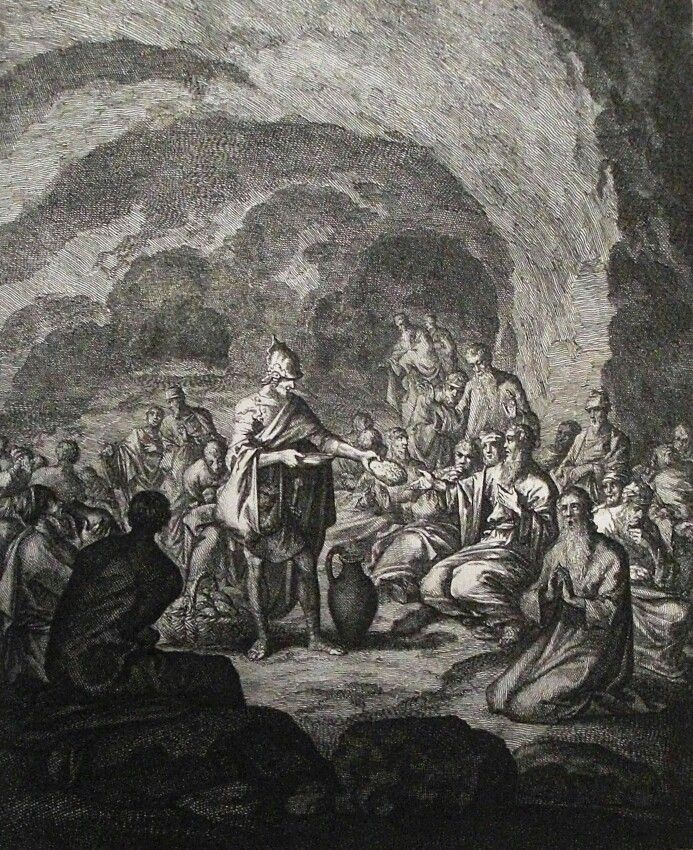
Obadiah Takes the Prophets to a Cave by Dutch engraver, Caspar Luyken (1672-1708)

For three years no rain fell in Samaria, and there was almost nothing to eat anywhere. The Lord said to Elijah, “Go and meet with King Ahab. I will soon make it rain.” So, Elijah went to see Ahab.

At that time Obadiah oversaw Ahab’s palace, but he faithfully worshiped the Lord. In fact, when Jezebel was trying to kill the Lord’s prophets, Obadiah hid one hundred of them in two caves and gave them food and water.

Ahab sent for Obadiah and said, “We have to find something for our horses and mules to eat. If we don’t, we will have to kill them. Let’s look around every creek and spring in the country for some grass. You go one way, and I’ll go the other.” Then they left in separate directions.

As Obadiah was walking along, he met Elijah. Obadiah recognized him, bowed down, and asked, “Elijah, is it really you?”

“Yes. Go tell Ahab I’m here.”

Obadiah replied:King Ahab would kill me if I told him that. And I haven’t even done anything wrong. I swear to you in the name of the living Lord your God that the king has looked everywhere for you. He sent people to look in every country, and when they couldn’t find you, he made the leader of each country swear that you were not in that country. Do you really want me to tell him you’re here?

What if the Lord’s Spirit takes you away as soon as I leave? When Ahab comes to get you, he won’t find you. Then he will surely kill me.

I have worshiped the Lord since I was a boy. I even hid one hundred of the Lord’s prophets in caves when Jezebel was trying to kill them. I also gave them food and water. Do you really want me to tell Ahab you’re here? He will kill me!

Elijah said, “I’m a servant of the living Lord All-Powerful, and I swear in his name that I will meet with Ahab today.”

Obadiah left and told Ahab where to find Elijah.

Ahab went to meet Elijah, and when he saw him, Ahab shouted, “There you are, the biggest troublemaker in Israel!”

Elijah answered:You’re the troublemaker—not me! You and your family have disobeyed the Lord’s commands by worshiping Baal.” (CEV)

Obadiah was the overseer in charge of King Ahab’s palace in Samaria of ancient Israel. To put it mildly, Ahab was a rascal. Old Testament stories frequently and purposefully contrast characters so that we will easily discern ethical differences between good and evil. Here we have a clear contrast between the godly and faithful Obadiah and the downright wicked royal couple of Ahab and Jezebel.

Whereas Obadiah was trying to preserve life and went to great lengths to do so, Ahab and Jezebel were doing everything in their sinister power to destroy life. The entire drama plays out like an episode of House of Cards. Ahab and Jezebel were a real king and queen who were thoroughly selfish and evil in all their dealings. Ahab, enabled and emboldened by his pagan wife, did away with the true worship of God and established the worship of Baal in the land of Israel. 

This did not mean, however, that God was absent or inactive. Rather, the Lord was working behind the scenes to undermine the systemic evil in the kingdom through his servant, Obadiah, who was devoted to God. Obadiah was neither a prophet nor a priest. He was simply a man working in an ungodly kingdom, doing the best he could to serve the Lord. 

Elijah may have had the prophetic voice and power, but Obadiah was the backstage administrator, daily cobbling together a living for hundreds of people without any support from the royal pain-in-the-butts.

Our ordinary everyday vocations and jobs have been ordained by God to use us where we are. Instead of lamenting our limitations or wishing the situation were different, we all have an opportunity for God to work through us in our current positions and stations in life. 

Every one of us has the daily opportunity to integrate our faith and our work through connecting biblical ethics to concrete applications at our jobs; seeing our workplaces as mission fields; interpreting our work through a Christian worldview; discerning our vocation as a calling from God; and, knowing our work is a means for God to transform and sanctify us.

So, how do you view your job?  How might you connect your faith and your work?  How does what you do reflect the nature and character of God?  In what ways do you think God wants to use you in your workplace?

Sovereign God, you cause nations and institutions to rise and fall; you set up leaders to rule and put them down.  Take my life and my work and use it in redemptive ways that glorify the name of Jesus and exemplify the power of the Holy Spirit.  Amen.

Discovering Yourself in the Bible

Elijah

The Holy Scriptures are timeless.  All kinds of people throughout the ages have been drawn to discover it.  One of the reasons we are interested in the Bible and become tethered to its contents is that we often resonate deeply with many of its characters.

A good and healthy spiritual exercise is to connect and project yourself into the pages of God’s Word.  To relate, express, and find a common human condition with ancient believers is a means of strengthening your faith, uncovering your own spiritual journey, and paying attention to the soundings of your soul.

Let me demonstrate what I’m talking about through speaking of my own life and the life of a famous biblical character….

I feel like Elijah.  Elijah was an Old Testament prophet who acted with unusual faith, single-handedly took on the ungodly Queen Jezebel, sparked a national revival, fell into a dark depression, allowed God to extend him pastoral care and comfort, learned to not journey alone in his faith through mentoring another great prophet of Israel, Elisha, and was taken up to heaven in a chariot of fire.

As far as prophets go, we have a great deal of information on Elijah in the biblical accounts.  Our introduction to him goes as follows: “Elijah was a prophet from Tishbe in Gilead.  One day he went to King Ahab and said, ‘I’m a servant of the living LORD, the God of Israel.  And I swear in his name that it won’t rain until I say so.  There won’t even be any dew on the ground.” (1 Kings 17:1). And it happened just as Elijah said it would.

I’m a believer in making simple observations of the Bible.  What stands-out to me foremost is Elijah’s solitary behavior.  He initiated and acted alone.  Elijah saw the systemic evil of Ahab and Jezebel’s reign in Israel and he boldly spoke truth to power.  Whether Elijah had thought through the consequences of his words or not, we don’t know.  But we are aware that this was understandably not received well, at all.

If Elijah was alone before, now he is driven to a life of solitude with only ravens for company (1 Kings 17:5-6).  I resonate deeply with Elijah on this.  I tend to think in organization and order.  When I see systems in place which oppress, hurt, and damage people instead of helping them to succeed, thrive, and flourish, it disturbs me.  Elijah was a solitary kind of guy, that is, until a system of injustice was in power.  Then, he used his speech to agitate for what is right.

In many jobs I have had throughout my life, I’ve had a kind of “Elijah” experience.  I see systemic issues which keep marginal people on the outside. Meanwhile, those on the inside enjoy the perks of power.  Sometimes I’ve been fired for calling-out corporate owners and vice-presidents, church elders, and denominational leaders for their exclusive policies and procedures which only benefit themselves.

This might sound commendable, except for the fact that I almost always acted alone on my own initiative without building a coalition of other concerned people.  Instead, I tended to think that I was the only one who cared and stepped forward, making myself a target that people couldn’t miss.  I wonder if Elijah, like me, was thoughtful and introverted with a close relationship with his God, yet with a fear of human relationships.

The event in Elijah’s life which defined him as a great prophet was the showdown with the four-hundred fifty prophets of Baal, of whom the Israelites had religiously prostituted themselves.  You don’t get any more John Wayne than one person versus four-hundred fifty.  In one of the best sarcastic statements you’ll find anywhere, Elijah said to the prophets of Baal who spent the entire morning trying to get their god to respond: “Pray louder! Maybe Baal is daydreaming or using the toilet or traveling somewhere.  Or maybe he’s asleep, and you have to wake him up.” (1 Kings 18:27, CEV)

Elijah on Mt Carmel

Elijah statue on Mount Carmel

Sometimes, for me, it seems easier to confront four-hundred fifty people than have an intimate encounter with one person.  I often find it more effortless to preach to thousands of people (of which I’ve done many times) than to connect meaningfully with one of them.  To me, Elijah sometimes seems like a contradiction, having within himself a great capacity for faith along with an equally large expanse of fear.

This bundle of contradiction is seen in the aftermath of the national revival Elijah helped to spark.  Through a miraculous display of the living God responding to Elijah’s sacrifice, the prophets of Baal were done away with (literally) and the worship of Israel’s God was immediately returned.  Queen Jezebel, the chief architect of establishing Baal worship in Israel, was not having this revival of Israelite religion.  A deeply symbolic heavy rain came with it, ending three years of drought, which only made Jezebel angry and on a mission.

Jezebel got a message straightaway to Elijah: “You killed my prophets.  Now I’m going to kill you!  I pray that the gods will punish me even more severely if I don’t do it by this time tomorrow.” (1 Kings 19:2).  The prophet who took on an entire establishment and saw the miraculous done right in front of his eyes had this response to the wicked queen: he was afraid, ran away, and said to God, “I’ve had enough.  Just let me die!  I’m no better off than my ancestors.” (1 Kings 19:3-4)

Elijah was, in contemporary terms, burned-out and exhausted – and he became terribly depressed.  It’s as if Elijah had identified himself with taking down the establishment for so long that when it happened, he was lost.  Who was he now?  The scaffolding of prophetic witness was gone, and Elijah was left face-to-face with his naked self.

I feel Elijah’s pain.  I know the sense of laboring to do good and being spiritually and emotionally spent to the point of just wanting to die and be done with all the brokenness of this old fallen world.  I have felt the awkwardness of identifying with a role, and when that role is gone there is only my true self and the God I serve.

But God, the ultimate spiritual caregiver, sent his angel to help Elijah in his broken state.  He fed him, let him sleep, and sent him on a sacred journey to growth as a transformed person.  Rather than exhort Elijah in his penchant for solitary action, God simply asked him a question: “Why are you here?”  After listening to Elijah express his narrow thinking on how the world works, God simply asked him again: “Elijah, why are you here?” (1 Kings 19:9-14)

That simple question lingered with Elijah and changed him.  From that point forward, Elijah seems to move with a quiet confidence that doesn’t come from a place of acting alone.  He doesn’t carry the world on his shoulders.  He isn’t quick to identify himself as a prophet.  His zeal for God remains yet is focused into including others.  Elijah goes from his sacred encounter with God and finds Elisha, who, by all appearances, is just a plain non-descript Israelite farmer.  No longer does Elijah walk alone.  His protégé, Elisha, is with him until the end of his life here on this earth.  And when Elijah is gone, Elisha inherits a double-portion of his mentor’s spirit and goes on to be a powerful prophet in his own right.

One of the best decisions I ever made in my life was, after going through a debilitating depression, I made it my aim and goal to mentor others in the faith.  I never went for a solo pastorate, always looked to build into the lives of younger ministers and found the value of traveling with companions in my pilgrimage of faith.

Unlike Elijah, I’m still on this earth and not likely to be swept up in a chariot of fire anytime soon.  I’m still figuring out who Tim Ehrhardt really is underneath the academic degrees, ministry successes and failures, and all the roles and responsibilities in my life.  There’s both faith and fear wrapped up in it all.  I still struggle with the old lies that my identity is in what I have, what I do, and in the attention and accolades of others.  I continue to wrestle with the compulsion to reform church and society and find it difficult to savor what is already present.

I see Elijah as a prophet with a deep faith that influenced everything he said and did. Yet, at the same time, he was a flawed man who was often characterized and paralyzed by fear and maybe acted from a place of self-righteousness more than he realized. What is clear to me, however, is that Elijah saw himself transformed as he allowed his God to care for him in ways that changed his life forever.  And that is the kind of spirit I’d like to inherit from my spiritual ancestor.