A Better System (Hebrews 7:11-22)

Mosaic of Melchizedek, in the Church of Sant’Apollinare, Ravenna, Italy, c.5th century, C.E.

If perfection could have been attained through the Levitical priesthood—and indeed the law given to the people established that priesthood—why was there still need for another priest to come, one in the order of Melchizedek, not in the order of Aaron? 

For when the priesthood is changed, the law must be changed also. He of whom these things are said belonged to a different tribe, and no one from that tribe has ever served at the altar. 

For it is clear that our Lord descended from Judah, and in regard to that tribe Moses said nothing about priests. And what we have said is even more clear if another priest like Melchizedek appears, one who has become a priest not on the basis of a regulation as to his ancestry but on the basis of the power of an indestructible life. For it is declared:

“You are a priest forever,
    in the order of Melchizedek.”

The former regulation is set aside because it was weak and useless (for the law made nothing perfect), and a better hope is introduced, by which we draw near to God.

And it was not without an oath! Others became priests without any oath, but he became a priest with an oath when God said to him:

“The Lord has sworn
    and will not change his mind:
    ‘You are a priest forever.’”

Because of this oath, Jesus has become the guarantor of a better covenant. (New International Version)

The author of the Book of Hebrews argued that the old Levitical sacrificial system was temporary; it was never designed to be permanent. And because it was temporary, the system was insufficient in bringing restoration to God and settling the sin issue once and for all.

Only Jesus could bring perfection to worshipers; the Levitical priests could not. The old system is obsolete, because of Christ. Jesus has brought a new and better way.

Before Google, Wikipedia, and the internet, there were actual physical libraries with lots of books. In order to research anything, you needed to go to the library, use the card catalogue to access what book(s) you needed, check them out, and pour over them to find the information you need.

I grew up in an era of typewriters. I learned to use one. All through my high school and college undergraduate years, I would draft all of my papers by writing with a pen on a legal pad of paper (I have to spell out what it actually was, because not everyone knows what it was like back in the day!).

Then, I would manually type my paper draft on a typewriter. If I made a mistake, I would have to use a fluid called “white out” to cover it, and then type the correction over it. As you can either remember, or imagine, this was a painstaking process.

Finally, the paper was physically submitted to the professor, in person. If you lost the document, or spilled something all over it, you would have to type it all over again.

But back then, when I was doing it, I didn’t know any better. There was no other way to get your papers researched, typed, and submitted.

Computers and the internet changed everything. It made library card catalogues with the Dewey Decimal System, and manual typewriters obsolete.

I have “written” thousands of documents since getting my first computer. A lot of my research is now done on a computer, via the internet. I can draft and finalize a document in one place. And when I’m done, I simply attach the virtual document to an email and send it. The entire process of “writing a paper” takes a fraction of the time it took me decades ago – with a lot less hassle.

I still remember some people ridiculing computers when they first came out. They said it was a fad that wouldn’t last; and just a way for electronic companies to fleece money from us in order to pay for one of the newfangled contraptions.

You will now find all the tools I once used to write a college term paper in antique stores and museums. They are obsolete. A better system now helps us all.

The old sacrificial system compared to Christ’s once for all sacrifice is even more pronounced than typewriters and computers, library books and the internet.

The author of Hebrews argued and insisted that the person and work of Jesus Christ is vastly superior and better than the Old Testament sacrificial system handled by the Levitical priesthood. It’s not even close.

The new covenant has replaced the old. We can be close to God and enjoy God because of Jesus, without using a typewriter.

The old way wasn’t bad; it’s just been replaced by a better way. Jesus is the way.

None of this came about haphazardly. It was according to God’s purpose, which is why the author of Hebrews referred to Old Testament passages to reveal that it has always been the divine purpose to have a priest forever in the order of Melchizedek, not Aaron.

God has made an oath and will not change the divine mind about it: Jesus Christ is a priest forever, permanently, eternally. With the permanence of Christ’s person and work, our hope is secure.

You cannot improve on perfection. The work is finished. All there is left to do is exercise faith, hope, and love, according to the system that is now permanently in place.

So, the ancient Jewish Christians were not to be fooled in thinking they could go back to the old Judaism they grew up with. They needed to persevere in faith and patience by sticking with the system of perfection, and with the perfector of our faith, Jesus Christ our Lord.

Let us keep our eyes fixed on Jesus, on whom our faith depends from beginning to end. He did not give up because of the cross! On the contrary, because of the joy that was waiting for him, he thought nothing of the disgrace of dying on the cross, and he is now seated at the right side of God’s throne.

Think of what he went through; how he put up with so much hatred from sinners! So do not let yourselves become discouraged and give up. (Hebrews 12:2-3, GNT)

Almighty God,
all thoughts of truth and peace
proceed from you.
Kindle in the hearts of all people
the true love of peace.
Guide with your pure and peaceable wisdom
those who take counsel
for the nations of the earth;
that in tranquility, your kingdom
may go forward,
till the earth is filled
with the knowledge of your love;
through Jesus Christ our Lord. Amen.

Jesus Is Better (Hebrews 7:1-10)

Abraham meets Melchizedek, 13th century mosaic, Basilica di San Marco, Venice, Italy

This Melchizedek was king of Salem and priest of God Most High. He met Abraham returning from the defeat of the kings and blessed him, and Abraham gave him a tenth of everything. First, the name Melchizedek means “king of righteousness;” then also, “king of Salem” means “king of peace.” Without father or mother, without genealogy, without beginning of days or end of life, resembling the Son of God, he remains a priest forever.

Just think how great he was: Even the patriarch Abraham gave him a tenth of the plunder! Now the law requires the descendants of Levi who become priests to collect a tenth from the people—that is, from their fellow Israelites—even though they also are descended from Abraham. This man, however, did not trace his descent from Levi, yet he collected a tenth from Abraham and blessed him who had the promises. And without doubt the lesser is blessed by the greater. In the one case, the tenth is collected by people who die; but in the other case, by him who is declared to be living. One might even say that Levi, who collects the tenth, paid the tenth through Abraham, because when Melchizedek met Abraham, Levi was still in the body of his ancestor. (New International Version)

We all become discouraged at various times in our lives; it’s part of being human. Chronic discouragement, however, can turn into a resignation to one’s apparent fate. It can cause us to give up.

That is where the Jewish Christians were, both spiritually and emotionally, in the New Testament Book of Hebrews. As Jews, they were living in a pagan Gentile world which did not appreciate their religious and cultural differences. As Christians, they lived with isolation from their Jewish families who did not understand their faith commitment to Christ and the Church.

It’s one thing to become discouraged. It’s another thing altogether to never have your situation change. Day after day, the Jewish Christians faced hardship, even persecution. So, over time, their faith and resolve to serve Jesus began weakening. They were in danger of reneging on their cherished beliefs and way of life.

This is why the author of Hebrews stepped in to address the situation. He wanted to encourage the struggling believers to not give up, to persevere in their faith. In order to do that, the Christians would need to fix their eyes on Jesus.

Instead of returning to Judaism, the Jewish Christians were encouraged to see how Jesus is superior to every important person in history, and better than the legal and sacrificial systems that they came from.

In chapter 7 of Hebrews, the author is continuing an argument that Jesus is better than the high priest Aaron (Hebrews 4:14-10:18). Part of that argument was to highlight the significance of an ancient king, Melchizedek, who was both a king and a priest of the Most High God.

The line of reasoning goes like this:

  • Melchizedek was a king and a priest in the time of Abraham.
  • Abraham acknowledged Melchizedek as such, and recognized his greatness and authority.
  • Therefore, Melchizedek is superior to the founder and patriarch of Jewish faith, Abraham.
  • Jesus is both a king and a priest, like Melchizedek.
  • Aaron is a priest, not a king.
  • Jesus is superior to Aaron; Aaron’s ministry was temporary, and Christ’s reign is permanent.

Specifically, regarding the lesson today, the argument is this:

  • Descendants of Levi were priests in Israel.
  • Levi was the ancestor of Aaron, the original Levitical high priest.
  • Abraham was the great grandfather of Levi.
  • Abraham was patriarch, and therefore, greater than Levi.
  • Melchizedek is greater than Abraham.

And so, the author of Hebrews was making this argument:

Jesus is a priest and king, like Melchizedek. Therefore, Jesus is superior to Abraham, Levi, Aaron, and all of the Levitical priests.

The Book of Hebrews insists that Jesus is greater than all other Jewish persons in history; and is superior to the old Levitical sacrificial system. Every Levitical priest lived and died. Jesus lived and died and rose from death. Therefore, Christ’s priesthood is still in existence. It is permanent.

From the New Testament perspective, Christ’s death and resurrection has replaced the Levitical priesthood as a new and better system of order. It’s new and better because, whereas the Levitical priests offered sacrifices day after day, Christ offered himself, once for all. The Cross of Christ was the sacrifice to end all sacrifices.

This spiritual reality, presented to the Jewish Christians in the ancient world, was meant to encourage them to hold fast in their commitment to Jesus.

We now have the privilege of coming to God without any spiritual hurdles to jump or obstacles to overcome, because Jesus made it possible.

God is available to us at all times, without having to offer a sacrifice in order to enter God’s presence, because the curtain of the temple has been torn in two.

Christ Jesus has finished the sacrificial work, and made it possible for every believer to come to God by faith alone.

So, don’t give up. Be encouraged with Jesus, the Savior and Sovereign of the universe, the Sustainer and Helper in a time of need, and the great King and High Priest who lives even now to intercede for us.

Hebrews is a somewhat long book in the New Testament of the Bible, encompassing thirteen chapters in all. It’s contents may sometimes seem dense and/or confusing. Yet, if you read through it, in one sitting, I believe you will come away encouraged and motivated to persevere and keep going.

Be patient, my friend. The situations which are now discouraging you will not last. And there is a King and High Priest who will last forever, and who has your back through all of the icky sticky circumstances of your life.

Fix your eyes on Jesus, the author and perfector of our faith.

Accept, O Lord, our thanks and praise for all that you have done for us. We thank you for the splendor of the whole creation, for the beauty of this world, for the wonder of life, and for the mystery of love.

Above all, we thank you for your Son Jesus Christ; for the truth of his Word and the example of his life; for his steadfast obedience, by which he overcame temptation; for his dying, through which he overcame death; and for his rising to life again, in which we are raised to the life of your kingdom.

Grant us the gift of your Spirit; that we may know you and make you known; and through your Spirit, at all times and in all places, may give thanks to you in all things. Amen.

The Mediator and Leader (Psalm 110:1-4)

The Lord said to my lord,
    “Sit here at my right side
    until I put your enemies under your feet.”
From Zion the Lord will extend your royal power.
    “Rule over your enemies,” he says.
On the day you fight your enemies,
    your people will volunteer.
Like the dew of early morning
    your young men will come to you on the sacred hills.

The Lord made a solemn promise and will not take it back:
    “You will be a priest forever
    in the priestly order of Melchizedek.” (Good News Translation)

This is the most quoted psalm in the New Testament (twenty-four times) with the reason being that the apostles discerned Jesus as the messianic ruler of Psalm 110. The author of Hebrews purposed to highlight the superiority of Jesus Christ over everyone and everything. So, he went to this psalm, and used it early in his letter for the beginning of his argument:

In the past God spoke to our ancestors through the prophets at many times and in various ways, but in these last days he has spoken to us by his Son, whom he appointed heir of all things, and through whom also he made the universe. The Son is the radiance of God’s glory and the exact representation of his being, sustaining all things by his powerful word. After he had provided purification for sins, he sat down at the right hand of the Majesty in heaven. So, he became as much superior to the angels as the name he has inherited is superior to theirs….

But about the Son he says,

“Your throne, O God, will last for ever and ever;
    a scepter of justice will be the scepter of your kingdom.
You have loved righteousness and hated wickedness;
    therefore God, your God, has set you above your companions
    by anointing you with the oil of joy.”

He also says,

“In the beginning, Lord, you laid the foundations of the earth,
    and the heavens are the work of your hands.
They will perish, but you remain;
    they will all wear out like a garment.
You will roll them up like a robe;
    like a garment they will be changed.
But you remain the same,
    and your years will never end.”

To which of the angels did God ever say,

“Sit at my right hand
    until I make your enemies
    a footstool for your feet”? (Hebrews 1:1-13, NIV)

In Christianity, Jesus is the ultimate Mediator between God and humanity. Neither angel nor any other human can fill such a role. The author of Hebrews wanted to make it clear that Jesus is the rightful Ruler of all creation.

Christ’s authority is far and above all others. So, Christians are never defenseless in this world. Believers have a caring mediator, and a powerful sovereign, knowing that Jesus has the authority to back up his words of love and assurance toward us.

Jesus has the unique combination of being both a king and a priest; he intercedes for us and provides us with compassionate leadership. Again, in the middle of his argument, the author of Hebrews used Psalm 110 to emphasize this:

Every high priest is selected from among the people and is appointed to represent the people in matters related to God, to offer gifts and sacrifices for sins. He can deal gently with those who are ignorant and are going astray, since he himself is subject to weakness. Therefore, he has to offer sacrifices for his own sins, as well as for the sins of the people. And no one takes this honor on himself, but he receives it when called by God, just as Aaron was.

In the same way, Christ did not take on himself the glory of becoming a high priest. But God said to him,

“You are my Son;
    today I have become your Father.”

And he says in another place,

“You are a priest forever,
    in the order of Melchizedek.”

During the days of Jesus’ life on earth, he offered up prayers and petitions with fervent cries and tears to the one who could save him from death, and he was heard because of his reverent submission. Son though he was, he learned obedience from what he suffered and once made perfect, he became the source of eternal salvation for all who obey him and was designated by God to be high priest in the order of Melchizedek. (Hebrews 5:1-10, NIV)

Christ demonstrated and proved that he is qualified to be the rightful priest and king because of his obedient suffering. Therefore, Jesus is perfectly suited and able to help us. He is neither a detached nor an aloof priestly king.

The Lord Jesus knows exactly what it’s like to be a human in this broken and fallen world. Such divine empathy translates into solid emotional and spiritual support because, as the Christian tradition holds, Jesus has taken care of the sin issue once for all through the Cross.

The Messiah’s enemies – whose eventual and final defeat is certain – are not Gentile kingdoms or human institutions. Christ’s ultimate foes are the hostile and evil principalities and powers of this dark world, including death itself. The universal reign of Jesus, the exalted Son of David, brings deliverance from guilt, shame, and injustice as the unique God-Man.

In this unabashed Christian view of Psalm 110, Jesus is our perfected high priest who is able for all time to save those who approach God, since he always lives to make intercession for us (Hebrews 7:25). The appropriate response to such a great king and priest is submissive loyalty and eternal praise.

O Lord our God: Reign in power over us, through your Son, Jesus Christ – for he is exalted over all governments and authorities, all ideologies and creeds, and all human hearts and souls. King Jesus: Be enthroned in our lives, in all people everywhere, as our mediator and atoning sacrifice. Spirit of God: Reign in power over us through Jesus Christ and give us the victory over all the enemies of our souls, within and without, for the glory of your Name. Amen.

Psalm 110 – The Priest King

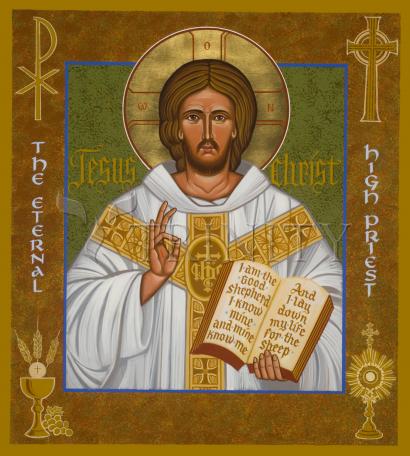
Jesus Christ – Eternal High Priest by American painter Joan Cole

The Lord says to my lord:

“Sit at my right hand
    until I make your enemies
    a footstool for your feet.”

The Lord will extend your mighty scepter from Zion, saying,
    “Rule in the midst of your enemies!”
Your troops will be willing
    on your day of battle.
Arrayed in holy splendor,
    your young men will come to you
    like dew from the morning’s womb.

The Lord has sworn
    and will not change his mind:
“You are a priest forever,
    in the order of Melchizedek.”

The Lord is at your right hand;
    he will crush kings on the day of his wrath.
He will judge the nations, heaping up the dead
    and crushing the rulers of the whole earth.
He will drink from a brook along the way,
    and so he will lift his head high. (NIV)

Today’s reading is the most quoted psalm in the New Testament (twenty-four times) and is mentioned in the Apostle’s Creed. The reason for this is, of course, because Christ’s apostles discerned Jesus as the messianic ruler of the psalm. The writer of Hebrews had the purpose of emphasizing the superiority of Jesus Christ over all others, and so, lifted this psalm, along with other psalms, and placed it in the beginning of his argument:

In the past God spoke to our ancestors through the prophets at many times and in various ways, but in these last days he has spoken to us by his Son, whom he appointed heir of all things, and through whom also he made the universe. The Son is the radiance of God’s glory and the exact representation of his being, sustaining all things by his powerful word. After he had provided purification for sins, he sat down at the right hand of the Majesty in heaven. So, he became as much superior to the angels as the name he has inherited is superior to theirs….

But about the Son he says,

“Your throne, O God, will last for ever and ever;
    a scepter of justice will be the scepter of your kingdom.
You have loved righteousness and hated wickedness;
    therefore God, your God, has set you above your companions
    by anointing you with the oil of joy.”

He also says,

“In the beginning, Lord, you laid the foundations of the earth,
    and the heavens are the work of your hands.
They will perish, but you remain;
    they will all wear out like a garment.
You will roll them up like a robe;
    like a garment they will be changed.
But you remain the same,
    and your years will never end.”

To which of the angels did God ever say,

“Sit at my right hand
    until I make your enemies
    a footstool for your feet”? (Hebrews 1:1-13, NIV)

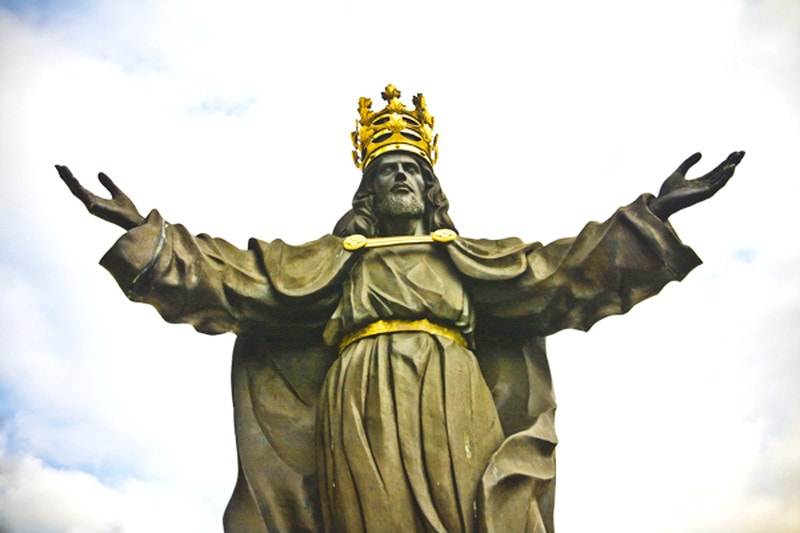
Jesus the King of the World in Czestochowa, Poland

In Christianity, Jesus is the ultimate Mediator between God and people. Neither angel nor any human can fill such a role. The author of Hebrews wanted to make it clear that Jesus is the rightful Ruler of all creation. Christ’s authority is far and above all others. So, Christians are never defenseless in this world. Believers have a sovereign Mediator and King to willingly submit to, knowing that Jesus has the power and authority to back up his words of love and assurance.

Jesus has the unique combination of being both King and Priest, the One who intercedes for us and leads us with compassionate leadership. Again, the author of Hebrews uses Psalm 110 to emphasize this:

Every high priest is selected from among the people and is appointed to represent the people in matters related to God, to offer gifts and sacrifices for sins. He can deal gently with those who are ignorant and are going astray, since he himself is subject to weakness. Therefore, he has to offer sacrifices for his own sins, as well as for the sins of the people. And no one takes this honor on himself, but he receives it when called by God, just as Aaron was.

In the same way, Christ did not take on himself the glory of becoming a high priest. But God said to him,

“You are my Son;
    today I have become your Father.”

And he says in another place,

“You are a priest forever,
    in the order of Melchizedek.”

During the days of Jesus’ life on earth, he offered up prayers and petitions with fervent cries and tears to the one who could save him from death, and he was heard because of his reverent submission. Son though he was, he learned obedience from what he suffered and once made perfect, he became the source of eternal salvation for all who obey him and was designated by God to be high priest in the order of Melchizedek. (Hebrews 5:1-10, NIV)

Jesus Christ demonstrated and proved he is qualified to be the rightful Priest and King through obedient suffering. That means he is perfectly suited and able to help us. Christ is no detached and aloof King and Priest. He knows exactly what it is like to be a human in this broken and fallen world. Such divine empathy translates into solid emotional and spiritual support because, as the Christian tradition holds, Jesus has taken care of the sin issue once for all through the Cross.

The Messiah’s enemies, whose final defeat is certain, are not Gentile kingdoms or human institutions. The ultimate foes are the hostile and evil principalities and powers of this dark world, including death itself. The universal reign of Jesus, the exalted Son of David, brings deliverance from guilt, shame, and injustice as the unique God-Man.

In this unabashed Christian view of Psalm 110, Jesus is our perfected high priest who is able for all time to save those who approach God, since he always lives to make intercession for us. (Hebrews 7:25)

The appropriate response to such a great King and Priest is submissive loyalty and eternal praise.

May it be so to the glory of God.

O Lord our God: Reign in power over us, through your Son, Jesus Christ – for he is exalted over all governments and authorities, all ideologies and creeds, and all human hearts and souls. King Jesus: Be enthroned in our lives, in all people everywhere, as our mediator and atoning sacrifice. Spirit of God: Reign in power over us through Jesus Christ and give us the victory over all the enemies of our souls, within and without, for the glory of your Name. Amen.