Don’t Assume (Job 32:1-22)

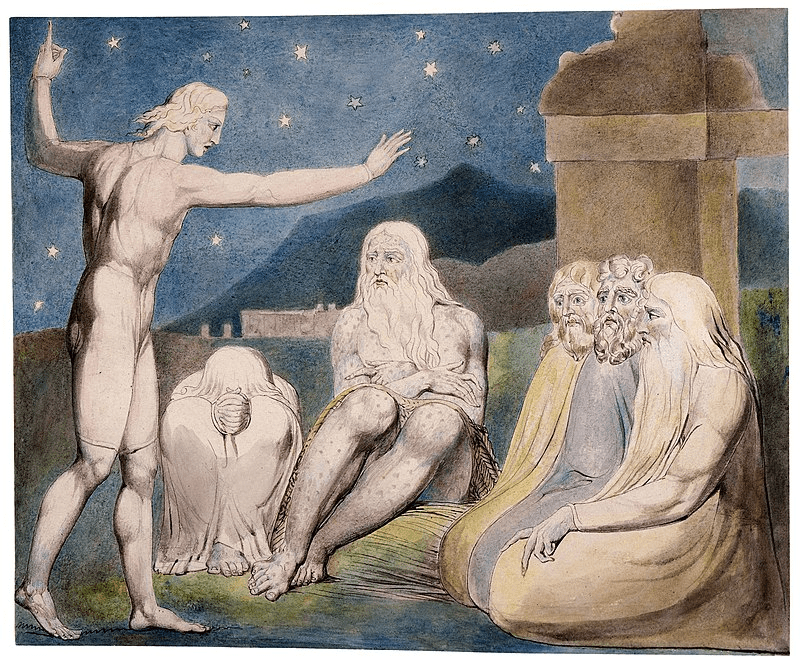
The Wrath of Elihu, by William Blake, 1805

Finally, these three men stopped arguing with Job, because he refused to admit he was guilty.

Elihu from Buz was there, and he had become upset with Job for blaming God instead of himself. He was also angry with Job’s three friends for not being able to prove that Job was wrong. Elihu was younger than these three, and he let them speak first. But he became irritated when they could not answer Job, and he said to them:

I am much younger than you,
so I have shown respect
    by keeping silent.
I once believed age
    was the source of wisdom;
now I truly realize
    wisdom comes from God.
Age is no guarantee of wisdom
    and understanding.
That’s why I ask you
    to listen to me.

I eagerly listened
    to each of your arguments,
but not one of you proved
    Job to be wrong.
You shouldn’t say,
“We know what’s right!
    Let God punish him.”
Job hasn’t spoken against me,
and so I won’t answer him
    with your arguments.

All of you are shocked;
    you don’t know what to say.
But am I to remain silent,
just because you
    have stopped speaking?
No! I will give my opinion,
because I have so much to say,
    that I can’t keep quiet.
I am like a swollen wineskin,
and I will burst
    if I don’t speak.
I don’t know how to be unfair
    or to flatter anyone—
if I did, my Creator
    would quickly destroy me! (Contemporary English Version)

Job and his three friends had talked themselves out. There were plenty of words and frustration, with nothing left but an impasse. We anticipate hearing from God….

But there is yet another who was present with Job and his companions. Elihu was a young man in tow with the older three friends. He respectfully held back and observed all the proceedings between the four men. As he watched, the angrier he became, to the point of feeling the need to speak up and offer his own voice concerning Job’s terrible suffering and trouble.

Elihu was angry because he believed Job was setting up himself as more righteous than God. And he was also perturbed with the three friends. He viewed them as bungling their argument against Job, offering no convincing answers.

Within the scope of what Elihu and the friends were talking about, the arguments were indeed found lacking. No one had the necessary wisdom to handle Job’s case.

But therein lies the problem. The assumptions are presuppositions which underlie all the arguments and speeches were off. The friends simply assumed Job was sinful, because they presupposed that anyone undergoing such terrible suffering is being punished by God.

Therefore, all of the bluster was doomed to go nowhere. Underneath all of the exhausting chaos was a cosmic drama which none of the human actors were privy to. In other words, nobody knew what they were talking about.

God only seems to be silent and absent from the perspective of us humans. We are an impatient people. Much like Elihu, we sit on our hands and bite our lips, waiting to get out what we want to say.

I wonder how much of Elihu’s listening wasn’t actually listening, but was thinking about what he was going to say when he got his chance. Job’s friends were ineffective in proving Job wrong and guilty before God, according to Elihu.

But if any of us begin our thinking and our speaking with assumptions and presuppositions which are off base, then it’s likely that nearly all of our thoughts and words will be unhelpful and even hurtful.

Too many people have a compulsion to speak and get their own opinions out. Few persons, however, have the same sort of compulsion to truly observe, listen, and learn. So, what we typically get are Elihu-like belching of speech – which may make the person speaking feel better, yet leaves everyone else groaning for them to keep their mouth shut.

An unteachable spirit which values one’s own thoughts and opinions over others is the mark of a fool, and not a sage. There ought never to be more wind coming from someone’s mouth than from the weather.

Unfortunately, many people claim to know and understand more than they actually do. And just because someone occupies a high position does not necessarily mean they know what they’re talking about.

In our anger and perturbed states of mind, we vent and talk too much, as if we have the corner on truth. Yet, how much of our talking is really worth others listening to us?

Instead of assuming we already know what is happening with another, there are questions we can ask ourselves, which may help guide us to speak more truthfully with helpful, not hurtful, words.

The following few questions can help orient us with compassion toward what another is saying:

  • What is the main point being made?
  • What might be going through their mind when they say that?
  • What need do they have that they are trying to satisfy?
  • What is the motivation of the person speaking?

Just as important is our own self-awareness. These questions can help us monitor ourselves as we listen and respond to others:

  • How am I feeling right now in this moment?
  • What do I need right now?
  • Why does that particular statement or opinion irritate me so much?
  • How am I presenting myself right now – my affect, posture, and eye contact?

We can also ask questions of God during a conversation:

  • Will you please help me to understand the person and what is being said?
  • How does this square with my understanding of you and your Word?
  • Which values – that are important to You – apply to this discussion?
  • What do you want me to say and do?

You will say the wrong thing
    if you talk too much—
so be sensible and watch
    what you say. (Proverbs 10:19, CEV)

The Book of Job would likely look a lot different if Job’s friends had taken such a wise saying to heart.

The following is a prayer from St. Francis of Assisi:

Lord, make us instruments of your peace.
Where there is hatred, let us sow love;
where there is injury, pardon;
where there is discord, union;
where there is doubt, faith;
where there is despair, hope;
where there is darkness, light;
where there is sadness, joy.
Grant that we may not so much seek to be consoled as to console;
to be understood as to understand;
to be loved as to love.
For it is in giving that we receive;
it is in pardoning that we are pardoned;
and it is in dying that we are born to eternal life. Amen.

A Very Heavy Burden (Job 20:1-29)

Woman carrying a burden, by Eugène Jules Joseph Laermans, 1916

Then Zophar the Naamathite replied:

“My troubled thoughts prompt me to answer
    because I am greatly disturbed.
I hear a rebuke that dishonors me,
    and my understanding inspires me to reply.

“Surely you know how it has been from of old,
    ever since mankind was placed on the earth,
that the mirth of the wicked is brief,
    the joy of the godless lasts but a moment.
Though the pride of the godless person reaches to the heavens
    and his head touches the clouds,
he will perish forever, like his own dung;
    those who have seen him will say, ‘Where is he?’
Like a dream he flies away, no more to be found,
    banished like a vision of the night.
The eye that saw him will not see him again;
    his place will look on him no more.
His children must make amends to the poor;
    his own hands must give back his wealth.
The youthful vigor that fills his bones
    will lie with him in the dust.

“Though evil is sweet in his mouth
    and he hides it under his tongue,
though he cannot bear to let it go
    and lets it linger in his mouth,
yet his food will turn sour in his stomach;
    it will become the venom of serpents within him.
He will spit out the riches he swallowed;
    God will make his stomach vomit them up.
He will suck the poison of serpents;
    the fangs of an adder will kill him.
He will not enjoy the streams,
    the rivers flowing with honey and cream.
What he toiled for he must give back uneaten;
    he will not enjoy the profit from his trading.
For he has oppressed the poor and left them destitute;
    he has seized houses he did not build.

“Surely he will have no respite from his craving;
    he cannot save himself by his treasure.
Nothing is left for him to devour;
    his prosperity will not endure.
In the midst of his plenty, distress will overtake him;
    the full force of misery will come upon him.
When he has filled his belly,
    God will vent his burning anger against him
    and rain down his blows on him.
Though he flees from an iron weapon,
    a bronze-tipped arrow pierces him.
He pulls it out of his back,
    the gleaming point out of his liver.
Terrors will come over him;
    total darkness lies in wait for his treasures.
A fire unfanned will consume him
    and devour what is left in his tent.
The heavens will expose his guilt;
    the earth will rise up against him.
A flood will carry off his house,
    rushing waters on the day of God’s wrath.
Such is the fate God allots the wicked,
    the heritage appointed for them by God.” (New International Version)

Well, there you have it. Proof positive that God is merciful. The fact that the Lord kept his mouth shut after hearing all of Zophar’s supposed insight is amazing.

Illustration of Job and his friends from the Kiev Psalter, 1397

Zophar talked as if he had the inside scoop on the righteous and the wicked, and could tell the difference with ease. He is, however, another “friend” of Job who either could not or would not entertain the possibility that Job could be innocent and undeserving of such terrible suffering.

In addition, Zophar took the further step of accusing Job of being an enemy of God, and a secret sinner who was finally exposed and found out.

I have been in the position of being accused of sinful things that I did not do; and of being victimized by others who assume I must be a sinner because of a particular set of life circumstances. In some ways, it’s worse than the situation itself.

So, not only did Job experience the loss of family, property, and health; he also experienced gross misinterpretations of that experience from the very people who ought to have consoled and helped him through it.

Zophar sounds like one of those guys who always has to win an argument, always has to have an answer for everything, always talks himself into believing the things he says, and always has to have the last word.

I don’t need a “friend” like Zophar. I’ll take a friend like Jesus, who said things like this:

Now there were some present at that time who told Jesus about the Galileans whose blood Pilate had mixed with their sacrifices. Jesus answered, “Do you think that these Galileans were worse sinners than all the other Galileans because they suffered this way? I tell you, no! But unless you repent, you too will all perish. Or those eighteen who died when the tower in Siloam fell on them—do you think they were more guilty than all the others living in Jerusalem? I tell you, no! But unless you repent, you too will all perish.” (Luke 13:1-5, NIV)

Christ put the onus on repentance where it needed to be – not on the ones who suffered and died, but on the ones who offered their bogus interpretations of the suffering.

I am confident that Jesus would have had little tolerance for Zophar, and would not have treated Job in the way he was treated by his so-called friends.

Jesus extends an invitation to those who are experiencing such heavy burdens that they seem like crushing loads. That is certainly where Job was. His spiritual and emotional wounds were just as great as his painful physical situation.

Job needed help, and not people who would add to his already inconceivable burden.

Jesus said, “Come to me, all you who are weary and burdened, and I will give you rest. Take my yoke upon you and learn from me, for I am gentle and humble in heart, and you will find rest for your souls. For my yoke is easy and my burden is light.” (Matthew 11:28-30, NIV)

Jesus! what a Friend for sinners! (verse 3)

By J. Wilbur Chapman, 1910

Jesus! what a Help in sorrow!
While the billows o’er me roll,
even when my heart is breaking,
He, my Comfort, helps my soul.
Hallelujah! what a Savior!
Hallelujah! what a Friend!
Saving, helping, keeping, loving;
He is with me to the end.

Amen.

A Great Reversal (Esther 8:1-17)

Reversal, by Margarita Lypiridou, 2021

That same day King Xerxes gave Queen Esther the estate of Haman, the enemy of the Jews. And Mordecai came into the presence of the king, for Esther had told how he was related to her. The king took off his signet ring, which he had reclaimed from Haman, and presented it to Mordecai. And Esther appointed him over Haman’s estate.

Esther again pleaded with the king, falling at his feet and weeping. She begged him to put an end to the evil plan of Haman the Agagite, which he had devised against the Jews. Then the king extended the gold scepter to Esther and she arose and stood before him.

“If it pleases the king,” she said, “and if he regards me with favor and thinks it the right thing to do, and if he is pleased with me, let an order be written overruling the dispatches that Haman son of Hammedatha, the Agagite, devised and wrote to destroy the Jews in all the king’s provinces. For how can I bear to see disaster fall on my people? How can I bear to see the destruction of my family?”

King Xerxes replied to Queen Esther and to Mordecai the Jew, “Because Haman attacked the Jews, I have given his estate to Esther, and they have impaled him on the pole he set up. Now write another decree in the king’s name in behalf of the Jews as seems best to you, and seal it with the king’s signet ring—for no document written in the king’s name and sealed with his ring can be revoked.”

At once the royal secretaries were summoned—on the twenty-third day of the third month, the month of Sivan. They wrote out all Mordecai’s orders to the Jews, and to the satraps, governors and nobles of the 127 provinces stretching from India to Cush. These orders were written in the script of each province and the language of each people and also to the Jews in their own script and language. Mordecai wrote in the name of King Xerxes, sealed the dispatches with the king’s signet ring, and sent them by mounted couriers, who rode fast horses especially bred for the king.

The king’s edict granted the Jews in every city the right to assemble and protect themselves; to destroy, kill and annihilate the armed men of any nationality or province who might attack them and their women and children, and to plunder the property of their enemies. The day appointed for the Jews to do this in all the provinces of King Xerxes was the thirteenth day of the twelfth month, the month of Adar. A copy of the text of the edict was to be issued as law in every province and made known to the people of every nationality so that the Jews would be ready on that day to avenge themselves on their enemies.

The couriers, riding the royal horses, went out, spurred on by the king’s command, and the edict was issued in the citadel of Susa.

When Mordecai left the king’s presence, he was wearing royal garments of blue and white, a large crown of gold and a purple robe of fine linen. And the city of Susa held a joyous celebration. For the Jews it was a time of happiness and joy, gladness and honor. In every province and in every city to which the edict of the king came, there was joy and gladness among the Jews, with feasting and celebrating. And many people of other nationalities became Jews because fear of the Jews had seized them. (New International Version)

“So the last will be first, and the first will be last.”

Jesus (Matthew 20:16)

Knowing that someone is not who they present themselves as can be maddening. They’re selfish and enamored with having authority, yet everyone thinks they are okay.

Haman was a bad man who camouflaged himself as important. As the right hand man to King Xerxes of the vast Persian Empire, Haman valued position, power, and attention above all else. But his arrogance proved to be his downfall.

People who are concerned to be seen as important can never get enough. Haman was not satisfied to be the prime minister in the empire, even though millions of people bowed down to him.

Mordecai, a Jew, Queen Esther’s cousin, refused to bow down. He saw the pride and arrogance within Haman to have what only belongs to God.

Haman could not stomach this one Jew dismissing his power and authority. As a person who wanted only “yes men” around him, Haman was determined to eradicate Mordecai. And even that was not enough for him. So, Haman proposed the destruction of all Jews.

He was supposedly an imperial expert on “the Jewish problem.” So, King Xerxes listened to him when he hatched a devious strategy to rid the empire of all Jews. A decree was made that on a particular day the Jews could be destroyed and plundered.

But the real plan that resets all other plans is the plan of God. And God’s plans are for good, not evil; and for Jewish life, not death.

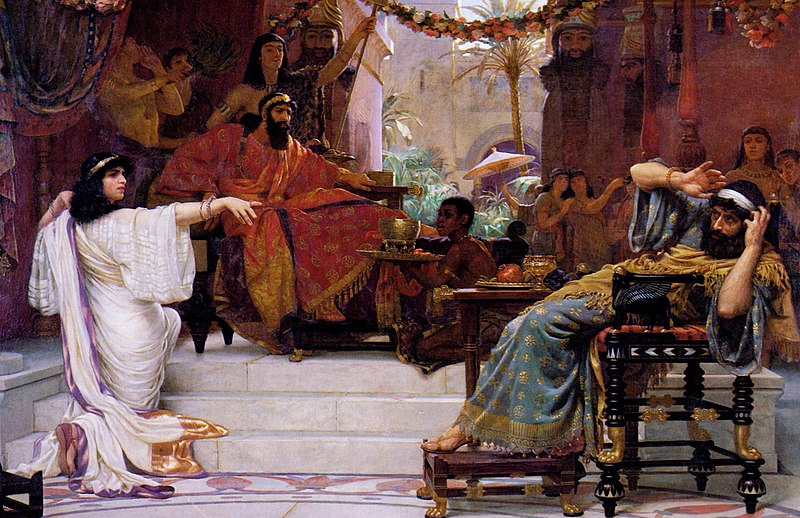
Esther Denouncing Haman, by Ernest Normand, 1888

Pride and arrogance never ends well for the proud and arrogant person. They may have their way for a while, but ultimately such people find that their evil plans come back on themselves.

So, one night when the king was unable to sleep, he had the annals of the kingdom read to him. He heard of Mordecai’s successful effort at saving the king’s life from an assassination plot. The king also learned that Mordecai had never been properly recognized and rewarded.

One of the main differences between the proud and the humble is that arrogant people are obsessed with recognition and rewards; whereas the humble person cares about what is right and just, viewing good deeds as their own reward.

As the king’s trusted right hand man, Haman was consulted as to what ought to be done for someone the king wants to honor. The proud person always believes the honored person is themselves.

So, Haman, believing Xerxes wanted to honor him, suggested an elaborate recognition ritual involving a parade and plenty of accolades.

The king, however, had this in mind for Mordecai. He ordered Haman to be the one who made sure the recognition happened. And that’s not all. Haman would also get retribution for his evil heart.

Behind the scenes of royal power and scuttlebutt, Esther and her people were praying and fasting. Esther had her own plans for good, and not for evil.

Of course, Haman believed that a banquet was being given in his honor by the queen. In reality, not at all.

Esther revealed to the king the true plot and hate against her own people. Enraged, King Xerxes demanded who would dare presume to do such a thing against his beloved queen and her people.

With Haman directly in front of them, Esther pointed out the adversary. And then, the gallows which Haman had made to hang Mordecai were used for his own execution. Thus ended the story of the villain Haman.

There was still, however, the problem of the royal decree to destroy the Jewish people on an appointed day. Haman had been dealt with, but there were still wide-ranging consequences of his actions that remained in effect, and that could only be dealt with at the political level.  

Queen Esther interceded to the king on behalf of her people. Although a decree from the king cannot be revoked, yet another decree could be written in another’s name that would counteract the first. And this is precisely what Mordecai and Esther did, with the king’s full knowledge and blessing to it.

Today’s Old Testament lesson is a great reversal of fortunes if there ever was one. The high position of Haman and his extreme hatred and arrogance are gone. The Jewish people, on the precipice of annihilation, are not only alive, but had the opportunity to pushback on their enemies. Mordecai was not hanged on a gallows, but became in charge of Haman’s entire estate.

This was a restoration beyond what anyone could have thought or imagined. And that is the sort of reversal which God specializes in.

You cannot fool God, so don’t make a fool of yourself! You will harvest what you plant. If you follow your selfish desires, you will harvest destruction, but if you follow the Spirit, you will harvest eternal life. Don’t get tired of helping others. You will be rewarded when the time is right, if you don’t give up. (Galatians 6:7-9, CEV)

God, I am far too often influenced by what others think of me. May I not pretend to be either richer or smarter or nicer than I really am. Please hinder me from trying to attract attention. Don’t let me gloat over praise on one hand or be discouraged by criticism on the other. Nor let me waste time weaving imaginary situations in which the most heroic, charming, witty person present is myself. Show me how to be humble of heart, like you. Amen.

When Things Are Screwy (Esther 3:1-15)

After these events, King Xerxes honored Haman son of Hammedatha, the Agagite, elevating him and giving him a seat of honor higher than that of all the other nobles. All the royal officials at the king’s gate knelt down and paid honor to Haman, for the king had commanded this concerning him. But Mordecai would not kneel down or pay him honor.

Then the royal officials at the king’s gate asked Mordecai, “Why do you disobey the king’s command?” Day after day they spoke to him but he refused to comply. Therefore they told Haman about it to see whether Mordecai’s behavior would be tolerated, for he had told them he was a Jew.

When Haman saw that Mordecai would not kneel down or pay him honor, he was enraged. Yet having learned who Mordecai’s people were, he scorned the idea of killing only Mordecai. Instead Haman looked for a way to destroy all Mordecai’s people, the Jews, throughout the whole kingdom of Xerxes.

In the twelfth year of King Xerxes, in the first month, the month of Nisan, the pur (that is, the lot) was cast in the presence of Haman to select a day and month. And the lot fell on[a] the twelfth month, the month of Adar.

Then Haman said to King Xerxes, “There is a certain people dispersed among the peoples in all the provinces of your kingdom who keep themselves separate. Their customs are different from those of all other people, and they do not obey the king’s laws; it is not in the king’s best interest to tolerate them. If it pleases the king, let a decree be issued to destroy them, and I will give ten thousand talents of silver to the king’s administrators for the royal treasury.”

So the king took his signet ring from his finger and gave it to Haman son of Hammedatha, the Agagite, the enemy of the Jews. “Keep the money,” the king said to Haman, “and do with the people as you please.”

Then on the thirteenth day of the first month the royal secretaries were summoned. They wrote out in the script of each province and in the language of each people all Haman’s orders to the king’s satraps, the governors of the various provinces and the nobles of the various peoples. These were written in the name of King Xerxes himself and sealed with his own ring. 

Dispatches were sent by couriers to all the king’s provinces with the order to destroy, kill and annihilate all the Jews—young and old, women and children—on a single day, the thirteenth day of the twelfth month, the month of Adar, and to plunder their goods. A copy of the text of the edict was to be issued as law in every province and made known to the people of every nationality so they would be ready for that day.

The couriers went out, spurred on by the king’s command, and the edict was issued in the citadel of Susa. The king and Haman sat down to drink, but the city of Susa was bewildered. (New International Version)

A Purim mask of Haman, by Mimi Gross, 1964

I don’t like arrogant people. I don’t like those who only think of themselves, and expect others to fall in line with them, too! It’s unlikely that an arrogant person would be reading or listening to this, namely because such individuals believe they are above the menial task of reading – unless it gets them more attention and/or power.

I don’t like Haman. The story clearly sets up Haman as the antagonist. He is a number one jerk in the first degree. Having a front row seat to his manipulative ways with the king arouses our sense of justice and injustice. Mordecai was the one person who saw Haman for who he is; so, if Haman couldn’t cajole and control Mordecai, he was determined to do him in, permanently.

It’s interesting that the royal command that people bow to Haman, follows the command that men are the lord of their homes. That doesn’t sound very “complimentary” to me. Haman wanted a strict hierarchical structure, with himself at the top.

It is consistent of the arrogant authoritarian person to not stop with wanting Mordecai out of the way, but also to lay plans for all of Mordecai’s people, the Jews, to be destroyed.

Because of Haman’s arrogant anger, he sought to enlist the king in his sinister plan. Every authoritarian dictator throughout history has scapegoated an entire race of people through rewriting history. Haman spun the Jewish people as a constant historical problem.

Using generalities and twisted truth, Haman depicted Jewish life as one long continuous rebellion against governmental authority. Note that Haman did not produce any hard evidence to his claims.

If this weren’t bad enough, Haman appealed to the king through the promise of financial gain with a plan of ridding the empire of Jews. The king let Haman go ahead with the plan, while keeping his own hands clean from the affair.

Thus, it was decreed that on the thirteenth day of the twelfth month, the people of the empire were to rise up against the Jews and wipe them off the face of the earth. No one was to be spared. And the Jews could be plundered.

So, King Xerxes and Haman went back to drinking and having a good time, neither being aware nor caring that the entire plan is insane and nonsensical – which is why we get the picture of the city’s citizens looking at one another quizzically… “Huh!?”

The story’s stage is set for the protagonist, Esther, to enter. Yet, we need to sit with this terrible situation for a while, and not rush to the conclusion of the narrative. That’s because the ancient Jews had to sit with this for an agonizing stretch of time, knowing that the actual day of their demise was on the calendar.

There would not be the centuries old Jewish celebration of Purim without this tension. Yes, the awful suffering would eventually end in glorious joy. However, there would not be such joy apart from the grinding circumstance of facing extinction.

Another way of putting this: There cannot be a resurrection without a crucifixion. There must be suffering before glory. When things are screwy, we have only our faith to cling to.

The wise person will ponder these things and take them to heart.

Do not forget us, your people, O Lord.
Be present to us in the time of our distress and grant us courage.
Save us by Your power, and come to our aid,
for I am alone and have no one but You on whom to depend. Amen.