Remain In Me (John 15:1-8)

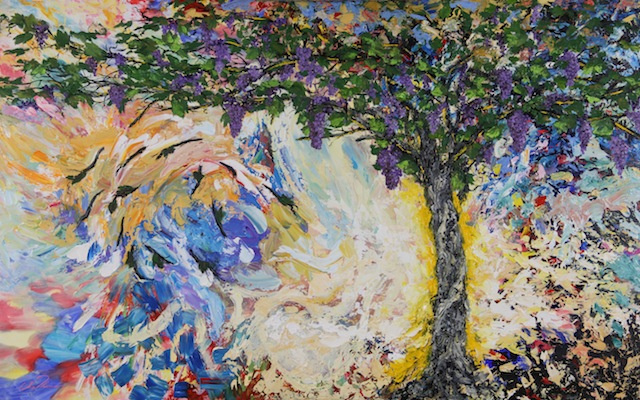
The Vine and the Branches, by Irene Thomas

I am the true vine and my Father is the gardener. He cuts off every branch in me that bears no fruit, while every branch that does bear fruit he prunes so that it will be even more fruitful. You are already clean because of the word I have spoken to you. Remain in me, as I remain in you. No branch can bear fruit by itself; it must remain in the vine. Neither can you bear fruit unless you remain in me.

I am the vine; you are the branches. If you remain in me and I in you, you will bear much fruit; apart from me you can do nothing. If you do not remain in me, you are like a branch that is thrown away and withers; such branches are picked up, thrown into the fire and burned. If you remain in me and my words remain in you, ask whatever you wish, and it will be done for you. This is to my Father’s glory, that you bear much fruit, showing yourselves to be my disciples. (New International Version)

In the New International Version of the Bible, the word “remain” is repeated 8 times in 8 verses. The original Greek word translated as “remain” is μένω (pronounced “men-oh”). It means to linger in the present moment; to be mindful to ourselves and our situations; to stay connected.

Remaining with Jesus means we that have continual unbroken connection of unity and fellowship with him.

In order to have a connection, there must be two ends to connect. The Jesus connection is always there. We are the other connection. And, frankly, we can be flaky – pulling away and coming close – which is why Jesus gave a repeated invitation to keep the connection.

Some other translations of John 15:4 may help to fill out an understanding of this invitation to remain in Christ (emphasis mine):

Stay joined to me, and I will stay joined to you. Just as a branch cannot produce fruit unless it stays joined to the vine, you cannot produce fruit unless you stay joined to me. (CEV)

Live in me, and I will live in you. A branch cannot produce any fruit by itself. It must stay attached to the vine. In the same way, you cannot produce fruit unless you live in me. (GW)

Abide in Me, and I in you. As the branch cannot bear fruit of itself, unless it abides in the vine, neither can you, unless you abide in Me. (NKJV)

Stay connected to me, and I will stay connected to you! A branch cannot produce fruit on its own but only if it has a vital connection to the vine. In the same way, there’s no way you can produce fruit at all, unless you have a meaningful connection with me. (my own translation)

The task of every Christian is to remain connected to Jesus. So, the question is: How do we keep the connection without breaking it? How can we be fruitful?

Focus on the Relationship

Christianity, at its core, is a living relationship with Jesus. Yes, doctrine is important; and it’s necessary to know the basic tenets of Christian faith. Yet, any knowledge we gain about Christianity is to be channeled into developing the relationship.
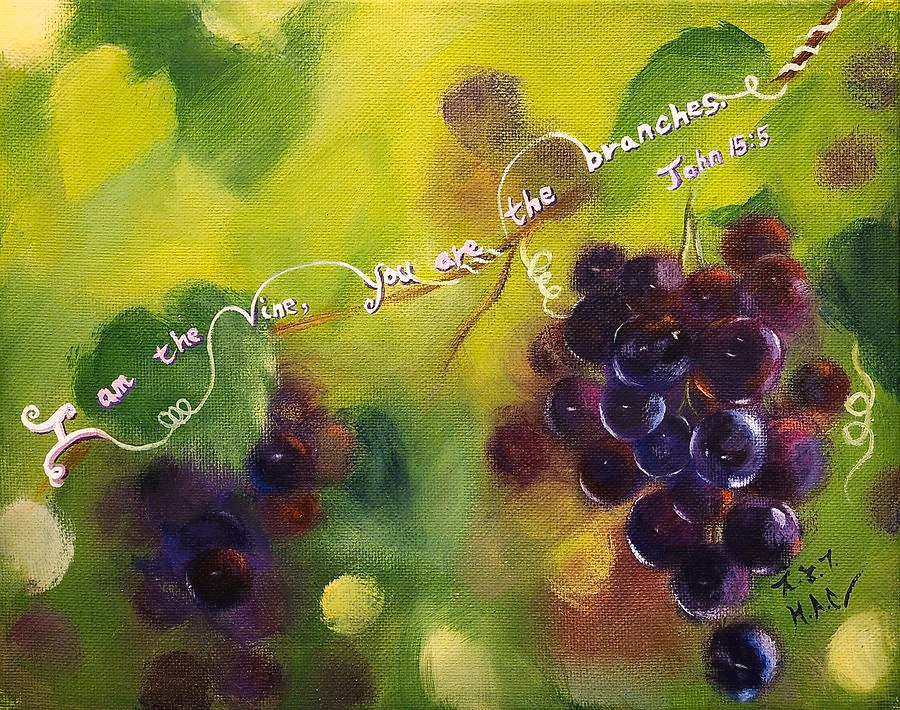
By Helian Cornwell

Bible trivia is only as good as the understanding we apply to build the relationship. Knowledge makes us proud of ourselves, while love makes us helpful to others. Knowledge makes us feel important, yet love strengthens the Church. Knowledge puffs up but love builds up. (1 Corinthians 8:1)

Christ’s redemption – his incarnation, holy life, death, resurrection, and ascension – are meant to restore the severed relationship with humanity. Only knowing doctrinal truth is not the same as using the doctrines to connect with God in a loving relationship.

It takes planning, dedication, time, and effort to grow and maintain our relationship with Jesus Christ. If we fail to use our time and energy on that relationship, then the leaves on the branch begin to wither.

Scripture, silence, solitude, community, prayer, giving, and fasting have always been at the center of Christian practices designed to put us in a position to hear and receive from God.

Relate Well to the Other Branches

The Church is a living growing community. Christ and the Church have a vital union with each other. I used to live in a place where there was a tree that had grown up next to an old fence post. The tree grew tall and engulfed the post to the degree that now you can only see part of the fence post.

To remove the post, you would have to remove the tree; the two have become one. Not only are we connected to the trunk, but we’re also connected to each other. We are all part of the same vine; we aren’t separate vines. So, we all need to do our part in the vine’s system.

Keep Close to the Vine

My grandmother had a grapevine in her backyard when I was a kid. I have firsthand understanding that the sweetest, juiciest, biggest, and best tasting grapes are found in the middle, securely next to the vine’s stem.

The sour grapes are found at the end of the branches. Show me a sourpuss Christian, and I’ll show you a Christian who is not close to Christ. Show me a sweet Christian and I’ll show you a believer who daily works at their close connection with Jesus.

Pruning is Necessary

Healthy vines need pruning, at least once a year; ideally, twice a year, in the Spring before budding, and in Autumn, after the harvest. Without pruning, the vine’s ability to produce good and abundant grapes is compromised. The grapevine’s branches need to be kept short because the nutrients are concentrated in and near the vine stem.

Pruning hurts. From the perspective of us branches, pruning feels like judgment. But it isn’t. Even though pruning is painful, it makes us healthier and tastier.

It’s better to do a few things well, rather than try and do a lot of things for which there is limited time and energy. So, do some spiritual pruning twice a year!

Know Why You are Connected

Yes, Christians have a connection with Jesus so that we are saved from sin, death, and hell. And, yes, we are connected to experience abundant life. Yet, the goal of that connection is to produce succulent fruit.

If there are no grapes on the vine, the vine is useless. Grapevines exist to produce grapes. Christians and Churches exist for the life of the world, to produce the fruit of righteousness consistent with our Christ-connected union: love, joy, peace, patience, kindness, goodness, faithfulness, gentleness, and self-control. (Galatians 5:22-23)

The Church is not an end in itself, but exists for the life of the world. Using other metaphors, Jesus said:

“You are the salt of the earth. But if the salt loses its saltiness, how can it be made salty again? It is no longer good for anything, except to be thrown out and trampled underfoot.

“You are the light of the world. A town built on a hill cannot be hidden. Neither do people light a lamp and put it under a bowl. Instead, they put it on its stand, and it gives light to everyone in the house. In the same way, let your light shine before others, that they may see your good deeds and glorify your Father in heaven.” (Matthew 5:13-16, NIV)

Pray

If we live in union with Christ – with the words and ways of Jesus powerfully within us—then ask for anything, and it will be done. Prayer is both an event that anyone can do, as well as a spiritual practice that needs growth and development.

The words of Jesus are the nutrients for our spiritual life. When those words find a home within us, there is a divine/human conversation. Christ promises that if we just ask, we’ll receive.

As the relationship with Christ grows, we learn to be thoughtful about our asking. Flippantly or selfishly asking for things disrespects the connection we enjoy with God. Claiming or demanding answers to prayer demeans the relationship. We can also dishonor God by simply not asking, at all.

Prayer is the delivery system for receiving our nutrients; and is also the means of delivering fruitful blessing so that the world might live. Jesus modeled a prayer for us that is grounded in connection and unity with the Father:

I am not praying just for these followers. I am also praying for everyone else who will have faith because of what my followers will say about me. I want all of them to be one with each other, just as I am one with you and you are one with me. I also want them to be one with us. Then the people of this world will believe that you sent me.

I have honored my followers in the same way that you honored me, in order that they may be one with each other, just as we are one. I am one with them, and you are one with me, so that they may become completely one. Then this world’s people will know that you sent me. They will know that you love my followers as much as you love me.

Father, I want everyone you have given me to be with me, wherever I am. Then they will see the glory that you have given me, because you loved me before the world was created. Good Father, the people of this world don’t know you. But I know you, and my followers know that you sent me. I told them what you are like, and I will tell them even more. Then the love that you have for me will become part of them, and I will be one with them. (John 17:20-26, CEV)

We must live and pray consistent with who we are, and what our mission is. The Church is to be one as God is One. Christians are to pray for unity because the triune God is always united. Believers everywhere need to remain in Christ through a vital connection of loving God and loving their neighbors. Amen.

Spiritual Strength (Daniel 10:2-19)

At that time I, Daniel, mourned for three weeks. I ate no choice food; no meat or wine touched my lips; and I used no lotions at all until the three weeks were over.

On the twenty-fourth day of the first month, as I was standing on the bank of the great river, the Tigris, I looked up and there before me was a man dressed in linen, with a belt of fine gold from Uphaz around his waist. His body was like topaz, his face like lightning, his eyes like flaming torches, his arms and legs like the gleam of burnished bronze, and his voice like the sound of a multitude.

I, Daniel, was the only one who saw the vision; those who were with me did not see it, but such terror overwhelmed them that they fled and hid themselves. So I was left alone, gazing at this great vision; I had no strength left, my face turned deathly pale and I was helpless. Then I heard him speaking, and as I listened to him, I fell into a deep sleep, my face to the ground.

A hand touched me and set me trembling on my hands and knees. He said, “Daniel, you who are highly esteemed, consider carefully the words I am about to speak to you, and stand up, for I have now been sent to you.” And when he said this to me, I stood up trembling.

Then he continued, “Do not be afraid, Daniel. Since the first day that you set your mind to gain understanding and to humble yourself before your God, your words were heard, and I have come in response to them. But the prince of the Persian kingdom resisted me twenty-one days. Then Michael, one of the chief princes, came to help me, because I was detained there with the king of Persia. Now I have come to explain to you what will happen to your people in the future, for the vision concerns a time yet to come.”

While he was saying this to me, I bowed with my face toward the ground and was speechless. Then one who looked like a man touched my lips, and I opened my mouth and began to speak. I said to the one standing before me, “I am overcome with anguish because of the vision, my lord, and I feel very weak. How can I, your servant, talk with you, my lord? My strength is gone and I can hardly breathe.”

Again the one who looked like a man touched me and gave me strength. “Do not be afraid, you who are highly esteemed,” he said. “Peace! Be strong now; be strong.”

When he spoke to me, I was strengthened and said, “Speak, my lord, since you have given me strength.” (New International Version)

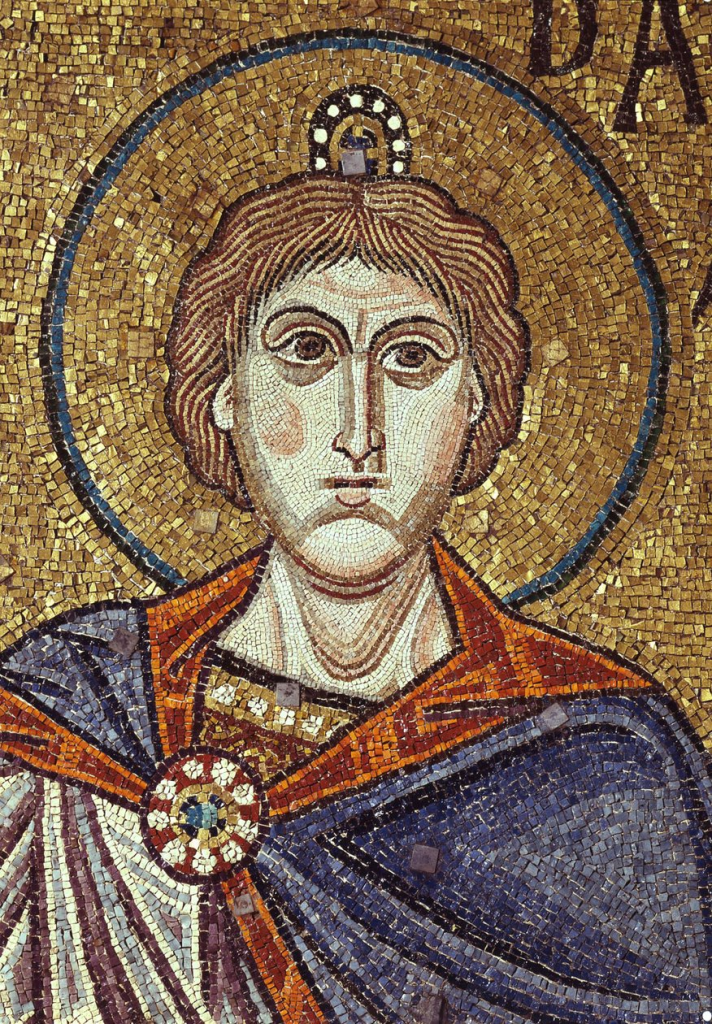
Byzantine mosaic of the prophet Daniel, 12th century, in St. Mark’s Basilica, Venice, Italy

Perhaps you, like me, have had the experience of praying, and feeling as if those prayers were only bouncing off the ceiling and never heard by God. But the Lord has been watching and listening all along. Although we may not get an immediate response, we will most certainly receive an answer to our prayers.

I am encouraged that God listened and was attentive to Daniel. The prophet had put himself in a position to hear God, so that when the Lord responded, Daniel was able to receive what was given to him.

The spiritual disciplines which Daniel was practicing almost seems like the guy was observing Lent. For three weeks, he gave up certain foods, did not eat meat, drank no wine; and he didn’t take a bath. He did all of this because he was troubled in spirit.

Daniel’s outward practices were congruent with his inward disposition. This is a far cry from our modern predilection for keeping up appearances, even though we are dying inside. But Daniel was not like us. He stopped his normal routines in order to give himself to prayer and a partial fast.

The Jews had been in exile for 70 years, and there was no sign of them going back to Jerusalem. And that troubled Daniel to no end – because the prophet Jeremiah had said the people would be in captivity for that long (Jeremiah 29:10). Daniel knew that fulfillment of the Lord’s promises would come by living in Palestine, and not by being exiled in Babylon.

While Daniel and his friends were together in a prayer meeting, Daniel experienced a vision; it was as if the veil separating this three-dimensional space from the spiritual dimension was lifted, and Daniel could see what was happening in the invisible realm.

Daniel’s prayers were being heard; they were not bouncing off the ceiling. And they were heard, I believe, because Daniel prayed according to his understanding of what God wants. He desired to participate in what God wanted, and not what he himself necessarily wanted.

And that is essentially what the Lord Jesus taught his followers in how to pray. We need not try and persuade God, as if we must be spiritual lawyers advocating for what we want. The Lord does not operate by twisting arms or harassing people; and neither ought we to try and treat God that way.

Prayer puts us in sync with what God wants. And as we desire to do God’s will, our prayers will reflect that desire. We only then need to ask. (Matthew 6:5-15; James 4:1-3)

Although God answers prayer, those responses are not always immediately put into effect. Daniel’s vision allowed him to see that there are other forces at work – dark forces – that oppose what God is doing. Sinister monkey wrenches are thrown into good plans and responses for people.

Behind the scenes of our lives, there are invisible powers which are influencing people. This is why our ultimate struggle is not on this visible realm; it is, instead, against the invisible demonic spirits of this present evil age.

Daniel saw and heard that behind the affairs of this world is a hierarchy of evil which seeks to control us for purposes contrary to God’s justice, peace, and goodness. Yet there is also an angelic host who are involved in ensuring that the Lord’s will is accomplished on this earth as it is always done in heaven.

Therefore, sometimes our delays in answered prayer have nothing to do with us; it may be because there is a great conflict happening in a dimension that you and I don’t see. In fact, if we do not have immediate answers to prayer, this is precisely the best time to persevere in prayer and not give up.

Through our perseverance in prayer, like Daniel, we are strengthened in faith. Our connection with God brings us peace and courage, emboldening us for continued wrestling in prayer and dealing with the structural and systemic evil that exists everywhere.

Faith is a belief in things we cannot see. Hope is the confidence of things which can happen. Love is a culmination of faith and hope coming together in order to make a difference in this fallen world. The Lord provides all the strength we need for the struggle. And there is perhaps no better model of how to deal with things and gain spiritual power than the prophet Daniel.

Strengthen us, O Lord, by your grace, so that we may overcome all spiritual enemies; and with pure hearts serve you; through Jesus Christ our Lord, who lives and reigns with you and the Holy Spirit, one God, for ever and ever. Amen.

Learning to Trust (Psalm 4)

Answer me when I cry out, my righteous God!
    Set me free from my troubles!
        Have mercy on me!
        Listen to my prayer!

How long, you people,
    will my reputation be insulted?
How long will you continue
    to love what is worthless
    and go after lies?
Know this: the Lord takes
    personal care of the faithful.
The Lord will hear me
    when I cry out to him.
So be afraid, and don’t sin!
    Think hard about it in your bed
    and weep over it!
Bring righteous offerings,
    and trust the Lord!

Many people say,
    “We can’t find goodness anywhere.
    The light of your face has left us, Lord!”
But you have filled my heart with more joy
    than when their wheat and wine are everywhere!
I will lie down and fall asleep in peace
    because you alone, Lord, let me live in safety. (Common English Bible)

The psalmist, David, was a man after God’s own heart. But that did not mean that he was inoculated from trouble and hardship.

David had a lot of adversity and much difficulty throughout his life. So, it only made sense to him to cry out to the Lord for deliverance and help. God had helped David in the past, and David was confident that the Lord would help him yet again.

We all find ourselves in a tight spot, between a rock and hard place, at times. It’s what we do when we are in that position that is critical. David had a history of looking to God, seeking God’s grace, and soliciting answers to prayer.

David, the psalmist, was a real victim of slander and lies. More than once in his life, he had people out to get him, to actually take his life. Whatever your understanding of stress is, it doesn’t get much more stressful than someone hunting you down like an animal to literally kill you. I’m sure that many times David wondered how long this surreal madness was going to go on.

Whenever we are especially stressed, it can be hard to even breathe. If we aren’t mindful of ourselves, we will take lots of short staccato breaths that only feed anxious signals to the brain. It leaves us in a perpetual state of hypervigilance, almost unable to pray and have thoughts of God.

But we absolutely need to take deep breaths and trust in God’s sustaining presence. We’ll never get to sleep, nor stay at rest, without a sense of the divine presence.

Insomnia happens for a lot of reasons. Many people have diagnosed sleep disorders that are very real medical conditions. Others can’t get a good night’s rest because of poor sleep hygiene by not planning for adequate sleep, drinking too much caffeine during the day, inattention to a healthy diet, or a host of other habits. Some have issues of chronic pain which can make it difficult to sleep well.

And then there are yet others who suffer from racing thoughts, anxiety, and depression. The stress of their waking life is so significant that several hours of deep sleep seems only like some pipe dream. It’s impossible to sleep when the weight of the day is pressing on you. Finding a sense of calm before bed isn’t easy—especially when you can’t unplug from the demands of your day.

I am wondering if many of us will even allow ourselves to unplug and establish some quiet wind-down time. Reading a real book – not one on a backlit tablet device – or talking with a friend or family member are simple ways of easing our anxiety and letting rest come.

The psalmist, David, had a regular practice of meditating on Scripture, recalling the events of God, and expressing gratitude and praise for answered prayer. Each of us has a built-in spiritual rhythm just like we have a circadian rhythm. Always trying to buck those God-given rhythms will inevitably result in being “off,” at the least, and experiencing debilitating depression, at the worst.

Yet, when we learn to move with the unforced rhythms of grace, there is a groove we slip into which serves us well. In other words, what I am trying to say, is that by allowing ourselves to be human, we can discover health.

David neither had delusions, nor illusions, about his enemies, friends, others, and himself. He didn’t try to be somebody he was not. Instead, David had firm and confident convictions about God and the place of prayer.

By taking in a steady diet of David’s psalms, we can learn to hold together both faith and doubt, confidence and confusion, perseverance and perplexity, in ways which strengthens our faith.

Everyone of us who desire God must learn to trust; and it’s in the school of hard knocks where our faith is developed in order to sustain us for a lifetime of service and resilience.

There will always be those who believe ill of us through slander, lies, or outright oppression. In such times, let’s cry out to God for both peace and guidance; and ask the Lord for help in learning to breathe, lie down, and get some rest.

As our trust develops, we may even find the grace and courage to confront our oppressors, so that they can seek their own peace with God.

May Christ be with you, and within you;
May Christ go before you, and linger behind you;
May Christ be on your right, and on your left;
May Christ hover above you, and bring support beneath you;
May the Lord Jesus Christ completely and thoroughly surround you, now and forever. Amen.

What Can I Do in an Impossible Situation? (Daniel 2:1-23)

Daniel Interprets King Nebuchadnezzar’s Dream, by Mattia Preti (1613-1699)

In the second year of Nebuchadnezzar’s rule, he had many dreams. The dreams made him anxious, but he kept sleeping. The king summoned the dream interpreters, enchanters, diviners, and Chaldeans to explain his dreams to him. They came and stood before the king.

Then the king said to them: “I had a dream, and I’m anxious to know its meaning.”

The Chaldeans answered the king in Aramaic: “Long live the king! Tell your servants the dream, and we will explain its meaning.”

The king answered the Chaldeans: “My decision is final: If you can’t tell me the dream and its meaning, you will be torn limb from limb, and your houses will be turned into trash dumps. But if you do explain the dream and its meaning, you’ll receive generous gifts and glorious honor from me. So explain to me the dream as well as its meaning.”

They answered him again: “The king must tell his servants the dream. We will then explain the meaning.”

The king replied: “Now I definitely know you are stalling for time, because you see that my decision is final and that if you can’t tell me the dream, your fate is certain. You’ve conspired to make false and lying speeches before me until the situation changes. Tell me the dream now! Then I’ll know you can explain its meaning to me.”

The Chaldeans answered the king: “No one on earth can do what the king is asking! No king or ruler, no matter how great, has ever asked such a thing of any dream interpreter, enchanter, or Chaldean. What the king is asking is impossible! No one could declare the dream to the king but the gods, who don’t live among mere humans.”

At this, the king exploded in a furious rage and ordered that all Babylon’s sages be wiped out. So the command went out: The sages were to be killed. Daniel and his friends too were hunted down; they were to be killed as well.

Then Daniel, with wisdom and sound judgment, responded to Arioch the king’s chief executioner, who had gone out to kill Babylon’s sages. He said to Arioch the king’s royal officer, “Why is the king’s command so unreasonable?” After Arioch explained the situation to Daniel, Daniel went and asked the king to give him some time so he could explain the dream’s meaning to him. Then Daniel went to his house and explained the situation to his friends Hananiah, Mishael, and Azariah so that they would ask the God of heaven for help about this mystery, in hopes that Daniel and his friends wouldn’t die with the rest of Babylon’s sages. Then, in a vision by night, the mystery was revealed to Daniel! Daniel praised the God of heaven:

God’s name be praised
    from age to eternal age!
        Wisdom and might are his!
God is the one who changes times and eras,
    who dethrones one king, only to establish another,
        who grants wisdom to the wise and knowledge to those with insight.
God is the one who uncovers what lies deeply hidden;
    he knows what hides in darkness;
I acknowledge and praise you, my fathers’ God!
    You’ve given me wisdom and might,
        and now you’ve made known to me what we asked of you:
            you’ve made known to us the king’s demand. (Common English Bible)

Daniel Interprets Nebuchadnezzar’s Dream, 1917

The King’s Trouble

Nebuchadnezzar was quite the guy – a stereotypical ancient king, in many ways. In our story for today, he certainly comes across as a demanding sovereign, expecting his wishes and commands to be done, no matter how difficult or unreasonable they seem to others.

The king was bothered by a troubling dream. So, in expected kingly fashion, Nebuchadnezzar called for his court appointed sages to explain it to him. And in an over-the-top expectation, even for an arrogant king, Nebuchadnezzar had no intention of telling them what it is he had dreamt.

The sages, of course, had no idea what to do with this exaggerated command. The king’s wise men replied that no one – except the gods – can reveal such secrets as what was dreamt. But in King Nebuchadnezzar’s line of thinking, since the gods of the sages cannot reveal the dream – and thus an interpretation of the dream – then those gods must be weak, ineffective, and useless.

The King’s Anger

In reading and listening to the story, we can feel the response of Nebuchadnezzar coming, and know that it isn’t going to be good. Indeed, the king flew into a rage. The wise men’s failure to provide the contents of the dream, and so, a solid interpretation for the dream, led King Nebuchadnezzar to order them all killed. In issuing such a command, this meant that Daniel and his wise friends were to be killed, as well.

Daniel was a Jewish exile, brought to Babylon after Nebuchadnezzar’s conquest of Jerusalem. He was wise, godly, and even-keeled. Daniel calmly intervened and offered to do exactly what the king requested in the first place. All he asked was for some time. Then, Daniel immediately went to his godly and wise friends, and together they looked to the Lord in prayer.

Sure enough, just as God had come to Nebuchadnezzar in a dream, so God came to Daniel and revealed the mystery to him. Daniel’s prayer of thanksgiving makes it clear that the source of the wisdom is the God of heaven, and not Daniel himself. Thus, we are meant to make the connection that Daniel’s God is vastly superior than the gods of the court sages.

The King’s Limits

King Nebuchadnezzar’s sovereignty and control was not universal. It is God who grants wisdom. Yes, we do our part in gaining knowledge and understanding as best we can. We look into Holy Scripture for guidance and seek to obey biblical commands and live into divine promises. Yet, there is also an aspect of wisdom that is given by God.

Ultimate insight comes as a result of both human observation and learning, and divine revelation and response to prayer. Throughout the book of Daniel, a prominent theme is the importance of prayer as the prerequisite to receiving wisdom. Daniel and his three friends joined in prayer together, immediately after hearing of the king’s situation and command.

An even greater theme in the book of Daniel is that God can give wisdom because there is nothing hidden from the Lord; God understands everything. And it is this theological conviction which underlies prayer. Daniel and his companions were supported and emboldened by their knowledge of God.

Believers in every historical age have the privilege of beseeching God for wisdom when circumstances are rough and dire. As the Apostle James says in the New Testament:

My friends, be glad, even if you have a lot of trouble. You know you learn to endure by having your faith tested. But you must learn to endure everything, so you will be completely mature and not lacking in anything. If any of you need wisdom, you should ask God, and it will be given to you. God is generous and won’t correct you for asking. (James 1:2-5, CEV)

Whenever facing opposition and suffering, it is important to know that God is in control, and that divine enablement and insight is only a prayer away.

Blessed God, Light of the world, shine upon us and disperse the clouds of our selfishness and stubbornness, so that we may reflect the power of the resurrection in our life together. Amen.