
Seeking God in Hard Times (Psalm 9:9-20)

By Bible Art

The Lord is a safe place for the oppressed—
    a safe place in difficult times.
Those who know your name trust you
    because you have not abandoned
    any who seek you, Lord.

Sing praises to the Lord, who lives in Zion!
    Proclaim his mighty acts among all people!
Because the one who avenges bloodshed
    remembers those who suffer;
    the Lord hasn’t forgotten their cries for help.

Have mercy on me, Lord!
    Just look how I suffer
    because of those who hate me.
But you are the one who brings me back
    from the very gates of death
        so I can declare all your praises,
        so I can rejoice in your salvation
        in the gates of Daughter Zion.

The nations have fallen
    into the hole they themselves made!
    Their feet are caught
        in the very net they themselves hid!
The Lord is famous for the justice he has done;
    it’s his own doing that the wicked are trapped.

Let the wicked go straight to the grave,
    the same for every nation that forgets God.

Because the poor won’t be forgotten forever,
    the hope of those who suffer won’t be lost for all time.

Get up, Lord! Don’t let people prevail!
    Let the nations be judged before you.
Strike them with fear, Lord.
    Let the nations know they are only human. (Common English Bible)

I firmly believe that there is hopeful comfort in the Lord – that when people go through awful things, God is there to be a safe place for them.

I also believe that, in the end, good triumphs and evil perishes. That’s because I am convinced that the Lord is an equitable judge; God hears the cries of defenseless righteous victims and acts on behalf of the oppressed without prejudice or favoritism.

Yet, that does not mean God’s people will always be inoculated from trouble, hardship, and adversity. What it does mean is that the Lord is with us, and that God loves us.

Everyone goes through difficult times. Some folks endure horrible trauma. And those experiences can dog us and torment us, even long after the event. Even in good times, we might sometimes become anxious or frantic without any real threat in front of us.

We may want to praise God with genuineness and sincerity. However, we might not yet feel vindicated or released. And there still may be some unjust suffering going on. We long to declare the goodness of God, but we also want to do so with a testimony of deliverance and healing.

That is precisely how the psalmist felt. He knows the wicked won’t endure, but he also wants to give praise to the Lord for seeing them sink in the sinister pit they’ve dug for others.

God is a righteous judge. And there are times when the Lord brings judgment upon evil by letting the wicked self-destruct with their own words and behavior. In other words, God at times engages in direct judgment, and other times lets the moral gravity of the earth crush them in their duplicitous crimes.

Whenever circumstances are hard, it’s easy to feel forgotten, as if no one sees or hears our suffering; they don’t realize the depth of our hurt by a wicked person. It’s appropriate, as the psalmist did, to cry out and plead with God to rise up on behalf of the weak and powerless; and to call for an end of the mindless and godless insanity of arrogant people.

It is equally hard to observe others we care about experience oppression. We cry out to the Lord on their behalf, that they will no longer have to endure such injustice. We want our loved ones to thrive and enjoy life and thrive – not to be crushed under an unjust burden from selfish people who only care about themselves.

We boldly ask God to knock them off the evil hill they’ve built for themselves – to blot them out because of their continual oppression of the righteous. The wicked think no one can touch them atop their proud strong perch. They believe they’re above accountability and can get away with anything. That makes us angry!

Whenever we are wronged or treated unfairly – or observe another person or group of people experiencing injustice – it stirs up our anger.

Anger, in and of itself, is neither good nor bad. It just is. It’s what we do with our anger that gets dicey. A lot of human anger gets expressed in unhealthy ways by either passively stuffing it and ignoring it; aggressively lashing out with verbal and/or physical violence; or passive-aggressively doing indirect jabs at the object of our anger.

The psalmist, however, is assertive with his anger. He offered straightforward observations with definite feelings to God. He also affirmed that the Lord is the One who administers justice with fairness and equity.

There are times when only God can bring an evil system, institution, organization, government, nation, group of people, or individual to heel.

When the poor are overlooked or oppressed by the rich, it’s unjust. It creates anger, both human and divine. In their misery and hardship, the needy can flee to God, who is faithful to care for them and treat them with respect and dignity, as people carrying the divine image.

The nations of the earth are not all attentive to the needy. They don’t all serve their citizens and try to do right by them. Unfortunately, many people throughout the world groan under national leadership which is enamored with power and privilege – and forget those who are powerless, unable to lift themselves by their bootstraps.

In the teeth of such a reality, the psalmist petitioned God. He asked, even insisted, that God step in and act as judge and jury. It was an assertive use of anger that went to the source of true help, to the Lord, who possesses both the will and the ability to overturn injustice and establish a right use of power.

Do you know what I want? I want justice—oceans of it. I want fairness—rivers of it. That’s what I want. That’s all I want.

Amos 5:24, MSG

The Lord, thankfully, is a strong fortress for the oppressed and a protective force in times of trouble.

God remembers the prayers of the down-and-out.

Sooner, or later, those who are wicked in their dealings through exploitation of the powerless, will know firsthand that they are puny humans, and that God is immensely big.

God almighty, you have given all peoples one common origin. It is your will they be gathered together as one family in yourself. Fill the hearts of humanity with the fire of your love and with the desire to ensure justice for all.

By sharing the good you give us, may we ensure equity for all our brothers and sisters throughout the world. May there be an end to division, strife and war. May there be a dawning of a truly human society built on love and peace, through Jesus Christ, our Lord. Amen.

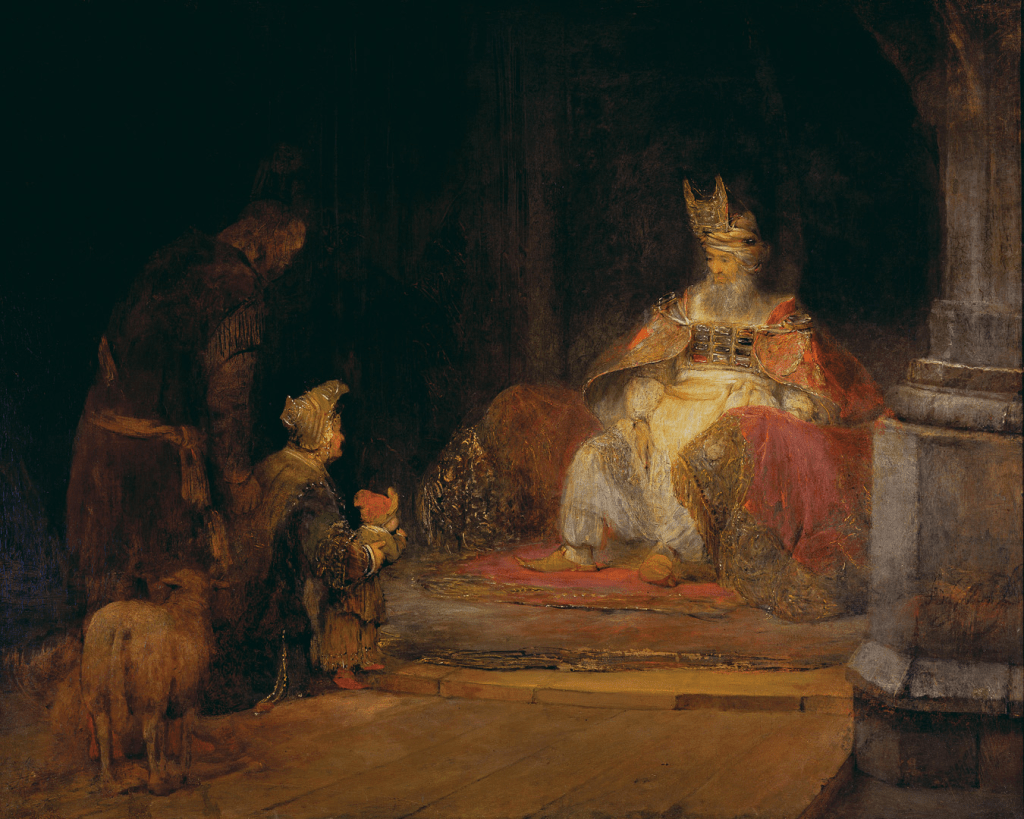
Making a Vow (1 Samuel 1:19-27)

Hannah Presenting Samuel to Eli, by Arent de Gelder, 1710

The entire family got up early the next morning and went to worship the Lord once more. Then they returned home to Ramah. When Elkanah slept with Hannah, the Lord remembered her plea, and in due time she gave birth to a son. She named him Samuel, for she said, “I asked the Lord for him.”

The next year Elkanah and his family went on their annual trip to offer a sacrifice to the Lord and to keep his vow. But Hannah did not go. She told her husband, “Wait until the boy is weaned. Then I will take him to the Tabernacle and leave him there with the Lord permanently.”

“Whatever you think is best,” Elkanah agreed. “Stay here for now, and may the Lord help you keep your promise.” So she stayed home and nursed the boy until he was weaned.

When the child was weaned, Hannah took him to the Tabernacle in Shiloh. They brought along a three-year-old bull for the sacrifice and a basket of flour and some wine. After sacrificing the bull, they brought the boy to Eli. “Sir, do you remember me?” Hannah asked. “I am the very woman who stood here several years ago praying to the Lord. I asked the Lord to give me this boy, and he has granted my request. (New Living Translation)

Hannah had no children. In an era of patriarchy and polygamy, she had to put up with a rival wife verbally attacking her – not to mention a husband who seemed somewhat clueless to what was going on.

The piety of Hannah was unmatched. When worshiping the Lord in the tabernacle at Shiloh, Hannah offered a heartfelt prayer to God. She not only asked for help in her distressing situation, but also promised that if the Lord would give her a son, she would return to the Giver; thus, making the child a double gift to both herself and God.

God listened to Hannah and remembered her. Through her pregnancy and birth of a son, there is even more going on than displaying the Lord’s power over infertility. In taking divine initiative to do what Hannah asked, God demonstrated care and vindication for one of the least valued members of an ancient society that looked askance on infertile women.

Hannah and Samuel in the Temple, by Rembrandt, 1650

In the patriarchal society, Hannah’s husband, Elkanah, could have nullified her vow to the Lord. But he allowed her promise to stand, and even encouraged it. Perhaps this was yet another sort of miracle, to have a husband move the great distance from unaware and aloof to aware and connected.

Hannah and Elkanah went to Shiloh, and back to the old priest Eli, not only making a typical animal sacrifice, but also offering their son, in fulfillment of Hannah’s vow to the Lord. Hannah very much took her vow to God seriously.

As you enter the house of God, keep your ears open and your mouth shut. It is evil to make mindless offerings to God. Don’t make rash promises, and don’t be hasty in bringing matters before God. After all, God is in heaven, and you are here on earth. So let your words be few.

Too much activity gives you restless dreams; too many words make you a fool.

When you make a promise to God, don’t delay in following through, for God takes no pleasure in fools. Keep all the promises you make to him. It is better to say nothing than to make a promise and not keep it. Don’t let your mouth make you sin. And don’t defend yourself by telling the Temple messenger that the promise you made was a mistake. That would make God angry, and he might wipe out everything you have achieved.

Talk is cheap, like daydreams and other useless activities. Fear God instead. (Ecclesiastes 5:1-7, NLT)

Any sort of commitment we express to God, no matter what, is to be taken seriously. Making vows to the Lord isn’t simply a way of helping us feel good about our relationship to God; rather, vows have important implications for our daily life and decisions.

What’s more, vows are not bribes. We don’t make deals with God. That’s because we have nothing to offer in any sort of human understanding of contractual obligations. A vow is a promise, a commitment to follow through with something. And the Lord will hold us accountable to our promises.

Hannah offered her son willingly and gladly to the Lord, and not begrudgingly. In fact, this may have been her thought all along to dedicate a child to God. In other words, giving up her son was not a sorrowful grief but a deep joy. Hannah raised the boy until he was weaned – which was likely, in that day and age, around 3 or 4 years old.

It’s quite possible that Hannah spent those formative years preparing her son for a life of service and doing all she could to help him get a good beginning in the Lord’s Tabernacle.

The biblical character of Hannah has a lot to teach us in our own journey of faith. She was completely devoted to God, found ways to honor and obey God, made a carefully crafted vow to God, persevered and never lost sight of what was important, and did it all with a spirit of obedience, initiative, spunk, gratitude, and gladness.

Hannah was motivated, principled, and sincere. Her good intentions developed into a focused vow, and she organized her life around her promise to God. Hannah did not overpromise or act impulsively; she knew what she was doing. And we have no record of her putting it all in her rival’s face.

God isn’t looking for grand ornate vows from us. The Lord just wants us to live obediently, with a good attitude, and follow through on our expressed commitments. And that’s one of the simplest paths to living a joyful and satisfied life.

Gracious and holy God, who creates, saves, blesses, and sustains us, these things we promise for this day and forevermore:

Never again shall we see another person as an enemy.
Never again shall we place our hope in power.
Never again shall we use violence against another person.
Never again shall we build walls to keep others out.
Never again shall we raise our hand in anger against others.
Never again shall we rob others of their dignity.
Never again shall we treat people differently based on the color of their skin or ethnicity.
Never again shall we take from others what is rightfully theirs.
Never again shall we make judgments about another’s gender identity.
Never again shall we blame another person or group for our own failings.
Never again shall we forget that we are all brothers and sisters.
Never again shall we refuse to listen to one another’s stories.
Never again shall we forget to love others as you love us.
Never again shall we forget that we belong to you.
Never again shall we forget to see ourselves caretakers of your whole creation.
Never again, Creator, shall we forget that you made us as we are, all colors,
shapes and sizes, and said, “Wow! Look at that. Now that is good!” Amen.

A Prayer of Confession (Ezra 9:5-15)

Ezra In Prayer, by Gustave Doré, 1866

Then, at the evening sacrifice, I rose from my self-abasement, with my tunic and cloak torn, and fell on my knees with my hands spread out to the Lord my Godand prayed:

“I am too ashamed and disgraced, my God, to lift up my face to you, because our sins are higher than our heads and our guilt has reached to the heavens. From the days of our ancestors until now, our guilt has been great. Because of our sins, we and our kings and our priests have been subjected to the sword and captivity, to pillage and humiliation at the hand of foreign kings, as it is today.

“But now, for a brief moment, the Lord our God has been gracious in leaving us a remnant and giving us a firm place in his sanctuary, and so our God gives light to our eyes and a little relief in our bondage. Though we are slaves, our God has not forsaken us in our bondage. He has shown us kindness in the sight of the kings of Persia: He has granted us new life to rebuild the house of our God and repair its ruins, and he has given us a wall of protection in Judah and Jerusalem.

“But now, our God, what can we say after this? For we have forsaken the commands you gave through your servants the prophets when you said: ‘The land you are entering to possess is a land polluted by the corruption of its peoples. By their detestable practices they have filled it with their impurity from one end to the other. Therefore, do not give your daughters in marriage to their sons or take their daughters for your sons. Do not seek a treaty of friendship with them at any time, that you may be strong and eat the good things of the land and leave it to your children as an everlasting inheritance.’

“What has happened to us is a result of our evil deeds and our great guilt, and yet, our God, you have punished us less than our sins deserved and have given us a remnant like this. Shall we then break your commands again and intermarry with the peoples who commit such detestable practices? Would you not be angry enough with us to destroy us, leaving us no remnant or survivor? Lord, the God of Israel, you are righteous! We are left this day as a remnant. Here we are before you in our guilt, though because of it not one of us can stand in your presence.” (New International Version)

God had made a covenant with the Israelites. The Lord graciously gave them laws and stipulations to live by before entering the Promised Land.

Yet, much of Jewish history during the times of the kings was characterized by a breakdown in morality. Cheating on workers and preying upon the weak became commonplace. The poor were fleeced for what little they had, and reduced to servitude.

Failing to obey God completely, the people intermarried with the surrounding nations. The worship of Yahweh was, at times, in severe neglect, due to worshiping the gods of other places. As a result, divine judgment brought a Babylonian captivity and an exile of the people to a foreign land.

But God, who is rich in mercy, brought many of the people back to Palestine and Jerusalem. The Babylonians were conquered by the Persians, who had a different philosophy about how to handle the nations within their empire. And they were open to Jerusalem being rebuilt and the temple restored.

Ezra was a scribe (a copier of Scripture) and one of the returning exiles. Ezra left Babylon in 458 B.C.E. with a considerable group of people. Because of Ezra’s position as a Jewish scribe, and as a descendant of Levi, the Persian king authorized him to reinforce the Torah (the Law) by reading it and setting up the necessary administrative systems to ensure it would be followed.

Under Persian rule, each subject people was allowed to live by its ancestral laws, which were enforced by the imperial government. Violations of the laws of the group to which one belonged constituted an offense against the state precisely because they led to instability.

Soon after Ezra arrived in Jerusalem, he learned of the spiritual state of the Jews there. They had intermarried freely with the non-Jewish women of the land, and had ceased to keep the Jewish holidays and other commandments.

This situation devastated Ezra. He tore his clothes and sat in mourning the entire day until evening. After the evening sacrifice was brought, he got up and began praying loudly to God, weeping for forgiveness for the sins of his people.

Ezra read the Torah publicly to the entire people. Indeed, this was a covenant‑renewal ceremony in the strict sense. To make the Torah understandable to them, he had it explained, because Hebrew was no longer in most people’s vernacular. (Nehemiah 8:1-18)

In today’s Old Testament lesson, we have Ezra’s prayer, his great confession of sin, and concern that the people not get into the same situation which brought God’s judgment and exile upon them to begin with.

It is a prayer laced with love for the covenant code, the Jewish people, and most of all, for God. A very complicated situation prompted Ezra’s prayer, and would take much courage and wisdom to confront and deal with.

Whenever things are awry, circumstances are less than desirable, and situations seem overwhelming, the place to begin is to pray. Admittedly, prayer is not everything; but it is certainly something – and something powerful – for which we have both the duty and the delight to engage in.

And in praying, there is perhaps no better way to begin, than with a heartfelt prayer of confession:

Gracious God, our sins are too heavy to carry, too real to hide, and too deep to undo. Forgive what our lips tremble to name, what our hearts can no longer bear, and what has become for us a consuming fire of judgment.

Set us free from a past we cannot change; open to us a future in which we can be changed; and grant us grace to grow more and more in your likeness and image; through Jesus Christ our Lord. Amen.

Jesus Prays For Us (John 17:6-19)

Word of Life, by Millard Sheets

“I have made your name known to those whom you gave me from the world. They were yours, and you gave them to me, and they have kept your word. Now they know that everything you have given me is from you, for the words that you gave to me I have given to them, and they have received them and know in truth that I came from you, and they have believed that you sent me.

I am asking on their behalf; I am not asking on behalf of the world but on behalf of those whom you gave me, because they are yours. All mine are yours, and yours are mine, and I have been glorified in them. And now I am no longer in the world, but they are in the world, and I am coming to you.

“Holy Father, protect them in your name that you have given me, so that they may be one, as we are one. While I was with them, I protected them in your name that you have given me. I guarded them, and not one of them was lost except the one destined to be lost, so that the scripture might be fulfilled. 

But now I am coming to you, and I speak these things in the world so that they may have my joy made complete in themselves. I have given them your word, and the world has hated them because they do not belong to the world, just as I do not belong to the world. 

“I am not asking you to take them out of the world, but I ask you to protect them from the evil one. They do not belong to the world, just as I do not belong to the world. Sanctify them in the truth; your word is truth. As you have sent me into the world, so I have sent them into the world. And for their sakes I sanctify myself, so that they also may be sanctified in truth. (New Revised Standard Version)

It seems to me only fitting that Jesus concluded his time with the disciples in the Upper Room before his betrayal, crucifixion, and death with prayer. It also seems to me that if you really want to know the heart of a person, listen to them pray.

The prayer of Jesus was thoroughly oriented toward the spiritual needs of his followers – even potential believers who will follow him in the future. And it was a prayer completely devoted toward honoring the heavenly Father through praying consistent with God’s will for this world.

Without the physical presence of Jesus – which would soon be gone – his followers would have to rely on prayer. And Christ was intent on instilling within his disciples the confidence and hope they needed for a solid life of prayer.

For post-resurrection Christians living in an ever-expanding world of oppression, greed, and indifference, we can be encouraged not to settle into despair or loneliness. Why? Because believers can have a solid hope and an abiding trust in the continuing presence of Jesus by means of the Holy Spirit.

God Gives

God gives. Jesus gives. Both the Father and the Son are givers. This is a major reason and motivation for prayer because God is not a reluctant giver. In the act of giving, the Father and the Son are fully on the same page; God is ready and willing to give. The Holy Trinity – Father, Son, and Spirit – are in complete unity, and act as One, in giving to us what we need.

“Those who drink of the water that I will give them will never be thirsty. The water that I will give will become in them a spring of water gushing up to eternal life.” (John 4:14, NRSV)

“Do not work for the food that perishes but for the food that endures for eternal life, which the Son of Man will give you.” (John 6:27, NRSV)

“I give them eternal life, and they will never perish. No one will snatch them out of my hand.” (John 10:28, NRSV)

We Belong

Through giving we are included. Believers and followers of Jesus – having been given the grace of faith – know that they belong to God. Christians are in union with Christ. The redemption which Jesus has secured is a million billion times stronger, and bonds us closer, than any sort of Gorilla glue. And, what’s more, once we belong, we are never forgotten, but always remembered by God.

“The Father knows me, and I know the Father. And I lay down my life for the sheep. I have other sheep that do not belong to this fold. I must bring them also, and they will listen to my voice. So there will be one flock, one shepherd.” (John 10:15-16, NRSV)

Christ the King, statue in Swiebodzin, Poland

The Name of Jesus

Because we belong, we know God’s name. The divine name stands for all that God is and all that God has done. It’s all focused in Christ. In the name of Jesus, through the person and work of Jesus Christ, we have everlasting life, spiritual power, and eternal security.

Now Jesus did many other signs in the presence of his disciples that are not written in this book. But these are written so that you may continue to believe that Jesus is the Messiah, the Son of God, and that through believing you may have life in his name. (John 20:30-31, NRSV)

We Have the Word

The Word became flesh and dwelt among us (John 1:14). Jesus has given to his disciples only those words which he first received from the Father. Those who accept the enfleshed Word and his words have been given power to become God’s children (John 1:12). Because believers belong to God, they know the truth and that truth has set them free.

It is the Christian’s mission to live into the words and ways of Jesus, to follow Christ in thought, word, and deed. The very glory of Jesus in his cross and resurrection is focused within the believing community, who is in union with Christ and belongs to God.

In his prayer, Jesus claimed an intimate oneness in the sharing of concern for people who are the objects of the Father’s gracious giving of love through the Son. All who belong to Christ belong to God, and vice versa. All the love that went into the cross was poured out upon us.

Those who believe in the name of Jesus Christ are the very glory of Jesus, and thus, the glory of God.

Sent Into the World

Because of the Father’s name—because of who the Father is and what the Father has given in love to the Son—we are set apart for truth; the words of God are truth.

Since we belong to God and bear the name of Christ, we don’t belong to the world’s systems of guilt, shame, injustice, and evil. And yet, we are separated from the world for precisely the reason of immersing ourselves in the world. In other words, Christianity is meant for the life of the world, and not as a religion that’s only concerned for itself.

To reach the world, we must be different from it. To reach the world, we need to have boots-on-the-ground in it. To reach the world, Christians are to be both far from the world, and near to the world.

As the Father sent the Son, so the Son sends us into the world – not to be like the world, but to embody the words and ways of Jesus to and for the world.

Just as the world rejected Jesus in his suffering and death, so the world, too, will reject his followers. Which means we will need to pray, a lot! And there is no better scriptural prayer to emulate than the very words of the Lord Jesus, who loved us and gave himself for us.

Holy Father, guard our hearts and minds in Jesus, as we pursue this Christian life which you gave as a gift through Christ, so that we can be united, just as the Father and the Son are one. Although we long for heaven, don’t take us out of the world until we have fulfilled our sacred mission to carry the words and ways of our Lord to the world. Make us holy, and give us everything we need for life in this present evil age; through Jesus Christ your Son, our Lord, who with you and the Holy Spirit are one God, now and forever. Amen.