Developing the Skill of Wisdom (Colossians 1:9-14)

Colossians 1:9-10, by Bible Art

For this reason, since the day we heard about you, we have not stopped praying for you. We continually ask God to fill you with the knowledge of his will through all the wisdom and understanding that the Spirit gives, so that you may live a life worthy of the Lord and please him in every way: bearing fruit in every good work, growing in the knowledge of God, being strengthened with all power according to his glorious might so that you may have great endurance and patience, and giving joyful thanks to the Father, who has qualified you to share in the inheritance of his holy people in the kingdom of light. 

For he has rescued us from the dominion of darkness and brought us into the kingdom of the Son he loves, in whom we have redemption, the forgiveness of sins. (New International Version)

When I was younger, I played a lot of ping-pong. And I got good at it. In fact, during a several months stretch, back-in-the-day, I had a record of 156-2. Not bad.

That kind of record was only possible because of the two reasons that make any skill an accomplishment:

  1. Knowledge. I learned the game of ping-pong and eventually knew it inside and out.
  2. Experience. I practiced for hundreds, if not thousands, of hours in developing my technique.

The sort of knowledge that Paul was talking about was more than information and intellectual understanding; he used a specific word (in the Greek language – ἐπιγινώσκω, pronounced “EPee-gi-NOS-ko) which refers to knowledge gained by experience.

In English, we need to put two words together in order to communicate Paul’s concept: experiential knowledge – an understanding which is gained by continual repetition and practice until there is proficiency.

There are just some things that can only be learned and integrated into life through constant use and development over time. And this is precisely how a person becomes mature in life:

Growth + Time = Maturity.

And with maturity comes the wisdom to live life as it meant to be lived. This means that wisdom doesn’t come overnight or quickly; to be wise requires a great deal of learning, effort, experience, and time.

The wisdom and understanding Paul refers to is not some sort of secret information which has to be accessed through careful initiation into a group of people who have the inside knowledge. No, this is wisdom which can be gained by anyone who embraces a life of faith and spiritual discipline.

The highest form of knowledge for the Apostle Paul is knowing God in Christ.

This sort of knowledge is an understanding of salvation, and experiencing deliverance from guilt, shame, and the false self. Such knowledge is evidenced by the fruit of the Spirit in living a life of love, joy, peace, patience, kindness, goodness, faithfulness, gentleness, and self-control. (Galatians 5:22-23)

Colossians 1:11, by Bible Art

From the outside of Christianity looking in, it may appear that this is all a grand achievement of the human will. But it isn’t. On the inside, the Christian life is thoroughly a work of God’s glorious power, bringing new life, and effecting spiritual growth and maturity into a wise and good way of life.

We did not deliver ourselves. God did. The Lord transferred our membership from the realm of darkness to the empire of light. Christians are simply people who have been redeemed by God in Christ. Our liberation is because of God’s gracious forgiveness of sins.

Forgiveness, however, is not the end game. Forgiveness frees us to pursue the spiritual life without guilt and shame hindering us and weighing us down all the time. Forgiveness opens us to the possibilities of positive and life-giving relational connections with God and other people.

In our relationship with God, prayer becomes the conduit of divine/human conversation. That connection, in the past, had blockage because of our unhealthy lifestyles. But it is now unobstructed because of God’s gracious intervention by Jesus, in the Spirit.

So, when it comes to our interactions in prayer, there’s no need to invent a new game; we just need to learn the one we’ve got, and put in the hours of work necessary to become accomplished at it. 

Today’s New Testament lesson is a prayer from the Apostle Paul to the Colossian Church. His prayer for them was singular: To have wise minds and spirits, that is, to have knowledge of God – an understanding of who God is and how God operates.

To learn divine ways is to acquire the skill of wisdom.

Paul prayed for a reason: so that we might live our lives in a way which pleases God and enables us to sustain a lifetime of spiritual growth. 

As people created in God’s image and likeness, we are hard-wired with a spirit which needs strengthening and exercise. That happens as we put in the constant repetitions of connecting with the divine and putting in the time on our knees – praying daily for ourselves and others to mature in faith so that we might all together act wisely and justly in this world, for the life of the world.

A good place to start is to use Paul’s prayer as our own. Never has there been such a need than now for us to know how to apply wisdom in the places and in the circumstances we’ve never been in before. 

For wisdom to happen, we must grow in our knowledge by putting in the hours of prayer.

The skill of wisdom doesn’t magically happen. Wisdom is the culmination of acquired understanding; a lot of practice exercising love in the places where love is not; and engaging in a lifetime project of becoming knowledgeable through constant learning, struggling, and growing.

Direct me, O Lord, in all my doings with your most gracious will and wisdom. Further in me your continual help – that in all my work and in all I do and say, I may glorify your holy name; and, by your mercy, obtain the life that is truly life; through Jesus Christ, my Lord.  Amen.

Some Perspective: Pray Like You Mean It (Psalm 61)

Hear my cry, O God;
    listen to my prayer.
From the end of the earth I call to you,
    when my heart is faint.

Lead me to the rock
    that is higher than I,
for you are my refuge,
    a strong tower against the enemy.

Let me abide in your tent forever,
    find refuge under the shelter of your wings.
For you, O God, have heard my vows;
    you have given me the heritage of those who fear your name.

Prolong the life of the king;
    may his years endure to all generations!
May he be enthroned forever before God;
    appoint steadfast love and faithfulness to watch over him!

So I will always sing praises to your name,
    as I pay my vows day after day. (New Revised Standard Version)

Some Historical Perspective

Historically, the book of Psalms has been the Church’s prayer book. Yet, over the centuries, the biblical psalms have tended to lose this understanding of being a written expression of one’s inner response to God.

Protestant Evangelicalism, in particular, has tended to disdain anything written, rote, and repetitive. Instead, the Evangelical understanding of true spirituality tends toward a strong bent of extemporaneous prayers.

Some Personal Perspective

I still remember years ago, when I was a young Pastor, a parishioner happened to see that I had a written prayer in my notes for the worship service. This person ended up “reporting” me to the church elders, questioning my relationship to God – simply because I read a prayer, instead of improvising it for the congregation.

The church elders had a discussion with me and “dressed me down” for the practice of using written prayers. What’s more, they didn’t like the content of the prayer – charging that I must be emotionally and spiritually unstable for having crafted such a prayer (assuming that I wrote the prayer myself).

After they were all done (and having not asked me why I “read” my prayer) I responded to them calmly, stating, “Yes, I read a prayer on Sunday. And the prayer I read was Psalm 61. By the way, that’s in the Bible. And I apologize that I didn’t have it memorized.”

Some Logical Perspective

Aside from my sarcastic and passive-aggressive statements at the end, it is a sad affair whenever we are unable to take advantage of Holy Scripture for it’s intended use in the life of the believer.

To be sure, the condemnation of written prayers originally came about because of clergy and lay persons alike reading prayers without any sincerity or heart behind it – sometimes not even understanding what they were reading.

Yet, it’s illogical and unreasonable to simply throw out the baby with the bath water. The problem was never with the prayers themselves, or the act of reading them; the issue always has been with the person praying.

Some Existential Perspective

All of this is to say that I am inviting you to read today’s psalm, out loud and several times; and to adopt it as your own and express it as your own offering to God in prayer.

Because it is truly possible (and I would argue necessary and important) to read biblical prayers with personal flavor, resonating with their content and intent.

Furthermore, I also invite you to restate the psalm in your own words, to write out your understanding of the text (with actual pen and paper) so that the concepts and ideas of the psalm are expressed from the heart. This is just one way of embracing both the written and personal aspects of praying to God.

Some Biblical Perspective

Psalm 61 is a personal lament of King David, concerned with having the reassurance of God’s protective presence. David found security in the Lord as his refuge and strength. Whatever particular circumstances prompted the prayer, it seems David was facing an adversity out and away from the worship center of Jerusalem.

David longed to be in that center, to be in the place where God dwells. He pictured himself under the shelter of angelic wings, as if he were there inside the Ark of God itself, as close to the Lord as he could possibly get.

Because it is in the presence of God that there is perfect steadfast love and faithfulness. There’s no better place in all the world than to be in that spot, enjoying the peace and protection of the sovereign almighty God of the universe.

Ultimately, deliverance from threatening situations, fearful circumstances, and dire straits, comes from the Deliverer, the Savior, the God who sees all, knows all, and has the power to do something about it!

Some Prayerful Perspective

So, having said all that, here is my own expression/translation/transliteration of Psalm 61 – and may the Lord’s blessing and peace rest upon you this day, and every day, as you pray for yourself and for those who are good and godly leaders:

God, listen to my loud echoing shout,
    and bend your ear to respond to my heartfelt prayer.
When I am experiencing a disappointed heart and at my last breath,
    from a place that seems the very end of the earth,
I cry out and call to You from the highest lonely mountain,
    so that You may hear me above all else that’s going on in the world.

You’ve always given me plenty of space and grace to be myself,
    and provided for me a place to get away from it all on this messed-up planet,
You have always taken me seriously, God,
    welcoming me under the shadow of your wings, letting me reside permanently in Your tent.

I know that You will let the days of the benevolent ruler add up,
    and that there will be years and years of good and just leadership.
Make this good leader’s chair last forever, in the full light of God.
    Post the sentries of Steadfast Love and Faithful Truth as ever-watching lookouts.
Then, it will be me who makes a grand musical fuss to You forever and ever,
    and I shall make good on that promise every single day.

Amen.

The Logic of Faith and Prayer (Mark 9:14-29)

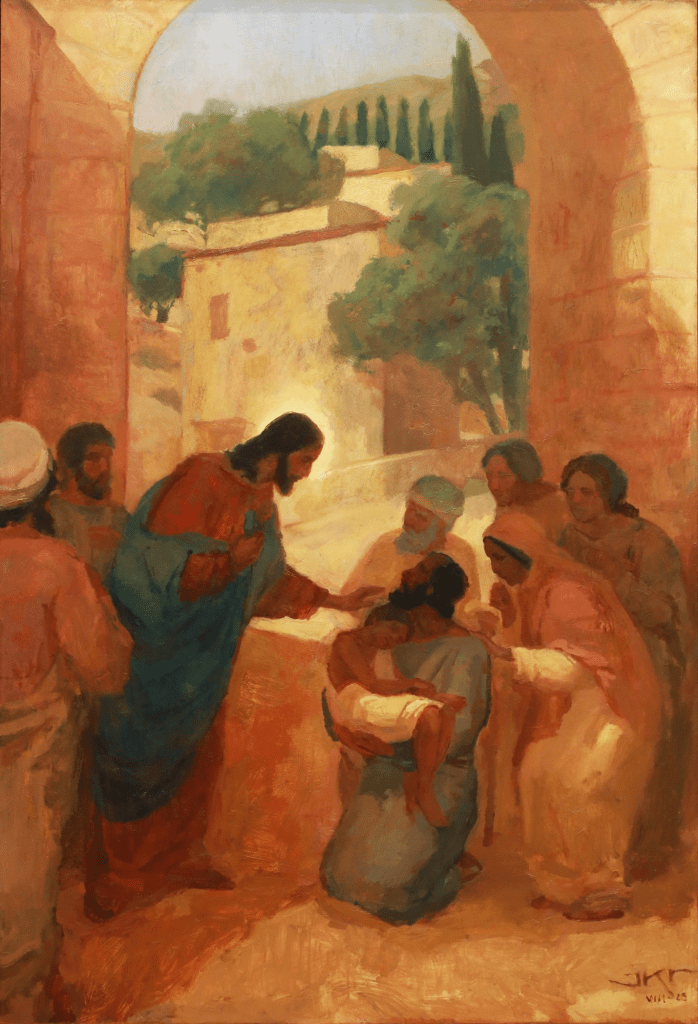
Help Thou My Unbelief, by J. Kirk Richards

When they came to the other disciples, they saw a large crowd around them and the teachers of the law arguing with them. As soon as all the people saw Jesus, they were overwhelmed with wonder and ran to greet him.

“What are you arguing with them about?” he asked.

A man in the crowd answered, “Teacher, I brought you my son, who is possessed by a spirit that has robbed him of speech. Whenever it seizes him, it throws him to the ground. He foams at the mouth, gnashes his teeth and becomes rigid. I asked your disciples to drive out the spirit, but they could not.”

“You unbelieving generation,” Jesus replied, “how long shall I stay with you? How long shall I put up with you? Bring the boy to me.”

So they brought him. When the spirit saw Jesus, it immediately threw the boy into a convulsion. He fell to the ground and rolled around, foaming at the mouth.

Jesus asked the boy’s father, “How long has he been like this?”

“From childhood,” he answered. “It has often thrown him into fire or water to kill him. But if you can do anything, take pity on us and help us.”

“‘If you can’?” said Jesus. “Everything is possible for one who believes.”

Immediately the boy’s father exclaimed, “I do believe; help me overcome my unbelief!”

When Jesus saw that a crowd was running to the scene, he rebuked the impure spirit. “You deaf and mute spirit,” he said, “I command you, come out of him and never enter him again.”

The spirit shrieked, convulsed him violently and came out. The boy looked so much like a corpse that many said, “He’s dead.” But Jesus took him by the hand and lifted him to his feet, and he stood up.

After Jesus had gone indoors, his disciples asked him privately, “Why couldn’t we drive it out?”

He replied, “This kind can come out only by prayer.” (New International Version)

Please, stick with me here, on what I see as the logic which undergirds this story:

God has authority over everything. God is powerful. Therefore, God can do the miraculous.

Humans have limited authority over some things. Humanity is sometimes strong, yet often weak. Therefore, humans must look outside themselves for a miracle.

God created people. Humans reflect the divine image and likeness of God. Therefore, God and humanity are inextricably linked.

God has miraculous power. Humans can have confidence (faith and hope) in God’s power. Therefore, miracles can happen when God’s power meets human confidence in that power.

God is personal. Humans are personal. Therefore, humans can know God.

God listens to human prayers. Humans have the ability to pray to God. Therefore, God’s power and human faith in that power are very much connected to each other.

Since God is authoritative, powerful, and personal, then God’s choice and ability to effect miracles is not an impersonal force which can be used and manipulated by humans, but rather is a gift to be prayed for and received with gratitude to God.

This then, is why Jesus seems exasperated with the experience of a botched exorcism, because:

  1. The father and the crowd have a profound lack of faith in God’s authority and power to personally effect the miraculous.
  2. The disciples have a disappointing lack of prayer in their own ministry.

The father of the son with the bad spirit was understandably desperate. And, on top it, disappointed with the disciples’ inability to do anything about the situation. The issue, however, is never about God’s ability – which is where the father went in talking to Jesus.

“If you are able” expresses little confidence in Christ.

Jesus emphatically replied that everything can be done for the one who believes. To which the father, still desperate, but then adding a healthy dose of honesty, confessed: “I believe; help my unbelief!”

That was all Jesus needed. The father’s humble and honest confession opened the soul’s door to receive the gift of faith. And the boy was rid of the bad spirit.

Furthermore, the father was also rid of his own bad spirit. The man was not demonized, like his son, nevertheless he possessed a spirit of ill confidence. The encounter with Jesus changed him, as well. It wasn’t just one person who walked away healed; both a father and a son were healed.

As often happened, the disciples left the scene with Jesus scratching their heads. They couldn’t figure out their own inability and failure to help the desperate father and his demonized son.

The bad spirit was indeed a stubborn one, and quite hard to deal with. Jesus told his disciples that one like this can only come out for those who nurture the spiritual habit of prayer.

Essentially, Jesus was saying that the vital connection between God and humans is dependent upon God. People don’t give orders to God, or act as the keepers and manipulators of divine power, like the ancient magicians did with their gods.

Rather, humans pray and ask for what they need, based upon the quality of their connection with God. This isn’t about the level of faith; it’s about whether there is any connection.

I can have lots of faith that my desk lamp will illuminate if I tell it to, but it won’t light unless I plug it in and turn it on. And if I do that, and the lamp will not turn on, then I know there is a problem with the connection – and not with my level of faith in making the lamp light up.

Everything in life must be maintained well, and taken care of. If it isn’t, it will eventually stop working, and may even fall into complete disrepair.

Faith and prayer are not simply tools which we wield with our own authority and autonomy. They must be developed and used with care for where they’ve come from.

Our prayers are opportunities for us to establish and maintain our vital connection with God via faith. Then, whenever we are in dire straits, the confidence is there, because of our connection with the Lord; nothing is hindering the power from flowing and lighting up the situation.

At its heart, Christianity is a relationship with God through Jesus Christ in the power of the Holy Spirit. And that relational connection has been brought about God, not me; and the means to maintain the relationship is from God, not me. Yet, we get to enjoy this beautiful access.

So, take advantage of it.

O Lord, our blessed Companion in life and death, your love is steadfast and never ends. Our wondering and weeping may linger in the night, but you give joy in the morning. Touch us with your healing grace so that, restored to wholeness, we may live our calling as your faithful resurrected people. Amen.

The Wounded Healer (Psalm 18:1-6, 43-50)

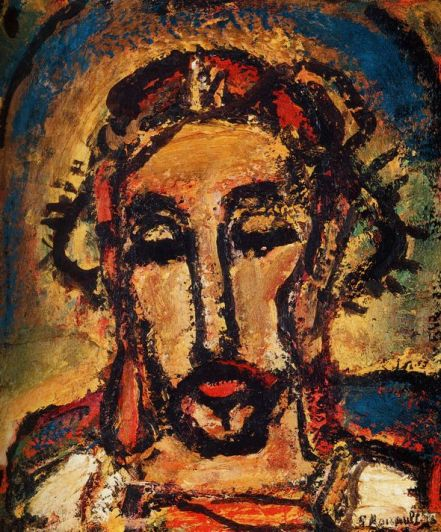
By French painter Georges Rouault (1871-1958)

I love you, Lord;
    you are my strength.
The Lord is my rock, my fortress, and my savior;
    my God is my rock, in whom I find protection.
He is my shield, the power that saves me,
    and my place of safety.
I called on the Lord, who is worthy of praise,
    and he saved me from my enemies.

The ropes of death entangled me;
    floods of destruction swept over me.
The grave wrapped its ropes around me;
    death laid a trap in my path.
But in my distress I cried out to the Lord;
    yes, I prayed to my God for help.
He heard me from his sanctuary;
    my cry to him reached his ears…

You gave me victory over my accusers.
    You appointed me ruler over nations;
    people I don’t even know now serve me.
As soon as they hear of me, they submit;
    foreign nations cringe before me.
They all lose their courage
    and come trembling from their strongholds.

The Lord lives! Praise to my Rock!
    May the God of my salvation be exalted!
He is the God who pays back those who harm me;
    he subdues the nations under me
    and rescues me from my enemies.
You hold me safe beyond the reach of my enemies;
    you save me from violent opponents.
For this, O Lord, I will praise you among the nations;
    I will sing praises to your name.
You give great victories to your king;
    you show unfailing love to your anointed,
    to David and all his descendants forever. (New Living Translation)

King David, the psalmist, had no problem with publicly expressing his great feeling of love for God. His desire was to be thoroughly devoted to the Lord; and he confidently discerned God as the source of his strength.

What’s more, David freely recognized God as the One who brought him deliverance. David cried out in distress. In his despair and desperation, he looked to the Lord, and God responded.

This is in contrast to those who complain about God and consider the Lord as distant and uncaring – if existing at all. David’s experience was that of being heard by God. And he wanted everyone to know, so that the faithful may be encouraged.

David didn’t want people becoming discouraged because of the bitterness of others who accuse God of being unconcerned.

The psalmist was not just talking about some mundane request, like asking for parking spot close to the building. David was in a life-and-death situation, stressful beyond imagination. Things were not looking good for him.

It seemed that the insolent, who think God isn’t watching, believed they could act unjustly and do whatever they wanted. Sadly, their lust for power and control blinds them to the larger reality of an invisible God who sees, and who responds at just the right time.

David wanted people to remember and not to forget about the saving actions of God. Because by keeping in mind who God truly is, then we can have confident trust, and will live in a way that is right, just, and good.

“Our service will not be perceived as authentic unless it comes from a heart wounded by the suffering about which we speak.”

Henri Nouwen

A good, right, and just life is always the appropriate response to divine mercy and deliverance. We are saved from evil, so that we might live in the spiritual freedom of purity and peace. And David gave God some due praise, adoration, and thanksgiving for rescuing him from his enemies.

Since David went through all of the adversity, hardship, stress, and suffering of dealing with unjust people, he was in a position to be a wounded healer for us.

A wounded healer is not someone who endorses a victim mentality. Rather, this is a person who has been profoundly hurt – physically, mentally, emotionally, or spiritually – and comes through the experience with an ability to be present with others and help facilitate healing in those who suffer.

Surely he took up our pain
    and bore our suffering,
yet we considered him punished by God,
    stricken by him, and afflicted.
But he was pierced for our transgressions,
    he was crushed for our iniquities;
the punishment that brought us peace was on him,
    and by his wounds we are healed. (Isaiah 53:4-5, NIV)

We all suffer and face various hard circumstances. And we are all changed by the hurtful encounters. But we don’t all respond the same way to that adversity. The difficult experiences of pain lead us to become either bitter or better.

If we have a wounded healer in our life, there is a good chance that we will be able to move through the hardship and come to a place of gratitude for what the Lord has done for us and how God brought us deliverance.

“As followers of Jesus we can also allow our wounds to bring healing to others.”

Henri Nouwen

Deliverance may not end up looking like anything we anticipate. If we are stuck on particular outcomes and have a singular expectation, then we may very well miss the Rescuer when the ship of salvation shows up.

Yet, if we can remain open to and aware of God – as well as of what’s going on inside us – then we shall likely experience healing for our deep wounds of pain. And we will embrace the scars it leaves as a reminder of the Lord’s deliverance.

It could be that things don’t change, at least like we want. In such times, perhaps the greatest healing that can take place is to be healed from the need for healing.

The Lord shows unfailing commitment and steadfast love to the faithful, to those who seek God. We shall find the divine in all circumstances, that is, if we seek God with all our heart.

“You will seek me and find me when you seek me with all your heart.” (Jeremiah 29:13, NIV)

Pain cannot be taken away unless we enter into it. So, it only makes sense to me, that we have a guide like the psalmist to lead us, and a Savior like Jesus to rescue us.

“Wholeness is not achieved by cutting off a portion of one’s being, but by integration of the contraries.”

Carl Jung

May you be patient in suffering, as Christ was in his earthly pain.

May the Lord be near you in your time of weakness and wondering.

May God sustain you by divine grace, and grant you courage not to have a failure of faith.

May you know healing of both body and soul.

And may you always believe that what happens to you in this present life is of little account if you hold Christ in eternal life. Amen.