Psalm 138 – The Lord Will Defend the Humble

I give thanks to you with all my heart, Lord.
    I sing your praise before all other gods.
I bow toward your holy temple
    and thank your name
    for your loyal love and faithfulness
        because you have made your name and word
        greater than everything else.
On the day I cried out, you answered me.
    You encouraged me with inner strength.

Let all the earth’s rulers give thanks to you, Lord,
    when they hear what you say.
Let them sing about the Lord’s ways
    because the Lord’s glory is so great!
Even though the Lord is high,
    he can still see the lowly,
    but God keeps his distance from the arrogant.

Whenever I am in deep trouble,
    you make me live again;
    you send your power against my enemies’ wrath;
    you save me with your strong hand.
The Lord will do all this for my sake.

Your faithful love lasts forever, Lord!
    Don’t let go of what your hands
    have made.
(Common English Bible)

“God opposes everyone
   who is proud,
but is kind to everyone
    who is humble.”

James 4:6, CEV

God Cares

God consistently cares for lowly and humble folk. The Lord continually draws near to them. God bends down to meet them at their level. Conversely, the Lord hangs out on the margins of proud and arrogant people. God stands straight up and looks down from afar on such persons. They will experience divine distance, mostly because their attitudes and actions put the stiff arm toward God.

One of the most frustrating experiences in life is to have someone in power arrogantly misjudge you. Rather than carefully listening and offering gracious attention, the proud already assume they know what’s going on and what is best. So, like a bull about to enter a china shop, or a timebomb ready to explode, human hubris of the heart violates and blows up another’s life based upon misinformation and faulty egotistic assumptions.

God Sees

Yet, God sees. From a lofty place, clearly observing all creaturely activity, the Lord knows what is truly happening. And God is not okay with injustice perpetrated by cocky and pretentious autocrats. Everyone will experience God’s power. It’s just a matter of what type of power one receives.

Saving and encouraging power will sustain and uphold the humble of heart. However, the power of God’s wrath is the lot of puffed up peacocks who only care about getting their way. Their own puny power will be eventually stripped away and given to those who will wield it with grace.

The difference between the proud and the lowly is evidenced by their prayers. Megalomaniacs are concerned for material acquisitions, high positions, and fame. And their prayers reflect those ambitions. The meek, however, pray for increased spiritual strength to withstand trouble; enlarged hearts to hold more of God; and acceptance of whatever the Lord wants, whether it is for personal good or ill.

God Knows

The haughty might do many things which are good. It’s possible for them to achieve greatness through outstanding work and incredible feats. Yet, God knows the real score. Jesus said:

“Not everyone who calls me Lord will enter God’s kingdom. The only people who will enter are those who do what my Father in heaven wants. On that last Day many will call me Lord. They will say, ‘Lord, Lord, by the power of your name we spoke for God. And by your name we forced out demons and did many miracles.’ Then I will tell those people clearly, ‘Get away from me, you people who do wrong. I never knew you.’” (Matthew 7:21-23, ERV)

Self-absorbed people enjoy their own presence and narcissistically believe everyone else should, too. Yet, ordinary people, being attentive to the common good of all persons, rely on the presence and protection of God for everyone and everything.

God Helps

Whereas the vainglorious person trusts in their own ability to achieve accomplishments and hold power so that they can smugly boast about their superiority, on the contrary, the meek are content to labor for the Lord in relative obscurity, to try and use their skills and aptitude for the benefit of their fellow humanity. God holds them tightly and securely, but not so with the egotistical. They will fall because they were never in God’s hand to begin with.

If the humble are weak, that’s okay. Because God is strong. If they are in trouble, no problem. The Lord has their back. They can let go, knowing there is a God who doesn’t. And that is the irony to the spiritual life – that in releasing and relinquishing we gain and acquire. We shall be vindicated by God from the wicked. For the Lord’s steadfast love will have the day.

Most merciful God, we confess that we have sinned against you in thought, word, and deed, by what we have done, and by what we have left undone. We have not loved you with our whole heart; we have not loved our neighbors as ourselves. We are terribly sorry, and we humbly repent. For the sake of your Son, Jesus Christ, have mercy on us and forgive us so that we may delight in your will, and walk in your ways, to the glory of your Name. Amen.

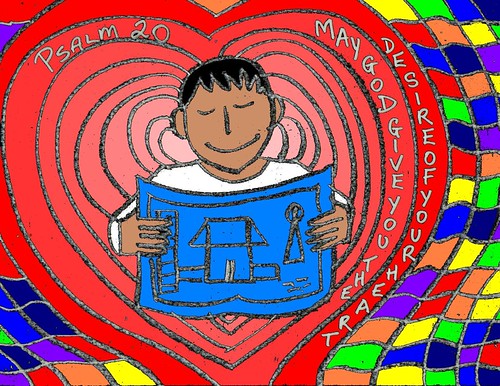
Psalm 20 – There Is Help from Heaven: Just Ask

I pray that the Lord answers you
        whenever you are in trouble.
    Let the name of Jacob’s God protect you.
Let God send help to you from the sanctuary
    and support you from Zion.
Let God recall your many grain offerings;
    let him savor your entirely burned offerings. Selah
Let God grant what is in your heart
    and fulfill all your plans.
Then we will rejoice that you’ve been helped.
    We will fly our flags in the name of our God.
    Let the Lord fulfill all your requests!

Now I know that the Lord saves his anointed one;
    God answers his anointed one
        from his heavenly sanctuary,
    answering with mighty acts of salvation
        achieved by his strong hand.
Some people trust in chariots, others in horses;
    but we praise the Lord’s name.
They will collapse and fall,
    but we will stand up straight and strong.

Lord, save the king!
    Let him answer us when we cry out!
(Common English Bible)

Sometimes, the connection between our present situations and the past biblical historical context is readily apparent; and sometimes it’s not so clear. In the crucible of life, and the struggles of daily living, we might too quickly pass over the grace, relevance, and truth of God’s Word to us. 

The psalms are both prayer and worship directed to God. Many of those prayers are for oneself. Others, like today’s psalm, are intercessions for others. It is my sincere and ardent desire that you will experience a good life, even when that life has a bevy of challenges, stresses, and difficulties baked into it. And so:

May the Lord answer you in the stress of your life.

May the name of the ever-living, ever-present God protect you.

May the Lord send you help from the holy habitation, and give you support from heaven itself!

May God almighty remember all the ways you have given and served.

May the Lord be pleased with everything you have sacrificed on behalf of divine purposes and plans.

May God grant your heart’s deep longing and carry out every good plan you conceive.

May we together shout for joy when you overcome incredible pressure, and in the name of God throw a big ol’ party because of answered prayer!

May the Lord bring to fruition every one of your prayers.

I have supreme confidence God’s people shall be delivered. The Lord will answer from heaven with the full force of saving power. Some put their ultimate trust in military might. Others place faith in financial security. But the people of God trust in the name of the Lord our God.

We may collapse and fall. There might be obstacles galore. Stress and pressure may be our constant companions. No matter. We get up and stand again with confidence. The Lord will save us. God will answer when we call.

For the Christian, all God’s good promises are realized in Jesus. Ultimate help and deliverance come from Christ. Even more, Jesus came to give victory to all people. Consider the following New Testament expressions of salvation’s opportunity for everyone:

Yes, God loved the world so much that he gave his only Son, so that everyone who believes in him would not be lost but have eternal life. (John 3:16, ERV)

This Jesus is the stone you builders rejected; he has become the cornerstone! Salvation can be found in no one else. Throughout the whole world, no other name has been given among humans through which we must be saved. (Acts 4:11-12, CEB)

God made a promise to our ancestors. And we are here to tell you the good news that he has kept this promise to us. It is just as the second Psalm says about Jesus,

“You are my son because today
    I have become your Father.”

God raised Jesus from death and will never let his body decay. It is just as God said,

“I will make to you
    the same holy promise
    that I made to David.”

And in another psalm, it says, “God will never let the body of his Holy One decay.” When David was alive, he obeyed God. Then after he died, he was buried in the family grave, and his body decayed. But God raised Jesus from death, and his body did not decay. My friends, the message is that Jesus can forgive your sins! The Law of Moses could not set you free from all your sins. But everyone who has faith in Jesus is set free. (Acts 13:32-39, CEV)

“The God who made the world and everything in it, this Master of sky and land, doesn’t live in custom-made shrines or need humans to run errands for him, as if he couldn’t take care of himself. He makes the creatures; the creatures don’t make him. Starting from scratch, he made the entire human race and made the earth hospitable, with plenty of time and space for living so we could seek after God, and not just grope around in the dark but find him. He doesn’t play hide-and-seek with us. He’s not remote; he’s near. We live and move in him, can’t get away from him! One of your poets said it well: ‘We’re the God-created.’ Well, if we are the God-created, it doesn’t make a lot of sense to think we could hire a sculptor to chisel a god out of stone for us, does it?”

“God overlooks it as long as you don’t know any better—but that time is past. The unknown is now known, and he’s calling for a radical life-change. He has set a day when the entire human race will be judged, and everything set right. And he has already appointed the judge, confirming him before everyone by raising him from the dead.” (Acts 17:24-31, MSG)

There is help from heaven. It is available to us – if we but ask…

*Above art by Stushie Art of Psalm 20:4

Pentecost: Where We Want to Be, and Where We Are

We know that the whole creation has been groaning as in the pains of childbirth right up to the present time. Not only so, but we ourselves, who have the first-fruits of the Spirit, groan inwardly as we wait eagerly for our adoption to sonship, the redemption of our bodies. For in this hope, we were saved. But hope that is seen is no hope at all. Who hopes for what they already have? But if we hope for what we do not yet have, we wait for it patiently.

In the same way, the Spirit helps us in our weakness. We do not know what we ought to pray for, but the Spirit himself intercedes for us through wordless groans. And he who searches our hearts knows the mind of the Spirit, because the Spirit intercedes for God’s people in accordance with the will of God. (Romans 8:22-27, NIV)

Pentecostal Groanings

“Pentecost” is the Latin word for “fifty.” Each year, fifty days after Easter, Christians celebrate the Holy Spirit coming upon the early church with power. This Pentecostal energy is not just dynamite with an explosion of spiritual gifts and energizing ministry. Spiritual power certainly is and can be optimistic, positive, and full of faith. 

More than that, Holy Spirit power can also be found in the travails and tribulations we face. It can be discovered in the dark night of the soul, in times of loneliness and doubt, and in the constant need for prayerful intercession. The Spirit is both a mighty wind and a gentle breeze.

The good news of Pentecost is that when we are not powerful, the Spirit helps us in our weakness – that is our hope and our quiet strength. The Apostle Paul used the experience of childbirth to communicate and illustrate what the experience of the Christian life is like. Growth, wonder, expectation, hope, patience, pain, and joy are all words to describe pregnancy and childbirth. 

Pentecostal Prayer

When it comes to the Church and the Christian life, believers are in the gestation period. Our salvation has not yet come to full term. Meanwhile, we must remain encouraged and healthy, keeping our future hope always in front of us so that we will not lose heart. When we are limited in what we can do, we pray. When we are flat on our backs, overwhelmed with our circumstances, we may not be able to utter any words in prayer.

My dear wife and I know something about pregnancy and prayer. We did not know, twenty-six years ago, whether we would have our third child, or not. Our lives were turned upside-down for nearly four months, as we did everything possible to deal with an overwhelming situation, not knowing if our little peanut of a daughter was going to live or die in the womb.

Pentecostal Patience

We had to wait. We had to force patience on ourselves. It really was a life and death situation. As Christians, we are waiting for our complete redemption. If we are not patient and do not focus on our hope, we will not make it. 

To be sure, in difficult times it does no good to be like Eeyore and feel sorry for ourselves. Yet, on the other hand, it equally does no one any good to always be smiling, positive, and upbeat as if nothing is worth grieving over. To take such a posture toward the awful challenges of life is to, at best, ignore the power of lament, and, at worst, live in abject denial about what our true situation really is with all its weakness and inability to control most of what is going on.

In the teeth of adverse circumstances, enter God in the person of the Holy Spirit. The Spirit resides with us and strengthens us with Pentecostal power. So, on this Day of Pentecost, we not only celebrate the Spirit’s mighty power to blow a violent wind and upturn history; we also proclaim and praise the Spirit’s power to come alongside and provide the deep inner strength necessary to fortify us for all we must face.

Pentecostal Awkwardness

We cannot run away from what God has put in front of us. We live in an awkward time of spiritual pregnancy in which we possess salvation but do not yet possess it in all its fullness. There is so much groaning going on because we realize there is such a large gap between where we are and where we want to be.  If women could have babies without nine months of struggle, limitation, and pain, I think they would opt for that instead of the way it is now (I know I would!).

All of creation groans because where it is now and where it will be seems like such a long time in coming.  Every creature and all living things are presently experiencing decay and death. The earth is not yet redeemed from its cursed bondage. So, the planet convulses and contracts with natural disasters and diseases because we live in a fallen world that is not yet redeemed.

People groan because they fall victim to circumstances beyond their control. We also groan because of our own poor choices which grieve us. Although we have been delivered from sin, death, and hell, and experience spiritual power, we still must wait eagerly for the redemption of our bodies. 

We are keenly aware of the terrible disconnect between where we are as people and where we want to be. It feels like Pinocchio, who is not yet a real boy, and must deal with strings and other puppeteers who don’t care about him, who feels the need to lie because of his situation and pays the consequences of his nose growing.

But we are not left to fend for ourselves. Because the Spirit groans on our behalf, uttering prayerful sounds that words cannot express. The Spirit helps us in our weakness, in our pregnant state of discomfort and wondering. 

“The Holy Spirit is an expert on knowing our concerns, knowing God’s will, and bringing the two in harmony with each other.“

Mit Tdrahrhe

Pentecostal Hope

So, we focus on hope – the confident expectation we will not always be in this position. In the meantime, we learn to enjoy the process of growing in the Lord and discovering the ways of Jesus. We learn to slow down to listen to the gentle voice and the refreshing breeze of the Spirit. During this interim time, this gestation period, we develop new rhythms of life, moving back-and-forth between rejoicing and groaning; praising and grieving; hoping and lamenting; believing and doubting – all with agonizing patience.

Living patiently and hopefully in the Christian life will be worth it all when we see Jesus. We must walk through the valley; yet we never do it alone – God’s presence is with us in the personal provision of the Holy Spirit.

Do not give up in prayer. Even if you do not know what to say or cannot even speak, you can groan because the Spirit will pick up those groans and groan them in the ear of our gracious heavenly Father. The Holy Spirit stands in the gap between where we are and where we need to be. The Spirit intercedes for us, bridging that wide chasm, and bringing us practical deliverance from our impatience.

One of the oldest definitions of prayer is this: Lifting mind and heart to God. Too often in our efforts to pray formally, we fail to truly lift our hearts and minds to God. That’s because what is really in our hearts and minds is not something we generally connect with prayer, at all. Our frustrations, bitterness, jealousies, lusts, curses, sloth, and quiet despair are sometimes understood to be the opposite of prayer, as if they are things overcome so that we can pray.

Pentecostal Power

However, something deeper is happening within: Our frustrations, longings, lusts, jealousies, and escapist daydreams, the things we are fearful and ashamed to name in prayer, are in fact already lifting our hearts and minds to God in more honest ways than we ever do consciously.

If you are carrying a heavy burden, take the light yoke of Jesus and offload your worries to the Holy Spirit who is waiting to intercede for you. And if there is no immediate relief, persevere in prayer without giving up. Pentecostal power is available, but it is not cheap; it will cost us time in prayer as well as patience for the Spirit to work on our behalf. For the Christian life is a lifelong process of becoming.

Come, Holy Spirit, fill our hearts. Kindle within us the fire of your love. Send the gentle breeze of your Spirit, and we shall be renewed into patient people, growing in the grace and knowledge of our Lord Jesus Christ. Spirit of the living God, we invite you to wring the death out of our hearts and saturate our souls with your breath and life.  Hoping against all hope we lay defeat aside. We grab for the corner of your cloak and wait for a miracle. Amen.

*Above artwork by Rebecca Brogan

1 Corinthians 15:42b-49 – Attention to the Body is Spiritual

It’s the same with the resurrection of the dead: a rotting body is put into the ground, but what is raised won’t ever decay. It’s degraded when it’s put into the ground, but it’s raised in glory. It’s weak when it’s put into the ground, but it’s raised in power. It’s a physical body when it’s put into the ground, but it’s raised as a spiritual body.

If there’s a physical body, there’s also a spiritual body. So, it is also written, the first human, Adam, became a living person, and the last Adam became a spirit that gives life. But the physical body comes first, not the spiritual one—the spiritual body comes afterward. The first human was from the earth made from dust; the second human is from heaven. The nature of the person made of dust is shared by people who are made of dust, and the nature of the heavenly person is shared by heavenly people. We will look like the heavenly person in the same way as we have looked like the person made from dust. (Common English Bible)

Laying around on clouds. Strumming harps. Perhaps chanting. Maybe an angel choir. Ethereal. Yes, quite disembodied. That’s the stereotypical idea when it comes to the afterlife for many people. Although many believers in Jesus realize heaven won’t be quite like that, they still might think of it as non-corporeal.

The stereotypical view really comes from Plato, not Scripture. The ancient Greek philosopher Plato (423-347, B.C.E.) believed the soul to be immortal and the body mortal. Hence, after death, an ethereal existence with no physical attributes. Plato saw death itself as an emancipation from the body.

A New Testament understanding of the body is that it’s perishable and will die. However, the body will be resurrected and become permanently imperishable. Just as Christ died and rose again, so shall we. Since Jesus was raised to new life with an actual spiritual body, complete with the scars of crucifixion, so humanity is raised to new life – not without a body but with a renewed one – and will be fit to exist with God forever.

“All the fullness of deity lives in Christ’s body.” (Colossians 2:9, CEB)

This all might seem like theological trivia or quibbling over philosophical musings. But when we mosey through the Bible, the body is important, lifted-up as equal to the spirit or soul. The material and the immaterial are not to be ranked in order of importance; they are to be held together as equal partners of personhood.

The Lord God formed a man from the dust of the ground and breathed into his nostrils the breath of life, and the man became a living being. (Genesis 2:7, NIV)

Body and soul belong together like a hand in a glove; like biscuits and gravy; or like copy and paste; Calvin and Hobbes; cupcakes and frosting; the moon and the stars; gin and tonic; bacon and anything; and, well, like Adam and Eve. Care of both the material and immaterial dimensions of personhood are vital and necessary.

Our bodies are the vehicles in which we do the will of God in the world. And the same shall be true after this life is over. The next life requires some full lungs to sing to the Lord; tongues to praise God; hands to lift high in worship; and feet to dance with the Trinity – not metaphorically but with actual plain speech and real live action.

We were made from dust, and to dust we shall return. But that isn’t the end of the story. Resurrection has the final say. Mortality will give way to immortality. The perishable will become imperishable. Temporal existence will cease and a permanent life, eternal life, shall endure without degeneration or entropy, with no disease, disorder, or death.

We, therefore, have hope – a confident expectation that it will not always be this way – a planet filled with pain, heartache, and grief. The tent of our present existence will be left behind for a grand mansion with God at the center – all things revolving around divine grace and love with the light of glory dispelling the night forever.

Our faith is embodied; and will be for all time. Embodied spirituality discerns all human dimensions—body, soul, heart, mind, emotions, and consciousness—as equal partners in bringing oneself into fuller personal alignment and engagement with the world.

Spiritual transformation is incomplete unless it encompasses the body. We need to be aware of and connected to our physical selves. Else, we lack wholeness and integrity. The body is not a platonic prison of the soul but a spiritual temple of the Holy Spirit. It is our home and the place where we meet with God.

A complete human being with a full-orbed spirituality is firmly grounded in the body, fully open to the spirit, and in community with others experiencing transformation from the inside-out.

One way of honoring our bodies is to incorporate them into our prayers. Here are some physical postures we can take when praying:

  • Sit with hands open, palms up, ready to receive grace and love from God.
  • Stand with hands open and raised overhead, and face toward ceiling/sky.
  • Kneel with head bowed (I personally use a kneeler. My knees aren’t what they used to be).
  • Kneel with hands/head in one of the positions described above.
  • Walk a prayer labyrinth.
  • Lie on your back (on your bed, the floor, the grass).
  • Lie face down with hands outstretched (prostrate).
  • Genuflect (bow) and make the sign of the cross.
  • Cupped hands facing up to receive blessing from God.
  • Deep breath in (saying “more of you”) and a full exhale out (saying “less of me”).

Our worship on this earth is training us for worship in the new heavens and the new earth. Paying attention to our bodies is good spiritual sense, not to mention being thoroughly biblical.

Almighty God, Creator of heaven and earth, we await your divine presence in our lives – not as we expect or imagine – but just as it is. We allow and invite all the ministry of your Spirit into our lives. We accept whatever you give to us or withhold from us as a gift. And we will attend to our bodies and care for them as faithful stewards of this flesh and blood existence, through Jesus Christ our Lord. Amen.