I Concede (Job 42:1-6, 10-17)

By Bible Art

Then Job answered the Lord:

“I know that you can do all things
    and that no purpose of yours can be thwarted.
‘Who is this that hides counsel without knowledge?’
Therefore I have uttered what I did not understand,
    things too wonderful for me that I did not know.
‘Hear, and I will speak;
    I will question you, and you declare to me.’
I had heard of you by the hearing of the ear,
    but now my eye sees you;
therefore I despise myself
    and repent in dust and ashes.”

…And the Lord restored the fortunes of Job when he had prayed for his friends, and the Lord gave Job twice as much as he had before. 

Then all his brothers and sisters came to him, and all who had known him before, and they ate bread with him in his house; they showed him sympathy and comforted him for all the evil that the Lord had brought upon him; and each of them gave him a piece of money and a gold ring. 

The Lord blessed the latter days of Job more than his beginning, and he had fourteen thousand sheep, six thousand camels, a thousand yoke of oxen, and a thousand donkeys. He also had seven sons and three daughters. He named the first Jemimah, the second Keziah, and the third Keren-happuch. In all the land there were no women so beautiful as Job’s daughters, and their father gave them an inheritance along with their brothers. 

After this Job lived one hundred and forty years and saw his children and his children’s children, four generations. And Job died, old and full of days. (New Revised Standard Version)
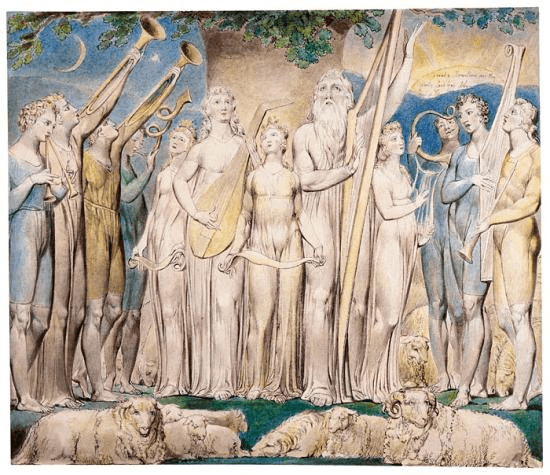
Job is restored, by William Blake (1757-1827)

Job was in awful suffering. He contended with God about it. Job’s friends contended with Job. In the end, God never gave a humanly suitable answer to the problem of suffering. Namely, because we cannot understand the answer, even if it is provided.

Indeed, the gap between God and humanity is quite pronounced. God is the Creator. We are creatures. Yet, God did vindicate Job.

That’s right God affirmed Job – and not Job’s companions. Even though Job did what many a believer in God today believes is wrong, perhaps even sacrilegious or sinful.

Job argued, confronted, grappled with, and even opposed God for the terrible troubles he faced in losing his family, his wealth, and his health. He fully engaged God.

Job’s friends, however, did no such thing. Instead, they argued, confronted, grappled with, and even opposed their friend Job. They fully avoided God.

In the end, Job conceded that he himself knows nothing. Yet, there is still the hint of complaint within him. This is good. Job did not stop engaging God. He remained faithful and devoted.

Let us never believe that faithfulness and devotion to God involves putting up a false front and nice polite piety. Prayer, in truth, is a hard wrestling with God, a struggling and working through all the difficulties of this unfair life.

God is not the least offended by our full, real, and raw engagement of him. But God is offended by avoiding such engagement altogether.

All of us, in reality, speak mostly in ignorance. We talk about things we don’t really understand. The only thing we can be 100% truthful about, however, is ourselves – about how we are really doing, feeling, experiencing, believing, struggling with, etc.

I myself am the true expert on me – and you, the expert on you. And this truth I can bring to God anytime, anywhere. The Book of Job affirms to me that this is the sort of devotion and sacrifice which the Lord is pleased with.

Job gained some knowledge and understanding through personally encountering God. The Lord God almighty, Creator of heaven and earth, actually spoke to Job in a direct revelation of the Divine presence.

This is an affirmation of Job’s integrity. But the godless, disintegrated, and fragmented person cannot see God or expect a personal audience with God.

Through all that Job had been through, he held to his integrity, and held onto God, both at the same time. In the end, he still did not understand why he had to go through such horrible suffering.

English translations of the Hebrew text don’t do it justice. There is always something lost in translation of any language to another. And it seems what is lost here is that Job was perhaps still protesting at the end. Yet, it comes across in English as Job despising and abhorring himself, as if he had done something very wrong.

“I despise myself,” misses the mark. Without getting into some deep grammatical Hebrew waters, I wonder if the phrase might better be rendered, “I protest.” What is meant to be conveyed is that Job still acknowledges what he originally held onto. Namely, that he has done nothing wrong, did not deserve what he went through, yet has never rejected God, nor lost faith in God.

Job did not need to repent of some secret sin, as his friends supposed. Job repenting does not mean because of sin; Job’s repentance was a change of position from mourner and complainer, to accepting the situation as it is, without answers.

So, this brings us back to the beginning of the book. God is God. There are celestial forces and operations in play we know nothing about. Humans are not God. Humans are never going to get most of what is happening in this world. And humans will inevitably experience hard and bad things – and not know why.

No answers given. No change of situation (yet). But Job changed. He changed his mind about how to live with what he was experiencing. He relinquished his complaint, and decided to keep living, even though he did not get answers.

Honestly, this response of Job is more consistent with my own experience of awful suffering, and more faithful to the text of Scripture. Much like Jacob wrestling with the angel, Job had to finally concede and relent, and continue on his life journey, come what may.

Following Job’s intercession for his friends, God restored Job to wealth and family. A significant piece of this restoration was Job’s wider community of friends and family who gathered around him, giving Job the consolation and comfort that the three “friends” in the book did not provide.

The community cared for Job, not through nice theological phrases, but with genuine fellowship. They shared together around the table, the community giving both a meal and contributing monetary gifts for Job’s needs.

The Book of Job ends, perhaps with as many, or more, questions than when it started. Answers, however, are not the point.

Rather, Job’s incredible and awful experience of suffering and redemption becomes an invitation for you and me to have a more expansive view of what a relationship with the living God truly looks like.

May God bless you with discomfort
At easy answers, half-truths, and superficial relationships,
So that you may live deep within your heart.

May God bless you with anger
At injustice, oppression and exploitation of people,
So that you may work for justice, freedom and peace.

May God bless you with tears
To shed for those who suffer pain, rejection, hunger, and war,
So that you may reach out your hand to comfort them
And turn their pain into joy.

And may God bless you with enough foolishness
To believe that you can make a difference in the world,
So that you can do what others claim cannot be done
To bring justice and kindness to all our children and the poor. Amen.

Be Honest (Job 42:7-9)

Job’s Sacrifice, by William Blake (1757-1827)

After the Lord had finished speaking to Job, he said to Eliphaz, “I am angry with you and your two friends, because you did not speak the truth about me, the way my servant Job did. Now take seven bulls and seven rams to Job and offer them as a sacrifice for yourselves. Job will pray for you, and I will answer his prayer and not disgrace you the way you deserve. You did not speak the truth about me as he did.”

Eliphaz, Bildad, and Zophar did what the Lord had told them to do, and the Lord answered Job’s prayer. (Good News Translation)

After all of Job’s terrible trouble in losing everything and everyone he cared about; after all of the longwinded speeches of his supposed friends; and after God’s breaking of silence through unanswerable questions; the epilogue of the story brings us God’s verdict concerning Job and his situation.

God finally dispenses his assessment, and renders his judgment. The Lord was not at all happy with Job’s companions; and was pleased with Job. Therefore, God made a decision against the companions, and for Job.

Four times in three verses, God refers to Job as “my servant,” but does not describe the friends as such. It is Job, and not Job’s friends, who spoke truth. Only Job spoke words consistent with reality.

At best, the friends spoke unhelpful words. At the worst, their words were hurtful and full of hubris. In retrospect, they probably should have at least kept their mouths shut. And ideally, they could have been true comforters, and consoled Job in his agony.

This gets at something which I believe we all need to get a firm hold upon: Not extending help, mercy, and consolation to those in dire straits, pisses-off God.

It irks God because it is a misrepresentation of God’s basic character, and distorts God’s true nature.

Being dishonest and pretending to be okay when one is not…

telling someone who is hurting to suck it up and confess their sin…

believing that the world operates according to good guys getting health and wealth, and bad guys getting sickness and poverty…

downright angers the holy and merciful God of the universe.

Job, unlike the Three Stooges he had as friends, affirmed what is right and true:

  • God is the Sovereign of the universe who dispenses both good and bad (Job 2:10)
  • God is the One who gives and who takes away (Job 1:21)
  • God is the Lord to whom we must bow in willing submission (Job 42:5-6)

In the dialogue with his friends, Job rightly insisted that God is sometimes an enemy, and that God’s inexplicable silence and absence is unjust and destructive.

I don’t want you to easily pass over what I just referred to, or to flip-out over it. In truth, God is both present and absent. And God’s absence hurts. Sometimes, it hurts like hell. We must affirm that God is sometimes silent. There are times when it feels like God is on vacation and is paying no attention.

I want you to get ahold of this important dimension to the spiritual life:

Human pretentions and posturing only present a false self to God and the world. That sort of behavior angers God. The Lord wants honest vulnerability.

Whereas Job’s friends insisted on maintaining theological respectability and an ordered theological system, Job essentially said, “To hell with all that!”

And Job was right.

Job contended with God. He cried, yelled, and exposed his innermost thoughts and feelings to God. Job was real. No phoniness existed with him. Yet, Job did not forsake God, curse God, or say there was no God.

The genuine spiritual life is always a tricky and risky combination of devotion and confrontation toward God.

Job presented his true self to God.

Job’s friends presented to God what they believed God wanted to see and hear.

There is a big difference between those two approaches.

God affirmed Job. God was against Job’s friends.

Maybe today it is necessary to rethink what you have always believed it is which gets God’s affirmation, and what raises God’s ire.

If we cannot be honest about what we are really thinking, and about how we are really doing, then we are hopeless people. In that state, no one can help us. And God is not pleased.

The final verdict of God is that only the prayers of one who speaks truth, like Job, will be effectively heard. Less honest prayers, like those of Job’s wife and friends, are foolish and ineffective.

One of the big overall messages of the Book of Job is this: For God’s sake, be honest!

My own culture is one of Midwest nice. That’s a nice way of saying that Midwesterners are mostly dishonest creatures. Every Midwesterner I know, understands being nice and polite to someone’s face, and then speaking gossip and slander to their back.

Ask any Midwestern American how they are doing, and they’ll tell you, “Just fine,” or “Great!” or “The sun is shining,” or some other deflection or blathering lie about how they are really doing. More than once, I have actually heard a depressed person with suicidal ideation tell another person that they are “doing fine today.”

That sort of claptrap gets us nowhere, especially with God. The Lord is okay with you and I telling him what we really think, even if we are extremely upset with God. God isn’t bothered by our anger, yelling, or messed-up thinking. But God is bothered by our pretending, our dishonesty, and our false presentations.

None of this means that we must wear our heart on our sleeve. In fact, I have found that persons who declare to me that they “tell it like it is,” are some of the most false people on the planet. It’s usually a sign that I’m not going to get from them how they are really feeling. It usually means they’re angry, and want to talk smack against someone, without ever examining themselves.

Don’t be a jerk. There are nice jerks, and obnoxious jerks, but in the end, they’re all just jerks. You and I really can speak honest words of truth, without being a jerk about it.

Job was honest, real, raw, hurt, angry, sad, lonely, and grieving out of his mind. And he was no jerk. And God affirmed him.

Personally, I’d rather have God’s affirmation than anyone else’s. How about you?

Almighty God, help us to speak and act truthfully in all situations. May we be honest with ourselves and with others, building trust and integrity in our relationships. Thank you for your example of truth and honesty. Help us to follow in your footsteps and to live with authenticity.

Guide us to be honest even when it is difficult, recognizing that honesty is the foundation of trust and respect. Help us to confront our own falsehoods and to seek the truth in all aspects of our lives. May we create environments where honesty is valued and encouraged, fostering open and transparent communication.

We pray for those who struggle with honesty, asking for your guidance and support in their journey towards truthfulness. Thank you for the clarity and peace that comes from living honestly. Help us to embrace and uphold this value every day. Amen.

Mercy and Judgment (Revelation 8:1-5)

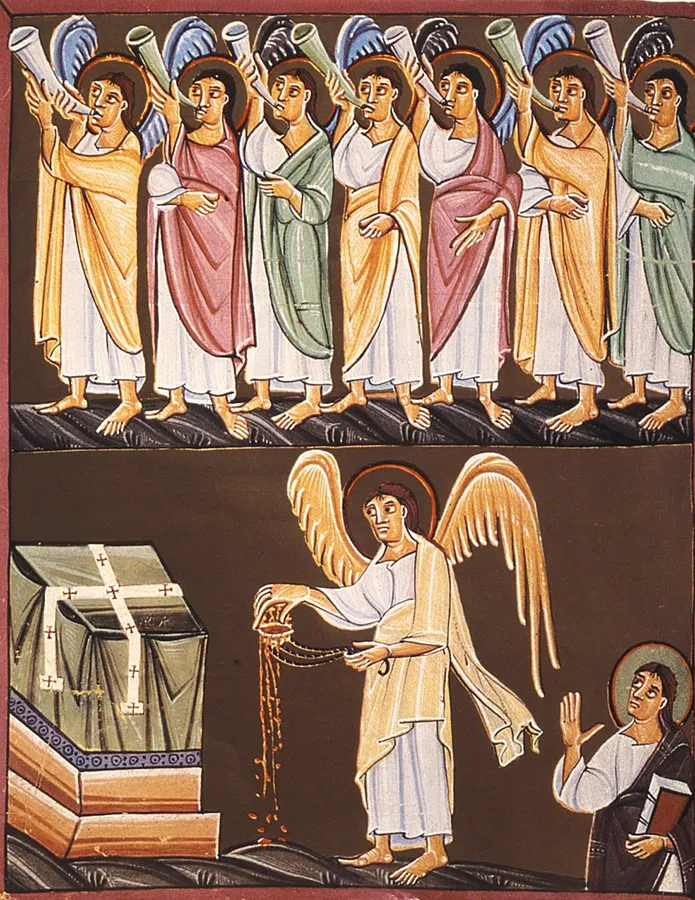
Seven angels with seven trumpets, and the angel with a censer, from the Bamberg Apocalypse, c.1020 C.E.

Then, when the Lamb opened the seventh seal, there was silence in heaven for about half an hour.

Then I saw the seven angels who stand before God, and seven trumpets were given to them. Another angel came and stood at the altar, and he held a gold bowl for burning incense. He was given a large amount of incense, in order to offer it on behalf of the prayers of all the saints on the gold altar in front of the throne. 

The smoke of the incense offered for the prayers of the saints rose up before God from the angel’s hand. Then the angel took the incense container and filled it with fire from the altar. He threw it down to the earth, and there were thunder, voices, lightning, and an earthquake. (Common English Bible)

When I was kid, growing up on a Midwest American farm, I remember times when severe weather was coming. I knew it was going to be bad whenever everything became still and there was complete silence: No wind, no birds singing, no insects chirping, nothing moving whatsoever. It was the eerie silence which precedes something big coming.

That is the way it will be in heaven when the seventh seal is opened. The silence is so quiet that you know a lot of noise and movement are about to happen. It’s not serene silence; it’s scary silent.

With the opening of the seventh seal, a climactic moment is reached. The silence is not only an anticipation of the coming drama, but is also a sign of reverence and awe.

The seventh seal initiates a series of woes: The seven trumpets. But before the trumpets begin, an angel appears. Standing before a heavenly altar, the angel mixes incense along with prayers from the people, then offers them on the altar.

These prayers of the people are for justice, and a longing for the kingdom to come, and God’s will to be done, on earth, as it is always done in heaven.

The imagery relates to us that God hears the prayers, and will act, according to the divine character and will.

The angel takes fire from the altar and hurls it down to earth, causing thunder and lightning, and an earthquake. In other words, the prayers are being answered; they are having an effect. Judgment on the earth begins with the blowing of the seven trumpets.

As we may expect, the incredible silence gives way to an equally incredible noise of weather and the earth moving. And the angel, serving as a quiet and contemplative high priest, now moves to becoming a judge upon the earth.

It turns out that mercy and judgment are not two contrasting concepts and actions; they are two sides of the very same coin. The altar of mercy becomes the source of judgment.

Whenever there is an injustice, we want (and expect) to have that act acknowledged and taken care of by a proper authority. To have a judge simply say that he/she is merciful and will acquit the guilty, does not work in every situation. Mercy only exists because of the presence of guilt and judgment.

God takes care of sin because God loves. An unloving deity would be unconcerned, random, and capricious in handling injustice. But not the God of the Bible. God shows mercy to the righteous, and will judge the wicked.

God’s mercy extends to the point of acquitting the guilty, if God so desires to do so. And everyone needs mercy, because we all have committed injustices in our lives.

Yet, by means of humble contrition and faith, we can mercifully discover gracious amnesty. This is why Jesus came, to take care of the sin issue once for all through the Cross.

We have been made holy by God’s will through the offering of Jesus Christ’s body once for all. (Hebrews 10:10, CEB)

In the time of the Apostle John’s vision, which is the Book of Revelation, Christians were facing persecution and martyrdom. The prayers of the suffering believers rose to heaven:

They cried out with a loud voice, “Holy and true Master, how long will you wait before you pass judgment? How long before you require justice for our blood, which was shed by those who live on earth?” (Revelation 6:10, CEB)

God’s response to the prayers of the saints is to send judgmental fire against the earth by the hand of the angel. In John’s apocalyptic vision, not only are the believers in Christ facing trials and tribulations for their faith, but the unbelieving persecutors who victimize the saints will be punished, as well.

If the persecutors use fiery elements against the believers, God can (and will) turn that fire back on the them. This is similar to the Book of Exodus, in which the plagues that struck and judged the Egyptians were, at the same time, a means of protecting and preserving the Israelites.

The Book of Revelation included in the Christian canon of scripture, not for the purpose of predicting the time or the season in which Jesus Christ will come back to judge the living and the dead. Rather, John’s Apocalypse is meant to encourage the followers of Christ that their suffering will not last forever; and neither will the arrogance of the wicked.

We don’t know when all of this end-of-the-age stuff is going to shake out. Which is why it is so important we learn to persevere through suffering. Because we might have to wait awhile.

Prayer for us then becomes not simply something we do if we have a bit of discretionary time; it becomes vital for us. We discern that we must speak with God. We are compelled to offer our prayers. We feel the great need to cry out and petition God for justice and righteousness.

It seems, if I don’t pray, I won’t make it. Therefore, I must pray. I will pray with all of my heart and soul, till I cannot pray anymore. And then I will pray some more, because I need God.

There is nothing easy about moving through suffering. It’s hard to persevere. It hurts to be the brunt of another’s violent tongue and/or hand. Yet, we do not experience this alone. The divine presence is with us. And that makes all the difference.

Oh God:
Give me strength to live another day;
Let me not turn coward before its difficulties, or fail in its duties;
Let me not lose faith in other people;
Keep me sweet and sound of heart, in spite of ingratitude, treachery, or meanness;
Preserve me from minding little stings, or giving them;
Help me to keep my heart clean, and to live so honestly and fearlessly that no outward failure can dishearten me, or take away the joy of conscious integrity;
Open wide the eyes of my soul that I may see good in all things;
Grant me this day some new vision of your truth;
Inspire me with the spirit of joy and gladness and make me the cup of strength to suffering souls; in the name of the strong Deliverer, our only Lord and Savior, Jesus Christ. Amen.

Live with Integrity (Psalm 26)

Vindicate me, O Lord,
    for I have walked in my integrity,
    and I have trusted in the Lord without wavering.
Prove me, O Lord, and try me;
    test my heart and mind.
For your steadfast love is before my eyes,
    and I walk in faithfulness to you.

I do not sit with the worthless,
    nor do I consort with hypocrites;
I hate the company of evildoers
    and will not sit with the wicked.

I wash my hands in innocence
    and go around your altar, O Lord,
singing aloud a song of thanksgiving
    and telling all your wondrous deeds.

O Lord, I love the house in which you dwell
    and the place where your glory abides.
Do not sweep me away with sinners
    nor my life with the bloodthirsty,
those in whose hands are evil devices
    and whose right hands are full of bribes.

But as for me, I walk in my integrity;
    redeem me and be gracious to me.
My foot stands on level ground;
    in the great congregation I will bless the Lord. (New Revised Standard Version)

Those with integrity long for, and pray for, justice and righteousness. They despise evil and desire the community of faith to be full of love.

Today’s psalm, as well as all of the psalms, are solid prayers which are meant to be prayed by any individual person, at any time, in any era. Those desiring the right, the just, and the good, will especially gravitate toward the psalter and prayer.

The faithful seek to live a morally upright life of integrity, peace, and wholeness. Yet, the psalm is also for those who find themselves unfaithful. They can pray and ask God to search their hearts and bring them to innocence. So, no matter who you are, this psalm is for anyone who wants to connect with the Lord

We have the ability to come before God because God encourages it, and makes it possible for us to approach. The Lord isn’t looking for perfection; God wants some honesty and vulnerability, and for us to realize how utterly dependent creatures we are.

The steadfast love of God is everywhere, and the psalmist recognized this. No matter the situation or circumstance, no matter the place or time, God’s love is present. The reason why we can wrap our faith and commitment around God is that God is consistently and constantly loving in everything.

And whenever we discern and know that this world spins on the axis of love, then we have no desire whatsoever to hang out with those who practice wickedness; we want nothing to do with worthless conversations and actions.

When one has been touched by divine love, not only is there a desire to avoid all evil, but there is also a longing to remain in that love, and to have love be the dominant operative force in all things on this earth.

Once we receive love, we want to give love. And having given love, we desire for the entire world to know this love, which is the true ballast and support of the world.

Without love, there is nothing. With love, all things are possible.

The one who loves does not consort with liars or hypocrites, because such persons indulge deception and selfishness, not openness and respect for others. The lover of God and of righteousness is not found in the company of evildoers.

The lovers amongst us are much too busy providing justice and goodness. The haters amongst us just sit around and curmudgeon on about everything that is messed up in this world, and make fun of all the do-gooders who are so enamored with love.

Which group of people would you rather be around? The lovers or the curmudgeons? Would you like to be in the group who acts like they have everything together? Or would you instead like to be in the group who knows how much they are dependent on the force of love, and of the originator of love, the one who is Love incarnate?

I, personally, would rather be in the community of the redeemed, who know they have been rescued by grace and could fall into wickedness if not for God’s sustaining grace. I have no desire to be in community with people who talk one way and live another.

I would like to be in the place characterized by integrity and love, the sort of place described by the Apostle Paul in his letter to the Romans:

Therefore, I urge you, brothers and sisters, in view of God’s mercy, to offer your bodies as a living sacrifice, holy and pleasing to God—this is your true and proper worship. Do not conform to the pattern of this world, but be transformed by the renewing of your mind. Then you will be able to test and approve what God’s will is—his good, pleasing and perfect will.

For by the grace given me I say to every one of you: Do not think of yourself more highly than you ought, but rather think of yourself with sober judgment, in accordance with the faith God has distributed to each of you….

Love must be sincere. Hate what is evil; cling to what is good. Be devoted to one another in love. Honor one another above yourselves. Never be lacking in zeal, but keep your spiritual fervor, serving the Lord. Be joyful in hope, patient in affliction, faithful in prayer. Share with the Lord’s people who are in need. Practice hospitality.

Bless those who persecute you; bless and do not curse. Rejoice with those who rejoice; mourn with those who mourn. Live in harmony with one another. Do not be proud, but be willing to associate with people of low position. Do not be conceited.

Do not repay anyone evil for evil. Be careful to do what is right in the eyes of everyone. If it is possible, as far as it depends on you, live at peace with everyone. (Romans 12:1-3, 9-18, NIV)

The only thing better than blessing the Lord, is blessing the Lord with an entire congregation of redeemed people who possess integrity, righteousness, and sincere love.

The psalmist, along with the Apostle Paul, lets us know that each of us is responsible for our moral and spiritual integrity. We bear the responsibility to give and receive love. Prayer then becomes much easier and desirable whenever we can pray with a longing for God and God’s righteousness. We really can follow God’s ways and serve the common good of all people with some solid integrity.

Our Father in heaven,
Hallowed be Your name.
Your kingdom come.
Your will be done
On earth as it is in heaven.
Give us this day our daily bread.
And forgive us our debts,
As we forgive our debtors.
And do not lead us into temptation,
But deliver us from the evil one.
For Yours is the kingdom and the power and the glory forever. Amen. (Matthew 6:9-13, NKJV)