Then Pilate entered the headquarters again, summoned Jesus, and asked him, “Are you the King of the Jews?”
Jesus answered, “Do you ask this on your own, or did others tell you about me?”
Pilate replied, “I am not a Jew, am I? Your own nation and the chief priests have handed you over to me. What have you done?”
Jesus answered, “My kingdom does not belong to this world. If my kingdom belonged to this world, my followers would be fighting to keep me from being handed over to the Jews. But as it is, my kingdom is not from here.”
Pilate asked him, “So you are a king?”
Jesus answered, “You say that I am a king. For this I was born, and for this I came into the world, to testify to the truth. Everyone who belongs to the truth listens to my voice.” (New Revised Standard Version)
Each year in the Christian Calendar, Christ the King Sunday is observed as the final Sunday in the liturgical year. It comes at this time, just before the beginning of Advent, in order to consider an important question.
Since Jesus came to this earth in his incarnation to be a king, we must ask, “What kind of a king was Jesus?”
Christ was not, and is not, a king, a ruler (or any other sort of title one wants to use for an authoritative leader) in the same way as was the Roman Emperor, King Herod, or the regional authority of the time, Pontius Pilate.
Jesus was also not like those in authority such as the Jewish High Priest, the Jewish ruling council of the Sanhedrin, or the local synagogue ruler. And Christ is most definitely not like any sort of present day President, Prime Minister, or petty dictator in any of the world’s nations.
Jesus was a king and a ruler who used his power and authority for those on the underbelly of society, that is, people without much, if any, power or authority.
That means Christ the King is concerned to effect a very different set of values from that of any politically dominant governmental system or society that was or is on this earth.
Whether a person or group of people are seeking to win an election, initiate a coup, or effect a change in government, they want their particular system of governing to be in power. They want to call all the shots in a particular place.
That means there will be winners and losers. There will be people in power, and others without it. Some people will benefit from the system, and others will not. Looking at kingship and/or leadership from that perspective, there is a built in failure rate.
The obsession with winning, at a national level, typically involves securing a strong military. Yet, despite military might, soldiers rarely secure any sort of political solution to anything. All it really does is strongarm others into doing what the powerful want done. It does nothing to change the hearts of people.
People in power can be enamored with their authority to do things. And they don’t like it whenever they are not in control of everything. The kings, rulers, and even religious leaders in Christ’s day, were used to controlling public discourse and even the daily lives of common people.
From that sort of worldly understanding of power, Jesus had no real authority. He was this pathetic person standing before a powerful person. Most people would have been begging for their lives. But not Jesus. Christ knew who was really in charge. And it was not Pilate.
Pilate was flummoxed by the presence of Jesus. From Pilate’s perspective, Jesus was not at all acting like a king ought to. Pilate, in his authoritative role, wanted answers about what was going on. But he didn’t realize that his authority was given to him from a power outside the Roman Empire.
Christ’s kingdom is not of this world. Therefore, the power politics and authority positions of that kingdom are nothing what people like Pilate were used to. There was no way that Pilate could use the typical tactics of manipulation, lies, corruption, and leveraging power to come to a satisfactory outcome for himself.
The values of God’s kingdom are quite different from any political government in this world, either past or present.
Jesus had no need to try and be at the top of Pilate’s system, or of the Roman world. So, he wasn’t even going to try and exercise that kind of authority within it. And neither were his disciples. Clubs and swords and pitched battles would not be happening. There was absolutely no need for it whatsoever.
For us today, that means we serve the interests of humility, gentleness, respect, righteousness, mercy, purity, and peace. We are not here on this earth to engage in the routine and typical ways of earthly power politics.
For the Christian, Jesus is King. But this king isn’t riding around in a chariot or a limousine; he comes to us on a jack ass and driving a Subaru.
Jesus is the king with all the power of the universe, and yet is tortured and killed by those with the local society’s authority. That happened not because of weakness or inability, but because of a completely different set of values which have to do with love defeating hate, instead of an army winning a victory.
A God who is crucified is diametrically different than any other deity or authority which has ever existed. The power of love is the ultimate power of doing what is right, just, and good; and letting truth have its way, no matter what.
Christians everywhere must be reminded, on this Christ the King Sunday, that we serve a sovereign king whose power and authority is used to be a humble servant who meets the needs of others.
All Christians, therefore, ought to embrace and engage in becoming gentle folk who bring humble service to others wherever they go. Seeking power, position, prestige, and pedigree is in direct opposition to the values of God’s kingdom, with Christ as King.
Any sort of Christendom, which seeks to control both government and society, or a Christian Nationalism which intends to ensconce personal agendas into society, ought to be rejected.
Christian Nationalism is nothing more than Grape Nuts; just as the cereal is neither grapes nor nuts, so the political movement is neither Christian nor concerned for national interests.
This is a day for the church to reassess what is most important, to affirm its true values, and to evaluate how it really ought to operate in society.
Almighty and everlasting God, whose will it is to restore all things in your well-beloved Son, the King of kings and Lord of lords: Mercifully grant that the peoples of the earth, divided and enslaved by guilt and shame, may be freed and brought together under his most gracious rule; who lives and reigns with you and the Holy Spirit, one God, now and forever. Amen.
Today’s Gospel lesson encompasses the full two chapters of events surrounding the arrest, torture, crucifixion, and death of Christ. Jesus died not only for white European heritage persons (like me) but for people of all races and ethnicities everywhere. And so, it is good and appropriate that the following comes from the First Nations Version: An Indigenous Translation of the New Testament.
Every English translation of the Bible is accomplished by people translating from their own cultural perspectives and understandings. This particular translation comes through the cultural lens of American Indigenous peoples. And, in my view, this is a much needed addition to the many versions of the Bible now in print.
We have so many various translations, because we deem Holy Scripture important enough to be translated for all of the various peoples who exist – with all of their particular societal assumptions, and angles on spirituality.
So, please read this slowly, out loud if you can, and let the redemptive events of Jesus be seen in a way that will help your own understanding of Christ and his loving sacrifice for the whole world. This is Good Friday…
When he finished sending up his prayers, he and the ones who walked the road with him walked across the Valley of Darkness (Kidron) and entered a garden with many olive trees.
Speaks Well Of (Judas), the betrayer, knew about this place because Creator Sets Free (Jesus) would often go there with his followers. The betrayer came into the garden, and with him came a band of lodge soldiers sent from the scroll keepers, head holy men, and Separated Ones (Pharisees), representing the elders of the Grand Council. The air was filled with the smell of burning torches as they entered the garden carrying clubs and long knives.
Creator Sets Free (Jesus) knew all this would happen, yet he turned to the soldiers and asked, “Who have you come for?”
With one voice they answered back, “Creator Sets Free (Jesus) from Seed Planter Village (Nazareth)!”
The betrayer, Speaks Well Of (Judas), was standing there with the lodge soldiers when Creator Sets Free (Jesus) answered, “I am he!”
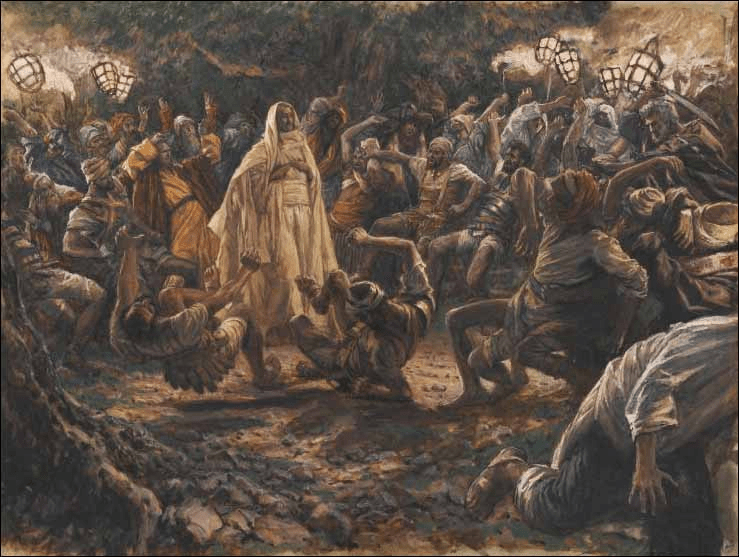
The Guards Falling Backwards, by James J. Tissot (1836-1902)
At the sound of his voice they all moved back and fell to the ground.
He asked them again, “Who have you come for?”
They answered, “Creator Sets Free (Jesus) from Seed Planter Village (Nazareth).”
“I told you already, I am the one you are looking for,” he said, “Let these other men go.”
He said this to fulfill his promise, “None of the ones you gave to me have been lost.”
Right then, Stands on the Rock (Peter) drew his long knife from its sheath and cut off the right ear of the servant of the chief holy man. The servant’s name was Chieftain (Malchus).
Creator Sets Free (Jesus) turned to Stands on the Rock (Peter) and cried out, “Enough of this! Put your long knife back into its sheath. Shall I not drink the cup of suffering my Father has asked of me?”
The lodge soldiers, along with their head soldier and the Grand Council representatives, the took hold of Creator Sets Free (Jesus), tied him securely with cowhide strips, and took him first to Walks Humbly (Annas), one of the high holy men. He was the father of the wife of Hollow in the Rock (Caiaphas), the chief holy man who had advised the Grand Council by saying, “It will be better if one man dies for all the people.”
Stands on the Rock (Peter) and one other follower had been watching from a distance. Since this follower was known by the chief holy man, he entered the courtyard of the house. But Stands on the Rock (Peter) stood outside the gate. This follower spoke to the gatekeeper, a young woman, who then let Stands on the Rock (Peter) in.
The Denial of St. Peter, by Gerard Seghers, c.1620
She said to him, “Are you not one of his followers?”
“No!” he told her, “I am not.”
The night was growing cold, so some of the men, along with the solider guards from the lodge, built a fire in the courtyard to keep warm. Stands on the Rock (Peter) stood there with them, trying to stay warm.
Back inside, the chief holy man began to question Creator Sets Free (Jesus) about his followers and his teachings. Creator Sets Free (Jesus) said to him, “I have spoken openly to all, in the gathering houses and the sacred lodge. I said nothing in secret. Why ask me? Ask the ones who heard me. They will know.”
One of the head soldiers struck him in the face and said, “Is that how you answer a chief holy man?”
Creator Sets Free (Jesus) answered him back, “If I have spoken wrongly, tell what I said wrong. If I spoke what is true, then by what right do you strike me?”
Walks Humbly (Annas) decided to send Creator Sets Free (Jesus) to Hollow in the Rock (Caiaphas), the chief holy man. So they took him, still bound by ropes, to Hollow in the Rock (Caiaphas).
Outside in the courtyard, Stands on the Rock (Peter) was still warming himself by the fire. The other asked him, “You are not one of his followers, are you?”
“No!” Stands on the Rock (Peter) denied. “I am not!”
One of the servants of the chief holy man, a relative of the man whose ear had been cut off, looked at him, and said, “Yes, you are! I saw you in the garden with him!”
Stands on the Rock (Peter) shook his head in denial – and right then a rooster began to crow.
Creator Sets Free (Jesus) was taken from the house of Hollow in the Rock (Caiaphas) to the lodge of the governor of the People of Iron (Romans). The tribal leaders stayed outside, for they did not want to become ceremonially unclean by going inside. It was early in the morning, and many of them had not yet eaten the ceremonial meal of Passover.
Spear of the Great Waters (Pilate) came outside to meet them.
They took Creator Sets Free (Jesus) and stood him before Spear of the Great Waters (Pilate). He took a good long look at him, then turned back to the crowd.
“What has this man done wrong?” he asked them.
“If he were not a criminal, would we have brought him to you?” they answered.
“Take him away!” Spear of the Great Waters (Pilate) said to them. “Use your own law to decide what to do.”
“Our tribal law will not permit us to put him to death,” they answered.
This proved that Creator Sets Free (Jesus) was right when he told them how he would die – by being nailed to a tree-pole – the cross.
Christ Before Pilate, by Duccio di Buoninsegna, 1310
Spear of the Great Waters (Pilate) went back into his lodge and had Creator Sets Free (Jesus) brought to him, so he could question him in private.
Once inside, he said to him, “Are you the chief of the tribes of Wrestles with Creator (Israel)?
“Is this your question,” Creator Sets Free (Jesus) asked, “or are you listening to others?”
“I am not from your tribes,” Spear of the Great Waters (Pilate) answered. “It is your own people and their head holy men who have turned you over to me. What have you done?”
“My way of ruling is a good road. It is not in the ways of this world. If it were, my followers would have fought to keep me from being captured.”
“So, then, you are a chief,” he said back to him.
“It is you who have said it,” Creator Sets Free (Jesus) answered. “I was born for this and have come into the world for this purpose – to tell about the truth. The ones who belong to the truth will listen to my voice.”
Spear of the Great Waters (Pilate) shook his head and said, “What is truth?”
Then Spear of the Great Waters went outside to the tribal leaders and said to them, “I find no guilt in this man. By your own tradition we set free one criminal during your Passover Festival. Do you want me to release Creator Sets Free (Jesus), your chief?”
“No! Not him,” the crowd roared back. “Release Son of His Father (Barabbas)!”
Son of His Father (Barabbas) was a troublemaker who had caused an uprising.
Spear of the Great Waters (Pilate) turned Creator Sets Free (Jesus) over to his soldiers to have him beaten. The soldiers twisted together a headdress from a thorn bush, pressed the thorns into his head, and wrapped a purple chief blanket around him. They bowed down before him, making a big show of it, and kept mocking him, saying, “Honor! Honor to the Great Chief of the tribes of Wrestles with Creator (Israel).”
Christ Mocked by Soldiers, by Georges Rouault (1871-1958)
They took turns hitting him on his face until he was bruised and bloodied.
Spear of the Great Waters (Pilate) stood before the crowd again and said, “I bring to you the one in whom I have found no guilt.”
Creator Sets Free (Jesus) was brought forward, blood flowing down his bruised face. He was wearing the headdress of thorns and the purple chief blanket that was wrapped around him.
“Behold the man!” Spear of the Great Waters (Pilate) said to them, “Take a good long look at him!”
The crowd stared at him in stunned silence.
But then the head holy men and the lodge guards began to shout, “Death! Death on the cross!”
“Then take him and kill him yourselves,” Spear of the Great Waters (Pilate) said to them. “I find no guilt in him!”
They answered him back, “Our law tells us he must die, for he has represented himself as the Son of the Great Spirit.”
When Spear of the Great Waters (Pilate) heard this, his fear grew stronger, so he took Creator Sets Free (Jesus) back inside his lodge.
“Who are you, and where are you from?” he questioned him.
Creator Sets Free (Jesus) stood there and remained silent.
“Speak to me! Do you not know I have the power of life and death over you? I can have you killed or set you free,” he warned him. “Have you nothing to say?”
“The only power you have is what has been given you from above,” he answered. “The ones who turned you over to me carry the greater guilt.”
Spear of the Great Waters (Pilate) tried harder to have Creator Sets Free (Jesus) released, but the people would not have it.
They stood their ground, saying, “If you release a man who says he is a chief, you are not honoring the ruler of your people, for anyone who claims to be a chief challenges his power.”
When Spear of the Great Waters (Pilate) heard this, he took Creator Sets Free (Jesus) and went to the Stone of Deciding, called Gabbatha in the tribal language, and sat down. It was now midday on the Day of Preparation for the Passover Festival.
He brought Creator Sets Free (Jesus) before the people and said, “Here is your chief.”
“Take him away! Take him away!” the crowd shouted with one voice. “Nail him to the cross!”
“Would you have me nail your chief to the cross?” he asked them.
This time the head holy men answered back, “We have no other chief than the Ruler of the People Iron (Caesar).”
Spear of the Great Waters (Pilate) then turned Creator Sets Free (Jesus) over to the soldiers to have him put to death on a tree-pole – the cross – so they took him away.
The cross was an instrument of torture and terror used by the People of Iron (Romans) to strike fear into the hearts of any who dared to rise up against their empire. The victim’s hands and feet would be pierced with large iron nails, fastening them to the cross. The victims would hang there, sometimes for days, until they were dead. This was one of the most cruel and painful ways to die ever devised by human beings.
The soldiers placed a wooden crossbeam on his back and forced him to carry it to the place where he would be executed.
Creator Sets Free (Jesus) carried the crossbeam to the Place of the Skull, which is called Golgotha in the tribal language. There they nailed his hands and feet to the cross, along with the two others, and placed his cross between the two of them.
Spear of the Great Waters (Pilate) fastened a sign to the top of the cross where they attached the crossbeam with these words written on it:
CREATOR SETS FREE
FROM SEED PLANTERS VILLAGE
CHIEF OF THE TRIBES
OF WRESTLES WITH CREATOR
This was near Village of Peace (Jerusalem). So that many of the Tribal Members could read it, the sign was written in Aramaic, their tribal language, but also in Latin and Greek, the languages of the People of Iron (Romans).
The chief head holy men and the tribal leaders said to Spear of the Great Waters (Pilate), “Do not write ‘chief of the tribes.’ Instead write, ‘He said he is chief.’”
But he answered, “What I have written will stand.”
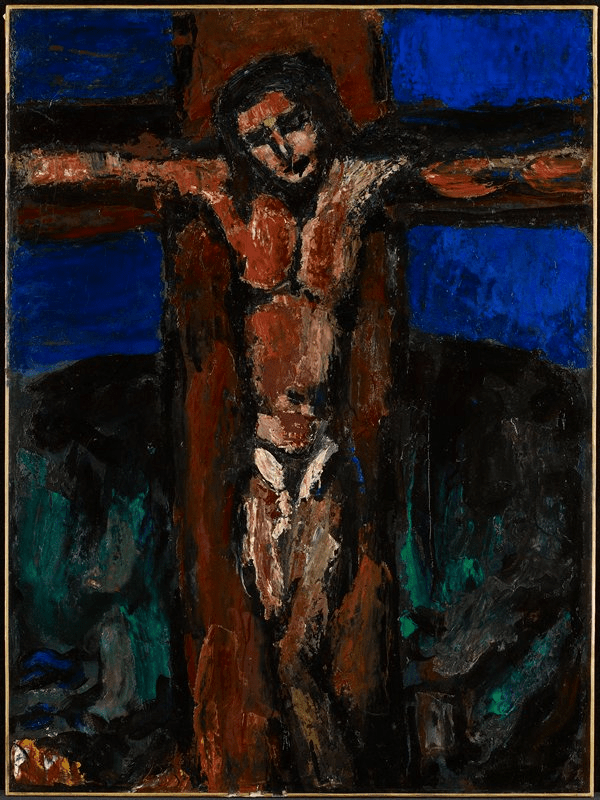
The Crucifixion, by Georges Rouault
The soldiers stripped his clothes from him when they nailed his hands and feet to the cross. They tore one of his garments in to four pieces, one for each guard. His long outer garment was woven together into one piece, so they said, “Let us not tear this, we can draw straws for it.”
This gave full meaning to the Sacred Teachings that said, “They divided my clothes between them and gambled for my garment.” This is what the soldiers did as they kept watch over Creator Sets Free (Jesus).
Standing near the cross was Bitter Tears (Mary), the mother of Creator Sets Free (Jesus), who had come to see him, along with her sister. Two other women also came with her, Brooding Tears (Mary) the wife of Trader (Clopas), and Strong Tears (Mary) from Creator’s High Lodge (Magdala). He Shows Goodwill (John), the much loved follower of Creator Sets Free (Jesus), was also there with them.
When Creator Sets Free (Jesus) looked down and saw them, he said to his mother, “Honored woman, look to your son.” The he said to his follower, “Look to your mother.”
From that time the follower took Bitter Tears (Mary) into his family and cared for her.
Creator Sets Free (Jesus), knowing he had done all the ancient Sacred Teachings had foretold, said, “I thirst.”
There was a vessel of sour and bitter wine standing nearby. One of the soldiers dipped a cloth in it to soak up some wine. He wrapped the cloth around the tip of a hyssop branch and held it up to the mouth of Creator Sets Free (Jesus).
He then tasted the bitter wine, turned his head to the sky and cried out loud, “It is done!”
He then lowered his head to his chest and, with his last breath, gave up his spirit.
Creator Sets Free (Jesus) was dead.
Soon the sun would set and a special Day of Resting would begin when no work could be done. It was time to prepare for this day, so the Tribal members asked Spear of the Great Waters (Pilate) to have the legs of the men on the crosses broken, which would make them die sooner. Then they could take the bodies down and prepare them for burial.
The soldiers came and broke the legs of the two men on each side of Creator Sets Free (Jesus). When they came to him, they saw he was already dead. Instead of breaking his legs, one of the soldiers took a spear and pierced his side. Blood and water flowed out from the wound.
The one who saw these things with his own eyes is telling the truth about this – so that all will believe. This was foretold in the ancient Sacred Teachings that say, “Not one of his bones was broken,” (Psalm 34:20) and, “They will look upon the one they have pierced.” (Zechariah 12:10)
Christ being lifted by Joseph of Arimathea and Nicodemus, by Antonio Canova (1757–1822)
He Gets More (Joseph) from High Mountain (Arimathea), a man with many possessions, was a follower of Creator Sets Free (Jesus), but in secret, because he feared the tribal leaders. Since it would soon be sunset, when the Day of Resting would begin, he went to Spear of the Great Waters (Pilate) and asked permission to remove the body of Creator Sets Free (Jesus) from the cross.
Spear of the Great Waters (Pilate) released the body to him. So he and another man, Conquers the People (Nicodemus), who had come to Creator Sets Free (Jesus) in secret at night, took his body away to prepare it ceremonially for burial. Conquers the People (Nicodemus) had brought a mixture of myrrh and oils weighing about seventy-five pounds. Together they ceremonially wrapped his body for burial in the traditional way, using strips of cloth and herbal spices and oils.
So because it was the Day of Preparation for the Passover Festival, and the day of resting was about to begin, they laid the body of Creator Sets Free (Jesus) in a nearby burial cave that had never been used and then returned to their homes.
14th century painting of Jesus standing before Pilate by Italian artist Duccio di Buoninsegna
Pilate then went back inside the palace, summoned Jesus and asked him, “Are you the king of the Jews?”
“Is that your own idea,” Jesus asked, “or did others talk to you about me?”
“Am I a Jew?” Pilate replied. “Your own people and chief priests handed you over to me. What is it you have done?”
Jesus said, “My kingdom is not of this world. If it were, my servants would fight to prevent my arrest by the Jewish leaders. But now my kingdom is from another place.”
“You are a king, then!” said Pilate.
Jesus answered, “You say that I am a king. In fact, the reason I was born and came into the world is to testify to the truth. Everyone on the side of truth listens to me.” (New International Version)
In Christianity, to worship God means we praise the person and work of Christ and are also spiritually formed through that adoration. Christ the King Sunday focuses our worship on Jesus Christ’s reign over the entire world. It is a proclamation that everything and everyone in all creation is subservient to King Jesus. Furthermore, it is an invitation to actively enjoy Christ’s gracious and benevolent rule over us.
Jesus came to this earth to bring connection and intimacy to God and humanity. We all have relationships in which we want to be closer.
A parent might be dissatisfied, and sad, that one of their children is estranged from them, because they want intimacy.
A spouse may want to have a more relationally intimate marriage, having been distant for too many years.
A teenagers or twenty-something might want to get closer to that special someone.
A friend might be keeping their distance. And although you have conversations with them, they only let you in so far.
We want to go deeper, and it isn’t happening because the other party is not willing.
In this we reflect the image of God within us because God feels that same longing and desire to move deeper and closer to us. The Lord desires intimacy, yet we might keep treating him like he is some untouchable monarch like Queen Elizabeth – as if there is no chance of really getting close, and we wonder if there is any real power there to make a difference.
However, God is not a ruling figurehead, and does not want a casual superficial relationship with us. Christ’s kingship moves closer to people, not further away. Everything Jesus did on this earth was to bring people closer to God because God wants a personal and familiar relationship with us.
Jesus does not want us estranged from God, and he has gone to the greatest lengths possible to make that close relationship possible and real through the cross, resurrection, ascension, and a kingly reign which is near to us. The kingdom of God, with Jesus as King, is a kingdom of closeness and fellowship with the divine.
Christ the King Sunday appropriately challenges us to consider what it means to say that Jesus Christ is the Lord of our life. Jesus Christ, as our Lord and King, means much more than God calling the shots and issuing commands; it means Christ uses his lordship to satisfy his longing to be with us.
Our Gospel lesson for today plunges us into an event we associate with Holy Week. Christ has been arrested by the conniving of his enemies. Since the religious authorities could not put anyone to death, they bring Jesus to the Roman governor, Pontius Pilate, in the hope he will do their dirty work for them.
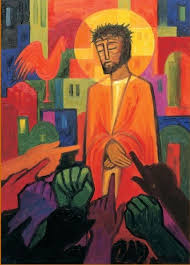
Jesus condemned to death, painting by the Benedictine Sisters of Turvey Abbey
The scene takes place early in the morning at Pilate’s palace. Pilate doesn’t like the Jewish authorities because they put a dent in his career plans through their constant complaints about him to his supervisors in Rome. For purely political reasons, Pilate decides he will satisfy their demand and interview this Jesus who they claim is an enemy of Rome.
The prisoner, Jesus of Nazareth, is brought to Pilate. He is a mess. Christ’s clothes are stained with dirt and blood. His face is bruised and haggard. He has not slept all night. Pilate has heard of Jesus, and so he’s curious to make a personal evaluation of him. Jesus looks nothing like a king to Pilate.
Pilate, in contrast, looks the image of a worldly leader with his power suit on and all the strength of Rome behind him. He hardly has time for this sideshow, this pathetic presentation of leadership in front of him. Jesus looks like nothing more than a kingly wannabe. There is nothing from Christ’s outward appearance that gives any impression he is qualified to be a leader of anybody. We can almost picture Pilate rolling his eyes, saying “so you are the King of the Jews?”
What follows is a strange, convoluted conversation about kingship and truth with a contrast between this world and a world to come. Repeatedly, Jesus makes it clear his kingdom is not of this world. Two thousand years have passed since that dialogue between Jesus and Pilate, yet the same issue remains.
The issue is this: Jesus is calling all of us to follow him – to put his Kingdom first in our lives. In Pilate, we have a symbol of worldly power, which is arbitrary, unprincipled, self-serving, and brutal. Pilate knows the right thing to do but chooses the path of least resistance. He caves to the political pressure, denying the truth which is right under his prominent Roman nose.
Earthly power seeks its own ends. It wants to hold onto control and call the shots. Conversely, Christ’s kingly power is used to serve, to wash feet and meet needs, to move closer to people. Earthly kingdoms use violence to conquer and maintain order and control its subjects. In stark contrast, Christ’s kingdom uses love to transform and unify people around Jesus so that the subjects are with the king and enjoy his rule and reign.
Christ’s kingdom is not of this world. It is counter-cultural and counter-intuitive to how every other leadership structure works on earth. It is an upside-down kingdom that seems like it won’t work or make sense: The way up is down; to be great is not to work for a high position, suck up to the boss, and climb the ladder of wealth and success. Rather, it is to embrace humility and be a servant.
In God’s kingdom, the way to pursue truth is not in forming original ideas and expressing opinions but is found in a person. Truth-seeking disciples will listen to this one voice of Jesus, and filter-out all others. It is a voice calling for submission to his lordship, and to do so because it brings us into an intimate relationship with God.
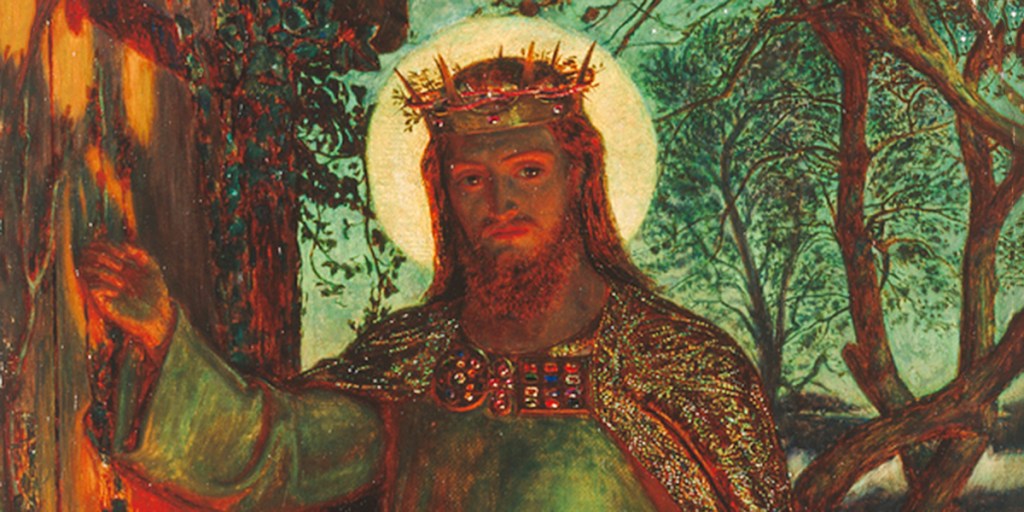
The Light of the World, by English artist William Holman Hunt, 1852
The message of our crucified Savior reigning as King in our lives is not that, having suffered for us, Jesus will somehow keep us from facing difficult times. Instead, Jesus faced a horrible death so that our own tough times can triumph with God’s power to save us and move deeper into our lives. God’s presence and promise is what sustains us, not the avoidance of suffering. Christ as our King means God is with us.
Black Friday and Cyber Monday are almost upon us. This season demonstrates a contrast between two kingdoms. The kingdom of this world calls on us to demonstrate our worth and gain meaningful relationship through grabbing control and obtaining stuff. The pressure in seeking the perfect gift at the perfect price in the hope that if we can bag it, wrap it, and get it under the tree, then we will be perfect, and the perfect family Christmas will happen, and relationships will be great, and everyone will act like I want. Right!?
In contrast, the kingdom Jesus describes assures us we don’t have to prove our worth through endless accomplishments and generous gifts. We don’t need to have the perfect Christmas experience to gain our deepest relational needs. Because, in our baptism, we have been accepted; we are sons and daughters of the living God; and we do not need to achieve greatness through financially and emotionally bleeding ourselves.
In his conversation with Pilate, Jesus said: “My kingdom is not of this world.” When Christians say Jesus Christ is our King, we acknowledge we are his subjects and that we march to the beat of a different drum. The heart of this relationship is our dependence on Jesus who came that we might have life and have it in abundance.
On this Sunday, followers of Jesus Christ boldly state our confidence that, at the end of time, Jesus will come again as King and Ruler of all.
Blessed are those who see the truth by faith and not by sight. Blessed are those who say “Jesus is the King and the Lord of Life” without rolling their eyes or with a selfish agenda but with a sincere conviction that they belong to Jesus and want to be ever closer to him who is the Way, the Truth, and the Life.
Almighty God, everlasting heavenly Father, you break the power of evil and make all things new in your Son Jesus Christ, the King of the universe. Our confidence is firmly in you, Lord Jesus, knowing you will redeem all things and make all things new.
We affirm that our security is not in personal abilities, clever plans, or lucrative jobs; our security is in you alone. Your creation still groans with the pain of living in a fallen world. But you have conquered sin through your love, and it is to your love we rely upon. May all things in heaven and on earth recognize the glory of your kingly rule and never cease to praise you. We ask this through our Lord Jesus Christ, your Son, who lives and reigns with you and the Holy Spirit, one God, now and forever. Amen.









 Rev. Tim Ehrhardt