Truth Stumbles In the Public Square

In these past few months, as an American citizen, I have often wondered what God thinks about the current political situation and climate of the United States.

I must say that with a serious reading of the biblical prophets, it’s rather easy to imagine what the Divine stance likely is:

Justice is far from us,
    and deliverance does not reach us;
we wait for light, but there is only darkness;
    and for brightness, but we walk in gloom.
We grope like the blind along a wall,
    groping like those who have no eyes;
we stumble at noon as in the twilight,
    among the vigorous as though we were dead.
We all growl like bears;
    like doves we moan mournfully.
We wait for justice, but there is none;
    for salvation, but it is far from us.
For our transgressions before you are many,
    and our sins testify against us.
Our transgressions indeed are with us,
    and we know our iniquities:
transgressing and denying the Lord
    and turning away from following our God,
talking oppression and revolt,
    conceiving lying words and uttering them from the heart.
Justice is turned back,
    and deliverance stands at a distance,
for truth stumbles in the public square,
    and uprightness cannot enter.
Truth is lacking,
    and whoever turns from evil is despoiled.

The Lord saw it, and it displeased him
    that there was no justice. (Isaiah 59:9-15, NRSV)

These days, many of my prayers echo the complaint of the ancient prophet Isaiah. I too, have an expectation that God will grant justice and righteousness; and that the Lord will take pity upon us for our ignorance of what is just, right, and good.

And like the prophet Isaiah, I grieve a situation of profuse lying, political malpractice, and socio-economic illiteracy. Many, if not most, Americans and the world community alike, lacks things it needs to live a viable and joyous life. So, I mourn, like a bear growling for a long-awaited meal.

It seems to me that we are failing one another. Our collective vice, and lack of virtue, have led us on a path of injustice. We are a flawed people; we need Divine help.

Perhaps you believe I am being something of a curmudgeon, being too negative – that I’m seeing the glass darkly as only half empty. But no, I’m actually seeing the glass as completely empty, for we are a bereft people.

But just maybe this emptiness can be filled with justice and righteousness, and not shallowness and lack of education, nor gaslighting and manipulative selfishness. Just maybe we can filled to the full in truth.

Our public life together depends upon ethics of accountability.

This insipid business of people stating that they are “being transparent” is nothing but a red flag letting us know that they are doing just the opposite.

We need a new community – a fresh vision of what life can be together. And we are getting anything but that. Instead, in the U.S., we get entrenched yelping from both Republicans and Democrats. And in the face of injustice, we receive an eerie silence from those who ought to know better.

This is not simply a struggle for a political party and its policies. What is happening now transcends each party’s vision of how to live together as a people.

Historically, the Democratic party has generally believed that government ought to raise money through a fair system of taxation. The funds then are to be used to provide basic services that serve the common good of all persons, i.e. ensuring a living wage, protection through laws, maintenance of infrastructure, equal access to healthcare and education, etc.

The Republican party has approached a more individualistic vision of government, believing that each person should manage their own money to make the best use of a market economy. Then, they can create economic growth without reliance upon government regulation of business. Private philanthropy and non-profit organizations are relied upon to provide social services. Private companies are called upon to handle infrastructure needs.

In essence, at the core, Democrats have a vision of community and caring for one another, whereas Republicans have a vision of each person living prosperously under their own fig tree without the interference of others.

This is why things like tax increases and tax cuts become such visceral issues, because they get at the practical outworkings of each party’s vision of how to live together.

But the stakes are even higher than an American two-party system. There is presently leadership in the United States that is openly antagonistic, belligerent, bullying, rude, and frankly, unbiblical and unvirtuous. There is nothing that comes out of the current president’s mouth that reflects the words of Jesus; and there is nothing he does which is consistent with the ways of Jesus.

Many, if not most, “Christian” Republicans are woefully out of touch with their own Bibles; and, at the very least, are complicit in retraumatizing the already traumatized people in the nation (and the world) through supporting unjust leadership.

In the time of the prophet Isaiah, not only was there injustice (common citizens not receiving what they need to build a good life and flourish) but there was no one willing and available, no one engaged and at work to turn around an unjust system so that the government would respect basic human rights for the poor and the needy, the least and the lost in society.

So, the prophet was on the scene to announce that Yahweh, the God of Judah, has noticed. Yahweh has seen that the leadership would not accept responsibility for implementing the Law of God (namely, a set of just, right, and good laws which were to frame all of Jewish society).

Nobody cared. No one bothered to help those without a voice and without hope. And Yahweh knew it. Therefore, a sorry state existed which eventually turned into the people losing their land through an active judgment of God.

Truth matters. And when it is suppressed in the public square, God’s eyebrow is raised.

Lips that speak lies, tongues that mutter wickedness, attitudes which are dishonest, hands that work only for self, and feet which run to violence are all anti-truth practices. (Isaiah 59:3-4)

There is no way on this earth and in this life to get along without government. And because of that, government’s legitimate duty to its people is to provide necessary order, safety, peace, and ensure justice – which means making sure that all citizens have what they need to grow, thrive, and prosper.

Both survival and prosperity must have the glue of truth holding society together – which means that a nation’s government needs to have the basic fundamentals of justice in mind and at heart.

A telltale sign that leaders do not have the best interests of their own people is how they speak to and treat others outside their own nation, people in differing circumstances in different places.

“They did not want to consider their duty. They have distorted their intelligence so as to not understand what ought to be done… They have distanced themselves so far from the truth that they openly combat those who turn away from perversity and choose the good.”

Theodoret (393-457 C.E.)

I cannot think of a better way to describe our current failure of leadership in this world.

Lord, have mercy upon us.

Instead of selfishness we need self-discipline. Rather than a personal concern for earthly wealth and profit, we need to seek first the kingdom of God and God’s righteousness.

Instead of simply loving those who love us, we can  love our enemies and seek to do good. We can actively walk alongside beleaguered people who have had quite enough of belligerent bullying and bogus bellicosity in their lives.

To God belongs the ability to save, deliver, redeem, and judge. To you and I belongs the responsibility for treating our fellow humanity with justice, equity, goodness, and humility with a gentle spirit, holding one another accountable for our attitudes and actions. In short, it means living the truth.

That includes every politician and political party.

“Truth is difficult to reach and endure, but it is always the doorway to new freedom and life.”

John O’Donohue

If you yet are looking for some sort of positive outlook, some kind of hope, it is this: Our present suffering of spirit can serve to burn away any illusions (and delusions) that a politician or political process will save us.

Any disillusionment we may have becomes an opportunity to discover both old and new ways living the truth. It often takes suffering to teach us what is truly most important to us.

Our current malaise, national anxiety, and world troubles can become the means of future possibility, if we will let it. Worrisome circumstances can open to us the light of undiscovered truth about ourselves and our world.

We may stumble, yet there is always the chance to catch ourselves and not fall. So, what does God think of this present national and world situation? The prophet Isaiah insisted:

Let the wicked forsake their way
    and the unrighteous their thoughts;
let them return to the Lord, that he may have mercy on them,
    and to our God, for he will abundantly pardon.
For my thoughts are not your thoughts,
    nor are your ways my ways, says the Lord.
For as the heavens are higher than the earth,
    so are my ways higher than your ways
    and my thoughts than your thoughts. (Isaiah 55:7-9, NRSV)

No matter what happens on this earth, Isaiah’s perspective insists upon the truth and reality of God’s ultimate authority. We shall not always understand divine authority, yet at its core, is full of justice and righteousness. And nothing can stop from it breaking out into the public square.

May it be so, to the glory of God.

Addressing the Divisions Amongst Us (1 Corinthians 4:8-13)

Are you already satisfied? Are you now rich? Have you become kings while we are still nobodies? I wish you were kings. Then we could have a share in your kingdom.

It seems to me that God has put us apostles in the worst possible place. We are like prisoners on their way to death. Angels and the people of this world just laugh at us. Because of Christ we are thought of as fools, but Christ has made you wise. We are weak and hated, but you are powerful and respected. 

Even today we go hungry and thirsty and don’t have anything to wear except rags. We are mistreated and don’t have a place to live. We work hard with our own hands, and when people abuse us, we wish them well. When we suffer, we are patient. When someone curses us, we answer with kind words. Until now we are thought of as nothing more than the trash and garbage of this world. (Contemporary English Version)

On this particular July 4 in the USA, there is perhaps no more pertinent biblical passage than today’s in addressing the current American political and emotional climate. Yet, before this is specifically addressed, let’s understand what was going on with the Apostle Paul and the Corinthian Church…

The Corinthian Divisions

Special interest groups had formed within the church. Each was following a specific person – some Paul, some Apollos, and some other leaders and teachers. The groups began to harden into political church factions. And Paul wanted nothing to do with this way of being Christian, because it is antithetical to the gospel itself.

Christ died to bring unity, not division. Paul established egalitarian churches that showed no favoritism. The Corinthians were called to a way of being that breaks down barriers between rich and poor, Jew and Greek. This business of groups and factions only fostered the division which Christ died to do away with.

By the time the Apostle wrote his letter to the Corinthian Christians, they had devolved a way of being with each other that was judgmental. They were pointing out unhealthy and demeaning comparisons, and boasting about how their group was more spiritual and wise than the others.

The Apostle Tackles the Divisions

So Paul, never one to shy away from initiative and justice, went on the offensive. Admittedly, in today’s New Testament lesson, Paul is quite sarcastic. He was actually mocking the Corinthians for their sinful arrogance and pride; and he used their own ways of being together against them to demonstrate how utterly foolish and ridiculous they were being.

The Apostle Paul countered with some comparisons of his own, using the example of the apostles themselves. Through his sarcastic comparison, he essentially argued that God used the very real oppression and suffering of the apostles toward good and positive ends.

Paul contrasted the apostles and the Corinthians to show the injustice that was happening in their factional wars with each other. By drawing attention away from the Corinthians and putting it on the apostles, Paul upheld a Christian ministry of weakness, not strength.

The apostles endured much suffering and opposition in their ministry. Paul viewed himself as a sort of dishrag that was used to clean the dirty dishes of the world. And he was okay with that, because it had a redemptive purpose. But he was not at all okay with the dirty business of factions and divisions within the church.

George Washington Addresses the Divisions

In our own day, it’s as if we have not learned the lessons of the past. And that is most likely because we have such little historical knowledge and awareness. I know of few people who realize George Washington was very much against a party system of government – and argued against it for similar reasons to the Apostle Paul.

Washington considered parties to be the bane of republican government. Parties were factions that threatened to divide the electorate into competing groups who might use violence to advance their interests.

He argued that political parties might also disrupt the separation of powers, especially in the case of unified government where loyalty to a party could interfere with the system of checks and balances.

What’s more, Washington said that parties threatened to stand in the way of effective representation, with elected officials tempted to represent only fellow party members and to leave opposition groups without a voice in government.

George Washington was mostly unique among the founders in never reconciling himself with political parties and never acknowledging the positive things that parties can bring to republican government.

Although it’s likely that Washington understood that parties were inevitable, he argued for keeping them under restraint and limiting their interference in the political process as much as possible.

Obviously, the party system won out, and rather quickly. In a healthy state of being, political parties can mobilize voters and encourage voter participation. They help build support for officeholders and serve as conduits of communication to the people. Political parties allow minorities to form coalitions to create majority rule.

Stick with the Evidence

Yet, what we seem to continually experience nowadays is the unhealthy aspect of the party system. People are hardened and reified into established positions and refuse to listen to the other. In such a position, evidence-based practices take a back seat.

For example, although there is not a shred of evidence that the former U.S. President experienced a hung jury and a corrupt judge in being convicted on 34 felony counts, a sizable chunk of Americans believe the corruption to be true – seemingly only because the former President said so, and without any objective, reasonable, and serviceable evidence to offer in backing up that claim.

And that prideful hardened spirit is the very thing that was happening in the ancient Corinthian Church. They wanted what they wanted, and they didn’t care what the other group thought. Each group believed (without evidence) they were wise and right. Yet, all of them were, in reality, foolish and unjust.

If we want a better public political climate; the freedom to be who we are; and confidence for the future; then, we had better begin with examining ourselves and listening well to the other first, before we assume that our own group is in the right and should be in control.

The privileges of freedom can only be enjoyed by embracing the responsibilities of freedom. And those responsibilities include a unified concern for the common good of all citizens, and not just the ones I like and who agree with me.

O God, the Father of our Lord Jesus Christ, our Savior, and the Prince of Peace; Give us grace to lay aside our unhappy divisions. Take away all hatred and prejudice, and whatsoever else may hinder us from godly union and concord. Help us to build bridges, not walls, and live into the unity you provided for us in Christ, through the Spirit. Amen.

Putting Political (and Church) Parties in Their Place


            In speaking of political parties in either government or church, I’m not talking about weekend benders, Washington D.C. cocktail gatherings, nor fellowship hall potlucks after church.  The word “party” in the New Testament of the Bible means what we would understand as either a special interest group who lobbies to get their agenda accomplished on the backs of others, or a group of like-minded people who stand opposed to another group with a different set of ideals through belligerent, manipulative, and/or bullying tactics.  The consistent ideal of the Scripture is that a “party spirit” belongs to the sinful nature, part of the old person, and has no part with the redeemed person in the kingdom of God.
            The word is, in Greek, ἐριθεία (English transliteration, eritheia). It appears as a vice which the Apostle Paul condemns as being contrary to the fruit of the Spirit.  It is translated in various ways throughout the different versions of the Bible as “rivalry,” “selfish ambition,” “strife,” “faction,” and “dispute,” just to mention a few.  It is to have a contentious spirit that continually strives and cajoles to get its way.  It’s just the opposite of scanning the horizon of human need and seeking to implement what is in the best interest of the common good of all people.
“Now the works of the flesh are evident: sexual immorality, impurity, sensuality, idolatry, sorcery, enmity, strife, jealousy, fits of anger, rivalries, dissensions, divisions, envy, drunkenness, orgies, and things like these. I warn you, as I warned you before, that those who do such things will not inherit the kingdom of God.” (Galatians 2:19-21, ESV)
 
“Do nothing out of selfish ambition or vain conceit. Rather, in humility value others above yourselves.” (Philippians 2:3, NIV)
 
“For where envying and strife is, there is confusion and every evil work.” (James 3:16, KJV)
 
Whenever churches, ministries, organizations, and even governments devolve into opposing groups or parties which are constantly at odds with one another, this is a situation that is not to be lauded but condemned.
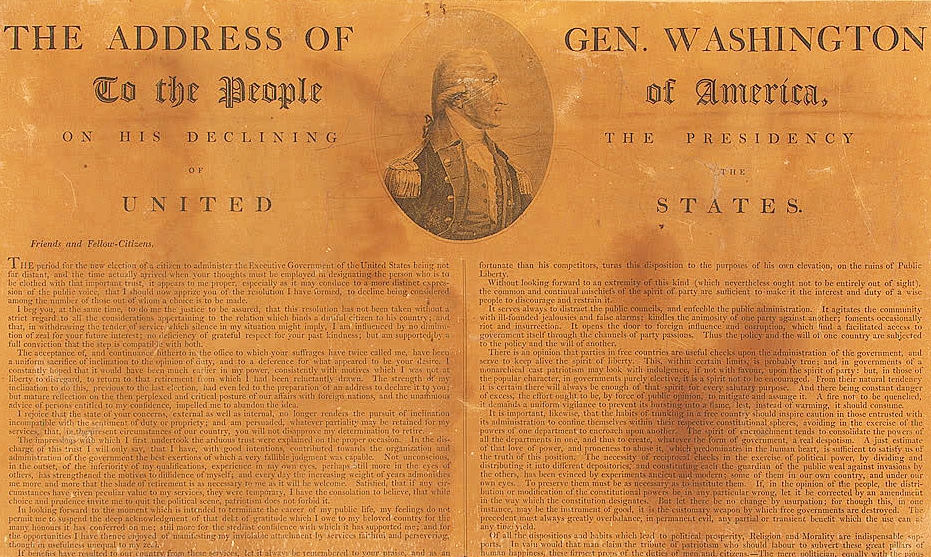
            Seemingly lost to many are the comments from George Washington concerning the understanding of a party-spirit which, for him, was this biblical idea of contentious rivalries which did not have in view the interests of all people.  In George Washington’s 1796 Farewell Address when leaving the presidential office, he sagaciously and prophetically said that political parties:
“are likely, in the course of time and things, to become potent engines, by which cunning, ambitious, and unprincipled men will be enabled to subvert the power of the people and to usurp for themselves the reins of government, destroying afterwards the very engines which have lifted them to unjust dominion….  The alternate domination of one faction over another, sharpened by the spirit of revenge, natural to party dissension, which in different ages and countries has perpetrated the most horrid enormities, is itself a frightful despotism. But this leads at length to a more formal and permanent despotism. The disorders and miseries which result gradually incline the minds of men to seek security and repose in the absolute power of an individual; and sooner or later the chief of some prevailing faction, more able or more fortunate than his competitors, turns this disposition to the purposes of his own elevation, on the ruins of public liberty.”
 
 
Washington went on to say:
“In contemplating the causes which may disturb our Union, it occurs as matter of serious concern that any ground should have been furnished for characterizing parties by geographical discriminations, Northern and Southern, Atlantic and Western; whence designing men may endeavor to excite a belief that there is a real difference of local interests and views. One of the expedients of party to acquire influence within particular districts is to misrepresent the opinions and aims of other districts. You cannot shield yourselves too much against the jealousies and heartburnings which spring from these misrepresentations; they tend to render alien to each other those who ought to be bound together by fraternal affection.”
 
            I’m grinding on this current party-spirit reality because we have gotten to a place in both our political discourse and our church rhetoric where we take opposing parties for granted – as if it’s okay.  It’s not okay, and we need to resist it.  Furthermore, I am in no way advocating for everyone to think and believe the same way.  Monolithic groupthink is only a form of the party-spirit which seeks to conquer all opposing views and corral them under a certain group’s views.
            Its possible to celebrate individual thought, identify yourself with organizations which labor to change a situation, and engage in lively debate with one another without having a party spirit.  What’s not okay is a spirit of rivalry which aims to colonize other people’s minds and strip them of critical thinking skills that either advance a selfish group agenda or push power politics to maintain the powerful at any cost.  God will not contend with this situation forever.
            If one person dominates and determines how a church ministry operates; if one group of families holds power and refuses to listen to others; if two or more groups can be clearly identified as engaging in the power politics of fear; if the aisle down the middle of the church building is symbolic of division; or, if individuals exhibit anger and jealousy when they are not properly recognized in the church; then, there is a party spirit within that church, ministry, or organization which needs to be addressed before the spirit of rivalry destroys the Body.
Working against a party spirit, and establishing a spirit for the common good requires:
·         Leaders naming the factious spirit
·         Calling-out individuals with bad behavior
·         Valuing the voices of others not in power
·         Great courage through trust in God
·         A calming presence from leadership
·         Humility and wisdom
·         Being filled with the Holy Spirit
·         Bearing one another’s (everyone’s) burdens
·         Sharing wealth, stature, recognition, and privilege
·         Not hiding from or ignoring marginal people
The best antidote to a party spirit is to have the heart of servant.  Recovering politics as public service, and reestablishing church ministry as sacred service puts the focus away from bad spirits of sectionalism and sensationalism, placing it squarely on those people who need the services which you have to offer.
“For even the Son of Man [Jesus] did not come to be served, but to serve, and to give his life as a ransom for many.” (Mark 10:45)
 
Groups are not inherently evil.  But if they only look inward as to how they can benefit themselves – and do not look outward to include, help, serve, and uphold others very different from themselves – then there is a “party spirit” which is contrary to Holy Scripture.
            Prayer is always the best place to begin facing down a party spirit.  Only solid spiritual resources can effectively combat bad negative spirits.  Party spirits won’t go away on their own – they must be faced down with the fruit of the Spirit.


            Everyone and every organization must confront party spirits at various times in their existence because its just the nature of living in this fallen world.  What we do when we see them is the critical step….