Fear or Faith? (1 Samuel 13:23-14:23)

The pass at Micmash had meanwhile been secured by a contingent of the Philistine army.

One day Jonathan said to his armor bearer, “Come on, let’s go over to where the Philistines have their outpost.” But Jonathan did not tell his father what he was doing.

Meanwhile, Saul and his 600 men were camped on the outskirts of Gibeah, around the pomegranate tree at Migron. Among Saul’s men was Ahijah the priest, who was wearing the ephod, the priestly vest. Ahijah was the son of Ichabod’s brother Ahitub, son of Phinehas, son of Eli, the priest of the Lord who had served at Shiloh.

No one realized that Jonathan had left the Israelite camp. To reach the Philistine outpost, Jonathan had to go down between two rocky cliffs that were called Bozez and Seneh. The cliff on the north was in front of Micmash, and the one on the south was in front of Geba.“Let’s go across to the outpost of those pagans,” Jonathan said to his armor bearer. “Perhaps the Lord will help us, for nothing can hinder the Lord. He can win a battle whether he has many warriors or only a few!”

“Do what you think is best,” the armor bearer replied. “I’m with you completely, whatever you decide.”

“All right, then,” Jonathan told him. “We will cross over and let them see us. If they say to us, ‘Stay where you are or we’ll kill you,’ then we will stop and not go up to them. But if they say, ‘Come on up and fight,’ then we will go up. That will be the Lord’s sign that he will help us defeat them.”

When the Philistines saw them coming, they shouted, “Look! The Hebrews are crawling out of their holes!” Then the men from the outpost shouted to Jonathan, “Come on up here, and we’ll teach you a lesson!”

“Come on, climb right behind me,” Jonathan said to his armor bearer, “for the Lord will help us defeat them!”

So they climbed up using both hands and feet, and the Philistines fell before Jonathan, and his armor bearer killed those who came behind them. They killed some twenty men in all, and their bodies were scattered over about half an acre.

Suddenly, panic broke out in the Philistine army, both in the camp and in the field, including even the outposts and raiding parties. And just then an earthquake struck, and everyone was terrified.

Saul’s lookouts in Gibeah of Benjamin saw a strange sight—the vast army of Philistines began to melt away in every direction. “Call the roll and find out who’s missing,” Saul ordered. And when they checked, they found that Jonathan and his armor bearer were gone.

Then Saul shouted to Ahijah, “Bring the ephod here!” For at that time Ahijah was wearing the ephod in front of the Israelites. But while Saul was talking to the priest, the confusion in the Philistine camp grew louder and louder. So Saul said to the priest, “Never mind; let’s get going!”

Then Saul and all his men rushed out to the battle and found the Philistines killing each other. There was terrible confusion everywhere. Even the Hebrews who had previously gone over to the Philistine army revolted and joined in with Saul, Jonathan, and the rest of the Israelites. Likewise, the men of Israel who were hiding in the hill country of Ephraim joined the chase when they saw the Philistines running away. So the Lord saved Israel that day, and the battle continued to rage even beyond Beth-aven. (New Living Translation)

The vicinity of Micmash (modern Mukmas) in Israel

Israel had demanded a king. The people wanted to be like everyone else in the world. All the other nations had a king. The Israelites believed that they needed one, too. (1 Samuel 8)

Not unlike today, Israel got a king who looked the part. Saul was tall, dark, and handsome. The only problem was that he didn’t act much like a king at all.

On the day he was anointed king, Saul hid in the baggage, like some guy ducking into a dumpster to avoid people chasing him. If the kings of other nations acted boldly on behalf of their subjects, Saul was not that sort of king. He seemed bent toward cowardice, and more concerned about his reputation than actually accomplishing anything.

Saul could have distinguished his royal kingship through listening to God and obeying the Lord; instead, his rule and reign was often marked by a half obedience, if he obeyed at all.

Old Testament stories are filled with contrasting characters. And in the narrative for today, there is a clear difference between King Saul and his son Jonathan. Saul was supposed to be leading the charge against the Philistine threat to Israel, but he was hiding out.

But Jonathan was determined to deal with the arrogant Philistines, even though it meant going against an entire garrison of troops with only his armor-bearer alongside him.

In the story, we find Saul and the army cowering in secrecy. But we find Jonathan in the bright light of day for the entire Philistine army to see. The contrast couldn’t be any more obvious:

  • Saul is afraid, and Jonathan is brave
  • Saul is fearfully passive; Jonathan is faithfully aggressive
  • Saul could only see reasons not to face the Philistines; Jonathan saw no obstacles to facing them, even though he had to scale crags and thorns in order to get to the Philistines

The opposite of faith is not unbelief; it’s fear. All of the Israelite soldiers were afraid, except Jonathan and his armor-bearer. The two of them had remarkable faith.

Jonathan had full confidence in the power of God. It wasn’t stupidity that led him toward an entire army by himself; it was the firm conviction that nothing is too difficult for the Lord.

It was neither pride nor glory-seeking that caused Jonathan to go, against all odds, to fight the Philistine army. He simply reasoned by faith that perhaps God would work on their behalf and bring about a great deliverance for Israel.

What’s more, Jonathan trusted the Lord without making assumptions that God would act in a particular way. There wasn’t any ‘name-it-and-claim-it’ theology happening with him.

Indeed, God did intend to defeat the Philistines. Maybe the Philistines thought Jonathan was bluffing by coming up to them; and they were going to teach this guy a lesson! But false confidence is typically shown through talking smack, whereas real confidence is born of faith.

Trust fully expects God to show up and take on injustice, unrighteousness, and arrogant pride.

Jonathan did some damage; and God got into the thick of it by directly intervening. The Lord turned the tables by bringing great fear on the Philistines. This turning of the tables emboldened the Israelites. The result was a decisive victory for Israel, leaving Philistia slack-jawed and confused.

We may be uncertain about the future; but if we are pursuing a good thing, and are confident in God’s power, there’s no need to be afraid in pursuing it.

We are free to step out in faith and attempt great things for the sake of the Lord, knowing that God may indeed bless our trusting initiative.

Almighty and everlasting Father, you have given the Holy Spirit to abide with us forever: Bless us with divine grace and presence so that, being preserved in true faith and confident hope, we may fulfill all the good that is in our mind and heart to do; through Jesus Christ your Son, our Lord, who lives and reigns with you, in the unity of the Holy Spirit, one God, today and always. Amen.

Who Do You Look To When Things Are Tough? (1 Samuel 9:1-14)

There was a Benjamite, a man of standing, whose name was Kish son of Abiel, the son of Zeror, the son of Bekorath, the son of Aphiah of Benjamin. Kish had a son named Saul, as handsome a young man as could be found anywhere in Israel, and he was a head taller than anyone else.

Now the donkeys belonging to Saul’s father Kish were lost, and Kish said to his son Saul, “Take one of the servants with you and go and look for the donkeys.” So he passed through the hill country of Ephraim and through the area around Shalisha, but they did not find them. They went on into the district of Shaalim, but the donkeys were not there. Then he passed through the territory of Benjamin, but they did not find them.

When they reached the district of Zuph, Saul said to the servant who was with him, “Come, let’s go back, or my father will stop thinking about the donkeys and start worrying about us.”

But the servant replied, “Look, in this town there is a man of God; he is highly respected, and everything he says comes true. Let’s go there now. Perhaps he will tell us what way to take.”

Saul said to his servant, “If we go, what can we give the man? The food in our sacks is gone. We have no gift to take to the man of God. What do we have?”

The servant answered him again. “Look,” he said, “I have a quarter of a shekel of silver. I will give it to the man of God so that he will tell us what way to take.” (Formerly in Israel, if someone went to inquire of God, they would say, “Come, let us go to the seer,” because the prophet of today used to be called a seer.)

“Good,” Saul said to his servant. “Come, let’s go.” So they set out for the town where the man of God was.

As they were going up the hill to the town, they met some young women coming out to draw water, and they asked them, “Is the seer here?”

“He is,” they answered. “He’s ahead of you. Hurry now; he has just come to our town today, for the people have a sacrifice at the high place. As soon as you enter the town, you will find him before he goes up to the high place to eat. The people will not begin eating until he comes, because he must bless the sacrifice; afterward, those who are invited will eat. Go up now; you should find him about this time.”

They went up to the town, and as they were entering it, there was Samuel, coming toward them on his way up to the high place. (New International Version)

“He who seeking asses, found a kingdom.”

John Milton, Paradise Regained

We are introduced to Saul, who eventually became the infamous first king of Israel. And he is described in almost a kingly sort of tone; his stature and pedigree are impressive. Saul looks the part of someone who could be important, do things, and go places.

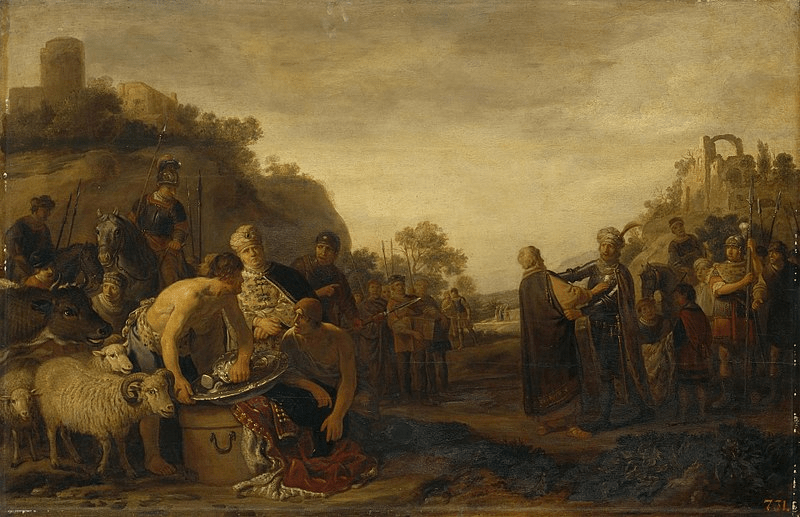
Samuel and Saul, by Dutch painter Claes Moeyaert (1592-1655)

In today’s story, we find Saul to be an obedient and responsible son, going out to find some lost donkeys. By all appearances, Saul was an upright, law-abiding, faithful Jew from the tribe of Benjamin. However, appearances can be rather deceitful. The outward presentation of someone is not always congruent with what is on the inside; and vice versa.

These were the days when Samuel the priest would make a circuit through the country. He made regular rounds as Israel’s judge. Saul and Samuel would encounter each other in a divine appointment. The contrast between the two of them would become ever more pronounced and obvious. But to the point at hand, Saul was simply out looking for some lost animals.

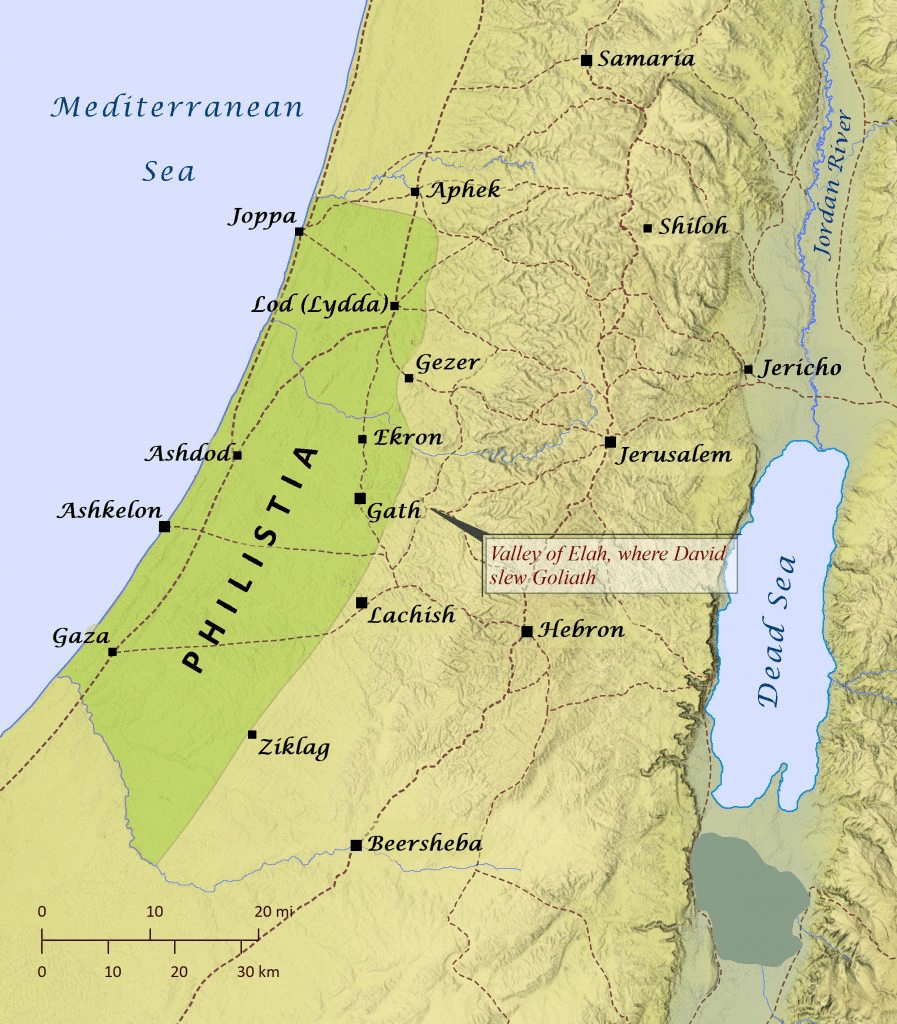
At that time, Israel was facing yet another Philistine military threat. The Philistines were not indigenous to Palestine. The Egyptians referred to them as “sea people;” they originally came from somewhere around the Aegean Sea area and settled in Canaan along the coastal plain between Gaza and Jaffa.

The Philistines expanded their territory, which continually put them at odds with Israel their neighbor. Militarily, the Israelites looked like bumpkins compared to the Philistines – who were skilled warriors with state of the art weapons.

Israel had no king. Instead, they were led by a series of judges who gave rulings throughout the land. Samuel was the last of them because the Israelite tribes determined and demanded that they must have a king in order to face the Philistine threat. (1 Samuel 8:1-21)

Samuel wisely perceived that asking for a king was not going to go well for the people. And he had warned them appropriately. Yet, Israel persisted in wanting to be like all the other nations in having a king to lead an army and fight Israel’s battles.

Although the people loved and appreciated the priest and prophet Samuel, his leadership was regarded as insufficient for the constant anxiety of dealing with the Philistines. It seems the people did not realize or consider what they were asking for, because they got it, and it wasn’t always victory and celebration.

If Israel wanted a king – and someone who looked the part – then that is exactly what they would receive. Saul was tall, strong, and seemed qualified to wage war on the pesky Philistines. Frankly, Saul was a putz who lacked the internal character needed to govern God’s people and ensure God’s will would be done in Israel.

But, again, I get ahead of myself. Reading the account of Saul for the first time, it’s easy for one to not see the signs of a coming personal implosion of the soul.

Sometimes whenever circumstances have been challenging for so long, and difficulty just keeps showing up, we begin to lose our good judgment and start wanting easy solutions for complex problems. And that is what I believe happened to Israel.

The Israelites got tired of the constant Philistine threat – to the point of believing that the grass is greener on the other side of the fence. They thought they needed a king and that everything would be better. And initially it was. But, over the long haul, it proved to be fatal.

For us today, it is good to remember that sound self-discipline through proven spiritual practices, and development of the soul by means of humility, patience, and wisdom, accomplish what is most needed in life.

Becoming weary and tired, we may slowly lose faith. Yet, the ability to persevere, stay the course, and listen well to wise people, can begin to erode and decay through the discouragement of constant adversity.

There is, however, a way to keep going when things are hard. Encourage one another daily. Avoid a critical spirit which drains the energy from others. Be careful who you listen to and take advice from. Become ever more familiar with Holy Scripture and that which is right, just, and good. Rely upon the Lord.

Living a faithful and devoted life to the divine covenant, instead succumbing to human culture, may not be easy; but it will serve us well in the long run.

Father of mercy, alone we have no power in ourselves to help ourselves. When we are discouraged by our weakness, strengthen us to follow Christ, our pattern and our hope; who lives and reigns with you and the Holy Spirit, one God, now and forever. Amen.

It’s a Bad Idea to Try and Handle God (1 Samuel 6:1-18)

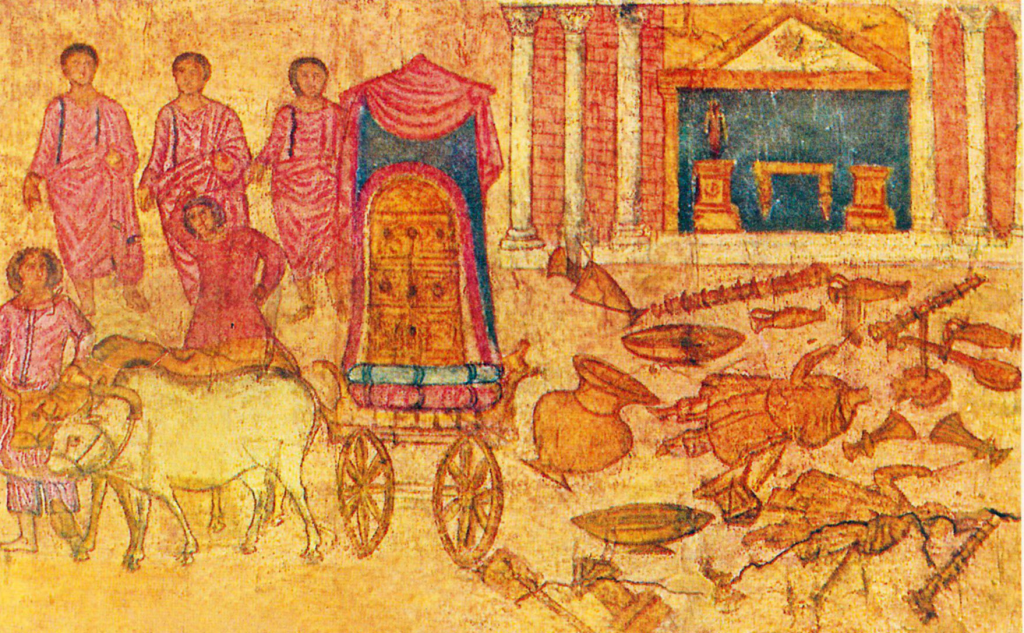
A fresco of the Philistine captivity of the Ark of God, from the ancient Dura-Europos Synagogue, excavated in 1932

The Ark of the Lord remained in Philistine territory seven months in all. Then the Philistines called in their priests and diviners and asked them, “What should we do about the Ark of the Lord? Tell us how to return it to its own country.”

“Send the Ark of the God of Israel back with a gift,” they were told. “Send a guilt offering so the plague will stop. Then, if you are healed, you will know it was his hand that caused the plague.”

“What sort of guilt offering should we send?” they asked.

And they were told, “Since the plague has struck both you and your five rulers, make five gold tumors and five gold rats, just like those that have ravaged your land. Make these things to show honor to the God of Israel. Perhaps then he will stop afflicting you, your gods, and your land. Don’t be stubborn and rebellious as Pharaoh and the Egyptians were. By the time God was finished with them, they were eager to let Israel go.

“Now build a new cart, and find two cows that have just given birth to calves. Make sure the cows have never been yoked to a cart. Hitch the cows to the cart, but shut their calves away from them in a pen. Put the Ark of the Lord on the cart, and beside it place a chest containing the gold rats and gold tumors you are sending as a guilt offering. Then let the cows go wherever they want. If they cross the border of our land and go to Beth-shemesh, we will know it was the Lord who brought this great disaster upon us. If they don’t, we will know it was not his hand that caused the plague. It came simply by chance.”

So these instructions were carried out. Two cows were hitched to the cart, and their newborn calves were shut up in a pen. Then the Ark of the Lord and the chest containing the gold rats and gold tumors were placed on the cart. And sure enough, without veering off in other directions, the cows went straight along the road toward Beth-shemesh, lowing as they went. The Philistine rulers followed them as far as the border of Beth-shemesh.

The people of Beth-shemesh were harvesting wheat in the valley, and when they saw the Ark, they were overjoyed! The cart came into the field of a man named Joshua and stopped beside a large rock. So the people broke up the wood of the cart for a fire and killed the cows and sacrificed them to the Lord as a burnt offering. 

Several men of the tribe of Levi lifted the Ark of the Lord and the chest containing the gold rats and gold tumors from the cart and placed them on the large rock. Many sacrifices and burnt offerings were offered to the Lord that day by the people of Beth-shemesh. The five Philistine rulers watched all this and then returned to Ekron that same day.

The five gold tumors sent by the Philistines as a guilt offering to the Lord were gifts from the rulers of Ashdod, Gaza, Ashkelon, Gath, and Ekron. The five gold rats represented the five Philistine towns and their surrounding villages, which were controlled by the five rulers. The large rock at Beth-shemesh, where they set the Ark of the Lord, still stands in the field of Joshua as a witness to what happened there. (New Living Translation)

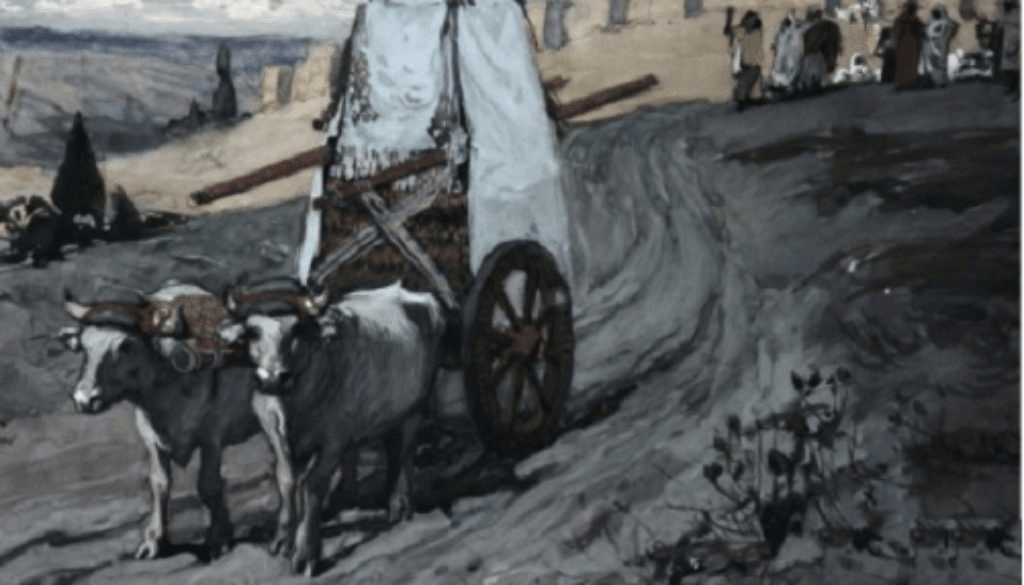
The Ark Sent Away from the Philistines, by James Tissot, 1902

Out of all the stories in the Bible, this is one of them. The Philistines and the Israelites were fighting military battles. The Israelites did not do so well. Therefore, they decided to bring up the Ark of the Covenant of God (the symbol of God’s presence) to the front lines in order to win the battle.

The plan backfired. Israel lost, and the Ark of God (think Raiders of the Lost Ark, and not Noah’s ark) was taken by the Philistines. However, the five cities of Philistia likely regretted ever doing this. Wherever the Ark was, the people were plagued with nasty tumors, so that they suffered grievously. And that’s when the Philistines decided to hatch their own plan for ridding themselves of the Ark, while preserving their cities.

For three chapters (1 Samuel 4-6) we get various humans who made plans for the Ark of the Covenant. Since the Ark is a symbol of God’s presence, engaging in these plans is akin to deciding how things are going to go with God.

Humanity doesn’t get to flip-flop who is in control, God as sovereign over humanity to humanity manipulating God for their own purposes. Trying to leverage the Lord into what we want is a bit like believing we can make the sun spin around the earth. In other words, it’s not going to happen, no matter how much effort and ingenuity you put into it.

It’s a bad idea to try and handle God, instead of letting God handle us.

At least the Philistines quickly figured out it was a fool’s errand in possessing God’s Ark. And they had enough sense to consult somebody before they acted in getting the Ark away. Eventually, we’re all going to either humble ourselves, or just get humiliated; it’s our choice.

Yes, it seems like a weird plan – making gold objects in the shape of tumors – and yet the Lord often cares much more about the humility behind a plan than the actual plan itself. Despite being worshipers of pagan gods, God was picking up what the Philistines were putting down, and graciously received the Ark back into Israel.

Turn anywhere in Holy Scripture, begin reading, and you will quickly find that God will not tolerate any person or group of people trying to use, leverage, or manipulate heaven for it’s own purposes. The Lord has made it clear what is important; it’s up to us to live into it.

Holy and almighty God, help us to walk humbly with You and one another. Let your holy Spirit guide us on the right path to truth and reconciliation with humility. Help us to hear each other, for we do not want to walk by pride or self-sufficiency. Amen.