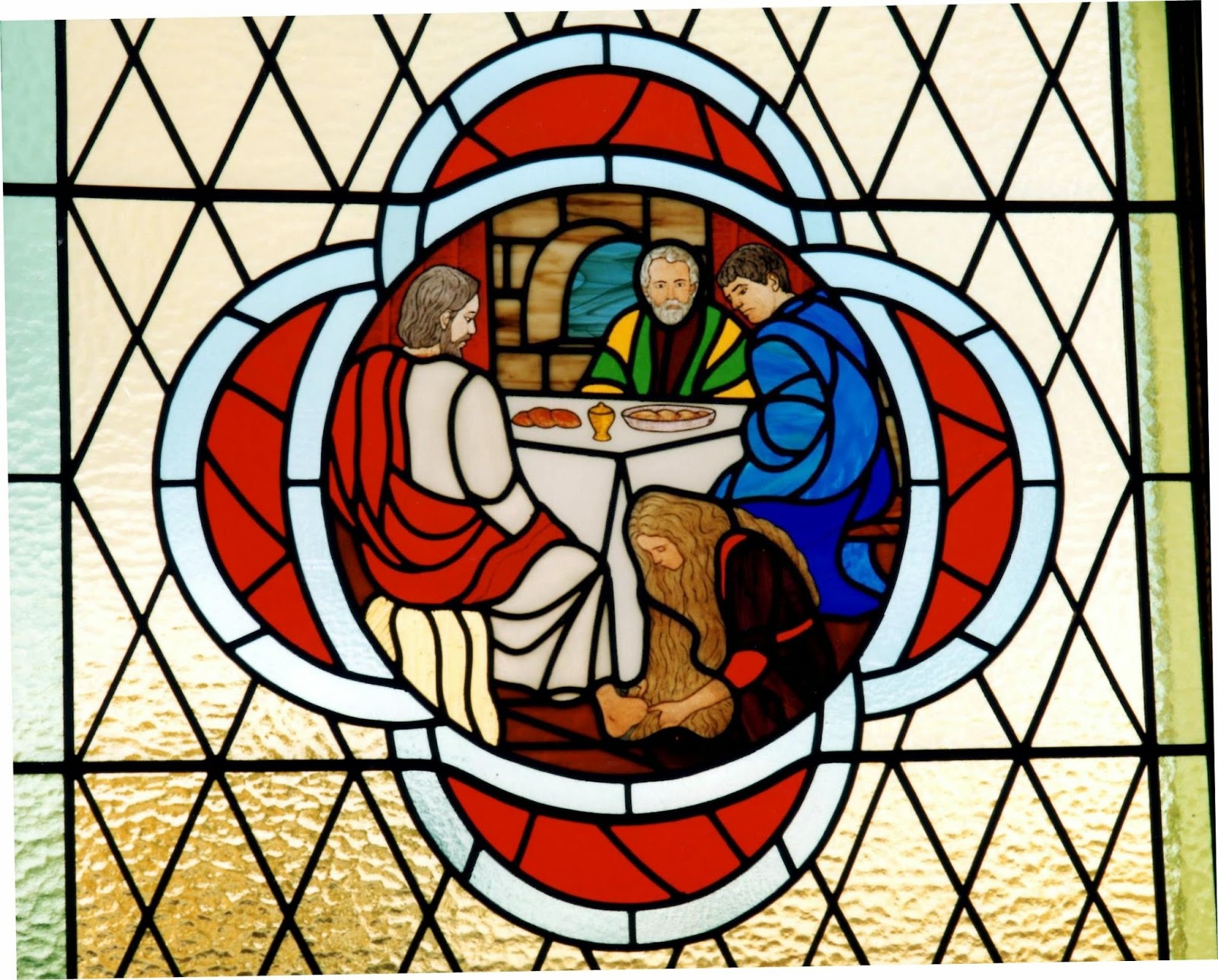
John 12:1-11 – Broken and Poured Out

Six days before the Passover, Jesus came to Bethany, where Lazarus lived, whom Jesus had raised from the dead. Here a dinner was given in Jesus’ honor. Martha served, while Lazarus was among those reclining at the table with him. Then Mary took about a pint of pure nard, an expensive perfume; she poured it on Jesus’ feet and wiped his feet with her hair. And the house was filled with the fragrance of the perfume.

But one of his disciples, Judas Iscariot, who was later to betray him, objected, “Why wasn’t this perfume sold and the money given to the poor? It was worth a year’s wages.” He did not say this because he cared about the poor but because he was a thief; as keeper of the money bag, he used to help himself to what was put into it.

“Leave her alone,” Jesus replied. “It was intended that she should save this perfume for the day of my burial. You will always have the poor among you, but you will not always have me.”

Meanwhile a large crowd of Jews found out that Jesus was there and came, not only because of him but also to see Lazarus, whom he had raised from the dead. So, the chief priests made plans to kill Lazarus as well, for on account of him many of the Jews were going over to Jesus and believing in him. (NIV)

Jack Klugman as Quincy, M.E. (1976-1983)

When I was a kid there was a show on TV called “Quincy.” Quincy was a coroner. Every episode was him performing an autopsy on someone who appeared to have a rather normal death. But Quincy always found something suspicious and spent his time prying into people’s lives to confirm his investigation. His boss and the police chief would chide and warn him saying, “Leave it alone, Quincy.” Quincy’s typical response was: “But I can’t leave it alone. There’s more here than what meets the eye!”

Indeed, the Apostle John was the Quincy of his ancient generation. In his gospel there is always more going on than what meets the eye. There are double-meanings, sometimes even triple-meanings to the events unfolding.  There are deeply symbolic encounters, as well as tangible events serving as almost metaphors pointing to the spiritual.

Mary, a woman with a sordid background, had her life transformed through meeting Jesus.

Near the end of Christ’s life, as he was about to enter Jerusalem and be arrested, tried, tortured, and killed, Mary sensed what was happening. In fact, she was aware of what was happening when others did not. Mary’s own brokenness cracked open to her the true reality of life.

The surface event itself is a touching and tender moment in history. This woman, whom everyone knew as a damaged person, took a high-end perfume, and broke the entire thing open. She then proceeded to anoint Christ’s feet with it. You can imagine the aroma filling the house with an expensive perfume for all to smell.  Giving what she had to Jesus, Mary demonstrated the path of true discipleship.

But there’s more here than what meets the eye. Let’s observe some of John’s expert autopsy work:

  • The broken jar of perfume shows us the brokenness of Mary and our need to be broken. (Matthew 5:3-4)
  • Mary used an extraordinary amount of perfume, picturing her overflowing love for Jesus. (John 20:1-18)
  • Mary applied the perfume to Jesus with her hair; hair is culturally symbolic for submission and respect. (1 Corinthians 11:14)
  • The perfume directs us to the death of Jesus. (John 19:38-42)
  • The perfume highlights for us the aroma of Christ to the world. (2 Corinthians 2:15-17)
  • There is more to Judas than his words about perfume; he is not actually concerned for the poor. (Matthew 26:15)
  • Judas and Mary serve as spiritual contrasts: Mary opens herself to the sweet aroma of Christ; Judas just plain stinks.
  • The perfume presents a powerful picture of the upcoming death of Christ, for those with eyes to see; he was broken and poured out for our salvation. (Luke 23:26-27:12)

Christianity was never meant to be a surface religion which merely runs skin deep. The follower of Christ is meant for deep personal transformation, inside and out, so that there is genuine healing, spiritual health, and authentic concern for the poor and needy. 

Keeping up appearances is what the Judas’s of this world do. But the Mary’s among us dramatically point others to Jesus with their tears, humility, openness, and love.

In our social landscape of fragmented human ecology, our first step toward wholeness and integrity begins with a posture of giving everything we have – body, soul, and spirit – to the Lord Jesus. Methinks Quincy was on to something.

Loving Lord Jesus, my Savior, and my friend, you have gone before us and pioneered deliverance from an empty way of life and into a life of grace and gratitude. May I and all your followers emulate the path of Mary and realize the true freedom which comes from emptying oneself out for you. Amen.


Perspective Changes Everything

Perspective is everything. Nearly sixteen years-ago, me and my family were in a car accident. I was traveling on a highway in rural Iowa and a small car on a gravel road blew right through the stop sign without even slowing down. There was nothing I could do. I slammed into the rear quarter panel of his car, and he literally spun like a top off the highway and came to a stop. Both the driver and his girlfriend passenger were not injured. 

Two of my daughters were in the very back seat of our minivan, with my wife and dog as front seat passengers.  The girls were not harmed. However, my wife tore her shoulder’s rotator cuff trying to protect the dog and had to have surgery to repair it. My lower back was injured, but not in a way which surgery could repair. To this day I live with low-level chronic pain. Most days it’s not bad, maybe a one or two on the pain scale. But on a bad day I can barely walk across the room and need a cane to get around.

I have played the scene of the accident in my mind hundreds of times. I have thought over-and-over again about what I could have done to prevent the accident. Yet there was no way to avoid it. I thought about the fact that if we just would have left a minute earlier or a minute later from my parents’ house from where we were visiting, all would be fine. But I know that kind of thinking is a fool’s errand. I have pondered every possible scenario in my head and have gotten nowhere. 

It also took me awhile to forgive the young man who was driving the other car. He changed my life, and not in a good way. Although his insurance took care of everything and he was very repentant about the whole thing, I was understandably mad for a long time. I eventually did come to the point of forgiving him.

Over the years I have learned to live with my limitations. I have now accepted the sometimes-irritating pain as part of my life. Still, on occasion, I cannot help but think of what my life would be like today if I hadn’t been in that stupid senseless accident. 

“Everything that irritates us about others can lead us to an understanding of ourselves.”

carl jung

About six years ago I was praying alone in the church for which I was a pastor, at the time. God brought the accident to my mind. I said to God, “Lord, we’ve been through this accident hundreds of times together. I don’t want to think about it anymore. Why are you bringing this up now?”

Even though I wasn’t really looking for an answer to my question, God brought it up because the Lord knew I was finally ready to get a divine perspective on the accident. Out of the hundreds of times I went over that accident, the one perspective I never took was that of the young man – the other driver. God invited me to take the young driver’s view of what happened that day. So, I did.  I know that intersection like the back of my hand, so it wasn’t a hard exercise. 

I put myself in the driver’s seat of his car. I’m driving down the gravel road not paying attention to the fact that a stop sign is coming up. I blow through the sign onto the highway and right in front of a minivan who slams on the brakes just enough to plow into the rear quarter panel. I spin out like a top and come to rest only a few feet from a huge Iowa grain elevator.

For the first time in my life, I finally understood. God had a divine appointment for me that day. You see, if I had not come along just when I did, that young man and his girlfriend would have blown through the stop sign and struck that grain elevator. It would have killed them both instantly.

“Life is 10 percent what you make it and 90 percent how you take it.”

Irving Berlin

Suddenly, my perspective changed 180 degrees. I always thought about me and my family. I always considered my hardship and my change of life. But now I saw that God sent his servant to save two lives that day. Had I not struck his car, causing him to spin and come to a rest unharmed, two people would have died. 

Now, every time my back acts up and it effects how my life is lived, I’m reminded that it is a small price to pay for the lives of two human beings. Perspective changes everything.

The Bible invites us to view our lives from a different perspective. Our hurts and our pains, our sorrows and our sufferings, our changes, and our limitations, are all part of something much bigger God is doing in the world.  We are not always privy to God’s plans and purposes. Yet God’s Word challenges us to take a perspective of the world, of humanity, and of ourselves which is counter to how we often think.

In this season of Lent, we are invited to read God’s Word and practice repentance – literally, a change of mind.  We are invited to see the Ten Words (Commandments) as the glasses through which we are to view our relationship with God and our relationships with others (Exodus 20:1-17). Jesus, summarizing those Ten Words, put it this way: All the Law hangs on loving God and loving our neighbor. (Matthew 22:36-40)

The thread of those moral words, those ethical commands, runs through the entirety of God’s Word, the Bible. The psalmist reminds us that this Word is good, sweet, and more precious than gold (Psalm 19:7-14). The Apostle Paul reminds us that this Word is our wisdom to live by (1 Corinthians 1:18-25).  And Jesus, as the Word made flesh among us, lived that loving and gracious Word with perfect moral and ethical goodness.

The temple, as the place where God’s Word was read and observed, was not to be adulterated with making a profit – which was why Jesus drove out the moneychangers.  And he did it with flavor! (John 2:13-22) Later, after Jesus died and rose from death, the disciples remembered their master’s words and affirmed them as being the Word of God. They believed. Their faith and repentance changed the world.

God is inviting us to take up the Divine Word and see our lives, the lives of others, and every event and situation through that lens. We are to see Jesus, not only as a great teacher, a moral and good person, and a loving healer – but also as Lord and Savior. In a small way, I suffered so that someone else could live. Yet Jesus suffered sin, death, and hell in our place so that you and I could live – so that we might have the eternal life of enjoyment with God forever.

Allow the Word of God to shape your lives and form your thinking today and every day. You might not always know what God is doing, but you can be assured that everything God does is just, right, and good. 

May you know God’s peace today. May you know Christ better in this season as you reflect upon our Lord’s great sacrifice on our behalf.

Dying to Our Plans


Most people are not much into personal change.  Change means adjusting to a different reality, and we would much rather prefer others adjusting to how we do things so that we don’t have to change.  We like how we do things. Routine, consistency, predictable outcomes are things we rely on for a sense of safety and stability in our lives. Even good change, like becoming debt-free or getting in shape is difficult, if for no other reason the effort and energy it takes to see our goals accomplished. In order to change something about ourselves, we have to be willing to admit we might have been doing it wrong and try to do something different.
 
            God’s love in Jesus Christ changes everything.  But the kind of change that Jesus talked about and died for is not just making a few alterations to our lives or re-arranging some of our schedule around.  It is not about exerting more effort or adding more to the to-do list.  Jesus, instead, loved us so that we would be completely transformed from the inside-out.  For that to happen, in order to have a new life, the old life must die.  What is more, Jesus does not want us half dead because then we are zombies who are not really living the life God intended for us to live.  No, if there is to be a resurrection and new life, there must be a death.  
 
            We must die to our plans.  Jesus had a crowd of people following him wherever he went.  He was interesting and compelling, even magnetic.  He taught like no other person before him, and healed all kinds of people.  In the first century, Jesus became the latest fad.  With his fame, there were people who looked to Jesus to further their own agenda and their plans about how things should go.
 
            The Apostle John recorded a contrast between two people, Mary and Judas (John 12:1-8).  Mary is a picture of dying to her own plans of how things should go.  Mary took some very expensive perfume, the kind that could have set her up for some needed financial security, and poured it all on Jesus’ feet.  In addition, she humbly wiped it on him with her hair.  It is a picture of giving herself completely and wholly to Jesus, no matter the cost, no concern with how it would look to others, with no strings attached and no other agenda other than total devotion.
 
            Judas, on the other hand, piously objected to Mary’s act of worship.  We might hear him rationally pushback on what Mary was doing:  “My friends, this is a lot of money – money that could be used for the poor instead of needlessly wasting it.  A little perfume is just fine, but to use the whole bottle is just too over the top – it isn’t fiscally responsible!”  Judas had a secret agenda.  He was not thinking of giving himself completely to Jesus, but of how he could use the cash for himself and his own purposes.  Judas is the picture of a zombie – half dead, walking around saying all kinds of spiritual things, but only devoted to Jesus and God’s kingdom when it agreed with him.  Judas had his own ideas of how the kingdom operation ought to go; and, when he became convinced that Jesus was not going to operate according to his agenda and plans, Judas betrayed him.
 
            When it comes to church ministry, every single member must be willing to die to self – to die to our own agendas of how we think things ought to go.  Conflict and contention exist because there are persons who tenaciously hold on to their pet programs or their ideas on how to proceed.  But what needs to occur is that each Christian must serve Jesus with the same attitude and action as did Mary.
 
            A church cannot be revitalized, revived, renewed, or resurrected apart from death.  Something or someone must die for new life to happen.  We must die to our plans so that God’s kingdom agenda can take over.  Believers in Jesus need to express the same devotion and dedication as did Mary.


            We all become frustrated and discouraged at times with the petty sinfulness of the church.  The answer is not to distance or detach, but to devote ourselves to dying to our plans and personal agendas.  When an entire group of believers does this, there is an abundance of grace and a mass transformation of heart.  May it be so, to the glory of Jesus Christ.