“Holy, Holy Week, Batman!”

Burt Ward as Robin, and Adam West as Batman, in the 1960’s TV show

In some Christian traditions, Holy Week – observing the last earthly week of Christ’s life on earth – is either forgotten or neglected. And those that do recognize and observe it, this week can too easily become just something we do every year, without much meaning behind it. The following is a tongue-in-cheek way of reminding us of it’s importance, and recapturing it for the life of the Church…

“Robin, there is something seriously sinister afoot.  It seems the people of Gotham have lost their sense of the story of Christ’s life, death, and resurrection.” 

“Holy Holy Week, Batman!  It must be the work of that arch-villain the Joker who has turned the narrative of Jesus into a by-gone joke… or maybe the Riddler who has made the redemptive events of Jesus into a complicated riddle that no one can solve… or maybe that fiend, Cat Woman, has finally found the purr-fect way to foil attention to the Lord Jesus.”

“I fear, Boy Wonder, that you have stumbled upon who is behind the loss of Holy Week… they are all conspiring together not just to create a spin on the life and death of Jesus, but to form a new narrative that doesn’t even include Christ at all.”

“Those dastardly demons of disaster!  Let’s go get them, Batman!  How could they have done such an ugly underhanded umbrage as that!?”

“Let’s use the Bat computer to analyze the evidence found at the crime scene churches…. Look, Robin, it seems a feculent film of gross gas has rendered the believers prone to the noxious notion that the Christian observance of Holy Week is optional, as if the journey with Jesus to the cross doesn’t need special attention.  They are attempting to rewrite it all so that Christians will pass through this week without even a thought about Jesus… until it’s too late.  Then they will sweep in and make all of Christianity into something that’s merely an accessory to life, like a petty plastic purse.”

Burgess Meredith as the Penguin, Frank Gorshin as the Riddler, Lee Meriwether as the Catwoman, and Cesar Romero as the Joker, in the 1960s TV show Batman.

“Holy evisceration, Batman!  They’re trying to do away with the Christian life and the story of Jesus altogether and replace it with their fiendish focus on the foul festering faith of fecund followers!”

“That’s right, Robin.  It’s our job to stop them from following through with their platitudinous plot before it’s too late.”

“But how, Batman?  Their vile villainy has already voiced a vacuous votum of veneered viciousness to any observance of the last week of Christ’s life on this earth.”

“Yes, Robin, but you are forgetting the one “v” word which has already spelled doom for our culprits of crime… “victory.”

“Holy resurrection, Batman!  You’re right!  All we need to do is voice the victory of Jesus and those bungling bandits of belief will get another “v” word: “vanquished!”

“Holy Week and all the major Christian seasons of the Church Year are meant to help us remember Jesus and follow Christ in our daily life.  When strayed souls begin berating believers for observing obedience to Palm Sunday, Maundy Thursday, Good Friday, Holy (or Black) Saturday, and Easter Sunday then you can bet, Boy Wonder, that the gangsters’ gross gas of gullibility has fumigated their faith.”

“So, you’re saying, Batman, that the forgetting of faith festivals can be reversed through setting our sites on the contempt of the cross and the resplendence of the resurrection?”

“The cross is the mid-point of history, Robin, the very center of faithful followers.  From it flows the flowering of all faith.”

“Holy forgiveness, Batman.  I see it now.  The sin issue has been taken care of once-for-all through the death of Jesus Christ.  And his rising again has enabled us ignorant idiots of ignominy to live a new life of love through the words and ways of Christ.”

“And, don’t forget, Boy Wonder, that we get our faith focused through walking into those ways and words by highlighting holidays as eminently important to our crowded calendars.”

“Holy, holy, holy, is the Lord God Almighty, creator of heaven and earth; and, Jesus Christ his only Son, our Savior; who, with the Holy Spirit lives and reigns forever and ever!” 

“Amen, Boy Wonder.  Amen.”

Spiritual Confidence (2 Corinthians 3:4-11)

Such confidence we have through Christ before God. Not that we are competent in ourselves to claim anything for ourselves, but our competence comes from God. He has made us competent as ministers of a new covenant—not of the letter but of the Spirit; for the letter kills, but the Spirit gives life.

Now if the ministry that brought death, which was engraved in letters on stone, came with glory, so that the Israelites could not look steadily at the face of Moses because of its glory, transitory though it was, will not the ministry of the Spirit be even more glorious? If the ministry that brought condemnation was glorious, how much more glorious is the ministry that brings righteousness! For what was glorious has no glory now in comparison with the surpassing glory. And if what was transitory came with glory, how much greater is the glory of that which lasts! (New International Version)

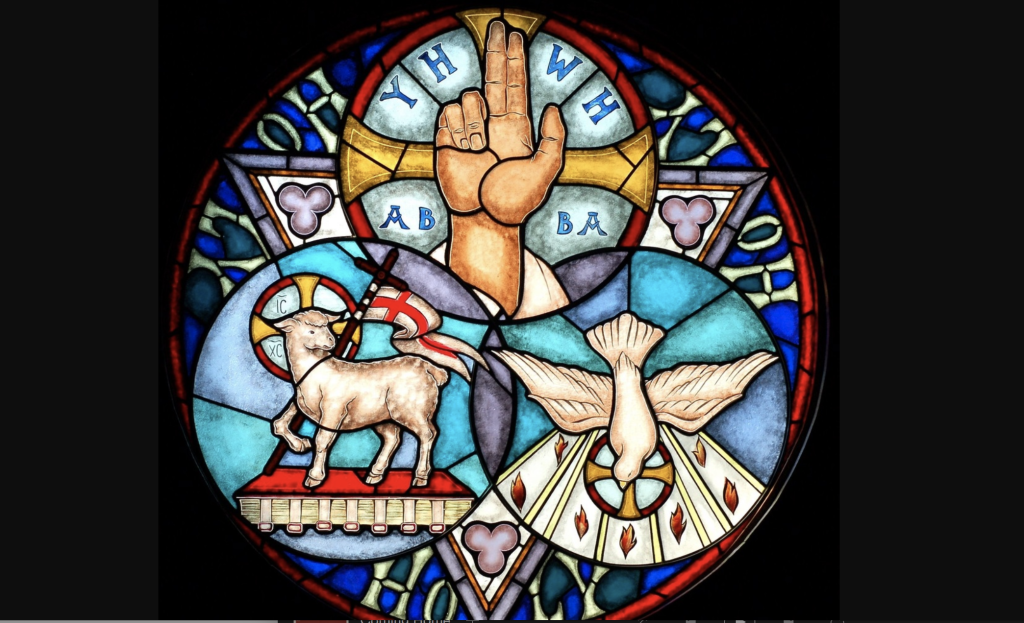
The Christian religious tradition holds to the great Three-in-One of God – God is indivisibly One, and at the same time, a Trinity of Father, Son, and Spirit. Christians typically have no problem expressing their prayers and devotion to the Persons of the Father and the Son, as well as connecting their ministry efforts to them. 

However, when it comes to the Spirit, this Person of the Holy Trinity is often referred to as an “it” or a “force.” Yet, the Holy Spirit is as much God and a Person as the heavenly Father and the Savior, Jesus Christ. The Spirit is the One who provides the guidance and energy for Christian ministry – and not the Law.

We very much need the Holy Spirit of God. Without the Spirit’s help, Jesus is merely looked at as one person out of thousands of individuals crucified in history; and only an example of one who was martyred for his faith. But Jesus is infinitely more than that. 

Christ is the Son of God, the Savior of the world. Through Jesus Christ’s life, death, resurrection and ascension, people can be redeemed from empty lives, saved from destructive life-patterns, and given the kind of security and purpose in life that God intended from the beginning for people to possess. 

And the Spirit of God is the One that takes these redemptive events of Jesus and applies them to our lives. Apart from the Holy Spirit, we are lost, because we are unable to see the genuine spiritual truth about the cross of Jesus Christ unless God the Holy Spirit breaks into our lives and does an intervention – showing us our denial about how we are really doing and our delusions about who we really are (1 Corinthians 2:1-16).

This, then, is the basis for spiritual confidence. And this sort of confidence does not and cannot come from obedience to the Law.

Admitting that we absolutely need the Holy Spirit of God means that the power of Christianity does not reside with me or you; power for the Christian life rests upon Jesus Christ and him crucified, with the Spirit witnessing to us of this truth. 

In other words, we are largely powerless. 

Now, I realize this is not a popular message, especially in Western society. That sounds ridiculous to a particularly can-do kind of people, like most Americans. We believe we’ve done fairly well on our own, thank you very much. A couple of cars, a house, a job, and a family. I work hard. I’ve earned my stuff and my accomplishments. 

But the thing is, any worldly success may lead us to the delusion that we have the power to do what we want – as if I am the sole captain of my soul. I did it. And I did it my way.

“Oh, sure,” many a person may reason, “we have problems just like everybody else. After all, I can’t control everything!” Yet, we are not powerless just because we have difficult circumstances and a few problem people in our lives. “God will step in a take-over where I leave off, right?” Wrong. 

It’s all wrong, because it’s based in one’s effort to obey a personal creed, the rules of the game, or even the Law and the Ten Commandments. But if we could really do it on our own, there’s no need for any of this spiritual stuff.

In truth, apart from the Holy Spirit of God, we are unable to be Christians and live the Christian life. If we think we manage our lives just fine, with a bit of help from God, then we are likely in denial. We are probably placing ourselves at the center of the world; and believe we should be able to deal with whatever comes in life. 

Whenever the consistent response to adverse situations, or the realization that we are not handling something well, is to try and fix ourselves, then we are surely living in the delusion that we hold the power to change – independently without anyone or anything helping us.

If our first reaction to adversity or problems is:

  • Searching Google for more knowledge
  • Dealing privately with personal issues
  • Expecting that willpower should be enough

Then, we are feeding the delusion that we do not really need the Holy Spirit of God; we are actually believing that we need more effort, or information, in order to find the power to overcome whatever is in my life that needs overcoming.   

Unfortunately, it typically takes a tragedy or crisis to break our delusions of power. Let me ask: How bad must we hurt before we admit that we are not managing our lives well at all, and that the real power to change resides with the Holy Spirit?

Our spiritual power and confidence resides in the cross of Jesus Christ, with the Holy Spirit testifying to us of God’s great grace. 

The Apostle Paul believed this with all his heart. Although he was a very intelligent and learned person, he did not rely on his abilities, but on God’s. 

The cross of Jesus is not just an historical event, but an ongoing reality for us to experience victory over all the brokenness of this world, and all the mess we have made of things by putting ourselves at the center of the universe. 

We need the Holy Spirit of God to intervene and apply Christ’s finished work to us. 

None of this means that the Law, or that you, are bad. Both you and the Law are good. It’s just that we, by ourselves, and the Law by itself, are inadequate to save, deliver, and overcome. For that, we need God’s Spirit, and to tap into the spiritual reality that exists.

If the Ten Commandments were introduced with glory, and we ourselves were created with glory, then how much more glory and life is there through an intimate relation with the Spirit?

O God of peace, who has taught us that in returning and rest we shall be saved, in quietness and confidence shall be our strength: By the might of your Spirit lift us, we pray, to your presence, where we may be still and know that you are God; through Jesus Christ our Lord. Amen.

Speak the Good Word (2 Timothy 4:1-5)

St. Paul the Apostle, Unknown artist

I’m giving you this commission in the presence of God and of Christ Jesus, who is coming to judge the living and the dead, and by his appearance and his kingdom. Preach the word. Be ready to do it whether it is convenient or inconvenient. Correct, confront, and encourage with patience and instruction. 

There will come a time when people will not tolerate sound teaching. They will collect teachers who say what they want to hear because they are self-centered. They will turn their back on the truth and turn to myths. But you must keep control of yourself in all circumstances. Endure suffering, do the work of a preacher of the good news, and carry out your service fully. (Common English Bible)

This letter from the Apostle Paul to Pastor Timothy was the last writing he ever crafted. Soon after sending this, according to historical tradition, Paul was martyred for his faith in the city of Rome, having been imprisoned there for two years. The letter contains some final words the Apostle wanted his young protégé to know that were important to him.

Paul left Timothy with a sacred charge to proclaim the gracious message of God – no matter the time nor circumstance – with all the divine patience and spiritual exhortation that the Lord gives.

A Word of Christ

The simple commission of Paul was to preach the word, proclaim the message, spread the good news. Paul called on Timothy to speak the word that God has spoken – the word passed on to him, first through his devout mother, then from his mentor, and finally from all the apostles. It’s a unified message of sound teaching concerning the person and work of Jesus Christ – God-breathed and committed to all God’s people who respond to the message in faith.

The responsibility is to not only hear the message, obey it, and guard it’s truth; the charge is to speak, to lift one’s voice and proclaim the message with confidence and without fear – because it is always open season on the proclamation of the gospel.

I don’t know what sort of picture this evokes for you to “preach the word.” Maybe you envision a preacher behind a pulpit in a church; or a guy with a bullhorn on a street corner; or an obnoxious coworker who takes any opportunity to puke the gospel onto another person; or some other picture which may be foreign to you.

Paul preaches in Athens, Unknown artist, 19th century

Please let me assure you that the Apostle Paul was not talking about any of those sorts of scenarios. The image is one of letting out something which is already inside of you, burning to come out and be heard.

It is to be so full of the life of Christ, that the words which come out of you are filled with that very life – a message of grace, redemption, hope, forgiveness, and love. And communicated in a way that also reflects the person of Jesus – an affect, gestures, posture, and tone of voice that resonates with another and is winsome, not annoying.

A Relevant Word

The person who proclaims the message of Christ does so in order to convince, encourage, rebuke, inform, and love. The messenger tells what another needs to hear, and not necessarily what they want to hear. This is a word that speaks to anyone in any situation within any sort of context or culture.

To speak with relevance in no way waters down the message of Christ. Rather, it means that the speaker takes great pains to talk in such a way as to help another in their own circumstance. Utilizing the mind and emotions, as well as the spirit, the preacher presents ideas, ethics, and feelings in order to announce good news.

And we are to always be patient with others. One must never resort to pressurized sales tactics to force another into the kingdom of God. The Word of God is a gracious message that provides life; and is not a big thick Bible that is used to smack somebody upside the head with condemnation.

Our responsibility is to be faithful in handling the message and proclaiming it with mercy. It is the Holy Spirit’s job to woo people to Jesus and purify them.

Don’t throw all over somebody a bucket of judgment, as if you are acting for God. Impatience, impertinence, impoliteness, and being impetuous, all belong to the devil’s imps, and have nothing to do with announcing good news of great joy for all the people.

An Uncompromising Word

Timothy lived in a society that was difficult in proclaiming the message of Jesus Christ. He lived in a city that had a grand temple to the goddess Artemis. He walked around seeing unethical practices and dubious living. Any of us would likely understand if Timothy shrunk back from having a bold proclamation of Christianity.

Paul speaking in the synagogue, a 12th century Byzantine mosaic

But the Apostle Paul was calling Timothy to preach good news without shrinking or shirking the message. One might be tempted to simply tell others what they’d like to hear and not stir the pot and cause any sort of conflict. Not everyone wants to hear the truth. For everyone who genuinely responds to a truthful and merciful message, there are four more persons who want none of it. They want what they want, and if someone says different, they’ll make their life hell.

These are the conspiracy theorists who would rather entertain spicy nuggets of opinion and speculation, than listen to evidence-based research and professionally peer reviewed material. They ground their ideas according to subjective taste and forsake objective documentation and witness.

Paul did not want Timothy coddling such persons or giving into them in any form whatsoever, because they have a severe hearing problem. People who won’t listen, constantly interrupt others, and believe they are always right, need a good dose of the uncompromising word of Christ.

In the face of those who refuse to listen and use their ears for good, Timothy was exhorted by Paul to be a steady teacher who keeps presenting the truth in intellectually and emotionally responsible ways. Timothy may have to endure suffering and put up with a bunch of simpletons giving him a hard time, but he was never to back down from sound and solid apostolic teaching.

It’s important that we all maintain a sense of emotional calm and intellectual soundness amidst all the crud within a given society. The believer is to avoid a discouragement that leads to abject silence.

Let us not be deterred from saying and doing what is right, just, and good. And let’s make sure that in the words we say and the behavior we display, there is the very life of Jesus Christ oozing out of us.

There are more than enough bad words being spoken every day; let’s instead speak the good word, full of grace and truth.

Soli Deo Gloria

The Source of True Godliness (1 Timothy 3:14-16)

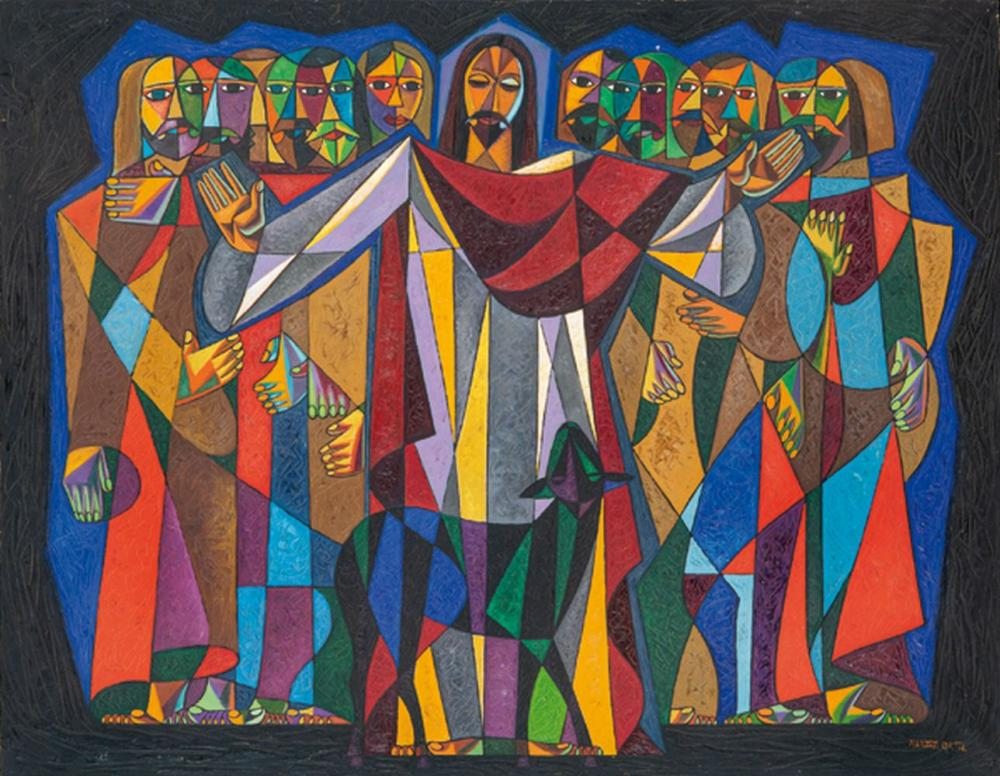
Jesus Christ and the Apostles, by Nicolás Martínez Ortiz (1907-1990)

Although I hope to come to you soon, I am writing you these instructions so that, if I am delayed, you will know how people ought to conduct themselves in God’s household, which is the church of the living God, the pillar and foundation of the truth. Beyond all question, the mystery from which true godliness springs is great:

He appeared in the flesh,
    was vindicated by the Spirit,
was seen by angels,
    was preached among the nations,
was believed on in the world,
    was taken up in glory. (New International Version)

Godliness is an important thing for those who seek to follow God.

So, the Apostle Paul wrote to his young protégé, Timothy, who was leading the church in Ephesus. Paul gave Timothy some sound practical instructions regarding how things ought to be conducted between pastor and people. Paul did this because he wasn’t quite sure how long it would be before he could show up in person, and he wanted to ensure that the ministry would go forward in a way that honored Christ.

Christian ministry is important because it doesn’t simply have to do with one’s private abilities and affairs. Rather, Christian leaders and pastors are entrusted with the household of God, the church. Believers are a holy sanctuary of the soul, the place where God dwells by means of the Spirit.

The Church is not a brick and mortar building, but the place of the living God, the pillar and foundation of the truth. Pastor and parishioners alike are to support the truth of the gospel, that is, the good news about the person and work of Jesus Christ.

Both believers and bishops who make up the Church support gospel truth by doing the following:

  1. Hear and heed the truth. “Whoever has ears to hear, let them hear… This is the meaning of the parable: The seed is the word of God. Those along the path are the ones who hear, and then the devil comes and takes away the word from their hearts, so that they may not believe and be saved. Those on the rocky ground are the ones who receive the word with joy when they hear it, but they have no root. They believe for a while, but in the time of testing they fall away. The seed that fell among thorns stands for those who hear, but as they go on their way they are choked by life’s worries, riches and pleasures, and they do not mature. But the seed on good soil stands for those with a noble and good heart, who hear the word, retain it, and by persevering produce a crop.” (Luke 8:8, 11-15, NIV)
  2. Handle the truth rightly. Make an effort to present yourself to God as a tried-and-true worker, who doesn’t need to be ashamed but is one who interprets the message of truth correctly. (2 Timothy 2:15, CEB)
  3. Hide the truth in your heart. I have hidden your word in my heart that I might not sin against you. (Psalm 119:11, NIV)
  4. Hold the truth as the Word of Life. Hold firmly to the word of life; then, on the day of Christ’s return, I will be proud that I did not run the race in vain and that my work was not useless. (Philippians 2:16, NLT)
  5. Ingest and digest the truth. Study, meditate, and devote yourself to God’s Word. Your words were found, and I ate them, and Your word was to me the joy and rejoicing of my heart. (Jeremiah 15:16, NKJV) You must not depend on bread alone to sustain you, but on everything that the Lord says. (Deuteronomy 8:3, GNT)
  6. Interest yourself in the truth, and defend it. “I have been put here for the defense of the gospel.” (Philippians 1:16, NRSV) I must write and ask you to defend the faith that God has once for all given to his people. (Jude 1:3, CEV)
  7. Impart the truth and disseminate it to others. The unfolding of your words gives light; it imparts understanding to the simple. (Psalm 119:130, NRSV) Teach these new disciples to obey all the commands I have given you. (Matthew 28:20, NLT)
  8. Indicate and demonstrate the power of the truth in the way you live your life. Let the message about Christ completely fill your lives, while you use all your wisdom to teach and instruct each other. With thankful hearts, sing psalms, hymns, and spiritual songs to God. Whatever you say or do should be done in the name of the Lord Jesus, as you give thanks to God the Father because of him. (Colossians 3:16-17, CEV)

The Church is a big deal because the head of the Church, Jesus Christ, is a big deal.

In many quarters of the world, the Church no longer has much influence or impact. For some, the Church is nothing more than an outdated antiquarian club that’s irrelevant to us today. For others, the Church is an abusive institution that looks to extend selfish power over others. And for many, the Church is simply not something they want to be a part of, having neither strong opinions one way nor the other.

Yet, the Apostle Paul, in his letters to all the churches, presents the Church as united to Christ and an extension of his person and work on this earth. Now, that’s a big deal!

Therefore, the Church is meant to confess Christ in its daily witness in all it says and does. In other words, the Church is to embody the words and ways of Jesus, and even Christ himself, by means of God’s Holy Spirit.

Everything about the Christian is to exude the very life of Christ.

How we can possess such a vital union and connection with Jesus is a mystery. Rather than trying to understand it, we embrace it and live it with all the energy the Spirit of God grants us.

We do, however, seek to know Jesus Christ ever more, every day. The more we know Christ, the better we will be able to know the height and depth of love, and to extend that love in all the places of this fallen planet that lack it. This is where true godliness and goodness spring from.

The Church everywhere and for all time confesses and proclaims that Jesus Christ descended to this earth, was visibly seen in a human body by both people and angels, proved right by the invisible Spirit, proclaimed among all kinds of peoples, believed in all over the world, and ascended into heavenly glory.

After two thousand years of church history, Christians are still unpacking the incredible richness and mystery of what all that means for us and for our salvation. And it is a spiritual journey worth taking for the rest of our lives.

May I walk this day, O Christ, in the realm of grace, walking with you, my feet firmly on your earth-path, my heart loving all as kindred, my words and deeds alive with justice. Amen.