A Better System (Hebrews 7:11-22)

Mosaic of Melchizedek, in the Church of Sant’Apollinare, Ravenna, Italy, c.5th century, C.E.

If perfection could have been attained through the Levitical priesthood—and indeed the law given to the people established that priesthood—why was there still need for another priest to come, one in the order of Melchizedek, not in the order of Aaron? 

For when the priesthood is changed, the law must be changed also. He of whom these things are said belonged to a different tribe, and no one from that tribe has ever served at the altar. 

For it is clear that our Lord descended from Judah, and in regard to that tribe Moses said nothing about priests. And what we have said is even more clear if another priest like Melchizedek appears, one who has become a priest not on the basis of a regulation as to his ancestry but on the basis of the power of an indestructible life. For it is declared:

“You are a priest forever,
    in the order of Melchizedek.”

The former regulation is set aside because it was weak and useless (for the law made nothing perfect), and a better hope is introduced, by which we draw near to God.

And it was not without an oath! Others became priests without any oath, but he became a priest with an oath when God said to him:

“The Lord has sworn
    and will not change his mind:
    ‘You are a priest forever.’”

Because of this oath, Jesus has become the guarantor of a better covenant. (New International Version)

The author of the Book of Hebrews argued that the old Levitical sacrificial system was temporary; it was never designed to be permanent. And because it was temporary, the system was insufficient in bringing restoration to God and settling the sin issue once and for all.

Only Jesus could bring perfection to worshipers; the Levitical priests could not. The old system is obsolete, because of Christ. Jesus has brought a new and better way.

Before Google, Wikipedia, and the internet, there were actual physical libraries with lots of books. In order to research anything, you needed to go to the library, use the card catalogue to access what book(s) you needed, check them out, and pour over them to find the information you need.

I grew up in an era of typewriters. I learned to use one. All through my high school and college undergraduate years, I would draft all of my papers by writing with a pen on a legal pad of paper (I have to spell out what it actually was, because not everyone knows what it was like back in the day!).

Then, I would manually type my paper draft on a typewriter. If I made a mistake, I would have to use a fluid called “white out” to cover it, and then type the correction over it. As you can either remember, or imagine, this was a painstaking process.

Finally, the paper was physically submitted to the professor, in person. If you lost the document, or spilled something all over it, you would have to type it all over again.

But back then, when I was doing it, I didn’t know any better. There was no other way to get your papers researched, typed, and submitted.

Computers and the internet changed everything. It made library card catalogues with the Dewey Decimal System, and manual typewriters obsolete.

I have “written” thousands of documents since getting my first computer. A lot of my research is now done on a computer, via the internet. I can draft and finalize a document in one place. And when I’m done, I simply attach the virtual document to an email and send it. The entire process of “writing a paper” takes a fraction of the time it took me decades ago – with a lot less hassle.

I still remember some people ridiculing computers when they first came out. They said it was a fad that wouldn’t last; and just a way for electronic companies to fleece money from us in order to pay for one of the newfangled contraptions.

You will now find all the tools I once used to write a college term paper in antique stores and museums. They are obsolete. A better system now helps us all.

The old sacrificial system compared to Christ’s once for all sacrifice is even more pronounced than typewriters and computers, library books and the internet.

The author of Hebrews argued and insisted that the person and work of Jesus Christ is vastly superior and better than the Old Testament sacrificial system handled by the Levitical priesthood. It’s not even close.

The new covenant has replaced the old. We can be close to God and enjoy God because of Jesus, without using a typewriter.

The old way wasn’t bad; it’s just been replaced by a better way. Jesus is the way.

None of this came about haphazardly. It was according to God’s purpose, which is why the author of Hebrews referred to Old Testament passages to reveal that it has always been the divine purpose to have a priest forever in the order of Melchizedek, not Aaron.

God has made an oath and will not change the divine mind about it: Jesus Christ is a priest forever, permanently, eternally. With the permanence of Christ’s person and work, our hope is secure.

You cannot improve on perfection. The work is finished. All there is left to do is exercise faith, hope, and love, according to the system that is now permanently in place.

So, the ancient Jewish Christians were not to be fooled in thinking they could go back to the old Judaism they grew up with. They needed to persevere in faith and patience by sticking with the system of perfection, and with the perfector of our faith, Jesus Christ our Lord.

Let us keep our eyes fixed on Jesus, on whom our faith depends from beginning to end. He did not give up because of the cross! On the contrary, because of the joy that was waiting for him, he thought nothing of the disgrace of dying on the cross, and he is now seated at the right side of God’s throne.

Think of what he went through; how he put up with so much hatred from sinners! So do not let yourselves become discouraged and give up. (Hebrews 12:2-3, GNT)

Almighty God,
all thoughts of truth and peace
proceed from you.
Kindle in the hearts of all people
the true love of peace.
Guide with your pure and peaceable wisdom
those who take counsel
for the nations of the earth;
that in tranquility, your kingdom
may go forward,
till the earth is filled
with the knowledge of your love;
through Jesus Christ our Lord. Amen.

Living Bread from Heaven (John 6:51-58)

Art by Nigel Wynter (1957-2024)

I am the living bread that came down from heaven. Whoever eats of this bread will live forever, and the bread that I will give for the life of the world is my flesh.”

The Jews then disputed among themselves, saying, “How can this man give us his flesh to eat?” 

So Jesus said to them, “Very truly, I tell you, unless you eat the flesh of the Son of Man and drink his blood, you have no life in you. Those who eat my flesh and drink my blood have eternal life, and I will raise them up on the last day, for my flesh is true food, and my blood is true drink. Those who eat my flesh and drink my blood abide in me and I in them. Just as the living Father sent me and I live because of the Father, so whoever eats me will live because of me. This is the bread that came down from heaven, not like that which the ancestors ate, and they died. But the one who eats this bread will live forever.” (New Revised Standard Version)

To the religious leaders of Christ’s day, Jesus was making more noise than a couple of skeletons dancing on a tin roof. And they neither liked it, nor appreciated him drawing so much attention to himself.

Tensions had been escalating between Jesus and the religious establishment. The atmosphere was thick with grumbling leaders, as they tried to make some sense of Christ’s words to them.

Jesus offering his body for people to eat was causing far too much noise for the Jewish leaders. What in the world is this guy talking about?

Rather than making the meaning clear for them, Jesus added drinking his blood to the discussion. What’s more, Christ got up in their grill and confronted them with a choice, instead of a straightforward explanation.

Using some good old double negative language, Jesus flatly stated that there’s no life without any eating of his flesh and drinking of his blood. Then conversely, stated positively, Jesus affirmed that eternal life is found in those who eat his flesh and drink his blood.

This was next level communication of Jesus to the religious leaders. Earlier, Christ let them know that they needed to make the choice of coming to himself, of engaging in a life-giving relationship with him.

Yet now, it’s a matter of outright participation in Jesus, of eating and drinking the body and blood of Christ. Both the choice of relationship and of participation are radical decisions, which requires ditching some old traditions, and beginning some new ones.

Christ’s words are difficult, because they demand a change in thinking and behavior. Indeed, his words demand a change in our very way of being.

Christian discipleship requires that we stop the false ways of being in this world, and start a different way of being, according to the true self. In other words, Jesus was insisting on repentance and faith.

We are all on the hook to not just talk some theology and take some communion elements. It’s a lot more involved than that. Jesus demands our very lives, and not simply to sign off on some doctrinal statement about him. It’s about life itself, the power of life and death.

By eating and drinking Christ, there is meaningful relational connection, and ongoing participation in his life and ministry.

None of this is about literal cannibalism, and not even about actual bread and wine. This is deep metaphorical stuff which is meant to convey to us who Jesus is and how we can be related to him.

When we ingest food and drink, it goes into us and throughout our entire body. You cannot get much closer to something than by eating it and having it inside you. Just as eating bread goes to our very core and helps sustain life, so ingestingJesus is about allowing him to be as close to us as possible, into the very depths of our soul.

And by taking Christ into us, we will truly live and connect; and not be separated and die.

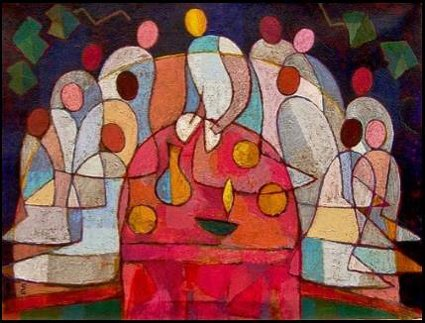
Art by Soiche Watanabe

We can no more spiritually live without taking Jesus into us, as we could live without eating on a regular basis. Christ is our breakfast, lunch, and dinner; our midnight snack and our birthday cake. Jesus is all that, and more.

Perhaps you are wondering why Jesus didn’t just state plainly who he is, why he came, and what will happen. Because it’s too much to handle.

We don’t simply accept Jesus into our heart, and then go on our merry way. Jesus Christ is someone to search for and discover, as if we were looking for fresh water or for the best baguette in the world.

Anyone can affirm a few belief statements, or do some good deeds. But it takes real courage to go hard after the spiritual life and find out what it’s all about:

It requires some solid bravery to explore the depths of your own true self and face the internal crud that’s been hiding in the shadows of your soul.

It demands identifying the bogus ways we prop up a false self for others to see – wanting to control how people view us and treat us.

It takes some real chutzpah to pursue the God life without worrying about where it will take you or who it will upset.

Jesus is a force to contend with. He is the Son of God, sent from above, to provide the world with real spiritual food and drink. Christ is the one who sustains life, and makes abundance possible. He is the Lord who speaks, calls out, and draws us to himself.

Jesus Christ helps us fit, even though we come from the island of misfit toys.

Even more pertinent than the question of “Who is Jesus?” is the probing question, “And what will you do with him?”

Christ cannot fit into your neat theological system, your tidy doctrinal statements, and on your nicely cleaned coffee table within the attractive Bible. Sooner or later, we all must contend with the divine force which gives life to everything. We cannot get away from him.

So, go after Jesus. Find out who he is. Determine how to deal with a mercy so powerful that it melts away guilt and shame as if it were in a 500 degree oven. After all, it’s better to have a tasty loaf of bread than to become a hard slice of burnt toast.

But let’s not worry about how hot it is in here, but how noisy it’s getting.

Gracious Lord, move us, your people, to experience your love more deeply. Fill us with the energy that comes from a desire for service. Connect us with creation to care for your world. Engage us in the scriptures and increase our knowledge of you. Raise up your power and come among us. May your bountiful grace and mercy equip us. Amen.

I Am the Bread of Life (John 6:35, 41-51)

Ethiopian Orthodox depiction of Jesus sharing with the disciples

Jesus said to them, “I am the bread of life. Whoever comes to me will never be hungry, and whoever believes in me will never be thirsty…

Then the Jews began to complain about him because he said, “I am the bread that came down from heaven.” They were saying, “Is not this Jesus, the son of Joseph, whose father and mother we know? How can he now say, ‘I have come down from heaven’?” 

Jesus answered them, “Do not complain among yourselves. No one can come to me unless drawn by the Father who sent me, and I will raise that person up on the last day. It is written in the prophets, ‘And they shall all be taught by God.’ Everyone who has heard and learned from the Father comes to me. Not that anyone has seen the Father except the one who is from God; he has seen the Father. Very truly, I tell you, whoever believes has eternal life. I am the bread of life. Your ancestors ate the manna in the wilderness, and they died. This is the bread that comes down from heaven, so that one may eat of it and not die. I am the living bread that came down from heaven. Whoever eats of this bread will live forever, and the bread that I will give for the life of the world is my flesh.” (New Revised Standard Version)

The lesson for today begins with the first of seven “I am” statements in John’s Gospel from Jesus:

  1. “I am the bread of life. Whoever comes to me will never be hungry, and whoever believes in me will never be thirsty.” (John 6:35)
  2. “I am the light of the world. Whoever follows me will never walk in darkness but will have the light of life.” (John 8:12)
  3. “I am the gate. Whoever enters by me will be saved and will come in and go out and find pasture.” (John 10:9)
  4.  “I am the good shepherd. The good shepherd lays down his life for the sheep.” (John 10:11)
  5. “I am the resurrection and the life. Those who believe in me, even though they die, will live,and everyone who lives and believes in me will never die.” (John 11:25-26)
  6. “I am the way and the truth and the life. No one comes to the Father except through me.” (John 14:6)
  7. “I am the true vine, and my Father is the vine-grower. He removes every branch in me that bears no fruit. Every branch that bears fruit he prunes to make it bear more fruit. I am the vine.” (John 15:1-2)

Also, for the first time in the Gospel of John, the Jews are named and identified as the ones who cause conflict for Jesus. John, of course, did not mean every single Jew; he was referring chiefly to the Jewish religious establishment, the leaders. And even then, he, of course, was not making reference to every single rabbi or person in the ruling council.

It’s important to say that, because Jews throughout the centuries have had far too much persecution from Christians who think all Jews have it in for Jesus. So, please, exercise some plain common sense and basic human kindness when it comes to reading the New Testament Gospels; they are most definitely not anti-Semitic.

The religious leaders were taking issue with the claims of Jesus, his “I am” statement. They argued that Jesus was a plain ordinary Jew from a typical Jewish family. There’s no need, the authorities contended, for Jesus to think of himself any other way than a common Jew.

Instead of entertaining the complaint against him, Jesus pointed to God the Father. God initiated the action by sending Jesus; and takes action by drawing people to Jesus. And Christ does his part by raising those people up at the last day; and teaching them about God’s actions of deliverance.

When it comes to the earthly ministry of Jesus, seeing is believing, and hearing is learning. Trust what you see with Jesus; and believe it. Have faith in what you hear from Jesus; and learn from it.

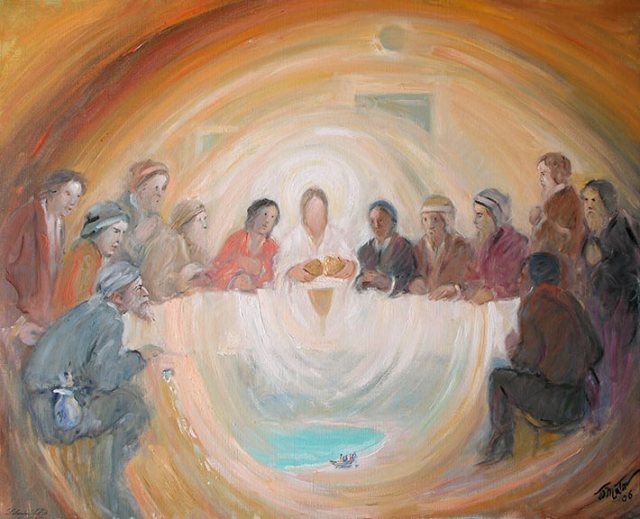
I Am the Bread of Life, by Joseph Matar

I like Jesus. I like metaphors. Jesus is a metaphor guy. I like that. Jesus said that he is the bread of life. Those who come to Jesus are satisfied. Those who eat him, live forever. This isn’t cannibalism, it’s a metaphor. The bread that Jesus gives for the life of the world is his flesh.

Metaphors help us relate to the concept, and grasp the message. If you’re hungry, just looking at a loaf of bread isn’t going to help you be satisfied. Obviously, you have to eat the bread and do more than see it, smell it, and touch it.

What’s more, people do more than eat once. We eat repeatedly, every day, at least a few times a day, in order to be healthy and alive.

Come and see Jesus. But do more than that. Ingest him. Take Jesus into your life. Let the bread of life come into you and thoroughly satisfy you. And do it every day. Do it several times a day. Make sure your soul is continually full of Jesus.

Then, you will have life to the full, an abundant life, filled with good things and right relationships.

Jesus is the bread of life. He is the great “I am.” And so much more.

Yet, perhaps at first glance, Jesus is just one person amongst a panoply of historical characters and religious figures. However, if we will but taste Jesus, we will come to see something very different about him. He’s more than a human being, more than a compelling teacher, and more than a miracle worker.

Jesus may appear, to many, as nothing more than a common person. But there’s really nothing ordinary about him, at all. Taking the time to have a good look at the Gospel of John, and watching Jesus move from village to village, and person to person will help us see a rather uncommon person who was no ordinary human being.

He moved to the beat of a different drum, and danced an alternative jig. And if we observe more closely, we can see the other two dance partners with him.

And with our two ears, when he says, “I am,” we can respond with an emphatic, “He is.”

Merciful Father, you heard the prayers of your people in the wilderness and fed them bread from heaven despite their sin. Graciously hear us today and feed us, too, with the Bread of Life from heaven, our Lord Jesus Christ, who lives and reigns with you and the Holy Spirit, one God, now and forever. Amen.

Listen Carefully (Mark 4:21-25)

Jesus went on: “Does anyone bring a lamp home and put it under a bucket or beneath the bed? Don’t you put it up on a table or on the mantel? We’re not keeping secrets, we’re telling them; we’re not hiding things, we’re bringing them out into the open.

“Are you listening to this? Really listening?

“Listen carefully to what I am saying—and be wary of the shrewd advice that tells you how to get ahead in the world on your own. Giving, not getting, is the way. Generosity begets generosity. Stinginess impoverishes.” (The Message)

Karma is a word from Hinduism which refers to the sum of a person’s actions in this life and previous states of existence, viewed as deciding their fate in the future. Contemporary Western society has picked up on this and uses the word in reference to a more universal reality.

The proverbial wisdom is that we typically get what we deserve by receiving exactly from others what we give to them in this life.

Jesus let us know that the way we treat others is the way we ourselves will be treated. A generosity of spirit toward one’s fellow humanity will come back in a similar way; and a stingy or miserly spirit will also be returned in kind. It’s a basic reality that we tend to receive what we give.

Every person has the capacity to elevate humanity, because people tend to live up to how they are being treated. What’s more, the initiator of basic human kindness and benevolence will find themselves receiving back much more than they put into it.

Now please understand that this is not some sort of ironclad law of the universe. If I give a dollar to someone, I won’t automatically get two dollars back later. If someone scratches your back, you may not be able to scratch theirs. The idea is rather that – all things being equal – if we live a wise and good life, full of giving and generosity – we will most likely not become destitute and in want.

That’s why classic movies, such as A Wonderful Life, resonate deeply with us. George Bailey went through a very trying time in his life when his business was in a pinch. But his way of living was above board and he freely lent to others, even when things were tough.

In the end, George experienced a rich encounter of his neighbors coming together to help, in the family’s time of need. George had been making a huge difference all along, and he never really knew how impactful it all was, until an angel imaginatively revealed it to him.

There is nothing that is truly hidden; all things shall be disclosed. Nor is anything really a secret; everything will come to light.

Jesus gave to his disciples (and to us) the secret of God’s rule and reign on this earth. Therefore, no one is to be complacent, rest on their laurels, or go about life with a “meh” sort of attitude. We must pay attention to the insight we’ve been given; and act on it.

God’s benevolent kingdom will be successful and have its way in this world. Although the Lord’s ethical agenda shall ultimately win out, there yet remains dark forces which temporarily oppose this good divine plan.

It’s important to be patient, and to persevere in doing good. We will see a harvest of righteousness if we don’t give up. So, keep on having a generous spirit of merciful giving. Keep going with living a humble and pure life. Continue on the path of justice and righteousness.

Whenever we encounter opposition, even persecution, or when evil appears to be having the day, don’t be discouraged. This is all part of the life and ministry to which we are called. We get up in the morning, keep planting gospel seeds of grace, and understand that it is God who gives the growth and the harvest.

Road to Emmaus, by Robert Zünd, 1877

Freely give, as freely as you have received. With the mercy and love shown to you, pass it on to others. As you become filled to the full, with the life of Christ, allow this to spill over onto others who are in need of comfort, encouragement, forgiveness, reconciliation, and hope.

Specifically, Jesus is the revealer of mysteries. In Christ, that which was hidden is now revealed; the secret things of God are on full display in the person and work of Jesus Christ.

Jesus is hope and life. Folks place faith in him, and are shown how to love and navigate this world according to the divine agenda. The magnanimous and generous spirit of Jesus Christ changes the world. The waves and ripples of his life and work are still filling the world.

In this present evil age, we have everything we need for life and godliness – because of Jesus.

I am wondering about us, about you and me. We are relational creatures, created by a good God in God’s very own image. The Lord has gone out of the way to create a divine/human connection that is supremely good, life-giving, and enjoyable.

Yet, all of us, in one way or another, have searched in all sorts of places, in vain, for the love which has been right there in front of us the entire time.

Jesus is the Light of the world, the Bread of life, the Good Shepherd, Living Water, and Savior of the world. And he is waiting patiently – to be the light at the end of the tunnel, the spiritual sustainer, the loving guide, and the deliverer from anything and everything that hinders your ability to be truly alive.

The Lord longs to be generous to us. Yet, you and I must be willing to receive, to hold out our open hands and take what God gives us. Our ears need to be open for listening to what the Lord is saying.

If our ears, hands, and hearts are open to others, there is a very good chance that God will be open to us. It isn’t necessarily karma; it’s just the way things are in the gracious and benevolent kingdom of God.

Oh God, our loving Creator and Giver of all good gifts, bless all churches and communities of faith; strengthen our faith and grant us the spirit of Christian stewardship so that we may give generously of our time, talent and treasure to spread your benevolent kingdom here and throughout the world; through Jesus Christ our Lord, in the power of the Holy Spirit. Amen.