Pass Along Values (1 Kings 2:1-11)

David’s Dying Charge to Solomon, by Ferdinand Bol (1616-1680)

David’s time was coming to an end. So he commanded Solomon his son, “I’m following the path that the whole earth takes. Be strong and be a man. Guard what is owed to the Lord your God, walking in his ways and observing his laws, his commands, his judgments, and his testimonies, just as it is written in the Instruction from Moses.

“In this way you will succeed in whatever you do and wherever you go. So also the Lord will confirm the word he spoke to me: ‘If your children will take care to walk before me faithfully, with all their heart and all their being, then one of your own children will never fail to be on the throne of Israel.’ 

You should know what Joab, Zeruiah’s son, has done to me and what he did to the two generals of Israel, Abner, Ner’s son, and Amasa, Jether’s son. He murdered them, spilling blood at peacetime and putting the blood of war on the belt around his waist and on the sandals on his feet. So act wisely: Don’t allow him to die a peaceful death. 

“As for Barzillai’s sons from Gilead, show them kindness. Let them eat with you. When I was running away from your brother Absalom, they came to me. 

“Now as for this Shimei, Gera’s son—a Benjaminite from Bahurim—who is with you, he cursed me viciously when I went to Mahanaim. When he came down to meet me at the Jordan, I swore to him by the Lord, ‘Surely I won’t execute you with the sword.’ But you don’t need to excuse him. You are wise and know what to do to him. Give him a violent death.”

Then David lay down with his ancestors and was buried in David’s City. He ruled over Israel forty years—seven years in Hebron and thirty-three years in Jerusalem. (Common English Bible)

David

On David’s deathbed, he ensured that his son Solomon would be king. And David had some pragmatic advice to pass along, before he himself passed away.

Along with an encouragement to remain faithful to God’s covenant stipulations, David communicated some personal scores to Solomon that needed to be settled. Old general Joab, as well as Shimei, a servant from Saul’s old house, were threats to the new king’s reign in Israel and Judah.

Joab and Shimei

King David had a complicated relationship with Joab. At issue for David was the murder of two opponents to the king. Joab had killed them in a time of peace, and not because of a wartime situation.

On top of that, Joab had thrown his lot in with Adonijah, Solomon’s half-brother, who had tried to wriggle onto the throne before David was even gone.

And then there was the character Shimei. He had cursed David repeatedly when yet another half-brother to Solomon, Absalom, engaged in a coup attempt against his father.

Once the threat had passed, Shimei made a quick about face back to David. The king told Shimei that he would not kill him. But with Solomon, David communicated that he was completely free to do what needed to be done with the old rascal Shimei.

Fathers

Ideally, all fathers would have the chance to communicate to their children at the end of their lives. Yet, having been at the bedside of many a father in my work as a hospital chaplain, I’ve not seen many who pass along wisdom and instructions on their deathbed.

Fortunately, there are times when I can help facilitate the conversation between father and family. Yet, unfortunately, there are far too many times when fathers simply die with no loved ones present; or they badger someone to promise to stop doing something.

Rare, however, are the experiences of expressing some sound instruction, along with instructions about how to deal with life.

I realize that wills and documents do much of this work nowadays, yet I still argue that face-to-face communication which reinforces one’s values is always a good idea – especially at the end of one’s life.

Honestly, nobody really needs to wait until they are nearly gone to communicate important values and sage advice to loved ones. It can be done now, before it’s too late.

I’m talking about more than healthcare decisions for the actual end of life situation – but about the grace, forgiveness, wisdom, and/or moral values one wants their loved ones to know; or to reinforce those things that are of upmost importance.

It seems to me that thinking through the following values, and how to communicate them, can be done now, and, if appropriate and possible, at the end of one’s life:

Empathy

Treat others with compassion and understanding. Practice kindness. Consider the emotions of others. Seek to understand another’s point of view. Encourage family members to talk about their feelings. 

Therefore, as God’s choice, holy and loved, put on compassion, kindness, humility, gentleness, and patience. (Colossians 3:12, CEB)

Relationships

In the end, the only thing permanent and enduring is relationships. We cannot take any of our stuff with us. Prioritize time with people, especially family. It only makes sense to value loved ones by putting our time into them.

Be happy with those who are happy, and cry with those who are crying. Consider everyone as equal, and don’t think that you’re better than anyone else. (Romans 12:15-16, CEB)

Honesty

Telling the truth is not always easy, but it’s essential to maintaining trust between people. Life requires knowing and living by the truth.

“You are truly my disciples if you remain faithful to my teaching. Then you will know the truth, and the truth will set you free.” (John 8:31-32, CEB)

Love

Deep affection and attachment connects people and keeps them together. It’s important to verbally express love, as well as to demonstrate it with actions.

Don’t be in debt to anyone, except for the obligation to love each other. Whoever loves another person has fulfilled the Law. (Romans 13:8, CEB)

Commitment

Support one another in difficult times; and do not intentionally harm each other. Don’t shame your family for mistakes they’ve made. Instead, express loyalty and encouragement.

Be the best in this work of grace in the same way that you are the best in everything, such as faith, speech, knowledge, total commitment, and the love we inspired in you. (2 Corinthians 8:7, CEB)

Respect

Treat everyone, and especially family members, with the upmost care and politeness; and discourage disrespectful words and offensive behavior.

Submit to each other out of respect for Christ. (Ephesians 5:21, CEB)

Perseverance

Your family will face many complex challenges in the years ahead. Encourage them to embrace shared goals, practice self-care, and patiently work together in order to overcome obstacles. 

We even take pride in our problems, because we know that trouble produces endurance, endurance produces character, and character produces hope. (Romans 5:3-4, CEB)

It is always open season on passing along wise and good values, no matter whether it’s in a calm or a calamitous season of life.

Almighty God, enable me to be mindful of your mercy and happy to do your will. Bless my family with honest work, sound learning, and good manners. Save us all from violence, division, and confusion; and from pride and arrogance, and all evil. Protect us, and keep us united.

Grant Your wisdom to all in positions of authority and influence, so that there may be justice and peace at home, and obedience and submission everywhere. In times of prosperity, fill our hearts with grace and gratitude, and in times of trouble, help us trust in Your divine justice, righteousness, and goodness; through Jesus Christ our Lord. Amen. 

Who Do You Look To When Things Are Tough? (1 Samuel 9:1-14)

There was a Benjamite, a man of standing, whose name was Kish son of Abiel, the son of Zeror, the son of Bekorath, the son of Aphiah of Benjamin. Kish had a son named Saul, as handsome a young man as could be found anywhere in Israel, and he was a head taller than anyone else.

Now the donkeys belonging to Saul’s father Kish were lost, and Kish said to his son Saul, “Take one of the servants with you and go and look for the donkeys.” So he passed through the hill country of Ephraim and through the area around Shalisha, but they did not find them. They went on into the district of Shaalim, but the donkeys were not there. Then he passed through the territory of Benjamin, but they did not find them.

When they reached the district of Zuph, Saul said to the servant who was with him, “Come, let’s go back, or my father will stop thinking about the donkeys and start worrying about us.”

But the servant replied, “Look, in this town there is a man of God; he is highly respected, and everything he says comes true. Let’s go there now. Perhaps he will tell us what way to take.”

Saul said to his servant, “If we go, what can we give the man? The food in our sacks is gone. We have no gift to take to the man of God. What do we have?”

The servant answered him again. “Look,” he said, “I have a quarter of a shekel of silver. I will give it to the man of God so that he will tell us what way to take.” (Formerly in Israel, if someone went to inquire of God, they would say, “Come, let us go to the seer,” because the prophet of today used to be called a seer.)

“Good,” Saul said to his servant. “Come, let’s go.” So they set out for the town where the man of God was.

As they were going up the hill to the town, they met some young women coming out to draw water, and they asked them, “Is the seer here?”

“He is,” they answered. “He’s ahead of you. Hurry now; he has just come to our town today, for the people have a sacrifice at the high place. As soon as you enter the town, you will find him before he goes up to the high place to eat. The people will not begin eating until he comes, because he must bless the sacrifice; afterward, those who are invited will eat. Go up now; you should find him about this time.”

They went up to the town, and as they were entering it, there was Samuel, coming toward them on his way up to the high place. (New International Version)

“He who seeking asses, found a kingdom.”

John Milton, Paradise Regained

We are introduced to Saul, who eventually became the infamous first king of Israel. And he is described in almost a kingly sort of tone; his stature and pedigree are impressive. Saul looks the part of someone who could be important, do things, and go places.

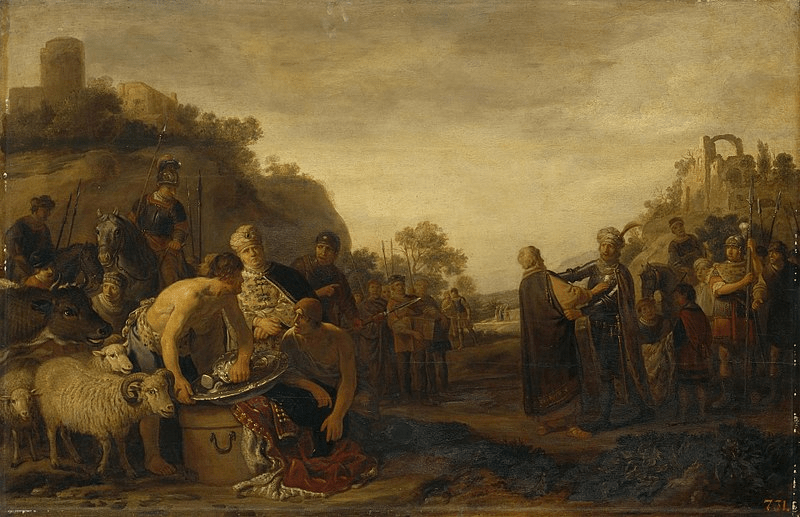
Samuel and Saul, by Dutch painter Claes Moeyaert (1592-1655)

In today’s story, we find Saul to be an obedient and responsible son, going out to find some lost donkeys. By all appearances, Saul was an upright, law-abiding, faithful Jew from the tribe of Benjamin. However, appearances can be rather deceitful. The outward presentation of someone is not always congruent with what is on the inside; and vice versa.

These were the days when Samuel the priest would make a circuit through the country. He made regular rounds as Israel’s judge. Saul and Samuel would encounter each other in a divine appointment. The contrast between the two of them would become ever more pronounced and obvious. But to the point at hand, Saul was simply out looking for some lost animals.

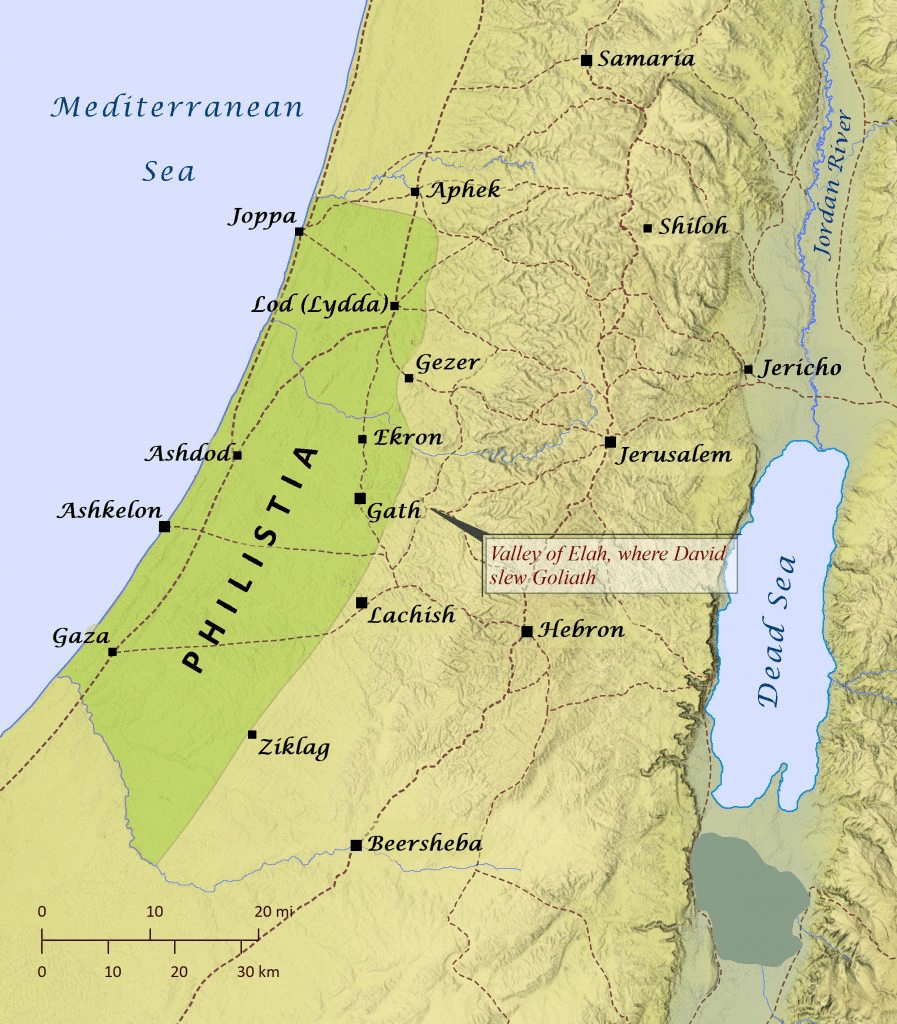
At that time, Israel was facing yet another Philistine military threat. The Philistines were not indigenous to Palestine. The Egyptians referred to them as “sea people;” they originally came from somewhere around the Aegean Sea area and settled in Canaan along the coastal plain between Gaza and Jaffa.

The Philistines expanded their territory, which continually put them at odds with Israel their neighbor. Militarily, the Israelites looked like bumpkins compared to the Philistines – who were skilled warriors with state of the art weapons.

Israel had no king. Instead, they were led by a series of judges who gave rulings throughout the land. Samuel was the last of them because the Israelite tribes determined and demanded that they must have a king in order to face the Philistine threat. (1 Samuel 8:1-21)

Samuel wisely perceived that asking for a king was not going to go well for the people. And he had warned them appropriately. Yet, Israel persisted in wanting to be like all the other nations in having a king to lead an army and fight Israel’s battles.

Although the people loved and appreciated the priest and prophet Samuel, his leadership was regarded as insufficient for the constant anxiety of dealing with the Philistines. It seems the people did not realize or consider what they were asking for, because they got it, and it wasn’t always victory and celebration.

If Israel wanted a king – and someone who looked the part – then that is exactly what they would receive. Saul was tall, strong, and seemed qualified to wage war on the pesky Philistines. Frankly, Saul was a putz who lacked the internal character needed to govern God’s people and ensure God’s will would be done in Israel.

But, again, I get ahead of myself. Reading the account of Saul for the first time, it’s easy for one to not see the signs of a coming personal implosion of the soul.

Sometimes whenever circumstances have been challenging for so long, and difficulty just keeps showing up, we begin to lose our good judgment and start wanting easy solutions for complex problems. And that is what I believe happened to Israel.

The Israelites got tired of the constant Philistine threat – to the point of believing that the grass is greener on the other side of the fence. They thought they needed a king and that everything would be better. And initially it was. But, over the long haul, it proved to be fatal.

For us today, it is good to remember that sound self-discipline through proven spiritual practices, and development of the soul by means of humility, patience, and wisdom, accomplish what is most needed in life.

Becoming weary and tired, we may slowly lose faith. Yet, the ability to persevere, stay the course, and listen well to wise people, can begin to erode and decay through the discouragement of constant adversity.

There is, however, a way to keep going when things are hard. Encourage one another daily. Avoid a critical spirit which drains the energy from others. Be careful who you listen to and take advice from. Become ever more familiar with Holy Scripture and that which is right, just, and good. Rely upon the Lord.

Living a faithful and devoted life to the divine covenant, instead succumbing to human culture, may not be easy; but it will serve us well in the long run.

Father of mercy, alone we have no power in ourselves to help ourselves. When we are discouraged by our weakness, strengthen us to follow Christ, our pattern and our hope; who lives and reigns with you and the Holy Spirit, one God, now and forever. Amen.

The Coming Divine Judgment (Revelation 20:7-15)

Lake of Fire, by David Howard Hitchcock, 1888

When the thousand years are over, Satan will be released from his prison and will go out to deceive the nations in the four corners of the earth—Gog and Magog—and to gather them for battle. In number they are like the sand on the seashore. They marched across the breadth of the earth and surrounded the camp of God’s people, the city he loves. But fire came down from heaven and devoured them. And the devil, who deceived them, was thrown into the lake of burning sulfur, where the beast and the false prophet had been thrown. They will be tormented day and night for ever and ever.

Then I saw a great white throne, and he who was seated on it. The earth and the heavens fled from his presence, and there was no place for them. And I saw the dead, great and small, standing before the throne, and books were opened. Another book was opened, which is the book of life. The dead were judged according to what they had done as recorded in the books. The sea gave up the dead that were in it, and death and Hades gave up the dead that were in them, and each person was judged according to what they had done. Then death and Hades were thrown into the lake of fire. The lake of fire is the second death. Anyone whose name was not found written in the book of life was thrown into the lake of fire. (New International Version)

Almost everything is temporary. All things temporal must come to an end. Therefore, it is foolish to live as if everything we have will last forever.

Conversely, there are a few things which are permanent, namely, God and relationships. So, it only makes sense that we exist for values that will last, while holding very loosely the temporal things. Jesus put the matter like this:

“Do not store up for yourselves treasures on earth, where moths and vermin destroy, and where thieves break in and steal. But store up for yourselves treasures in heaven, where moths and vermin do not destroy, and where thieves do not break in and steal. For where your treasure is, there your heart will be also. (Matthew 6:19-21, NIV)

Yet, despite knowing this, people struggle with their espoused values. Many times, we succumb to the temporal as if it were permanent; and with permanence the things which are temporary. This situation speaks to the power of evil; and evil is not something to trifle with.

Just when we might evil is contained, it isn’t. In today’s lesson, Satan is loosed from his imprisonment, still a threat. That is the nature of evil amongst us; it has the sinister capacity to rebound and wreak havoc in people’s lives.

In the Apostle John’s apocalyptic vision, Satan is joined by Gog and Magog, who represent the nations of the earth. This hearkens back to the prophecy of Ezekiel in the Old Testament (Ezekiel 38-39) in which Gog – the leader of the land of Magog – leads an attack on Jerusalem. In other words, evil comes together and focuses its energies on the people of God in order to destroy them.

However, God intervenes; the destruction the nations intended on God’s people comes upon them. Evil is finally done for, once and for all; it is thoroughly purged from the presence of the righteous.

With evil put in its place, there is nowhere for the old rebellious systems and order of things to exist anymore. A new heaven and a new earth is needed – not just a reconstituted heaven and earth – because that’s how nasty evil really is, that it must be completely purged. New systems are put in place which can accommodate righteousness. Jesus predicted this new reality:

And no one pours new wine into old wineskins. Otherwise, the new wine will burst the skins; the wine will run out and the wineskins will be ruined. No, new wine must be poured into new wineskins.  (Luke 5:37-38, NIV)

When the time comes, all persons will stand as they truly are before the Lord. There can be no making oneself look better than they are, or presenting a particular optic that spins a good look in order to impress. All the actions and deeds of people are laid bare.

God’s grace, along with and human actions, are held together in tension. God grants salvation; and what we humans do with that gift matters a great deal.

Humanity’s works in this life demonstrate what sort of person they actually are. So, if those works are inconsistent and incongruent with how one’s life has been lived, it demonstrates where their hearts truly are; and where their final destination will be.

There is a coming judgment in which death and hell are done away with forever. Anyone whose name is not found in the Book of Life goes the way of death and hell, because when they had the chance to use their temporal life to give permanent life for others, they did not.

The point is not to try and determine who Gog and Magog are; or when in the future this all will happen. The sage person remains far away from such useless folly.

The aim of the Apostle John, for which we must pay attention, is twofold: encourage the faithful; and warn the unfaithful.

The Book of Revelation was given to believers in Jesus, to help them see that suffering, persecution, and hardship is temporary; remain faithful, persevere in faith, and you will see your name written in the Book of Life.

Revelation was also given as great warning sign to those who have put so much stock into power politics, jostling for authority, and oppressing others to get what they want. The positions they hold now are temporary. The oppression they give in this life will be what they receive in the next.

In the end, all things shall be judged rightly. In this, I take great comfort and hope.

Lord Jesus Christ, by your patience in suffering you hallowed earthly pain and gave us the example of obedience to your Father’s will: Be near me in my time of weakness and pain; sustain me by your grace, that my strength and courage may not fail; heal me according to you will; and help me always to believe that what happens to me here is of little account if you hold me in eternal life, my Lord and my God. Amen.

Listen Carefully (Mark 4:21-25)

Jesus went on: “Does anyone bring a lamp home and put it under a bucket or beneath the bed? Don’t you put it up on a table or on the mantel? We’re not keeping secrets, we’re telling them; we’re not hiding things, we’re bringing them out into the open.

“Are you listening to this? Really listening?

“Listen carefully to what I am saying—and be wary of the shrewd advice that tells you how to get ahead in the world on your own. Giving, not getting, is the way. Generosity begets generosity. Stinginess impoverishes.” (The Message)

Karma is a word from Hinduism which refers to the sum of a person’s actions in this life and previous states of existence, viewed as deciding their fate in the future. Contemporary Western society has picked up on this and uses the word in reference to a more universal reality.

The proverbial wisdom is that we typically get what we deserve by receiving exactly from others what we give to them in this life.

Jesus let us know that the way we treat others is the way we ourselves will be treated. A generosity of spirit toward one’s fellow humanity will come back in a similar way; and a stingy or miserly spirit will also be returned in kind. It’s a basic reality that we tend to receive what we give.

Every person has the capacity to elevate humanity, because people tend to live up to how they are being treated. What’s more, the initiator of basic human kindness and benevolence will find themselves receiving back much more than they put into it.

Now please understand that this is not some sort of ironclad law of the universe. If I give a dollar to someone, I won’t automatically get two dollars back later. If someone scratches your back, you may not be able to scratch theirs. The idea is rather that – all things being equal – if we live a wise and good life, full of giving and generosity – we will most likely not become destitute and in want.

That’s why classic movies, such as A Wonderful Life, resonate deeply with us. George Bailey went through a very trying time in his life when his business was in a pinch. But his way of living was above board and he freely lent to others, even when things were tough.

In the end, George experienced a rich encounter of his neighbors coming together to help, in the family’s time of need. George had been making a huge difference all along, and he never really knew how impactful it all was, until an angel imaginatively revealed it to him.

There is nothing that is truly hidden; all things shall be disclosed. Nor is anything really a secret; everything will come to light.

Jesus gave to his disciples (and to us) the secret of God’s rule and reign on this earth. Therefore, no one is to be complacent, rest on their laurels, or go about life with a “meh” sort of attitude. We must pay attention to the insight we’ve been given; and act on it.

God’s benevolent kingdom will be successful and have its way in this world. Although the Lord’s ethical agenda shall ultimately win out, there yet remains dark forces which temporarily oppose this good divine plan.

It’s important to be patient, and to persevere in doing good. We will see a harvest of righteousness if we don’t give up. So, keep on having a generous spirit of merciful giving. Keep going with living a humble and pure life. Continue on the path of justice and righteousness.

Whenever we encounter opposition, even persecution, or when evil appears to be having the day, don’t be discouraged. This is all part of the life and ministry to which we are called. We get up in the morning, keep planting gospel seeds of grace, and understand that it is God who gives the growth and the harvest.

Road to Emmaus, by Robert Zünd, 1877

Freely give, as freely as you have received. With the mercy and love shown to you, pass it on to others. As you become filled to the full, with the life of Christ, allow this to spill over onto others who are in need of comfort, encouragement, forgiveness, reconciliation, and hope.

Specifically, Jesus is the revealer of mysteries. In Christ, that which was hidden is now revealed; the secret things of God are on full display in the person and work of Jesus Christ.

Jesus is hope and life. Folks place faith in him, and are shown how to love and navigate this world according to the divine agenda. The magnanimous and generous spirit of Jesus Christ changes the world. The waves and ripples of his life and work are still filling the world.

In this present evil age, we have everything we need for life and godliness – because of Jesus.

I am wondering about us, about you and me. We are relational creatures, created by a good God in God’s very own image. The Lord has gone out of the way to create a divine/human connection that is supremely good, life-giving, and enjoyable.

Yet, all of us, in one way or another, have searched in all sorts of places, in vain, for the love which has been right there in front of us the entire time.

Jesus is the Light of the world, the Bread of life, the Good Shepherd, Living Water, and Savior of the world. And he is waiting patiently – to be the light at the end of the tunnel, the spiritual sustainer, the loving guide, and the deliverer from anything and everything that hinders your ability to be truly alive.

The Lord longs to be generous to us. Yet, you and I must be willing to receive, to hold out our open hands and take what God gives us. Our ears need to be open for listening to what the Lord is saying.

If our ears, hands, and hearts are open to others, there is a very good chance that God will be open to us. It isn’t necessarily karma; it’s just the way things are in the gracious and benevolent kingdom of God.

Oh God, our loving Creator and Giver of all good gifts, bless all churches and communities of faith; strengthen our faith and grant us the spirit of Christian stewardship so that we may give generously of our time, talent and treasure to spread your benevolent kingdom here and throughout the world; through Jesus Christ our Lord, in the power of the Holy Spirit. Amen.