Pentecost: Where We Want to Be, and Where We Are

We know that the whole creation has been groaning as in the pains of childbirth right up to the present time. Not only so, but we ourselves, who have the first-fruits of the Spirit, groan inwardly as we wait eagerly for our adoption to sonship, the redemption of our bodies. For in this hope, we were saved. But hope that is seen is no hope at all. Who hopes for what they already have? But if we hope for what we do not yet have, we wait for it patiently.

In the same way, the Spirit helps us in our weakness. We do not know what we ought to pray for, but the Spirit himself intercedes for us through wordless groans. And he who searches our hearts knows the mind of the Spirit, because the Spirit intercedes for God’s people in accordance with the will of God. (Romans 8:22-27, NIV)

Pentecostal Groanings

“Pentecost” is the Latin word for “fifty.” Each year, fifty days after Easter, Christians celebrate the Holy Spirit coming upon the early church with power. This Pentecostal energy is not just dynamite with an explosion of spiritual gifts and energizing ministry. Spiritual power certainly is and can be optimistic, positive, and full of faith. 

More than that, Holy Spirit power can also be found in the travails and tribulations we face. It can be discovered in the dark night of the soul, in times of loneliness and doubt, and in the constant need for prayerful intercession. The Spirit is both a mighty wind and a gentle breeze.

The good news of Pentecost is that when we are not powerful, the Spirit helps us in our weakness – that is our hope and our quiet strength. The Apostle Paul used the experience of childbirth to communicate and illustrate what the experience of the Christian life is like. Growth, wonder, expectation, hope, patience, pain, and joy are all words to describe pregnancy and childbirth. 

Pentecostal Prayer

When it comes to the Church and the Christian life, believers are in the gestation period. Our salvation has not yet come to full term. Meanwhile, we must remain encouraged and healthy, keeping our future hope always in front of us so that we will not lose heart. When we are limited in what we can do, we pray. When we are flat on our backs, overwhelmed with our circumstances, we may not be able to utter any words in prayer.

My dear wife and I know something about pregnancy and prayer. We did not know, twenty-six years ago, whether we would have our third child, or not. Our lives were turned upside-down for nearly four months, as we did everything possible to deal with an overwhelming situation, not knowing if our little peanut of a daughter was going to live or die in the womb.

Pentecostal Patience

We had to wait. We had to force patience on ourselves. It really was a life and death situation. As Christians, we are waiting for our complete redemption. If we are not patient and do not focus on our hope, we will not make it. 

To be sure, in difficult times it does no good to be like Eeyore and feel sorry for ourselves. Yet, on the other hand, it equally does no one any good to always be smiling, positive, and upbeat as if nothing is worth grieving over. To take such a posture toward the awful challenges of life is to, at best, ignore the power of lament, and, at worst, live in abject denial about what our true situation really is with all its weakness and inability to control most of what is going on.

In the teeth of adverse circumstances, enter God in the person of the Holy Spirit. The Spirit resides with us and strengthens us with Pentecostal power. So, on this Day of Pentecost, we not only celebrate the Spirit’s mighty power to blow a violent wind and upturn history; we also proclaim and praise the Spirit’s power to come alongside and provide the deep inner strength necessary to fortify us for all we must face.

Pentecostal Awkwardness

We cannot run away from what God has put in front of us. We live in an awkward time of spiritual pregnancy in which we possess salvation but do not yet possess it in all its fullness. There is so much groaning going on because we realize there is such a large gap between where we are and where we want to be.  If women could have babies without nine months of struggle, limitation, and pain, I think they would opt for that instead of the way it is now (I know I would!).

All of creation groans because where it is now and where it will be seems like such a long time in coming.  Every creature and all living things are presently experiencing decay and death. The earth is not yet redeemed from its cursed bondage. So, the planet convulses and contracts with natural disasters and diseases because we live in a fallen world that is not yet redeemed.

People groan because they fall victim to circumstances beyond their control. We also groan because of our own poor choices which grieve us. Although we have been delivered from sin, death, and hell, and experience spiritual power, we still must wait eagerly for the redemption of our bodies. 

We are keenly aware of the terrible disconnect between where we are as people and where we want to be. It feels like Pinocchio, who is not yet a real boy, and must deal with strings and other puppeteers who don’t care about him, who feels the need to lie because of his situation and pays the consequences of his nose growing.

But we are not left to fend for ourselves. Because the Spirit groans on our behalf, uttering prayerful sounds that words cannot express. The Spirit helps us in our weakness, in our pregnant state of discomfort and wondering. 

The Holy Spirit is an expert on knowing our concerns, knowing God’s will, and bringing the two in harmony with each other.

Mit Tdrahrhe

Pentecostal Hope

So, we focus on hope – the confident expectation we will not always be in this position. In the meantime, we learn to enjoy the process of growing in the Lord and discovering the ways of Jesus. We learn to slow down to listen to the gentle voice and the refreshing breeze of the Spirit. During this interim time, this gestation period, we develop new rhythms of life, moving back-and-forth between rejoicing and groaning; praising and grieving; hoping and lamenting; believing and doubting – all with agonizing patience.

Living patiently and hopefully in the Christian life will be worth it all when we see Jesus. We must walk through the valley; yet we never do it alone – God’s presence is with us in the personal provision of the Holy Spirit.

Do not give up in prayer. Even if you do not know what to say or cannot even speak, you can groan because the Spirit will pick up those groans and groan them in the ear of our gracious heavenly Father. The Holy Spirit stands in the gap between where we are and where we need to be. The Spirit intercedes for us, bridging that wide chasm, and bringing us practical deliverance from our impatience.

One of the oldest definitions of prayer is this: Lifting mind and heart to God. Too often in our efforts to pray formally, we fail to truly lift our hearts and minds to God. That’s because what is really in our hearts and minds is not something we generally connect with prayer, at all. Our frustrations, bitterness, jealousies, lusts, curses, sloth, and quiet despair are sometimes understood to be the opposite of prayer, as if they are things overcome so that we can pray.

Pentecostal Power

However, something deeper is happening within: Our frustrations, longings, lusts, jealousies, and escapist daydreams, the things we are fearful and ashamed to name in prayer, are in fact already lifting our hearts and minds to God in more honest ways than we ever do consciously.

If you are carrying a heavy burden, take the light yoke of Jesus and offload your worries to the Holy Spirit who is waiting to intercede for you. And if there is no immediate relief, persevere in prayer without giving up. Pentecostal power is available, but it is not cheap; it will cost us time in prayer as well as patience for the Spirit to work on our behalf. For the Christian life is a lifelong process of becoming.

Come, Holy Spirit, fill our hearts. Kindle within us the fire of your love. Send the gentle breeze of your Spirit, and we shall be renewed into patient people, growing in the grace and knowledge of our Lord Jesus Christ. Spirit of the living God, we invite you to wring the death out of our hearts and saturate our souls with your breath and life.  Hoping against all hope we lay defeat aside. We grab for the corner of your cloak and wait for a miracle. Amen.

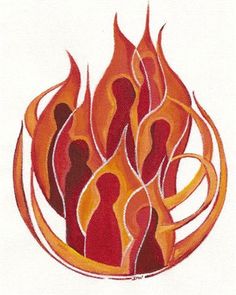
*Above artwork by Rebecca Brogan

What Pentecost Means for Us

Pentecost

The Holy Spirit is the distinguishing mark of the believer in Jesus Christ. Christians are given the Spirit.  Therefore, our main responsibility as Christians is to receive. Christianity is distinctive in this sense – it is primarily a religion of receiving. The Christian life is lived by the power of the Holy Spirit, and not in our own strength. The function of faith is to receive what grace offers. We are saved and sanctified by grace alone through faith. God lives in and through us by means of the Spirit. The miraculous and the supernatural cannot be done by any human person. It can, however, be accomplished through the power of the Holy Spirit.

We may put a lot of pressure on ourselves to be a certain way and to do certain things. The result is that we are tired. Every time we catch our breath, someone else needs something else. Yet, what if Christianity is not chiefly about giving, but about receiving? What if the Christian life was about putting ourselves in a position to receive through prayer and humility? The opposite of receiving is not giving – it is pride.

Maybe this kind of talk causes some uncomfortable feelings with you. This is no adventure into passivity or laziness. This is about receiving grace from God by means of the Holy Spirit and allowing God the Spirit to work in and through us to the glory of Christ. Jesus said we would do greater works than even he himself with the advent of the Spirit! (John 14:12-14). The question then becomes: Will we let God be God? Will we participate with God, and allow the Spirit to work? Will we petition God and let him do whatever he wants to do in and through us?

The Spirit is elsewhere in Scripture described as a gentle and encouraging presence, a counselor and comforter. Yet, not at Pentecost – the Spirit is portrayed like wind and fire (Acts 2:1-21). Neither a gentle breeze, nor a warm campfire – instead, a violent presence! The Holy Spirit on the Day of Pentecost was not some gentleman caller entering politely when invited. Rather, the Spirit appears more like a drunken sailor who bursts into the room and causes and big ruckus. There is nothing subtle about the Spirit at Pentecost. The Spirit is electric and volcanic, causing a huge upheaval. This is a big God with a big Word looking to expand out into a big world.

Pentecost

Because of Pentecost, believers are marked by God’s Spirit. The life of God within them is the life of the Spirit. God wants to pour out the Spirit on all kinds of people. He wants to fill people to overflowing so that what comes out of them is “prophecy.” That is, inspired speech and words coming from a spiritual heart full of the Spirit. Just as an inebriated person says and does things he/she would not typically say or do because they are filled with alcohol, so the person filled with God’s Spirit says things and does things that they would not typically say or do because their inspiration and courage do not come from themselves but is a result of God within them.

God transformed the little band of Christ followers from learners, to practitioners sent out with a mission.  Being on a mission from God is not so much about ability; it is about being filled and sent.  First time parents may read and learn all they can about parenting before their child is born. Yet, when that little bundle comes into the world and the hospital puts this kid in your arms and sends you out, you feel inadequate for the task.  Parenting becomes a kind of supernatural affair where you pray and learn on the fly, finding out that you need something beyond yourself to get anywhere in raising this screaming, pooping, sleeping person who depends completely on you for everything.

God has sent us into the world to make disciples and we may feel largely inadequate for the task. However, this has more to do with receiving the Spirit. The Spirit comes looking to turn our lives upside-down with new life in Jesus Christ.

Pentecost means the Spirit has come to shake things up and accomplish among God’s people what they could never do on their own. The church in the New Testament was not a country club for people to simply enjoy the perks of membership. The church in Acts 2 is more like a place where the people seem drunk because they are all talking with inspired speech from the Holy Spirit.

Everyone who calls on the name of the Lord will be saved. Maybe we do not need to be saved in the sense that we have already called on the name of the Lord concerning forgiveness of sins in Christ. Yet, maybe we need to call on the name of the Lord to be delivered from our misguided attempts to see the Christian life as a pleasant affair. Perhaps we need deliverance from disordered priorities and misguided loves. We may need to be saved from ourselves so that we are open to the Holy Spirit with palms up receiving from him whatever it is he wants to do in and through us, rather than telling God what we think he needs to do. Prayer, then, is more about receiving the Spirit and God’s purposes for us rather than giving God an earful and expecting him to buy into our plans.

Pentecost is the launching pad of the church’s mission – it was explosive because the Spirit is a kind of wild man who fills people up to overflowing with himself so that what comes out of them is inspired speech and missional actions.  If a language barrier cannot stop the Spirit from operating, then how much more can God transform us and use us in the lives of those around us?

0bab4-pentecost

How we interpret events is important. Peter interpreted the believers of Jesus speaking different languages as the outpouring of the Spirit. This outpouring of the Spirit is a sign that the end is near. This giving of the Spirit will be inclusive – there is room for all kinds of people. And, through the Spirit, God will save all who call on his name.  The way we interpret events is based upon what kind of relationships we have. Peter had a relationship with God that caused him to go constantly to prayer so that when the Spirit showed up, he interpreted that God was up to something.

Next week my wife and I will celebrate 35 years of marriage. How I interpret my anniversary is based upon what kind of relationship I have with my wife. A good relationship means that it will be a day of celebration and joy with the anticipation of more years together. A bad relationship would bring an interpretation of the day with anger or regret. If there is a bland relationship in which two people are married but just live under the same roof, then it is just another anniversary and there is no regret, but also no celebration or any anticipation of the future – it just is another day.

This is not just another day. It is Pentecost! Just as marriages occasionally need a spark and a fire and a fresh wind, so we need the Holy Spirit to breathe on us because God wants to do something within us that results in the church becoming afire with mission! How we interpret this day of Pentecost says a lot about our relationship to Jesus Christ. How we spend our day today says a lot about how we interpret the Holy Spirit in our lives. Let us be filled with the Spirit and with joy as we anticipate what our God will do now, and in the years to come.

1 Corinthians 12:12-27 – The Same Spirit

20180522_133138

“The body of Christ has many different parts, just as any other body does.  Some of us are Jews, and others are Gentiles. Some of us are slaves, and others are free. But God’s Spirit baptized each of us and made us part of the body of Christ. Now we each drink from that same Spirit.” (Contemporary English Version)

As you well know, it’s easy to take things for granted.  For instance, we don’t typically think too much about our toes… until we stub them, drop something on them, break them, or need a podiatrist to operate on them.  Then, we not only know they’re still there, but our entire body (along with the mind and emotions!) feels the need to give a lot of attention to lowest end of our body that enables us to stand and walk without thinking much about it.

The body is an apt metaphor for how to think about humanity and its various systems and institutions.  We might see the face of any church or organization, but there are scads of people behind the scenes doing all kinds of good work.  For example, the golfing profession understands the importance of caddies; lawyers know the need of paralegal persons; healthcare facilities and organizations rely not only on nurses and social workers, but also on cooks and housekeepers; schools need the coordination of teachers, parents, students, volunteers, and the entire community to effectively realize the education of children.

Also, as you well know, it’s easy to take for granted services we receive… until we don’t receive them, or in a way to our liking.  Then, we pay attention.  We want action and resolution.  We want our food now and to our exact specifications.  Sometimes we might even forget that we are dealing with people, not cogs in a machine or parts in a system.  Millions of people labor every single day, sometimes even seven days a week, just to make ends meet and provide for their families.  When we neglect to understand this, or see it right in front of our eyes, we have done our fellow human beings a disservice.

It’s also awfully easy to forget how extremely radical the Apostle Paul’s words were for 1st century folks, especially in religious circles.  Throughout the Old Testament, the Hebrew community was God’s people.  If you wanted to worship the one true God, you came to Jerusalem and learned from Jews.  But Pentecost and the giving of the Holy Spirit changed things in such a profound and organic way that the world would never be the same again.

It was firmly established by the early church, and preached with fervor and flavor by Paul, that there would not be a separate Jewish church and Gentile church.  They have become one Body of Christ through the redemptive events of Jesus.  Both Jews and Gentiles have the same Spirit – not different Spirits for each group.  Jesus Christ did not die so that people could be fragmented from each other; He was crucified to end once for all the segregation, discrimination, and ostentation of one group of people above another.

The cross was the ultimate radical act of justice against the powers of this dark world that seek to rank people according to their relative importance and worth.

The power of the resurrection is the energy of God raising Christ from death to triumph over the realm and system of evil throughout the earth.  All kinds of people everywhere are to rise with Christ in a great demonstration of God’s power to subvert the status quo of discriminatory racism, extreme individualism, gender inequality, social and economic class-ism, and any kind of “ism” which places one group of people in subjection to another in misguided notions of superiority.

The church is to be a community of redeemed people that reflects the diversity of God’s big world.  No two groups of people could have been more different than Middle-Eastern Jews and Greek Gentiles.  Yet, Paul insisted that they together, not separate, make up the one Body of Christ.  It isn’t easy listening to another group of people who think and act differently than you and me.  But listen we must.  And respond we must.  It is our responsibility as believers in the way of Christ.

“God put our bodies together in such a way that even the parts that seem the least important are valuable. He did this to make all parts of the body work together smoothly, with each part caring about the others. If one part of our body hurts, we hurt all over. If one part of our body is honored, the whole body will be happy. Together you are the body of Christ. Each one of you is part of his body.” (Contemporary English Version)

There is no ability to look down your nose on another person if you are already kneeling on the ground in humble prayer at the foot of the cross.  There is only the chance to look up.  There is even the opportunity to allow someone less privileged and fortunate to assist you.  Yes, we all need one another – even if it doesn’t seem that way at first.  It isn’t our job to colonize other people’s culture and society to make it more like our own.  It is our duty to share the Gospel, make room at the Table, extend love in the Name of Jesus, and work together as the one people of God, formed by the Spirit.

Almighty God of all creation, I understand that we don’t struggle merely against flesh and blood but against powers and principalities – those institutions and systems that keep separations alive by perpetuating the lie that some members of the family are inferior and others superior.  Create in us a new mind and heart that will enable us to see brothers and sisters in the faces of those divided by human constructed categories of power disparities.  Give us the grace and strength to rid ourselves of stereotypes that oppress some of us while providing entitlements to others.  Help us to create a Church and nation that embraces the hopes and fears of oppressed people everywhere we live, as well as those around the world.  Heal your family, God, and make us one with you, in union with our Lord Jesus, and empowered by your Holy Spirit.  Amen.

Pentecost


            Just this morning a group of us guys from church had a large grill session of burgers, brats, and hot dogs in preparation for a Sunday celebration.  This time of year is hugely significant when we attune ourselves to Holy Time because it is Pentecost.  Ten days after recognizing Christ’s Ascension, and fifty days after our Lord’s resurrection from death, the Christian Calendar observes the day of Pentecost (which literally means “fifty” in Greek).  The day coincides with an established Jewish festival, the Feast of Weeks.  Back in the day, Jerusalem would be filled with all kinds of different nationalities and ethnicities during the festival.
 
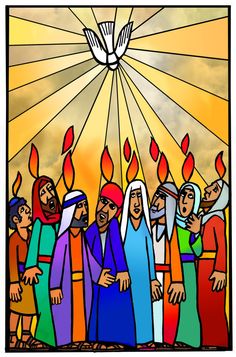
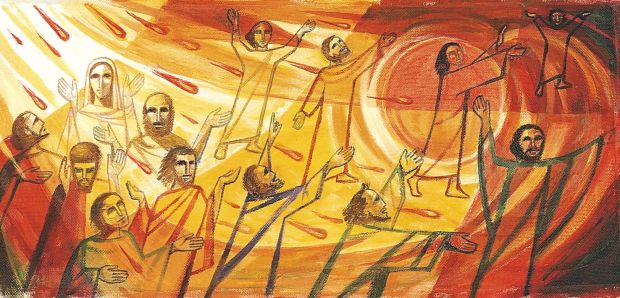
            Pentecost is often known as the birthday of the church.  It marks the time when the Holy Spirit came upon the fledgling believers in power.  The account is found in the New Testament book of Acts:  “On the day of Pentecost all the Lord’s followers [120 believers] were together in one place.  Suddenly there was a noise from heaven like the sound of a mighty wind!  It filled the house where they were meeting.  Then they saw what looked like fiery tongues moving in all directions, and a tongue came and settled on each person there.  The Holy Spirit took control of everyone, and they began speaking whatever languages the Spirit let them speak” (Acts 2:1-4).  The upshot of it all was that Peter, once an up-and-down follower, was filled with the Spirit and spoke the Word of God boldly.  His call to repentance and faith in Jesus led directly to three-thousand persons added to the little band of one-hundred twenty.
 
            But it didn’t stop there.  We live in a tremendous age in which all believers in Jesus have the same Holy Spirit as our spiritual ancestors.  It is an era of the Spirit empowering the church to reach the world with the good news that there is forgiveness and grace through the person and work of Christ.  So, then, the church possesses confidence and security in knowing that the Spirit’s enablement and power is available for the mission of proclaiming Christ to the nations.  It is an immense call, a calling that befits the bigness of God.
 
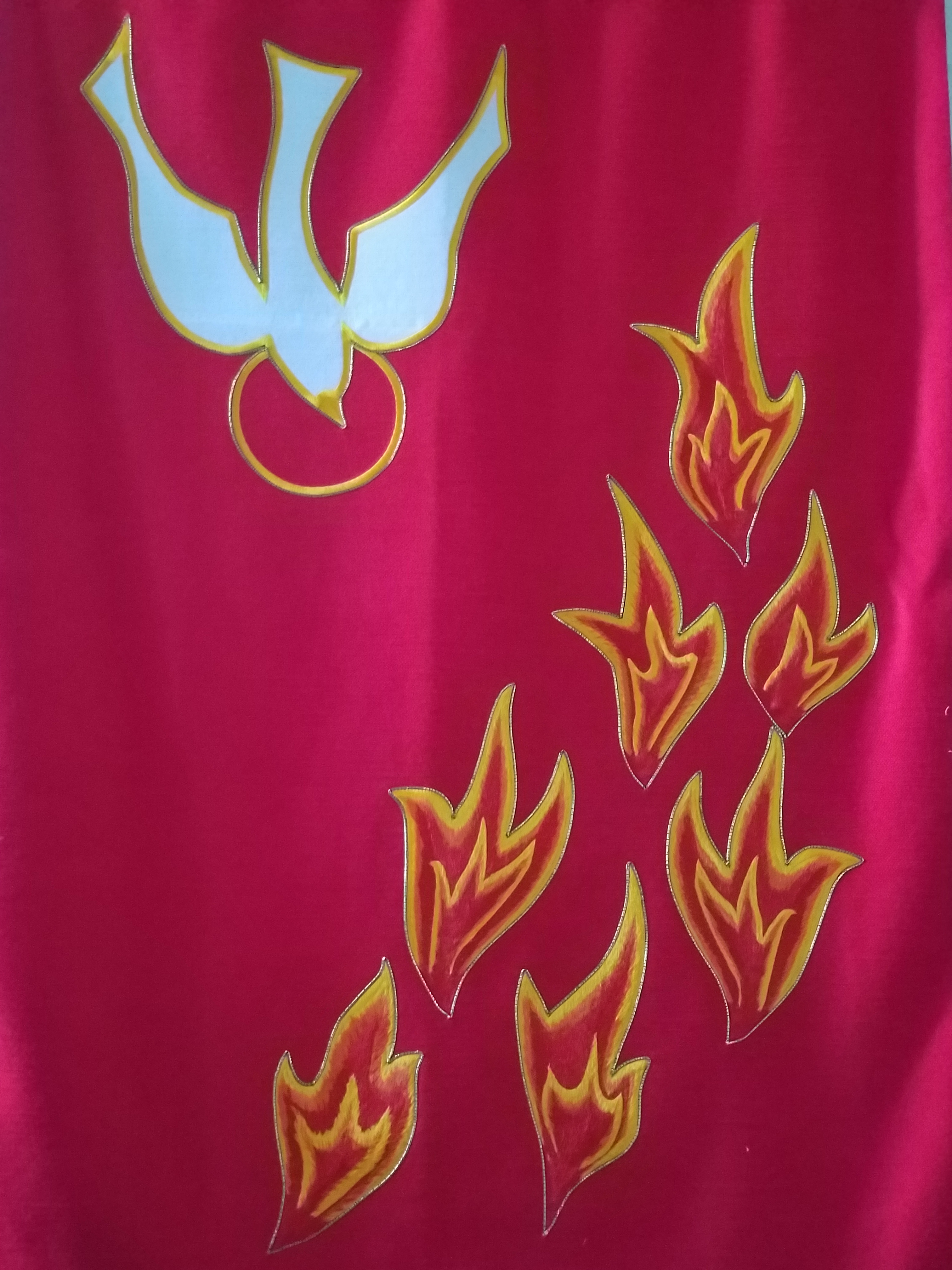
            There are a wide range of Christian celebrations of Pentecost. Some churches do not recognize the holiday at all. Most churches at least mention it in prayer, song, or sermon. Other churches go all out, with worship focused on remembering the first Pentecost and praying for a similar outpouring of divine power.  Churches that employ liturgical colors generally use red on Pentecost as a symbol of power and fire of the Spirit.
 
            Pentecost reminds us that Christians are meant to live in the presence and in the power of the Holy Spirit, all day, every day, 24/7.  It is a chance to confess our shortcomings and failures because of fear, apathy, and selfishness, and to ask for a fresh infusing and infilling of God’s wonderful Spirit.  Pentecost flings every single believer into a congregational whole, the church, and lets us know that we are not to be rugged individualists acting alone but are part of the Body of Christ.    Thus, we must renew our commitment to the church for whom Christ died and the Spirit is ready to use.  Pentecost throws disparate people together in a unified whole, made up of every kind of language, nationality, ethnicity, gender, and race.  We are all to use the gifts of the Spirit given to us for the benefit of building up one another.
 
            The church is the church because of the Holy Spirit.  We are to do the work of spreading the gospel in passionate outreach using the power of the Spirit, equipping and encouraging each other displaying the fruit of the Spirit, and worshiping the person of the Spirit for always being present with us.


            Pentecost was and is a watershed event.  Worship, community, and outreach are the logical extensions and the collective responsibility of each and every church around the globe.  In solidarity, let the day of Pentecost be recognized and observed with heartfelt thanksgiving and renewed impulses to exercising our spiritual abilities graciously promised by Jesus and given to us by the Holy Spirit.