Christ Is Born (Luke 2:1-20)

Nativity, by He Qi, 1998

In those days Caesar Augustus declared that everyone throughout the empire should be enrolled in the tax lists. This first enrollment occurred when Quirinius governed Syria. Everyone went to their own cities to be enrolled. Since Joseph belonged to David’s house and family line, he went up from the city of Nazareth in Galilee to David’s city, called Bethlehem, in Judea. He went to be enrolled together with Mary, who was promised to him in marriage and who was pregnant. While they were there, the time came for Mary to have her baby. She gave birth to her firstborn child, a son, wrapped him snugly, and laid him in a manger, because there was no place for them in the guestroom.

Nearby shepherds were living in the fields, guarding their sheep at night. The Lord’s angel stood before them, the Lord’s glory shone around them, and they were terrified.

The angel said, “Don’t be afraid! Look! I bring good news to you—wonderful, joyous news for all people. Your savior is born today in David’s city. He is Christ the Lord. This is a sign for you: you will find a newborn baby wrapped snugly and lying in a manger.” Suddenly a great assembly of the heavenly forces was with the angel praising God. They said, “Glory to God in heaven, and on earth peace among those whom he favors.”

When the angels returned to heaven, the shepherds said to each other, “Let’s go right now to Bethlehem and see what’s happened. Let’s confirm what the Lord has revealed to us.” They went quickly and found Mary and Joseph, and the baby lying in the manger. When they saw this, they reported what they had been told about this child. Everyone who heard it was amazed at what the shepherds told them. Mary committed these things to memory and considered them carefully. The shepherds returned home, glorifying and praising God for all they had heard and seen. Everything happened just as they had been told. (Common English Bible)

Nacimiento (Nativity), by Leoncio Saenz, 1983

It is of significance – and not by accident – that Jesus had a humble birth in a lowly setting. All around was the backdrop of a powerful Roman Empire. Whereas Christ could have been born as the mighty king that he actually is, he instead was born and then laid in a feeding trough for animals.

Caesar Augustus — whose name means revered or exalted one — ended a long period of war in the Roman Empire and was hailed as a prince of peace, the savior of the world. With his reign began the Pax Romana (Roman Peace). Under the rule of Augustus, the economy was booming; culture, religion, and infrastructure were developed and prospered. He was hailed by many with the title “Ceasar is Lord.”

Yet, as with many powerful rulers in history, Augustus ruthlessly suppressed his enemies and limited their human rights. It was peace by totalitarian rule – which is really no peace, at all.

It was in those days that Augustus proclaimed his decree for a census of the entire Roman world, so that taxes could be collected from all the conquered peoples of the empire. And so, despite being very pregnant, Mary and her fiancé Joseph made the arduous 90-mile trek from Nazareth in Galilee to Bethlehem, the city of David. That was the only way they could be properly registered, to return to the ancestral home.

It’s no surprise that Mary ended up giving birth to Jesus, far from their actual home, in less than ideal circumstances, for a delivery of a baby.

It appeared Ceasar Augustus was the absolute ruler, and much too powerful for anyone to challenge him. It also seemed that Jesus, a vulnerable little infant with even smaller resources, could do anything but just try and survive. But appearances can be, and are often, quite deceiving.
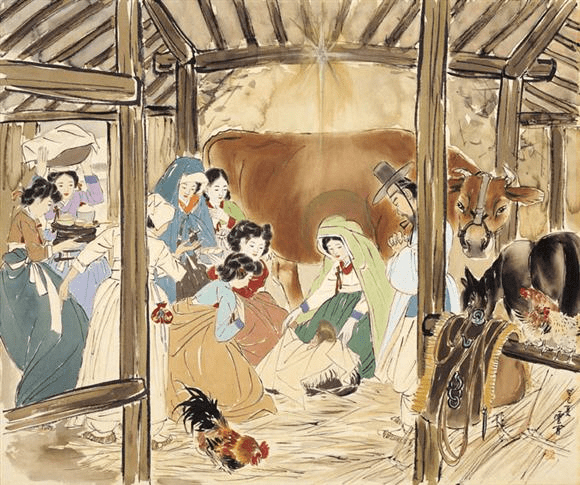
The Birth of Jesus Christ, by Woonbo Kim Ki-chang, 1952

In truth, Jesus is Lord, and Ceasar is not. Christ is the real Prince of Peace who brings God’s benevolent rule and reign to earth, as it is always done in heaven. And it will not be achieved through military power, but by the justice and mercy of God. Because, as it turns out, Love is a much greater force than any human authority or empire.

Considering God’s gracious kingdom – which turns all appearances on its head – it is quite appropriate that news of Christ’s royal birth comes first to a bunch of shepherds. They were among the lowliest of the emperor’s subjects.

Although we may tend to romanticize the shepherds keeping watch over their flocks by night, most people thought of shepherds as low class workers who nobody wanted to be around. They were poor, illiterate, and thought to be dishonorable drunks. Shepherds also had the reputation of being thieves because they grazed their flocks on other people’s property. In short, they were mostly the outcasts of society.

To this group of people the angel announces good news of great joy for all the people everywhere – and not just the powerful and the rich: To you is born this day in the city of David, a Savior, who is the Messiah, the Lord. The shepherds go to Bethlehem to find this baby, and become the first to share the good news of the Savior’s birth.

Today, we still live in a world dominated by people who desire power and privilege over others. We still live in a world enamored with wealth and resources, power and authority, military might and social control. In this world, much like the ancient world, the lowly still get trampled and the least among us get little if any attention.

Masters of both small and large worlds will eventually be toppled, not to mention our own personal petty empires we seek to build. All of our planning and scheming will never bring true peace and security. Jesus has arrived! Christ is born! All other empires are now on borrowed time.

Nativity, by Joseph Mulamba-Mandangi, 2001

The Savior is born for all the world, for us, even though we are separated from Christ’s birth by two millennia. Jesus still comes to bring peace on earth and goodwill to all humanity through the power of Love. He still casts out fear and relieves anxious hearts. And his reign will last forever and ever.

With Jesus Christ as Sovereign, outcasts are welcomed in; the hungry are fed; the poor are lifted up; captives are set free; enemies are reconciled. And wherever the good news is proclaimed, guilt and shame melts away, and lives are changed.

Today Christians all over the world celebrate the birth of Christ. And we also look forward to his coming again, when his reign of justice, mercy, and peace comes in all its fullness.

May God bless you this Christmas and always. May you be comforted by the Lord’s presence in your life, and always follow his guiding light. For Christ has come, the Immanuel, God with us. Amen.

Peace Be Upon Us (Psalm 125)

Those who trust in the Lord are like Mount Zion,
    which cannot be moved but abides forever.
As the mountains surround Jerusalem,
    so the Lord surrounds his people
    from this time on and forevermore.
For the scepter of wickedness shall not rest
    on the land allotted to the righteous,
so that the righteous might not stretch out
    their hands to do wrong.
Do good, O Lord, to those who are good
    and to those who are upright in their hearts.
But those who turn aside to their own crooked ways,
    the Lord will lead away with evildoers.
    Peace be upon Israel! (New Revised Standard Version)

I am profoundly grateful that God is a rock solid mountain who is strong. The Lord is never altered in the basic divine character of merciful grace, steadfast love, and abiding security. The main reason I so deeply appreciate this about God is that this old fallen world is awfully fickle, terribly unreliable, and forever changing.

So, to trust in God is to tether oneself to the ultimate anchor for life. Relationships come and go. People have their own agendas and listen to other people who, in turn, have their own agendas. But God’s plan is purely good, always right, and consistently just. The divine agenda has our best interests at mind.

Being linked to the Lord in faith establishes divine protection, provision, and presence. It’s as if the righteous believer has an invisible security blanket wrapped around them at all times. We are kept in the gracious arms of a loving God.

None of this, however, means that we shall never face grueling circumstances that might even feel like a hellish existence. If the Christian’s Lord Jesus had to undergo suffering before experiencing glory, then how much more do his followers need to expect the same?

Having injustice and wrongdoing in this world is one thing; but having it come from those close to you is quite another thing altogether. Again, the Lord Jesus endured wicked betrayal from Judas Iscariot, one who was within the inner circle of disciples. Yet, the heavenly Father was continually there, surrounding Jesus like the mountain chain, even though it may not have felt like it at many points, especially in the final week of Christ’s life on this earth.

God is good, all the time. Therefore, God knows who is truly good, and who is not. The Lord sees the heart, and clearly discerns the intents and motivations of each person and every group of people on this planet. And since God understands the real nature of a person’s life, the Lord is not fooled by pious sounding and slick talking persons with darkness in their hearts.

The wicked will not endure. God shall eventually lead them away. Like a shepherd separating the sheep from the goats, the Divine Judge will divide the righteous from the wicked. Those who think they can have a secret agenda of crookedness will find out that it’s not so secret after all.

This world, with all it’s inhabitants and systems and societies, needs peace. Sometimes, it seems to me that everyone right now in our contemporary world is upset about something; and they have the rudeness to back it up.

Nations fight nations. People groups attack other people groups. One ethnicity accuses another, and vice versa. Family members are estranged. Lawsuits abound. The judicial courts are beyond full. Unethical practices masquerade within ethical systems and thrive in the shadows. And persons are harmed – lots of them. Lives are destroyed.

I once came home from a day of interacting with patients at the hospital and said to my wife, “You could never dream up the atrocities that one person can do to another.” The short of it is that there is no harmony, no mutual understanding, and thus, no peace, no fulfillment or wholesome way of life for so many.

In the New Testament, the Apostle Paul once cried out concerning the muck of sin, “Who will rescue me from this body of death?” He then went on to answer his own question by saying a simple phrase, “Thanks be to God through Jesus Christ our Lord.” (Romans 7:24)

Yes, for me it’s Jesus. And, for me, that is what this very season of the year is all about. I anticipate the birth of the Christ Child, who came willingly to save us from this manure pile of a situation that is without peace. He became the Prince of Peace, so that we might have the light of life. It was the Apostle John who let us know:

The Word became flesh and blood,
    and moved into the neighborhood.
We saw the glory with our own eyes,
    the one-of-a-kind glory,
    like Father, like Son,
Generous inside and out,
    true from start to finish. (John 1:14, MSG)

Humility, meekness, righteousness, purity, mercy, love, and peace-making – yes, peacemaking – were the hallmarks of Christ’s ministry. These characteristics surrounded him like the divine mountains and shaped every word and each action of Jesus.

It is the time for peace. In fact, it’s high time for it! We have gone long enough provoking others and being provoked. There is a way – the way of peace. And for me, peace is achieved through the ultimate Peacemaker, Jesus Christ, my Lord.

He came and preached peace to you who were far away and peace to those who were near. For through him we both have access to the Father by one Spirit. (Ephesians 2:17-18, NIV)

May you find peace this season because you have discovered the Peacemaker. Peace be upon Israel, and peace to all.

Soli Deo Gloria

The Righteous and the Wicked (Isaiah 26:7-15)

The path of the righteous is level;
    you, the Upright One, make the way of the righteous smooth.
Yes, Lord, walking in the way of your laws,
    we wait for you;
your name and renown
    are the desire of our hearts.
My soul yearns for you in the night;
    in the morning my spirit longs for you.
When your judgments come upon the earth,
    the people of the world learn righteousness.
But when grace is shown to the wicked,
    they do not learn righteousness;
even in a land of uprightness they go on doing evil
    and do not regard the majesty of the Lord.
Lord, your hand is lifted high,
    but they do not see it.
Let them see your zeal for your people and be put to shame;
    let the fire reserved for your enemies consume them.

Lord, you establish peace for us;
    all that we have accomplished you have done for us.
Lord our God, other lords besides you have ruled over us,
    but your name alone do we honor.
They are now dead, they live no more;
    their spirits do not rise.
You punished them and brought them to ruin;
    you wiped out all memory of them.
You have enlarged the nation, Lord;
    you have enlarged the nation.
You have gained glory for yourself;
    you have extended all the borders of the land. (New International Version)

Within the Bible, there are really only two sorts of people: the righteous and the wicked. Repeatedly throughout Scripture, we are told that God attends to the needs, hopes, and prayers of the righteous; and conversely, God is opposed to the unjust practices and oppressive acts of the wicked.

The righteous are people who are attentive to God’s law and trust God with all their heart, soul, mind, and strength. For the righteous, God will make a way where there seems to be no way. If there’s a mountain obstructing the way of the righteous, they believe the Lord will flatten it. And if it isn’t flattened immediately, the righteous patiently wait, seeking to be obedient and full of faith, until it happens.

The world learns about life and faith and the divine through these postures of living by righteous persons. The exception to this is the wicked; they learn nothing. The wicked could see a mountain leveled before their very eyes, and refuse to see or acknowledge the power of God behind it.

All this is to say that the truly righteous persons among us stand out like a sore thumb to the prevailing wickedness of the world. Thus, the wicked would like to see them leveled, instead of a mountain. So, the wicked persons among us are committed to lies, half-truths, injustice, and even violence. They’ll use any practice that would knock down the righteous and advance the wicked person’s agenda.

Yet, in making this distinction between the two groups of people, we need to be very careful. Because whenever we group people, there is always the danger of assuming that the righteous are always righteous and the wicked always wicked – as if the righteous could never do any wrong, nor the wicked ever do anything right and just.

However, the reality is that we don’t live in a completely black and white world; there is a lot of gray. The world is far more complex than our simplistic categories of good and bad. This is why it can be so maddening to try and navigate this world each and every day.

So, when we speak of the righteous and the wicked, let’s have some clarity and understanding of the basic patterns of a person’s or a group’s life.

Biblically, the righteous are righteous – not because they are intensely moral and always actively obedient – but because the basic orientation of their lives is committed to communing and relating to the God of the universe.

And the wicked are wicked – not because they are belligerent and bullying – but because the general direction of their lives is continually bent inward to serve their own interests and ignore the Divine.

Therefore, the righteous have the foundational characteristics of yearning for God, and pursuing the Lord with all their energy. They desire a meaningful relationship with God that gives shape to their plans and purposes for living.

The righteous, as a general pattern of living, find their ultimate longings in life through belonging to God. They seek divine interventions for everything, and deeply desire the divine presence to envelop them and surround the world with love, mercy, and justice. Along with the psalmist, the righteous say:

I ask only one thing, Lord:
Let me live in your house
    every day of my life
to see how wonderful you are
    and to pray in your temple. (Psalm 27:4, CEV)

Like a deer drinking from a stream,
    I reach out to you, my God.
My soul thirsts for the living God.
    When can I go to meet with him? (Psalm 42:1-2, ERV)

As long as I have God, I don’t need anyone else in heaven or on earth. (Psalm 73:25, GW)

In contrast to these heartfelt longings, the wicked are dense and obtuse. They fail to see the beauty in any of this. Their end will be precisely what they have wanted throughout life: To be left alone and have space away from God altogether – which is the classic definition of hell.

But the righteous will also have their desires fulfilled, and shall experience peace and right relations forever with God.

How then shall we live?

Blessed is the person who does not
follow the advice of wicked people,
take the path of sinners,
or join the company of mockers.

Rather, he delights in the teachings of the Lord
and reflects on his teachings day and night.

He is like a tree planted beside streams—
a tree that produces fruit in season
and whose leaves do not wither.
He succeeds in everything he does.

Wicked people are not like that.
Instead, they are like husks that the wind blows away.

That is why wicked people will not be able to stand in the judgment
and sinners will not be able to stand where righteous people gather.

The Lord knows the way of righteous people,
but the way of wicked people will end. Amen. (Psalm 1, GW)

Beat the Swords into Plowshares (Micah 4:1-5)

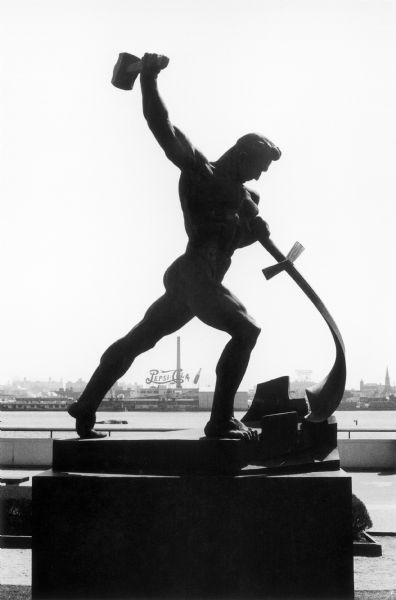
Let Us Beat Swords into Plowshares, by Yevgeniy Vuchetich (1908-1974)

In days to come
    the mountain of the Lord’s temple
shall be established as the highest of the mountains
    and shall be raised up above the hills.
Peoples shall stream to it,
    and many nations shall come and say:
“Come, let us go up to the mountain of the Lord,
    to the house of the God of Jacob,
that he may teach us his ways
    and that we may walk in his paths.”
For out of Zion shall go forth instruction,
    and the word of the Lord from Jerusalem.
He shall judge between many peoples
    and shall arbitrate between strong nations far away;
they shall beat their swords into plowshares
    and their spears into pruning hooks;
nation shall not lift up sword against nation;
    neither shall they learn war anymore;
but they shall all sit under their own vines and under their own fig trees,
    and no one shall make them afraid,
    for the mouth of the Lord of hosts has spoken.

For all the peoples walk,
    each in the name of its god,
but we will walk in the name of the Lord our God
    forever and ever. (New Revised Standard Version)

Yes, we are presently in the muck of the world. But no, it will not always be this way. There is a time coming, when all is said and done, when justice shall prevail. People will seek after God, and they will stop thinking about how to kill each other.

Weapons will be a thing of the past. They’ll just be repurposed for fostering life instead of death. Peace and security will take hold so that each person will be able to work and rest without worrying about poverty or protection.

If this sounds like an idyllic world and a utopian society, that’s because it is. I believe there is a longing within each of us to realize this hope. And someday, in God’s good time, it will happen.

It seems almost impossible, in this contemporary world of ours, that we could live without constant fear and anxiety, that people could actually live together in unity, harmony, and wholeness of being. We were meant for peace, which is why we yearn for it more than an Iowa boy yearning for bacon at breakfast.

Just because this is a prophetic utterance that the faithful believe will happen, doesn’t mean that we need not work toward this ideal now. For it is very possible, and likely real, that we have a large part to play in God’s drama of making a new world.

The day of the Lord will come like a thief. The heavens will disappear with a roar; the elements will be destroyed by fire, and the earth and everything done in it will be laid bare. Since everything will be destroyed in this way, what kind of people ought you to be? You ought to live holy and godly lives as you look forward to the day of God and speed its coming. (emphasis mine, 2 Peter 3:10-12, NIV)

If we are impatient to see an end to wars and rumors of wars, of oppression and hate, then let’s roll up our sleeves and do everything humanly possible (and trusting in divine power!) to bring justice everywhere we can. The future idyllic hope we have is not yet a present reality. We have a bit of say whether it’s going to be sooner or later.

It’s easy to destroy. It takes little imagination and effort to criticize and tear down someone with our words. It’s nothing to send missiles and rockets of destruction in order to raze a community. Bombs can be dropped with but a switch. A neighborhood can disappear in days with just a few bulldozers.

But to bring life and security and peace to a people requires our best efforts and everything we’ve got to make it happen. It’s hard, and takes a lot of committed sweaty work. Building something that will last always takes a great deal of time, resolve, and struggle.

We need the hard work of healers, not the easy path of harmers; we need peacemakers, not warmongers; public servants, not public strangers; faithful leaders, not fat louses; arbitrators, not disputers; religious penitents, not pious know-it-alls; and lovers, not haters.

In short, we need a whole cadre of caring citizens for a new society that prizes egalitarian relations, social and economic justice, personal and public righteousness, and compassionate service.

Injustice must be dismantled; and we need to become content with having enough. That’s what it means to walk in the name of the Lord our God.

If all things belong to God (which they do) and believers hold all things loosely as stewards (which they should) then there is no need to dig in and defend something which is not ours to begin with. Fear is taken away. Injustice becomes irrelevant.

Although we may not be able to make everything right in this present evil age, we can still make a difference and continue to pray:

Maranatha. Come, Lord Jesus, come. Amen.