“I Have Overcome the World” (John 16:25-33)

All Are Alike Unto God, by Madison Wardle

“Though I have been speaking figuratively, a time is coming when I will no longer use this kind of language but will tell you plainly about my Father. In that day you will ask in my name. I am not saying that I will ask the Father on your behalf. No, the Father himself loves you because you have loved me and have believed that I came from God. I came from the Father and entered the world; now I am leaving the world and going back to the Father.”

Then Jesus’ disciples said, “Now you are speaking clearly and without figures of speech. Now we can see that you know all things and that you do not even need to have anyone ask you questions. This makes us believe that you came from God.”

“Do you now believe?” Jesus replied. “A time is coming and in fact has come when you will be scattered, each to your own home. You will leave me all alone. Yet I am not alone, for my Father is with me.

“I have told you these things, so that in me you may have peace. In this world you will have trouble. But take heart! I have overcome the world.” (New International Version)

Imagine you are with Jesus in the Upper Room celebrating Passover. And your Lord tells you he is leaving – going back to the Father. After three years of a difficult, yet incredible ministry, there is palpable grief in the room. It’s as if you got sucker-punched. You want this time with Jesus to never end….

Jesus Christ, Son of God, Son of Man, Savior of the world, does not forget you. The Lord is concerned and careful to provide wonderful words of assurance: Father God loves you. I give you my peace. I have overcome the world.

My friend, do you hear the words of Jesus? Do you truly understand what the Lord of all the earth has said to you? The love and peace of Christ has overcome the world. That love and that peace is given to you. You, and not just someone else, possesses the love and peace to overcome the world.

Whenever we encounter trouble; in those times when grief seems to be swallowing us whole; and when all is dark and we cannot see our hand in front of our face – it is in these moments the Lord comes alongside us and communicates a loving divine presence which grants us the peace of settled rest, even if, and especially when, our troubling situations do not change.

If you have had a life largely free of struggle, the privilege of knowing where your next meal is coming from, and the assurance of having your most basic needs met, then please understand that many people throughout the world, right this moment, know nothing of that kind of experience.

However, this doesn’t necessarily mean that needy persons are unhappy, discontent, or bitter. Heavens, no!

Love and peace are neither bound nor limited by adverse circumstances.

In fact, love and peace are known in a much deeper way whenever we have been hated and in conflict. That’s because love thrives and flourishes in an environment of hate; and peace takes root more surely wherever there is disharmony and misunderstanding.

If everything always goes our way, how then would we know the Lord’s great grace to us? How would we ever know God as Provider unless we were in want? How would we know Christ as the Healer unless we were broken? How could we ever know resurrection unless there was a crucifixion?

Jesus specializes in the improbable and the impossible. He comes and lands on the Island of Misfit Toys, and airlifts the discarded ones to be a gift to the world.

You see, this is precisely how we overcome the world: We love and serve, just as our Lord did. Since he overcame, we walk in his footsteps.

The acquisition and presence of peace is anything but passive. Peace has been achieved through a bloody cross and settles within the spirit through an active pursuit of harmony, wholeness, integrity, and love.

Now that we have been put right with God through faith, we have peace with God through our Lord Jesus Christ. He has brought us by faith into this experience of God’s grace, in which we now live. And so, we boast of the hope we have of sharing God’s glory! We also boast of our troubles, because we know that trouble produces endurance, endurance brings God’s approval, and his approval creates hope. (Romans 5:1-4, GNT)

For the kingdom of God is not food and drink but righteousness and peace and joy in the Holy Spirit. The one who thus serves Christ is acceptable to God and has human approval. Let us then pursue what makes for peace and for mutual upbuilding. (Romans 14:17-19, NRSV)

God’s peace and love is free, but it is not cheap. It is obtained smack in the middle of worldly troubles. So, may the peace of God be with you, my friends, now and always.

Almighty and everlasting God, you are the fountain of all peace, spiritual and temporal. We humbly pray, in your great goodness grant us that peace which the world cannot give, that we may ever live in your fear, obedient to your commandments, to the end that you may deliver us from all our enemies, through your dear Son, Jesus Christ, our Lord. Amen.


The Parable of the Tenants (Mark 12:1-12)

Parable of the Vineyard Workers, from Unknown Artist in the Middle Ages

Then he began to speak to them in parables. “A man planted a vineyard, put a fence around it, dug a pit for the winepress, and built a watchtower; then he leased it to tenants and went away. 

When the season came, he sent a slave to the tenants to collect from them his share of the produce of the vineyard. But they seized him and beat him and sent him away empty-handed. 

And again he sent another slave to them; this one they beat over the head and insulted. Then he sent another, and that one they killed. And so it was with many others; some they beat, and others they killed. 

He had still one other, a beloved son. Finally he sent him to them, saying, ‘They will respect my son.’ But those tenants said to one another, ‘This is the heir; come, let us kill him, and the inheritance will be ours.’ So they seized him, killed him, and threw him out of the vineyard. 

What then will the owner of the vineyard do? He will come and destroy the tenants and give the vineyard to others. Have you not read this scripture:

‘The stone that the builders rejected
    has become the cornerstone;
this was the Lord’s doing,
    and it is amazing in our eyes’?”

When they realized that he had told this parable against them, they wanted to arrest him, but they feared the crowd. So they left him and went away. (New Revised Standard Version)

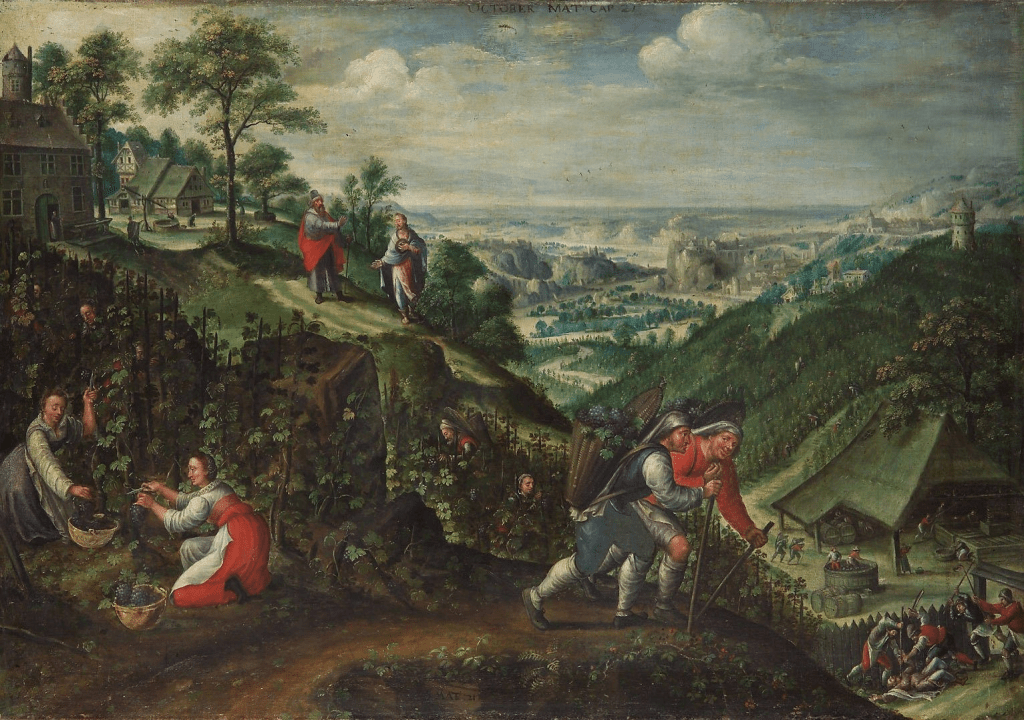
Parable of the Wicked Tenants, by Maarten Van Valckenborg (1535-1612)

Jesus was at the temple in Jerusalem. While there, the religious leaders confronted him over his supposed ministerial authority. Jesus, rather than become defensive, took the initiative by telling a parable.

The parable’s imagery comes directly from the second chapter of the prophet Isaiah in the Old Testament. It, too, was a parable concerning a vineyard. Isaiah leveled an accusation against the entire nation of Israel.

Jesus picked up the same imagery and directed his accusation against the people in front of him, the Jewish religious leaders. The connection between the parable of Isaiah and the parable of Jesus would not have been lost on those leaders.

In many ways, I can relate to the parable’s setting in the land. I grew up on a farm, and appreciate the deep connection of working the land and caring for it. I know something of owning land and having renters work it, since that it was my family did in my parent’s later years.

Anytime there is a relationship between owners, and renters or tenants or servants, it is an unequal relation. And whichever situation you relate to will affect your perspective of the parable.

If you understand what it means to be a landowner, with all of the rights and responsibilities of that ownership, and with the people who work that land, then you likely resonate with the landowner in Christ’s parable. You also will likely detest what the tenants in the parable do.

Perhaps you relate more to being a renter or a tenant. Having an understanding of what it means to rent from another, you may likely see the how the tenants in the parable think, and why they do what they do.

Having personal experiences on both sides of the owner/renter situation – for both good and bad – I can easily see how the violence in the parable could happen. I have my own stories of justice and injustice when it comes to each, the owners and the renters/tenants.

Much like today, ancient power dynamics were a fundamental part of life for many people. And those relations were, and are, fraught with all sorts of inequality.

Christ’s parable is a rather violent story. It’s not really bedtime reading. Notice that the owner has slaves, whom he sends to collect what is due him. Several of them are beaten and/or killed.

There is no backstory to the tenants situation. Yet, at the time of Christ’s ministry, there were many lower class folk who lost their land to unscrupulous owners, in a system of inequity. It’s possible that some of the men Jesus was talking to owned some land. And the religious leaders in the Gospels are rarely presented in a positive light.

Even today, there are violent struggles regarding land, especially in the Middle East. And the power dynamics and inequities are rife with injustice which is claiming to be justice. There are no easy answers to quelling the constant violence.

Feelings of hatred, anger, and fear are common. The desire to kill too often overcomes the desire for life. A group of people are outraged for being the brunt of murder, killing, and evil. Another group already feels neglected and have been the victims of unjust usury and death. They feel justified in their violence toward those they view as perpetrators.

Imagine how people on this earth, such as Palestinians, Israelis, Native Americans, and Ukrainians – just to name a few – feel about land. Land involves life, because the land has water, the potential for farming, trees, and a place to live. Thus, whoever controls land, in many ways, controls life. Agribusiness owns large chunks of land in the United States – and not the smaller family farms. Ah, but that is a topic for another time….

In Christ’s parable, everybody suffered in some way. Servants died. The landowner’s son died. The tenants were destroyed. Life was permanently altered for all involved.

Is that how any of us really want to live?

If we take a theological perspective, God owns everything. But we think we own the land and its resources. We believe we have the right to do whatever we want with it. And that is where the problem arises.

Until we truly hold to the notion that we humans are a society of equals, and that we are all subject to a God who owns everything, then we will continue to experience the effects of injustice, war, and death.

Can we, at least, change our minds? Yes, we can. And Christians are called to do just that:

Do not be conformed to this age, but be transformed by the renewing of the mind, so that you may discern what is the will of God—what is good and acceptable and perfect.

For by the grace given to me I say to everyone among you not to think of yourself more highly than you ought to think but to think with sober judgment, each according to the measure of faith that God has assigned. (Romans 12:2-3, NRSV)

The religious leaders of Christ’s day needed to change their minds about Jesus. Yet, no matter what they did, he would still become the cornerstone, if they rejected him as just one of the stones in the edifice of God’s kingdom.

Today, the parable is still meant to speak to people, to you and me. We have the chance to embrace the Prince of Peace, and walk in the way of peace, not violence. We still yet have the opportunity to be peacemakers, and live in a way that promotes human flourishing, and not human carnage.

If, like the parable of the prophet Isaiah, Christ’s parable is meant to speak to everyone, then it is most necessary that we heed the words of Jesus.

Almighty God our heavenly Father, guide the nations of the world into the way of justice and truth, and establish among them peace, which is the fruit of righteousness, so that they may become the kingdom of our Lord and Savior Jesus Christ. Amen.

Showing Kindness (Ruth 2:10-14)

Calling in the Gleaners, by Jules Breton, 1859

Then she fell prostrate, with her face to the ground, and said to him, “Why have I found favor in your sight, that you should take notice of me, when I am a foreigner?” But Boaz answered her, “All that you have done for your mother-in-law since the death of your husband has been fully told me, how you left your father and mother and your native land and came to a people that you did not know before. May the Lord reward you for your deeds, and may you have a full reward from the Lord, the God of Israel, under whose wings you have come for refuge!” Then she said, “May I continue to find favor in your sight, my lord, for you have comforted me and spoken kindly to your servant, even though I am not one of your servants.”

At mealtime Boaz said to her, “Come here and eat some of this bread and dip your morsel in the sour wine.” So she sat beside the reapers, and he heaped up for her some parched grain. She ate until she was satisfied, and she had some left over. (New Revised Standard Version)

Ruth and her mother-in-law Naomi were widows, living in the land of Moab. But Naomi decided to go back to Judah, to her hometown of Bethlehem. She and her husband had originally left because of a great famine.

Naomi had encouraged Ruth to remain in her own country, among her own people. But Ruth insisted on remaining and being with Naomi. But just because the two of them had each other, and they were in Naomi’s native land, it did not mean things were going to be easy or better.

The truth was that that Ruth and Naomi had next to nothing. It was common that during the harvest, the less fortunate folk would walk a ways behind the workers who were gleaning the fields, in order to pick up what was left behind.

Picking up after the workers in the field is precisely what Ruth went out to do. Naomi was too old for the work, so it was up to Ruth. The field that Ruth ended up walking, belonged to a man named Boaz.

Depending upon the owner of the land, the poor folk who came to walk the fields were treated either with kindness or contempt. Boaz was the sort of person who was attentive to God’s law, and sought to do what was right. He knew what Torah said:

“‘When you reap the harvest of your land, do not reap to the very edges of your field or gather the gleanings of your harvest. Leave them for the poor and for the foreigner residing among you. I am the Lord your God.’” (Leviticus 23:22, NIV)

Boaz had taken notice of Ruth. He approached her and told her to remain in his field and stay close to his workers. Boaz also commented to Ruth that he instructed the young men working for him to leave her alone and not bother her. He let Ruth know that she could drink from the vessels appropriated for his laborers.

This was a kindness which was overwhelming to Ruth. As a foreigner and a widow, she was not expecting anything from anyone in Judah. And yet, here is this man extending mercy to her.

One of the reasons Boaz showed kindness to Ruth is because he had heard about her commitment to Naomi, and admired her courage and spunk in coming to a land which was not her own.

Indeed, the picture we gain is that Ruth was a modest and faithful person, upright, diligent, and full of kindness. She understood who she was, where she was, and she was willing to do whatever she could for the sake of her dear mother-in-law.

Ruth had faith that Naomi would lead her well, and to a life of commitment to both God and God’s people. Ruth’s bravery and willingness to submit to Naomi is a beautiful portrayal of faith, hope, and love.

We can be inspired from such courage. For we, too, must take risks and allow ourselves to venture out into places we aren’t familiar with.

We will do well to understand that it was Ruth’s willingness to act, and her commitment to the life she chose, that helped bring about a family and an adopted community which she did not think possible.

It would be good for each of us to take the time to get a long look at our own lives. We must decide what risks we will take, and which things to avoid, and then go out in faith and perform those actions to the best of our ability, and with the grace which God grants us.

In stepping out and acting with kindness and commitment, Ruth discovered God’s care when she and Naomi were in poverty.

The blameless spend their days under the Lord’s care,
    and their inheritance will endure forever.
In times of disaster they will not wither;
    in days of famine they will enjoy plenty. (Psalm 37:18-19, NIV)

Boaz eventually found the blessing of family through his own act of kindness toward Ruth. He was well-off and had plenty, yet he used his privilege to bless others.

Command those who are rich in this present world not to be arrogant nor to put their hope in wealth, which is so uncertain, but to put their hope in God, who richly provides us with everything for our enjoyment. Command them to do good, to be rich in good deeds, and to be generous and willing to share. In this way they will lay up treasure for themselves as a firm foundation for the coming age, so that they may take hold of the life that is truly life. (1 Timothy 6:17-19, NIV)

So, whether we are poor or rich, underprivileged or privileged, we all can find ways to show kindness and live on this earth in peace and goodwill.

How, then, will you live?

O Lord, give me strength today to show kindness in all that I do. Help me to open my arms to those less fortunate and extend my hand to those who may need it, so that they may see You in my kind words and actions. Amen.

Directives For the Married and Divorced (1 Corinthians 7:10-16)

To the married I give this command—not I but the Lord—that the wife should not separate from her husband (but if she does separate, let her remain unmarried or else be reconciled to her husband) and that the husband should not divorce his wife.

To the rest I say—I and not the Lord—that if any brother has a wife who is an unbeliever and she consents to live with him, he should not divorce her. And if any woman has a husband who is an unbeliever and he consents to live with her, she should not divorce the husband. 

For the unbelieving husband is made holy through his wife, and the unbelieving wife is made holy through the brother. Otherwise, your children would be unclean, but as it is, they are holy. But if the unbelieving partner separates, let it be so; in such a case the brother or sister is not bound. It is to peace that God has called us. Wife, for all you know, you might save your husband. Husband, for all you know, you might save your wife. (New Revised Standard Version)

Having specifically addressed questions about sex; and having directly talked to the Christians in Corinth who were single; the Apostle Paul then turned to the married persons in the church. He gave directions about their concerns of divorce and how to handle a spouse who does not share the believing spouse’s Christian beliefs.

Divorce

Divorce is one of those things that no one plans on happening when they are married; and yet, it happens. The Apostle was realistic about the situation. He upheld the sanctity of marriage, while recognizing that the ideal of two people remaining together and blessing one another doesn’t always happen.

I find it interesting, as well as gracious and understanding, that Paul neither condemns nor denounces the divorced person. He assumes that both spouses have responsibility, and both can take initiative as partners in a marriage.

A Christian married to an unbelieving partner, according to Paul, ought to remain married. As long as the non-believing spouse is willing to remain in such a marriage, then it should continue.

The Apostle’s rationale is that peace, not divorce, needs to be the controlling characteristic of both the marriage and of the Christian life.

“Mixed” Marriage

Furthermore, Paul believed that Christians are not defiled by pagan spouses. This is important when it comes to the children of a Christian and non-Christian marriage. The relationship is sanctified by the presence of both the believing spouse and the Holy Spirit.

In addition, the Apostle saw that the Christian spouse is in a special position for God to work through them to the unbelieving spouse. On this point, Paul is sanguine and optimistic. Instead of worrying about impurity for the Christian, he foresaw an opportunity for purity in the non-Christian.

The Apostle Paul’s realism reminds us that if we are looking for ultimate satisfaction through marriage (or singleness and celibacy) it will never be found.

That’s because, as Christians, contentment and peace comes through giving our lives to serve the Lord Jesus in love. To love another, and offer the gift of self-sacrificial service to them, is the ultimate path to the way of Christ.

In losing our lives, we find them; in being last, we are promoted to first.

Marriage is beautiful. Divorce is ugly. Sometimes, despite a believer’s greatest efforts at being peaceful and loving, a divorce occurs. It takes two to have a marriage. There are times when the believing person must let their spouse go, that is, if that spouse wants to go.

Although divorce can be ugly and sad, full of broken dreams, and littered with missed expectations, it doesn’t need to stay that way. The divorced person, becoming single, now has the opportunity to bring something beautiful out of the brokenness.

Kintsugi

“Kintsugi” is a Japanese term for the art of repairing broken objects. The word literally means to “join with gold.” This art form uses a particular lacquer to reattach broken pieces. Then the newly attached joints are decorated with gold (or silver) powder.

The working idea behind the art of kintsugi is to embrace the flaws and the imperfections. By doing so, the artist can create a beautiful piece of art, stronger than the original.

Applying this to relationships, people no longer have to simply live with the shame of a broken marriage. We can assign value to people who are divorced, and stop trying to hide the relational damage. Through intentional efforts on healing, the scars left behind can truly become a source of beauty – instead of permanent ugliness.

Ikigai

Another Japanese concept which can be relevant for us is “ikigai.” It refers to having a reason for living, a sense of purpose and meaning to life. The idea behind ikigai is to help people find what is truly important to them, and then to live a life full of joy and purpose. Notice the concept is based on that which is internal – fulfillment, satisfaction, joy, and meaning – instead of external factors such as money, fame, power, or position.

Jesus joyfully lived his life on this earth to serve others. He came not to be served, but to serve, and to give his life as a ransom for many (Mark 10:45). If marriage was the ideal for everyone in this world, I’m quite sure Jesus would have modeled that for us by getting married. But he didn’t.

Neither marriage, nor singleness, is what really counts. Faith, expressing itself through love, is what actually counts. (Galatians 5:6)

And when Jesus was broken, the result became the salvation of the world. By his wounds, we are healed. (Isaiah 53:5)

All of this demonstrates for us where and what we are to assign meaning. And just because things don’t work out like we want, and leaves us in a state of brokenness, our lives can be transformed into a beauty beyond what we could have imagined.

This is the strength and ability of Christianity. Methinks we ought to let it have its way in our lives.

Almighty and everlasting God, the One who makes us whole in our brokenness, calls us to deeper faith, and delivers us from all things that hinder our devotion to you: Hear our prayer, Lord, and break open all we hold back from you, so that we may see a vision of your helping and healing presence in our lives and in our world, through Jesus Christ, in the power of the Holy Spirit. Amen.