Isaiah 60:15-22 – A Renewed Vision of Peace

Isaiah 60 by Margaret Nagib

Instead of being abandoned,
    hated, and forbidden,
    I will make you majestic forever,
    a joy for all generations.
You will suck the milk of nations,
    and nurse at royal breasts.
    You will know that I am the Lord, your savior
    and your redeemer, the mighty one of Jacob.
Instead of bronze I will bring gold;
    instead of iron I will bring silver;
    instead of wood, bronze;
    and instead of stones, iron.
I will make peace your governor
    and righteousness your taskmaster.
Violence will no longer resound throughout your land,
    nor devastation or destruction within your borders.
You will call your walls Salvation,
    and your gates Praise.
The sun will no longer be your light by day,
    nor will the moon shine for illumination by night.
The Lord will be your everlasting light;
    your God will be your glory.
Your sun will no longer set;
    your moon will no longer wane.
The Lord will be an everlasting light for you,
    and your days of mourning will be ended.
Your people will all be righteous;
    they will possess the land forever.
They are the shoot that I planted,
    the work of my hands, to glorify myself.
The least will become a thousand,
    and the smallest a powerful people.
I am the Lord; at the right moment, I will hurry it along. (CEB)

The people of ancient times typically had a love/hate relationship with prophets. After all, the Lord’s messengers gave verbal punches to the gut with bad news of judgment. But they also were bearers of good news, as well. So, it is important to hold both judgment and grace together. We need to always keep in mind that, despite human foibles, grace exists and is the grand operating force in God’s big world.

Good news turns to great news when there is a realization that judgment is deserved, yet it won’t have the last word. God’s grace always prevails in the end. God has a tenacious resolve to work out good for people, not ill. Although the Lord dispenses justice, sometimes with a firm hand, there is an unflagging commitment to divine love which will shine through the darkest of times.

God expertly knows how to make a reversal in people’s situations from hopeless despair to incredible fortune (and, I might add, vice versa). The Lord truly has plans of goodness and well-being for humanity. Humiliation and powerlessness will give way to exaltation and empowerment. Peace will eventually overcome both the human heart and human institutions.

Salvation and deliverance from the ills which plague both body and soul comes from the God who specializes in penetrating the blackest darkness with overwhelming light. And it is much more than personal well-being. Isaiah’s prophecy communicates a cosmic vision of peace which thoroughly works its way in all the shadowy places of the world. It is a vision of a new world and new life.

Because of God’s action in a broken and bruised world, we can make some bold and hopeful theological claims for God’s people:

  • God’s good grace and steadfast love are the superior forces in the church and the world. Because grace and love are pure gifts from the Lord, they are not dependent upon whether we deserve them, or not. The sheer fact that we need them is what prompts God to give generously and unsparingly. A new heaven and new earth are coming. Sin and death are not permanent.

Then I saw a new heaven and a new earth; for the first heaven and the first earth had passed away. (Revelation 21:1, NRSV)

  • God is the center of every good thing that was, is, and is coming. God’s world runs on God’s providence and power, and not on human agency. God is in control. All the Lord’s good promises shall not fail but will be realized. For the Christian, those promises are ultimately fulfilled in the person and work of Jesus Christ. When circumstances are at their worst, faith is at its best.

In everything we have won more than a victory because of Christ who loves us. I am sure that nothing can separate us from God’s love—not life or death, not angels or spirits, not the present or the future, and not powers above or powers below. Nothing in all creation can separate us from God’s love for us in Christ Jesus our Lord! (Romans 8:37-39, CEV)

  • God’s promises extend well beyond the “spiritual” to all of life. God’s peace will work its way into the fabric of the whole world, not just individual hearts. God’s benevolent kingdom and ethical will shall be done on earth as it is always done in heaven. Just as every human institution and all creation have been profoundly touched by sin, so everything will be touched by grace and renewed. Our prayers are to encompass this grand scope of God’s renewing vision for the world.

May your Kingdom come soon. May your will be done on earth, as it is in heaven. (Matthew 6:11, NLT)

God’s plans are more than good and gracious; they are cosmic in their scope and include an expansive realm of peace which is so incredible that the Lord’s glory will overwhelm all darkness and shall shine forever. Human sin might seem as though it is so pervasive as to win the day, yet it will not always be this way. God’s light will penetrate, overcome, and dispel guilt, shame, and disobedience. And it has already begun…

Almighty God give us a new vision of you, of your love, of your grace and power; and then, give us a new vision of what you would have us do as your people, and an awareness that in the strength of your Spirit we can do it to your glory, through Jesus Christ our Lord. Amen.


Perspective Changes Everything

Perspective is everything. Nearly sixteen years-ago, me and my family were in a car accident. I was traveling on a highway in rural Iowa and a small car on a gravel road blew right through the stop sign without even slowing down. There was nothing I could do. I slammed into the rear quarter panel of his car, and he literally spun like a top off the highway and came to a stop. Both the driver and his girlfriend passenger were not injured. 

Two of my daughters were in the very back seat of our minivan, with my wife and dog as front seat passengers.  The girls were not harmed. However, my wife tore her shoulder’s rotator cuff trying to protect the dog and had to have surgery to repair it. My lower back was injured, but not in a way which surgery could repair. To this day I live with low-level chronic pain. Most days it’s not bad, maybe a one or two on the pain scale. But on a bad day I can barely walk across the room and need a cane to get around.

I have played the scene of the accident in my mind hundreds of times. I have thought over-and-over again about what I could have done to prevent the accident. Yet there was no way to avoid it. I thought about the fact that if we just would have left a minute earlier or a minute later from my parents’ house from where we were visiting, all would be fine. But I know that kind of thinking is a fool’s errand. I have pondered every possible scenario in my head and have gotten nowhere. 

It also took me awhile to forgive the young man who was driving the other car. He changed my life, and not in a good way. Although his insurance took care of everything and he was very repentant about the whole thing, I was understandably mad for a long time. I eventually did come to the point of forgiving him.

Over the years I have learned to live with my limitations. I have now accepted the sometimes-irritating pain as part of my life. Still, on occasion, I cannot help but think of what my life would be like today if I hadn’t been in that stupid senseless accident. 

“Everything that irritates us about others can lead us to an understanding of ourselves.”

carl jung

About six years ago I was praying alone in the church for which I was a pastor, at the time. God brought the accident to my mind. I said to God, “Lord, we’ve been through this accident hundreds of times together. I don’t want to think about it anymore. Why are you bringing this up now?”

Even though I wasn’t really looking for an answer to my question, God brought it up because the Lord knew I was finally ready to get a divine perspective on the accident. Out of the hundreds of times I went over that accident, the one perspective I never took was that of the young man – the other driver. God invited me to take the young driver’s view of what happened that day. So, I did.  I know that intersection like the back of my hand, so it wasn’t a hard exercise. 

I put myself in the driver’s seat of his car. I’m driving down the gravel road not paying attention to the fact that a stop sign is coming up. I blow through the sign onto the highway and right in front of a minivan who slams on the brakes just enough to plow into the rear quarter panel. I spin out like a top and come to rest only a few feet from a huge Iowa grain elevator.

For the first time in my life, I finally understood. God had a divine appointment for me that day. You see, if I had not come along just when I did, that young man and his girlfriend would have blown through the stop sign and struck that grain elevator. It would have killed them both instantly.

“Life is 10 percent what you make it and 90 percent how you take it.”

Irving Berlin

Suddenly, my perspective changed 180 degrees. I always thought about me and my family. I always considered my hardship and my change of life. But now I saw that God sent his servant to save two lives that day. Had I not struck his car, causing him to spin and come to a rest unharmed, two people would have died. 

Now, every time my back acts up and it effects how my life is lived, I’m reminded that it is a small price to pay for the lives of two human beings. Perspective changes everything.

The Bible invites us to view our lives from a different perspective. Our hurts and our pains, our sorrows and our sufferings, our changes, and our limitations, are all part of something much bigger God is doing in the world.  We are not always privy to God’s plans and purposes. Yet God’s Word challenges us to take a perspective of the world, of humanity, and of ourselves which is counter to how we often think.

In this season of Lent, we are invited to read God’s Word and practice repentance – literally, a change of mind.  We are invited to see the Ten Words (Commandments) as the glasses through which we are to view our relationship with God and our relationships with others (Exodus 20:1-17). Jesus, summarizing those Ten Words, put it this way: All the Law hangs on loving God and loving our neighbor. (Matthew 22:36-40)

The thread of those moral words, those ethical commands, runs through the entirety of God’s Word, the Bible. The psalmist reminds us that this Word is good, sweet, and more precious than gold (Psalm 19:7-14). The Apostle Paul reminds us that this Word is our wisdom to live by (1 Corinthians 1:18-25).  And Jesus, as the Word made flesh among us, lived that loving and gracious Word with perfect moral and ethical goodness.

The temple, as the place where God’s Word was read and observed, was not to be adulterated with making a profit – which was why Jesus drove out the moneychangers.  And he did it with flavor! (John 2:13-22) Later, after Jesus died and rose from death, the disciples remembered their master’s words and affirmed them as being the Word of God. They believed. Their faith and repentance changed the world.

God is inviting us to take up the Divine Word and see our lives, the lives of others, and every event and situation through that lens. We are to see Jesus, not only as a great teacher, a moral and good person, and a loving healer – but also as Lord and Savior. In a small way, I suffered so that someone else could live. Yet Jesus suffered sin, death, and hell in our place so that you and I could live – so that we might have the eternal life of enjoyment with God forever.

Allow the Word of God to shape your lives and form your thinking today and every day. You might not always know what God is doing, but you can be assured that everything God does is just, right, and good. 

May you know God’s peace today. May you know Christ better in this season as you reflect upon our Lord’s great sacrifice on our behalf.

Luke 19:41-44 – The Place of Tears

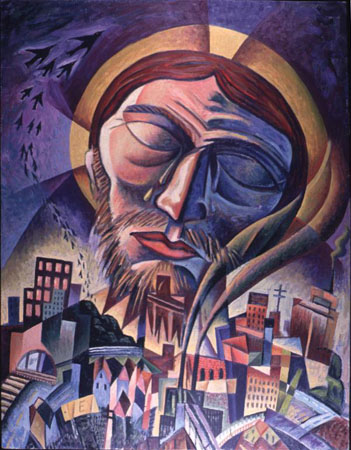
Man of Sorrows by James B. Janknegt, 1990

“As Jesus came to the city and observed it, he wept over it.  He said, ‘If only you knew on this of all days the things that lead to peace. But now they are hidden from your eyes.  The time will come when your enemies will build fortifications around you, encircle you, and attack you from all sides.  They will crush you completely, you and the people within you. They won’t leave one stone on top of another within you, because you didn’t recognize the time of your gracious visit from God.’” (CEB)

There are Christians who believe in as much withdrawal from the world – its earthly political and cultural realm – as is humanly possible this side of heaven. There are yet others who believe in as much accommodation as possible to the world, its structures and society. And there are others who believe that the world and the church are simply two distinct realms which Christians simply move back and forth within, like taking one hat off and doffing another.

Let us leave that all aside for a moment and just observe the pathos of Jesus. He came to the city of Jerusalem, a city which was both deeply religious and very worldly. Jesus stood and looked affectionately and longingly at the city… and he wept. This was not a quiet shedding of a tear. No, the word “wept” means that Jesus openly cried aloud over the city. Think of the kind of crying which takes place when a person is in the throes of grief.  These were great heaves of loud weeping.

The reason Jesus was lamenting with so much feeling was that the city did not recognize they had a gracious visit from God. The Lord looked at the city and saw all the future disaster which was coming. He knew it could be different, and he was emotionally undone by the city’s inability to see God, right in front of their own face.

Now let us return to our view of the world and our involvement in it. Taking some cues from our Lord Jesus, the first and foremost posture we are to take toward the worldly city is not separation, accommodation, or dual citizenship – it is, rather, to grieve and lament.

The longing Jesus had in his heart was to see the city of Jerusalem annexed and incorporated into the kingdom of God. The way of peace, of shalom on this earth, is to bring all things and all the world under the benevolent reign of God. It is as if there are Twin Cities, like Minneapolis and St. Paul, which exist side-by-side but have different municipal structures. 

The kingdom of this world and the kingdom of God exist next to each other. Jesus wanted to bring the earthly kingdom into the peaceful and gracious realm of God’s kingdom. But the people would have nothing to do with it. Both the religious establishment and the secular authorities of the city wanted their own municipal conceptions of how things should go – and they both rejected the Christ who could bring them all true harmony.

We are about to enter the season of Lent. It is a time set aside in the Christian Year for repentance and preparation to receive King Jesus as our rightful benevolent ruler. Let us lament the world full of both religious and secular people who do not recognize the time of God’s visitation. Let it be a time to journey with Jesus and follow him in his Passion for this world and all its inhabitants.

Blessed Father, Son, and Holy Spirit, the holy Trinity whom I serve – the world and even sometimes the church is estranged from grace – they have not recognized your gracious coming and presence. I lament such a state of things, and ask you, blessed Spirit may draw all people to the Savior, Jesus Christ, in whose name I pray.  Amen.

Acts 15:36-41 – Imperfect Relations

Paul said to Barnabas, “Let’s go back and visit all the brothers and sisters in every city where we preached the Lord’s word. Let’s see how they are doing.” Barnabas wanted to take John Mark with them. Paul insisted that they should not take him along, since he had deserted them in Pamphylia and had not continued with them in their work. Their argument became so intense that they went their separate ways. Barnabas took Mark and sailed to Cyprus. Paul chose Silas and left, entrusted by the brothers and sisters to the Lord’s grace. He traveled through Syria and Cilicia, strengthening the churches. (CEB)

Perfect consensus, complete harmony, and perpetual peace are ideals, not reality, this side of heaven. Oh, it is not as though we ought to give up striving for such things – we just need to understand we will only experience them partially, and not fully, until Christ returns. 

Imagine if Paul and Barnabas, along with their entire coterie of people who traveled with them, decided that they would not go anywhere until there was 100% consensus on every decision to be made. It could be that they would never get anything done at all. It is sad when people cannot come together and be of one mind, but it happens, and will happen again. Sometimes we simply need to go and do what we think is best, whether others agree with us, or not.

“Honest disagreement is often a good sign of progress.”

Mahatma Gandhi

I am a bit adverse to taking sides on most things, but I admit to having a bent toward going with Barnabas. His name means “Son of Encouragement.” He understands taking someone under his wing and giving them a second chance when they screw up.  Barnabas had a soft spot for John Mark.  Barnabas seems like the kind of guy who knows about grace. This is a guy I could hang out with.

Paul, on the other hand, had much more of a Type A personality. I can just imagine Paul saying, “There are things to do, goals to reach, areas to conquer. I don’t have time for this whining and cry baby stuff.”  Paul did not want someone in the group slowing them down with fear or lack of courage. For all that I appreciate about the great Apostle Paul in the New Testament, sometimes he strikes me as being too driven and difficult to work with.

Yet, in the end, taking sides is not really the issue. It is about God working a divine, sovereign, and good will through stubborn and stupid people like me, and maybe like you, who sometimes get lost in winning an argument. 

When all is said and done, nothing is going to thwart God’s providential plans and purposes in this world.  So, rather than taking sides, I think I will rely solely on God’s grace and mercy in my life to work through me, despite my oft short-sightedness.

Holy God, you work your good purposes in and through your people, no matter what.  I want my life and work to be a joy to you and with others, and not a burden.  Create in me a clean heart.  See if there is any offensive way in me and lead me in the way everlasting, through Jesus Christ, my Lord, in the power of the Holy Spirit.  Amen.