

Ephesians 6:10-20 – Spiritual Combat

A final word: Be strong in the Lord and in his mighty power. Put on all of God’s armor so that you will be able to stand firm against all strategies of the devil. For we are not fighting against flesh-and-blood enemies, but against evil rulers and authorities of the unseen world, against mighty powers in this dark world, and against evil spirits in the heavenly places.

Therefore, put on every piece of God’s armor so you will be able to resist the enemy in the time of evil. Then after the battle you will still be standing firm. Stand your ground, putting on the belt of truth and the body armor of God’s righteousness. For shoes, put on the peace that comes from the Good News so that you will be fully prepared. In addition to all of these, hold up the shield of faith to stop the fiery arrows of the devil. Put on salvation as your helmet, and take the sword of the Spirit, which is the word of God.

Pray in the Spirit at all times and on every occasion. Stay alert and be persistent in your prayers for all believers everywhere.

And pray for me, too. Ask God to give me the right words so I can boldly explain God’s mysterious plan that the Good News is for Jews and Gentiles alike. I am in chains now, still preaching this message as God’s ambassador. So, pray that I will keep on speaking boldly for him, as I should. (New Living Translation)

When I think of the Apostle Paul, I think of a guy who had a bucket load of boldness, who did not sidestep tough situations, but who fearlessly stepped into the world with the good news of God’s grace in Christ. 

Maybe Paul was that way because of prayer and the prayers of God’s people. Maybe what stands in the way of people knowing Jesus and believers maturing in faith is a profound lack of intense, consistent, and sustained prayer. Maybe too many of God’s people have been duped by the enemy of our souls to retreat in a bubble of fear, unable to effectively engage God’s big world with confidence.

Paul told the Ephesian Church what kind of practical and vital obligations were needed to put aside fear and flourish as Christians….

Be strong in the Lord because we are in an invisible war.

There is an unseen world all around us. We serve an invisible God, and we have an invisible enemy. Satan and all his wicked spirits exist. They are organized for war with methodical schemes and strategies designed to blunt our spiritual development and the expansion of God’s benevolent kingdom. The enemy seeks to render us ineffective in our walk with Christ, unproductive for God, and all knotted up inside in a broken mess so that we are weak, not strong.

The names of our invisible enemy in Scripture tells us the kind of diabolical and methodical work he is doing to snare us: 

  • Satan (the adversary who opposes us)
  • Lucifer (the shining one who comes looking like the light but only delivers darkness)
  • Beelzebub (lord of the flies, who is a false god promising protection and help apart from God)
  • Belial (the evil one, who seeks to have us engage in sin instead of righteousness)
  • Tempter (offering alternative plans to the will of God)
  • Accuser (the false judge, using criticism to bully people into shameful submission)
  • Prince of this world (the architect behind all systemic evil)
  • Devil (the diabolical one who engages in spiritual guerilla warfare against God’s people)

The unseen wicked spirits of this dark world pull out whatever technique they can to turn us from knowing who we are in Christ and how we are to really live. They seek to distract us from our mission, to keep us busy fighting among ourselves, so that we will put our ultimate confidence in anything or anyone but Christ.

Put on the armor of God and prepare for spiritual battle.

Satan is a defeated foe. The nails that crucified the Lord Jesus, and the power of God that raised him from the dead, ensured Satan’s doom.

Although we stand in the victory of the Lord Jesus, the world, the flesh, and the devil still dog us at every turn. So, we must discover and dislodge every threat to our spiritual growth and the mission of the church to step into the world with the gospel of grace. 

Jesus said he will build his church and the gates of hell will not prevail against us. The picture is not one of the church being defensive and only responding to threats, but of a church pushing forward and storming the gates. 

The promise we have is that we can engage the enemy to the point of hell itself – and will not be burned by demonic enemy fire. Therefore, we are not to hunker down in self-protective foxholes; we are to engage the enemy with our spiritual armor on.

  • Put on the belt of truth. We need to combat the demonic lies. The truth will set us free. Lies will place us in bondage. Shame will keep us in the dark shadows. We are to embrace Jesus who is the way, the truth, and the life. The truth is that we belong to God. We are not to fight demonic fire with fire. Instead, we fight Satan with the waters of baptism, remembering who we are in Christ. Just as the wicked witch of the west was killed with water, so we are to fling our baptismal water in the face of the enemy and watch him melt away.
  • Put on the breastplate of righteousness. It protects our heart as we push forward and engage the enemy. Satan is aiming for our hearts, so it is vital that they are well-guarded. Our hearts belong to God. Before we chose God, God chose us before the creation of the world to be holy and blameless (Ephesians 1:4).         
  • Put on the gospel shoes of peace. Satan and his minions are trying to cause chaos, unrest, and division.  We are to be ready for his methods through embracing God’s peace and harmony with others. We are to use our shoes, both for digging in and standing firm, and stepping forward into situations as peace-makers. Those who ready themselves with the gospel of peace live differently, openly, with grace and integrity.

Take up your spiritual weapons and do battle.

Whereas the spiritual armor is protective, giving us a solid defensive posture, our spiritual weapons help us to go on the offense and walk into the struggle.

  • Take up the shield of faith. Extinguish all the nasty flaming arrows of the evil one. The Roman phalanx was a rectangular military formation where the army took their shields and connected them together for protection and the ability to push forward, engaging the enemy. This tactic helped the Romans to conquer most of the known world of the time. It was based not on individual ability but on the strength of the entire army working together. The devil seeks to divide and conquer. Yet, there is strength in numbers, that is, as long as we work together!  Linking our shields together through unity, fellowship, and encouragement is absolutely necessary if we are going to win the battle.
  • Take up the helmet of salvation. Active transformation through the renewing of our minds enables us to avoid retreating and going back to old sinful patterns of thinking. We need mindfulness, not mindlessness, aware of who we are in Christ and actively occupying our thoughts with God’s Word.
  • Take up sword of the Spirit. This is the word of God. The written word is to be the spoken word. Our primary offensive weapon in the battle against the evil one is God’s Word. It needs to be read, memorized, meditated upon, learned, talked about, and, used by speaking it aloud.

Be alert and pray.

Prayer is to undergird everything we do. The early church was effective and successful through prayer. They all joined together constantly in prayer (Acts 1:14). They devoted themselves to the apostles’ teaching and to the fellowship, to the breaking of bread and to prayer (Acts 2:42). After they prayed, the place where they were meeting was shaken. And they were filled with the Holy Spirit and spoke the word of God boldly (Acts 4:31).  The early apostles re-arranged their busy schedules so that they could give their attention to prayer and the ministry of the word (Acts 6:4). Believers in Jesus pray.

Whenever prayer takes a back seat to everything else, believers end up fighting the wrong battles with the result of a lot of friendly fire where people get spiritually and emotionally hurt. Our battle is not with flesh and blood human beings; it is with Satan and his wicked spirits. Fight them, not each other!

Conclusion

The spiritual forces we are up against are wicked, evil, cunning and do not observe any kind of Geneva Convention rules when it comes to war. They are out for blood. Therefore, we must be ready and put on our spiritual armor, take up our spiritual weapons, and move forward with the word of God and prayer. This present darkness requires that we be at our best. Our very lives depend on it.

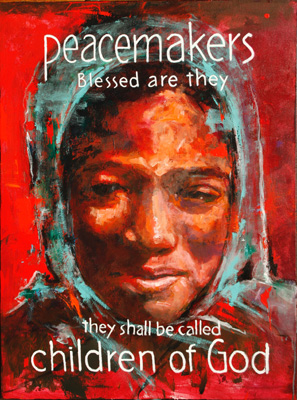
Matthew 5:9 – Blessed Are the Peacemakers

Blessed are the peacemakers,
    for they will be called children of God. (NIV)

Why peace?

A lot of people just want some peace… peace of mind, peace in their families and at their workplaces, and peace in their nation and in the world. Racing thoughts, disharmony at home, conflict on the job, constant national disturbances, and the wars, takeovers, coups, assassinations, and oppressive regimes of the world sometimes might lead us to believe there might never be peace – either in our personal lives or on this earth.

What is peace?

Peace is not merely the absence of conflict. It is harmony with God, others, and self. To be at peace involves more than simply getting along with others or being able to sleep at night. Peace involves wholeness and integrity, having unity of mind and purpose, so that people can live beyond surviving to thriving and flourishing in settled peaceful relationships.

How does peace happen?

For peace to be truly realized, there needs to be a peacemaker. Jesus was the ultimate peacemaker. He achieved peace by provoking and challenging the establishment. Jesus brought on conflict in order to bring real and lasting peace.

The cross of Christ became an act of subversion to the existing religious system. Jesus championed the common good of all through his death. The violence of the cross brought the serenity of peace. Christ has abolished all barriers and divisions so that people can come to God and come together.

So, remember that once you were Gentiles by physical descent, who were called “uncircumcised” by Jews who are physically circumcised. At that time, you were without Christ. You were aliens rather than citizens of Israel, and strangers to the covenants of God’s promise. In this world you had no hope and no God. But now, thanks to Christ Jesus, you who once were so far away have been brought near by the blood of Christ.

Christ is our peace. He made both Jews and Gentiles into one group. With his body, he broke down the barrier of hatred that divided us. He canceled the detailed rules of the Law so that he could create one new person out of the two groups, making peace. He reconciled them both as one body to God by the cross, which ended the hostility to God.

When he came, he announced the good news of peace to you who were far away from God and to those who were near. We both have access to the Father through Christ by the one Spirit. So now you are no longer strangers and aliens. Rather, you are fellow citizens with God’s people, and you belong to God’s household. As God’s household, you are built on the foundation of the apostles and prophets with Christ Jesus himself as the cornerstone. The whole building is joined together in him, and it grows up into a temple that is dedicated to the Lord. Christ is building you into a place where God lives through the Spirit. (Ephesians 2:11-22, CEB)

Peace has been accomplished through Christ. We now are to live into that peace by being peacemakers. So, how do we do that?

What characterizes a peacemaker?

Peacemakers demonstrate and show how to relate to God and others because they know the process of being humbled before God and being filled with righteousness. Peace doesn’t just happen. It must be attended to and cultivated.

  • Peacemakers don’t merely try to smooth things over but actively promote and put energy into unity and harmony.

Make every effort to keep the unity of the Spirit through the bond of peace. There is one body and one Spirit, just as you were called to one hope when you were called; one Lord, one faith, one baptism; one God and Father of all, who is over all and through all and in all. (Ephesians 4:3-6, NIV)

“It isn’t enough to talk about peace. One must believe in it. And it isn’t enough to believe in it. One must work at it.”

Eleanor Roosevelt
  • Peacemakers are careful to not use their speech for gossip or slander but help others with forgiveness issues.

Make a clean break with all cutting, backbiting, profane talk. Be gentle with one another, sensitive. Forgive one another as quickly and thoroughly as God in Christ forgave you. (Ephesians 4:31-32, MSG)

  • Peacemakers do not create problems but purposefully facilitate all around good relations by seeking to listen and understand, then gently applying truth.

Now, discipline always seems painful rather than pleasant at the time, but later it yields the peaceful fruit of righteousness to those who have been trained by it. (Hebrews 12:11, NRSV)

  • Peacemakers do not avoid conflict but seek reconciliation.

God’s kingdom isn’t about eating and drinking. It is about pleasing God, about living in peace, and about true happiness. All this comes from the Holy Spirit.If you serve Christ in this way, you will please God and be respected by people. We should try to live at peace and help each other have a strong faith. (Romans 14:17-19, CEV)

  • Peacemakers do not keep quiet but spread the gospel because they know that through Jesus there is true harmony between God and people.

Therefore, since we have been justified through faith, we have peace with God through our Lord Jesus Christ. (Romans 5:1, NIV)

  • Peacemakers will be called “children of God” because their character reflects the character of God.

Jesus said, “I’m leaving you well and whole. That’s my parting gift to you. Peace. I don’t leave you the way you’re used to being left—feeling abandoned, bereft. So don’t be upset. Don’t be distraught.” (John 14:27, MSG)

  • Peacemakers do not encourage divisions between people but promote and enable relational connections which foster everyone getting their needs met.

When peacemakers plant seeds of peace, they will harvest justice. (James 3:18, CEV)

  • Peacemakers don’t give up but continually keep making peace.

Stop doing what is wrong and do good. Look for peace and do all you can to help people live peacefully. (1 Peter 3:11, ERV)

Conclusion

Peacemakers are people who occupy a middle space between persons or groups at odds with each other. They desire to live righteously with the mercy and purity God has provided for them. 

People dedicated to peacemaking understand there is so little peace in this world because there are so few peacemakers. There are so few peacemakers because so many people in this world have not availed themselves of God’s justice and righteousness.

And precious few people have availed themselves of God’s righteousness because there are so few truly humble people. There are so few humble persons because, so few individuals realize their poverty of spirit. 

In order to achieve peace, one must first be at peace with God. This is why we desperately need the cross of Jesus Christ because through his blood peace has been achieved.  There is now no wall of separation because Christ’s cross has torn it down.

Finally, brothers and sisters, rejoice! Strive for full restoration, encourage one another, be of one mind, live in peace. And the God of love and peace will be with you. (1 Corinthians 13:11, NIV)

*Above painting by Hyatt Moore

Romans 15:1-6 – The Responsibility of the Powerful

We who are powerful need to be patient with the weakness of those who don’t have power, and not please ourselves. Each of us should please our neighbors for their good in order to build them up. Christ didn’t please himself, but, as it is written, The insults of those who insulted you fell on me. Whatever was written in the past was written for our instruction so that we could have hope through endurance and through the encouragement of the scriptures. May the God of endurance and encouragement give you the same attitude toward each other, similar to Christ Jesus’ attitude. That way you can glorify the God and Father of our Lord Jesus Christ together with one voice. (Common English Bible)

“With great power comes great responsibility.”

Stan Lee

Within the ancient church in Rome there existed people of Jewish descent as well as non-Jews (Gentiles) who had come to embrace Christ. These two groups had vastly different backgrounds and experiences. Now they found themselves within one church, with only their shared commitment to Jesus.

Getting along was downright hard. It took a great deal of work for them to understand one another. Throughout the Apostle Paul’s letter to the believers in Rome, he consistently went back and forth, addressing both groups.

Frankly, Paul was most difficult on his fellow Jews. He took them to task. In his view, the Jewish believers had a responsibility to set a tone of Christian equality and fairness. Since the Jewish people have such a rich spiritual history as God’s people, it was Paul’s admonition they use their power on behalf of the non-Jewish Gentiles.

There were some Jewish believers who believed it best that the non-Jewish believers become religiously Jewish. They thought that Gentiles, with no background whatsoever in Old Testament belief and practice, would need to be like them in order to become good Christians.

Paul passionately believed otherwise. The Jewish position of privilege was to be used to encourage and help, not criticize and make things more difficult for non-Jewish persons. Jesus, a Jew himself, did this during his life and ministry on earth.

It came down to a belief of whether Jews ought to hold positions of power within the church, or that power should be shared. As it still is today, it was then with the Jewish people: They have carried an inordinate burden of the world’s sin upon their shoulders. Paul wanted them to continue this special calling – not taking advantage of an opportunity to be on top – but embracing their call for the sake of Christ’s gospel.

Whether Jew or Gentile, all together were to make every effort to do what leads to peace and the encouragement of one another. Those with power were to make room at the table (and Table!) for those without power.

The ideal which Paul so adamantly struggled for was unity – to have both Jew and Gentile together as sisters and brothers in the faith. There was never to be two churches – one Jewish and one Gentile. Christ’s death had abolished all barriers to unity. Now, everyone must come together and re-orient their lives around the good news of new life in Christ. (Ephesians 2:11-22)

Since Jesus closely identified with others, now we, his followers, are to demonstrate a genuine spirit of care and welfare for all people. This is a new family relationship which did not exist before Christ. God, however, has adopted all kinds of non-Jewish people into the family. So, we have responsibilities to get along with each other.

It must always begin with those who possess the power and privilege. They have the first responsibility to initiate an egalitarian society. The onus is on the powerful to ensure that a fully inclusive Christian ethic is established and maintained. We are to welcome others just as Christ welcomed us.

The Christian ethic of welcoming, encouraging, and including is helped by being mindful of the following:

  • Listen more. Talk less. A particular temptation for those with power is to make decisions without consulting or collaborating. Basic human respect comes from listening – neither interrupting nor overtalking. The less powerful folks need to be heard. Give them a seat at the table and honor them with your ears.

People who listen when they are corrected will live, but those who will not admit that they are wrong are in danger. (Proverbs 10:17, GNT)

  • Be curious. Respect another’s contribution. Be welcoming and open, whether or not you agree. Seek understanding rather than always trying to be understood. “Tell me more.” “Help me understand.” And “I’d like some clarification…” are all simple phrases of healthy curiosity which invites others to talk.

The people in Berea were more open-minded than those in Thessalonica. They were so glad to hear the message Paul told them. They studied the Scriptures every day to make sure that what they heard was really true. (Acts 17:11, ERV)

  • Don’t assume. Not everyone has had the same experiences. We don’t all know the same things. Take the posture of a learner. Be something of an anthropologist, seeking to discover rather than superimpose what you already believe on a different group of people.

Don’t fool yourselves! If any of you think you are wise in the things of this world, you will have to become foolish before you can be truly wise. (1 Corinthians 3:18, CEV)

  • Be aware of your own biases. We all have them. It takes some work to uncover our prejudices as well as our privileges.

I solemnly command you in the presence of God and Christ Jesus and the highest angels to obey these instructions without taking sides or showing favoritism to anyone. (1 Timothy 5:21, NLT)

  • Embrace empathy. We all know how it feels to be excluded, left out, and even shamed about something. Let’s use our own experiences to realize what others might be going through. Looking down on another, or dismissing them in some way, is not the way of our Lord.

Laugh with your happy friends when they’re happy; share tears when they’re down. Get along with each other; don’t be stuck-up. Make friends with nobodies; don’t be the great somebody. (Romans 12:15-16, MSG)

  • Focus on connection, not fear. In many groups and in many places, the “other,” the one who is different, is looked upon with suspicion as someone who might upset existing societal norms or steal something we have. Seeking to establish connection with others mitigates fear and anxious feelings.

As many of you as were baptized into Christ have clothed yourselves with Christ. There is no longer Jew or Greek, there is no longer slave or free, there is no longer male and female; for all of you are one in Christ Jesus. (Galatians 3:27-28, NRSV)

  • Be patient with others. People need our gentleness and our humble help, not our judgment and exasperation. Treat others the way you’d like to be treated.

Be humble and gentle in every way. Be patient with each other and lovingly accept each other. (Ephesians 4:2, GW)

“So in everything, do to others what you would have them do to you, for this sums up the Law and the Prophets.”

Jesus (Matthew 7:12, NIV)

That about sums up exactly what Paul intended to say. Now go and do likewise.

O God, in accepting one another wholeheartedly, fully, and completely, we accept you. Fill us then with love and let us be bound together with love as we live our lives, united in this one spirit which makes you present in the world, and which makes you witness to the ultimate reality that is love. Love has overcome. Love is victorious. You are Love. Amen.

Psalm 14 – On the Significance of God

Statue of George Washington, outside the National Gallery, Washington D.C.

Godless fools say in their hearts,
“There is no God.”
They are corrupt.
They do disgusting things.
There is no one who does good things.
The Lord looks down from heaven on Adam’s descendants
to see if there is anyone who acts wisely,
if there is anyone who seeks help from God.
Everyone has turned away.
Together they have become rotten to the core.
No one, not even one person, does good things.
Are all those troublemakers,
those who devour my people as if they were devouring food,
so ignorant that they do not call on the Lord?
There they are—panic-stricken
because God is with the person who is righteous.
They put the advice of oppressed people to shame
because the Lord is their refuge.

If only salvation for Israel would come from Zion!
When the Lord restores the fortunes of his people,
Jacob will rejoice.
Israel will be glad
. (God’s Word Translation)

George Washington, first President of the United States, in his farewell address to the nation in 1796, constructed his encouragements to the American people on the basis of virtue. 

Only a virtuous people, Washington believed, could cause the American experiment to succeed among the family of nations. Virtue, for Washington, could only occur through the twin pillars of religion and morality. He stated:

“Observe good faith and justice towards all nations; cultivate peace and harmony with all. Religion and morality enjoin this conduct; and can it be, that good policy does not equally enjoin it – It will be worthy of a free, enlightened, and at no distant period, a great nation, to give to mankind the magnanimous and too novel example of a people always guided by an exalted justice and benevolence. Who can doubt that, in the course of time and things, the fruits of such a plan would richly repay any temporary advantages which might be lost by a steady adherence to it? Can it be that Providence has not connected the permanent felicity of a nation with its virtue? The experiment, at least, is recommended by every sentiment which ennobles human nature. Alas! is it rendered impossible by its vices?”

George Washington, Farewell Address, 1796

Washington was no fool. He understood that the guiding hand of Providence [God] was necessary to the flourishing of a free and happy people. 

Indeed, the ancient psalmist would agree. When humanity is untethered from their own deep spirituality, they become worthless, heartless, cruel and can rarely do right by others. 

Whatever Washington’s true personal sensibilities were about theology, he most certainly was convinced that belief in God along with the Scripture’s moral guidance were needed for a fledgling nation. The people’s ability to recognize and engraft religion into their lives would be a must for America.

Unmooring ourselves from the moral compass within us and forsaking the Creator leads to vice – whereas enjoining God and paying attention to the divine leads to virtue. 

It is not wise to ignore the God of all creation. From the psalmist’s perspective, through daily attentiveness and devotion to the Lord, moral and ethical ways can take root and produce justice, reconciliation, and peace.

Sovereign God, you rule the nations through your wise and benevolent reign. Help me to participate with you in your grand kingdom enterprise so that I can make decisions consistent with true morality, for the sake of Jesus, in the power of your Holy Spirit. Amen.